agentcairn
officialLocal-first agent memory: a plain-Markdown Obsidian vault is the source of truth, with a rebuildable DuckDB index for hybrid BM25 + vector + graph recall.
What can you do with Agentcairn MCP?
- Recall relevant memories — Ask your assistant to
recalldurable facts from your Markdown vault, with project-aware ranking and cited permalinks. - Store new knowledge — Use
rememberto atomically write a Markdown note and update the index, making it immediately recallable. - Import Claude Code memory — Run
cairn import claude-memoryto preview or migrate existingMEMORY.mdfiles into the shared vault with provenance. - Sweep transcripts for capture — Trigger
cairn sweepto read supported transcript stores out-of-band and distill durable context into the vault. - Manage vault health — Run
cairn doctororcairn index-statusto verify vault integrity and rebuild the disposable DuckDB cache withcairn reindex. - Link related notes — Execute
cairn linkto write deterministicrelated:neighbors based on[[wikilinks]]for an Obsidian-native graph.
Documentation
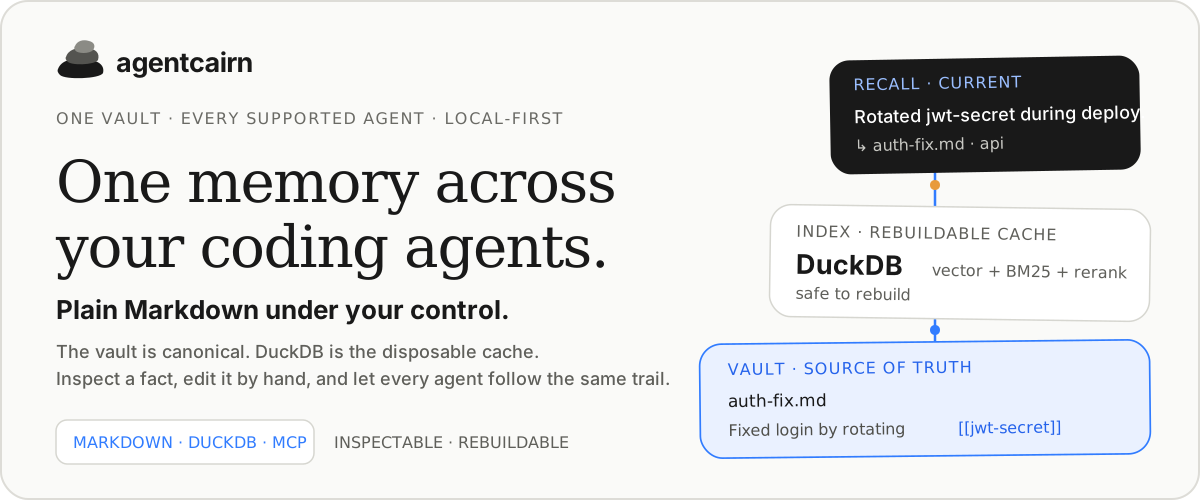




One durable memory across supported coding agents.
Your Markdown vault is canonical. DuckDB is the replaceable retrieval cache.
Website · PyPI · Obsidian companion · Benchmarks
A cairn marks a trail for whoever comes next. agentcairn does that for coding agents: it captures durable context from the tools you use, stores it as inspectable Markdown with provenance, and recalls only the most relevant pieces when another agent needs them.
Proof you can inspect
The memory is not hidden behind an admin console or a hosted database. The separate agentcairn-obsidian companion reads the same Markdown files as the agents and exposes provenance, currency, importance, supersession, and related: links.
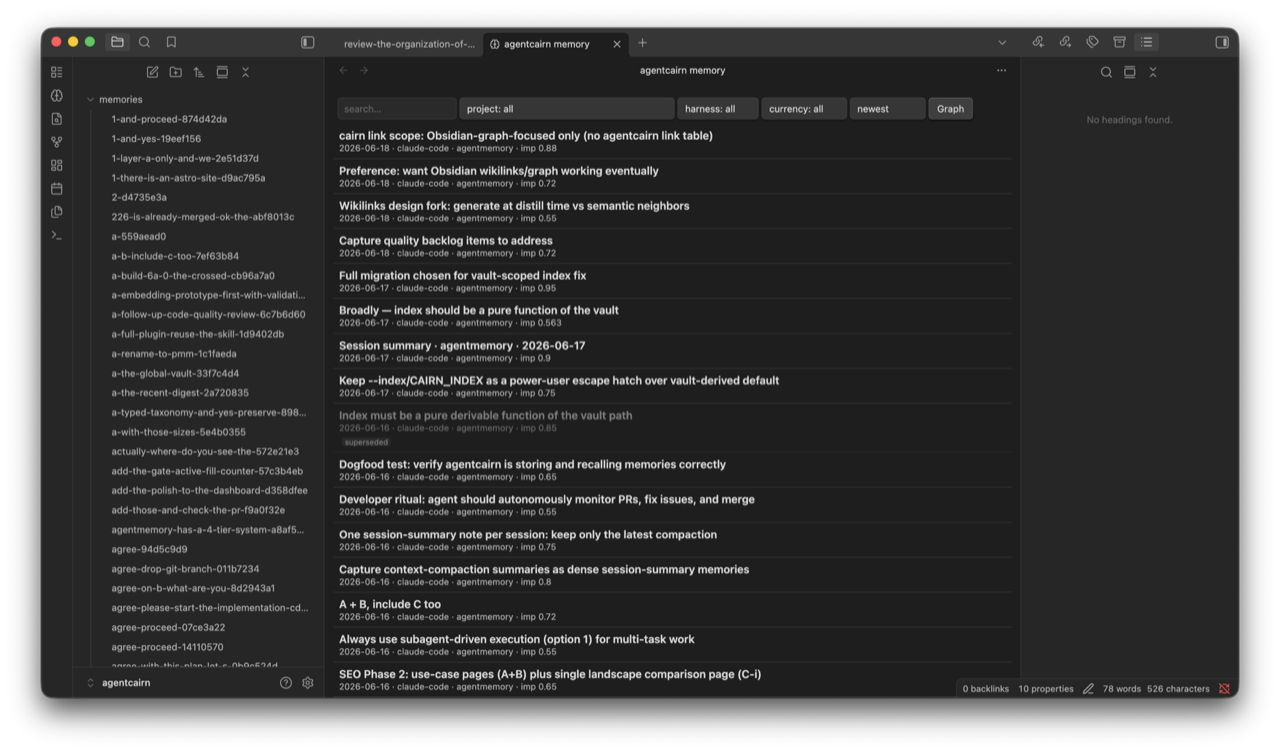
A real agentcairn vault in Obsidian. The list is a view over the files—not a second memory store.
Dogfood snapshot · 2026-07-15. Across 417 local recalls, the maintainer's vault returned context about
262× smallerthan loading the full vault each time—an estimated136.6M tokens of full-vault context avoidedin aggregate. Token counts use approximately four characters per token. This is not billed-token savings, and agentcairn sends no telemetry.
Install
The shortest path is a first-class plugin. It bundles the MCP server, the memory skill, and the host-specific ambient hooks—no separate agentcairn package install. The plugin launches through uvx, so install uv first if uvx --version is not already available.
Claude Code
claude plugin marketplace add ccf/agentcairn
claude plugin install agentcairn@agentcairn
Claude Code gets per-turn project-scoped recall, session/compaction capture, and the /agentcairn:recall, /agentcairn:remember, /agentcairn:memory, /agentcairn:savings, and /agentcairn:ingest commands.
Codex
codex plugin marketplace add ccf/agentcairn
codex plugin add agentcairn@agentcairn
Codex gets the bundled MCP tools and memory skill, live-verified SessionStart recall, and SessionEnd capture with cairn sweep as the out-of-band backstop.
Agent-assisted setup
Already use skills.sh or a find-skills workflow? Install the public setup assistant:
npx skills add ccf/agentcairn --skill agentcairn-setup -g
Then ask your agent: Use $agentcairn-setup to preview, install, and verify AgentCairn for this coding agent.
This installs setup guidance only—not the AgentCairn runtime, MCP server, plugin, or hooks. The assistant delegates those changes to AgentCairn's preview-first native installer and verifies the resulting integration. The Claude Code and Codex plugin commands above remain the shortest path.
The default vault is ~/agentcairn and is created on first use. A new empty vault has nothing useful to recall yet, so prove the whole loop explicitly:
You   → Remember this durable fact: staging deploys use blue-green.
Agent → written and indexed
You   → Recall the staging deploy strategy.
Agent → staging deploys use blue-green.  ↳ <memory permalink>
remember writes the Markdown note and index entry together, so immediate recall is part of the contract. The first local run may download and warm the configured embedding/reranking models.
The contract
| Promise | What it means in practice |
|---|---|
| Markdown is canonical | Notes, frontmatter, and [[wikilinks]] are the durable memory. Edit a fact by hand; the next reconciled read honors it. |
| The index is disposable | DuckDB is a derived cache. Deleting or rebuilding it does not delete the Markdown vault. |
| One vault crosses agents | Supported hosts share the same configured vault instead of building isolated memories per tool. |
| History is non-lossy | Derived notes do not silently erase stored notes; superseded and expired facts remain inspectable and are demoted rather than hidden. |
| Every result has context | Project, validity status, and permalinks travel with recall so an agent can distinguish current local evidence from cross-project history. |
How it works

- Capture: host hooks improve immediacy;
cairn sweepreads supported transcript stores out-of-band as the durable backstop. AgentCairn redacts recognized credentials, deduplicates, importance-gates, and distills before its automated plaintext writes. - Reconcile: the first read transactionally brings the vault-scoped index in sync with Markdown. A failed rebuild preserves the last good cache and the durable files remain untouched.
- Recall: BM25 and semantic vectors are fused with Reciprocal Rank Fusion, then optionally reranked. Model/provider failures visibly fall back to BM25 with diagnostics instead of returning incompatible vectors.
- Remember: the MCP tool atomically writes a Markdown note and updates the index under one writer lock, making a successful save immediately recallable.
Designed for trust
- Local by default. FastEmbed runs locally, the MCP server uses stdio, there is no required daemon or external database, and there is no telemetry.
- Plain boundaries. The synced vault contains Markdown; by default, the rebuildable
.duckdbindex stays outside it. Vault symlinks that escape the configured root are rejected. - Time-aware corrections.
valid_from,valid_until, andsuperseded_bykeep old evidence visible while making current facts rank first. - Deterministic graph.
[[wikilinks]]and optionalcairn linkneighbors create an Obsidian-native graph without asking an LLM to invent entities. - Project-aware recall. The current project is boosted by default; cross-project results remain available and are labeled. Automatic recall is project-scoped unless you explicitly opt into all projects.
Agents supported
Every host resolves the same configured vault. cairn install previews detected hosts without writing. MCP configuration writes are backup-first and preserve unrelated servers; plugin-host installs delegate to the host's own CLI.
| Host | Integration | Set up with | Ambient memory |
|---|---|---|---|
| Claude Code | Plugin + MCP + skill | cairn install claude-code | ✅ per-turn + SessionStart recall; SessionEnd/PreCompact capture |
| Codex | Plugin + MCP + skill | cairn install codex | ✅ SessionStart recall; SessionEnd capture + sweep |
| Cursor | MCP + skill + ingest | cairn install cursor | ◐ out-of-band sweep |
| OpenCode | Plugin + MCP + ingest | cairn install opencode | ✅ per-turn recall + idle/compact capture |
| Hermes Agent | Native MemoryProvider | integrations/hermes/ | ✅ auto-recall + session-end capture |
| Antigravity | Plugin + ingest | cairn install antigravity --source <dir> | ◐ out-of-band sweep |
| VS Code (Copilot) | MCP server | cairn install vscode | — |
| Claude Desktop | MCP server | cairn install claude-desktop | — |
| Any other MCP host | Portable MCP server | uvx agentcairn | host-dependent |
Codex SessionStart was verified live end-to-end with agentcairn 0.24.2 / plugin 0.1.2. The installed SessionEnd command dispatch and detached sweep pass exact handler probes; cairn sweep remains the out-of-band capture backstop. See the OpenCode integration and Hermes integration for their native lifecycle details.
Using it directly
The plugin is the easiest route, but agentcairn is also a standalone CLI and on-demand MCP server. Standalone installs require Python 3.11+.
uv tool install agentcairn

cairn init ~/agentcairn
cairn sweep --vault ~/agentcairn
cairn recall "how did we fix the auth bug?" --vault ~/agentcairn
cairn doctor --vault ~/agentcairn
Bring Claude Code's memory with you
Claude Code's auto-memory can seed the shared vault without changing its source files. The command previews only the current repository by default; add --apply to write the redacted notes and refresh the index.
cairn import claude-memory                         # preview; writes nothing
cairn import claude-memory --apply                 # import this repository
cairn import claude-memory --project ../other --apply
The one-way import reads MEMORY.md and its topic Markdown files—never CLAUDE.md or .claude/rules/. Imported notes retain Claude Code, project, and source-file provenance. When a source changes, the prior version remains inspectable but is superseded; when one disappears, its imported version expires. A small .agentcairn/native-memory/ registry preserves that lifecycle without indexing source content twice. Use --source <dir> for a custom, managed, or session-overridden Claude memory directory, or --no-reindex when batching imports.
Prefer an ephemeral process:
uvx agentcairn                             # MCP server
uvx --from agentcairn cairn recall "..."  # CLI; plain `uvx cairn` is a different package
CLI maintenance and automation
cairn schedule install --vault ~/agentcairn  # launchd on macOS / user crontab on Linux
cairn schedule status
cairn link --vault ~/agentcairn              # write deterministic related: neighbors
cairn reindex ~/agentcairn                   # rebuild the disposable cache
cairn savings                                # local context-efficiency estimate
cairn index-status --vault ~/agentcairn
On other operating systems, run cairn sweep from your scheduler of choice.
Configuration and optional cloud tiers
Settings live in ~/.agentcairn/config.toml; precedence is CLI flag → environment → config file → default.
cairn config --init
cairn config
auto_recall = true
auto_recall_k = 3
auto_recall_scope = "project"  # use "all" only as an explicit cross-project opt-in
Local nomic-embed-text-v1.5 embeddings are the default. Voyage, OpenAI-compatible embeddings, and the Anthropic durability judge are opt-in. With a cloud provider enabled, remaining secret-redacted note chunks and queries leave the machine; changing the embedding model re-embeds the vault and may incur real latency or API cost.
Benchmarks measured
The repository ships a revision-pinned, reproducible LongMemEval-S + LoCoMo harness. The default is local nomic-embed-text-v1.5 plus the cross-encoder reranker.
| Dataset / granularity | Metric | BM25 only | Hybrid RRF | Hybrid + reranker |
|---|---|---|---|---|
| LoCoMo · turn | recall@5 | 0.527 | 0.562 | 0.662 |
| LongMemEval-S · session | recall@5 | 0.920 | 0.954 | 0.969 |
| LongMemEval-S · turn | recall@5 | 0.680 | 0.640 | 0.788 |
Context returned at the default k=10 is much smaller than the complete indexed history:
| Dataset | Mean full history | Mean recalled | Reduction |
|---|---|---|---|
| LoCoMo (3 conversations) | 25,646 tokens | 529 tokens | 51.1× |
| LongMemEval-S (full 500) | 136,552 tokens | 2,207 tokens | 64.7× |
Read the numbers honestly:
- Retrieval recall is not QA accuracy. These tables compare controlled retrieval arms, not end-user answer quality or another product's leaderboard score.
- Token counts use an approximately four-characters-per-token heuristic. The reduction compares the indexed haystack with returned chunks; it is not billed cost savings.
- Graph boost is inert on these chat corpora because they contain no native
[[wikilink]]graph. It is designed for real interlinked vaults. - The optional QA judge uses Anthropic rather than the papers' GPT-4o setup, so those QA results are useful for relative ablations—not published-leaderboard comparisons.
Full metrics, embedding sweeps, latency measurements, licenses, commands, and caveats live in benchmarks/README.md.
Privacy and limits
- The vault is plaintext by design, not encrypted storage. AgentCairn redacts recognized credential patterns before its automated body/title/tag writes; unknown patterns and hand edits remain your responsibility.
- Vault files are owner-only (
0600/0700). Because the vault is plaintext and redaction is best-effort, the file mode is effectively its only access control. Shared-GID setups (e.g. two Docker containers on the same group but different UIDs) need group access, sovault_group_writable = truewidens new vault notes and directories to0660/0770. It is opt-in on purpose: on macOS every local user's primary group isstaff, so a group-readable default would expose your memories to other accounts on the machine. The knob never widens anything outside the vault — the index, ledgers, lock files, and~/.agentcairn/config.tomlstay private. - Cloud features are explicit egress. The default stays local. Opting into a cloud embedder or LLM judge sends the remaining redacted text to that provider.
- The project is beta. Standalone use requires Python 3.11+, and the first local model load can take time. The published retrieval evidence is strongest for conversational memory, not a universal code-search claim.
- Ambient behavior varies by host. The matrix above is intentional: Cursor and Antigravity rely on sweep capture; generic MCP hosts may expose tools without lifecycle hooks.
- Automation is platform-specific. Managed scheduling targets macOS launchd and Linux user crontab; use your own scheduler elsewhere.
Development
agentcairn uses uv exclusively for dependency management and tooling.
uv sync
uv run pre-commit install

uv run pytest
uv run ruff format .
uv run ruff check --fix .
uv run pre-commit run --all-files
Run the offline benchmark regression without API keys:
uv run pytest benchmarks/tests/
License
Apache License 2.0 — permissive, with an explicit patent grant. Copyright © 2026 Charles C. Figueiredo.