Mnemos
Local-first MCP memory server with no external dependency, source citations and OKF/Markdown KB.
Documentation
mnemos



Give your AI agent a memory it can cite.
Local memory for AI agents. Source citations included.
Claude Code is powerful, but it forgets your project context:
- it forgets why you rejected an architecture,
- it misses your ADRs,
- it invents answers instead of reading your docs,
- it can't reliably cite where a claim came from.
mnemos fixes that by giving it a local, cited memory of:
- your ADRs and design docs
- your notes and runbooks
- your source code
- your OKF knowledge base
No vector database. No Ollama. No Python or Node service. Just one cgo-free Go binary
that indexes your files — any plain-Markdown folder works as-is — and serves them over
MCP, so Claude can search, read, and cite your own
knowledge instead of guessing, with every answer landing on the exact file#section
and line range.
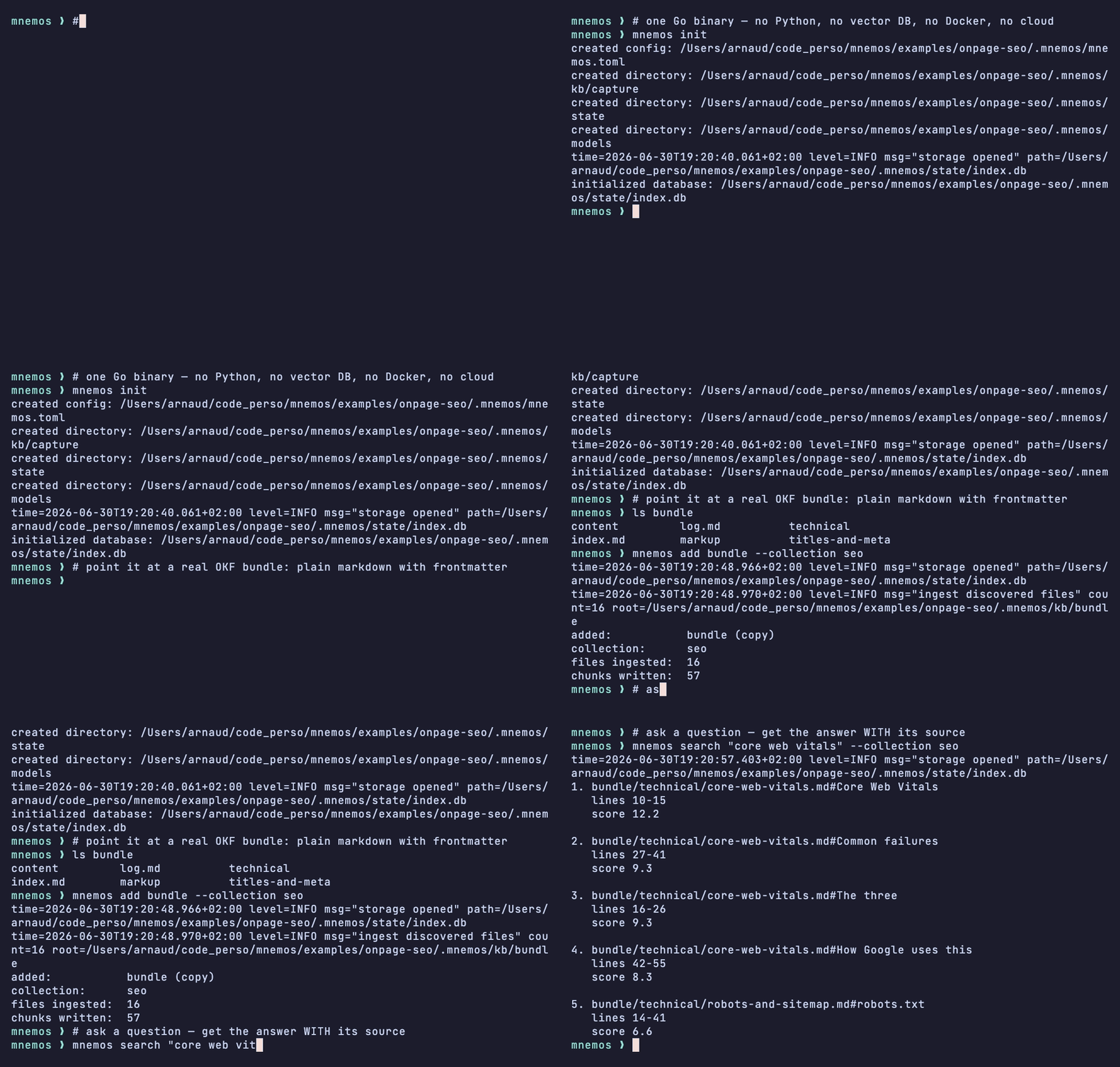
Try it in 60 seconds
# 1. install — one cgo-free binary into $GOBIN (requires Go 1.25+)
git clone https://github.com/arhuman/mnemos.git && cd mnemos
make install

# 2. index a project
cd ~/work/myproject
mnemos init                              # creates ./.mnemos/ (mnemos.toml, kb, db, models)
mnemos add docs --collection myproject   # copy a directory into the kb and index it
mnemos search "why did we choose this architecture"
Prefer
make build(→./bin/mnemos) to keep it off your$PATH. The default build is pure Go / cgo-free (CGO_ENABLED=0).
search prints citations you can open:
1. security/scim.md#Provisioning
   lines 42-88
   score 12.7
Then wire it into Claude Code (note the absolute --config path):
claude mcp add mnemos -- mnemos serve --config /abs/path/to/myproject/.mnemos/mnemos.toml
Now Claude answers from your project instead of guessing, and shows its source:
You: How do I recover lost commits?
Claude: Per
recovery/reflog.md, the reflog records whereHEADand each branch tip has pointed — even after a hard reset — so you can check out the lost commit's hash. (recovery/reflog.md — "Reflog: recover lost commits")
That's the whole loop — index → ask → cited answer. Everything below is depth: why it's built this way, how it works, and the full capabilities.
⚠️ One gotcha: add copies your files into the kb; it does not track them
mnemos is a managed store. Addressable content lives under .mnemos/kb/, and a
document's URI is its path relative to that kb root. mnemos add docs snapshots
docs/ into kb/docs/, so later edits to your original docs/ are not picked up
until you run mnemos add again. (mnemos ingest <kb-subpath> re-indexes content
already inside the kb; it refuses a path outside it.)
Two sources landing at the same kb subpath collide, and the later one wins. Use
--into to give each a distinct home:
mnemos add ~/work/api/docs   --into api
mnemos add ~/work/infra/docs --into infra
For a tree that must stay where it is, register it as an origin instead of copying it. It is indexed in place, read-only, under its own uri namespace:
mnemos origin add ~/work/spec --prefix spec --collection spec
mnemos origin reindex spec    # picks up new files, evicts deleted ones
Two registered trees can hold the same relative path without colliding, so a specification tree and a source tree stay searchable together in one store. mnemos never writes to a registered origin.
Details in docs/paths-and-indexing.md.
Why mnemos
- Truly local-first: runs entirely on your machine. No network, no telemetry, no data leaves your project.
- Zero dependencies: one self-contained, cgo-free Go binary. No Python, Docker, Qdrant, or Ollama.
- Any MCP client: built for Claude Code, works with anything that speaks MCP.
- Cited answers: every result links back to the exact
file#sectionand line range, so claims are verifiable. - Fast search by default: SQLite FTS5 / bm25 out of the box; optional local semantic + hybrid search behind a build tag.
- Read-write memory: the agent can capture durable notes (
remember); you can manage the tree (forget,move,list). - Safe by default: read-only unless you opt in; writes are path-confined, and content is secret-scanned on the way into the index (both capture and ingest, gated by
exclude_secrets).
How it works
your files → mnemos index (SQLite/FTS5) → Claude Code memory → cited answers
Once wired in, Claude can answer from your project instead of hand-waving, and point back to the source:
- "Why did we choose this architecture?"
- "Where is the ADR about the rule engine?"
- "Summarize what we know about SCIM provisioning."
- "What changed in this project's memory recently?"
Under the hood, the binary embeds an MCP server, an indexing pipeline, a SQLite store, full-text search, an incremental file watcher, and an admin CLI. See docs/architecture.md.
Does it actually retrieve?
A cited hit, out of the box (default lexical build, on a shipped example bundle):
$ mnemos add examples/git-recipes/bundle --into . --collection git
$ mnemos search "recover lost commits" --limit 1
1. recovery/reflog.md#Gotcha
   lines 24-28
   score 7.8
Every result is a real file#section and line range you can open — that is the whole
point.
Retrieval quality, measured. mnemos eval auto-derives held-out query→source pairs
from an OKF bundle (it strips each example block from its own document, then checks
whether retrieval still finds the right document) and reports doc-level metrics. On the
shipped examples/git-recipes bundle (6 recipes, keyword-style queries):
| Retriever | Hit@1 | Recall@12 | MRR@12 |
|---|---|---|---|
| Lexical, default (FTS5 / bm25) | 0.83 | 0.83 | 0.83 |
Semantic + hybrid (--semantic) | 1.00 | 1.00 | 1.00 |
All three are fractions in [0,1] (×100 for a percentage); higher is better. The
@K is the retrieval depth — top‑1 for Hit, top‑12 for the rest:
- Hit@1 — share of queries whose #1 result is the correct document (
0.83= 5/6). - Recall@12 — share where the correct document appears anywhere in the top 12.
- MRR@12 — mean reciprocal rank: average of
1/(rank of the first correct doc)over the top 12 (1.0= always ranked first).
The default lexical build already nails keyword retrieval. The optional embed build (see
Semantic search) earns its keep on harder,
natural-language-over-structured-data queries: on the examples/onpage-seo bundle, whose
held-out answers are JSON-LD / sitemap-XML blocks that share no keywords with their
prose, lexical scores 0.00 while --semantic recovers Hit@1 0.57 / Recall@12 0.86.
Reproduce (N is 6 and 7 respectively — smoke signals, not benchmarks):
mnemos eval examples/git-recipes/bundle              # lexical → 0.83
make build-embed && mnemos models install all-MiniLM-L6-v2
mnemos eval examples/git-recipes/bundle --semantic   # hybrid  → 1.00
mnemos eval examples/onpage-seo/bundle --semantic    # the hard case → 0.57
Connect Claude Code
The 60-second path above used claude mcp add with an absolute --config path:
claude mcp add mnemos -- mnemos serve --config /abs/path/to/project/.mnemos/mnemos.toml
To share it with the repo, commit it via .mcp.json instead:
{ "mcpServers": { "mnemos": { "command": "mnemos", "args": ["serve", "--config", "/abs/path/to/project/.mnemos/mnemos.toml"] } } }
Verify with claude mcp list (should show mnemos ✓ connected) and /mcp inside
a session. Claude then calls the tools automatically; see Capabilities.
Why the --config path must be absolute
Claude Code does not guarantee the working directory it spawns the server in, so
anchoring to the config file is what makes retrieval reliable. Passing --config <file> makes that file's directory the MNEMOS_DIR, and every location is a
fixed subpath of it, so an absolute --config is all you need: the knowledge base
(kb/), the database (state/index.db), and the models directory all anchor next
to that file regardless of where Claude Code launches the server. A bare mnemos serve falls back to discovery (the nearest project .mnemos, else ~/.mnemos),
which only finds your data when the server's working directory happens to be
inside the project, and Claude Code does not promise that. See
docs/paths-and-indexing.md for the full resolution
order.
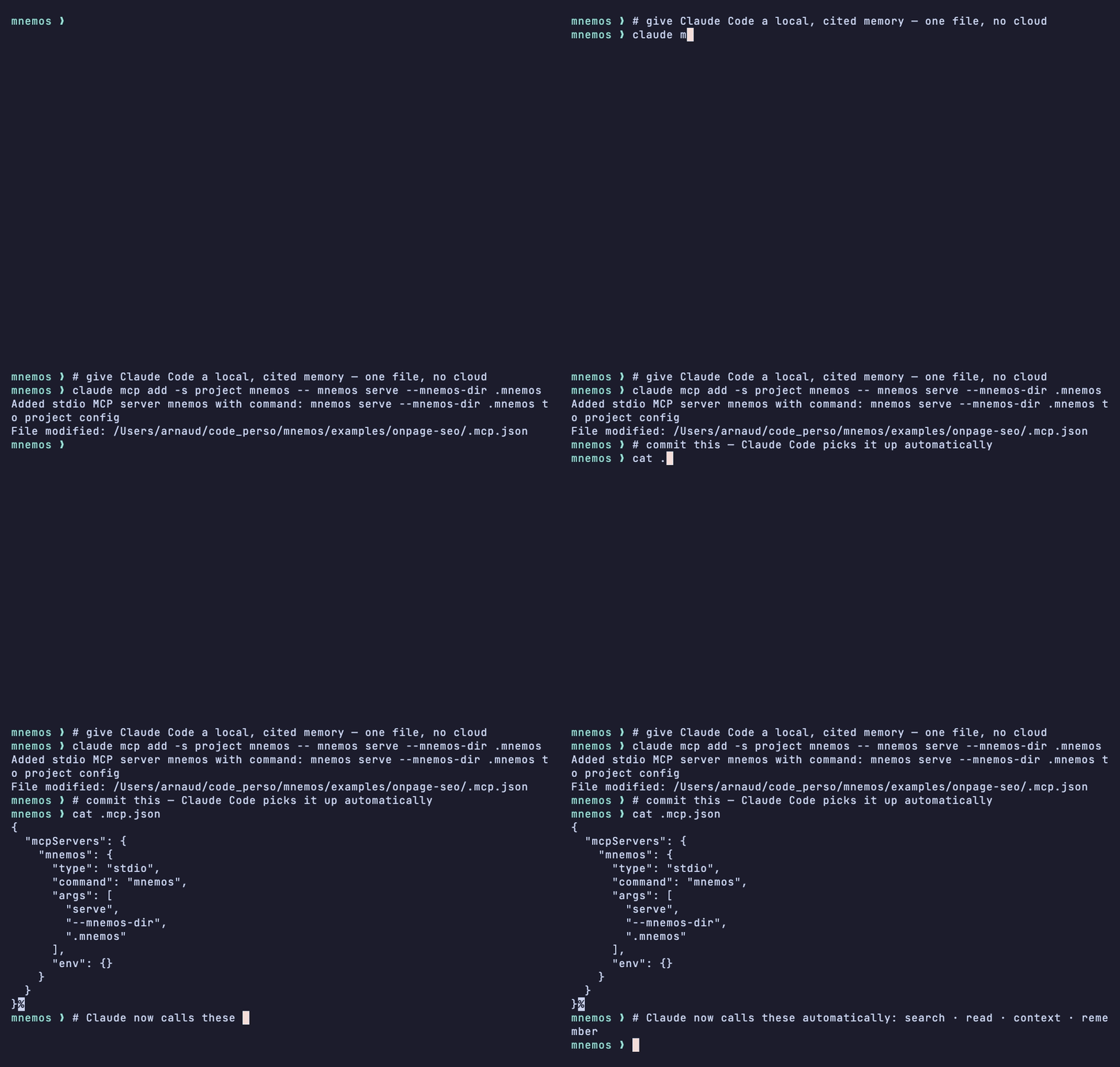
One command wires it in: Claude Code reports mnemos ✓ connected.

Semantic search: the question says "disappeared" — a word that appears nowhere in the notes — yet Claude finds and cites recovery/reflog.md.
This clip uses the optional semantic build (
make install-embed+mnemos models install all-MiniLM-L6-v2+use_vectors = true; see Semantic search). The defaultmake installbinary is lexical-only, so it won't answer a keyword-free question like this — search by keyword instead (e.g.mnemos search "recover lost commits", which hits the same doc).
Make Claude use memory automatically (optional skill)
MCP tools are passive: they're available, but Claude still has to decide to call
mnemos.search before answering or mnemos.remember when you say something worth
keeping, and models often don't. The bundled mnemos-okf skill closes that
gap by encoding when to reach for memory: recall before answering from
assumption, capture durable facts, and drive the OKF tools.
It's optional and Claude Code-specific: the server works with any MCP client without it. Install it user-wide (all projects):
make install-skill # copies skills/mnemos-okf -> ~/.claude/skills/ and merges its hooks
Or place it manually, e.g. project-level for this repo only:
mkdir -p .claude/skills && cp -r skills/mnemos-okf .claude/skills/mnemos-okf
Capture is deliberately conservative (durable facts only, secret-scanned) and stays
gated behind allow_write/allow_delete: the skill never grants access the config
hasn't opted into. See skills/mnemos-okf/SKILL.md.
The memory loop
mnemos is local project memory for coding agents: cited recall, durable project state, knowledge consolidation.
prompt
  -> recall (search first, cite)
  -> act
  -> capture durable facts to the inbox
  -> update project/task state
  -> consolidate raw captures into canonical docs
  -> cite everything
The bundled mnemos-okf skill encodes this as six modes: RECALL, CAPTURE, OKF, RESTORE, TASK, and CONSOLIDATE. Tasks are Task documents grouped by mnemos task list. Consolidation never overwrites silently: conflicts are surfaced and passes are journaled.
The reference layout is in examples/project-memory/bundle/, a fictional project with status, constraints, decisions, tasks (state/history split), and a consolidation journal. Ingest it to see mnemos task list in action:
mnemos add examples/project-memory/bundle --into aurora --collection aurora
mnemos task list
in_progress (1)
  aurora/tasks/rate-limit-ingest.md  Rate-limit the ingest endpoint
todo (1)
  aurora/tasks/csv-export.md  Add CSV export
done (1)
  aurora/tasks/fix-auth-timeout.md  Fix auth token timeout
Automation with hooks
The skill is advisory: the model decides when to fire each mode. Claude Code hooks make the memory loop deterministic. make install-skill (or make install-hooks on its own) merges skills/mnemos-okf/hooks/settings.example.json into your ~/.claude/settings.json idempotently, keeping a .bak; pass SKIP_HOOKS=1 to opt out, or merge the file by hand for a project-level .claude/settings.json. Two hooks are activated:
| Hook | Matcher | Effect |
|---|---|---|
SessionStart | startup|resume|compact | Injects the working set at session start: mnemos task list plus recent decisions (mnemos ls decisions). The compact matcher re-injects it after context compaction. |
UserPromptSubmit | recall cue phrases | When the prompt matches "as we decided", "what was", "remember when", and similar cues, injects the top 3 mnemos search hits. Requires jq. Silent no-op when no cue matches. |
PreCompact and Stop persistence (session summaries, capture flush) stays in the skill because those hook events cannot inject context into the model.
Capabilities
Claude reaches your memory through MCP tools (and you through the matching CLI
commands). Note the spelling: mnemos.search is the MCP tool Claude calls;
mnemos search is the CLI command you run.
Query (read-only, no gate)
mnemos.search: ranked, filtered retrieval with citations.mnemos.read: read a precise chunk (bychunk_id) or a whole document (byuri). Passfollow_links: trueto also attach the document's 1-hop link neighbors.mnemos.context: top-k results as LLM-ready context blocks (uri:start-end→ content). Passfollow_links: trueto attach each block document's 1-hop link neighbors.mnemos.related: the link-graph neighbors of a document, its outbound links and inbound backlinks (1 hop, document-level). Dangling outbound targets are returned withresolved: false. Filter withdirection(outbound/inbound/both) andlimit.mnemos.list: walk the OKF tree on disk and annotate each file with index metadata (title, type, tags, collection) plus anindexedflag, so both stored and not-yet-indexed files are visible. Filter bypath,collection,type, or indexed state.
Write (requires allow_write = true)
mnemos.remember: write a note into memory. Pass an optionalpath(e.g."adr/0003-rule-engine.md") to place it at an explicit location in the OKF tree instead of auto-naming underkb/capture/. Content is secret-scanned before it is written and indexed.mnemos.okfy: convert an existing.txt/.mdfile in the tree into an OKF document (frontmatter + body) atout(defaults to the source path with a.mdextension) and index it, leaving the source intact. The source body is secret-scanned first.
mnemos edit <uri> is the human counterpart: a terminal editor for one document, gated by the same allow_write flag, with no MCP tool of its own. See Edit documents interactively.
Manage (requires allow_delete = true)
mnemos.forget: remove a file from the OKF tree and de-index it; idempotent.mnemos.move: move a file or directory within the tree and re-index it under the new path. A directory moves its whole subtree, preserving each document's collection. Inbound markdown links to the old paths are not rewritten in V0 (logged as a warning).
Keep memory fresh
Run a watcher to reindex on change (incremental; removes deleted files):
mnemos watch . --collection myproject
Enable write-back in .mnemos/mnemos.toml so Claude can capture and manage notes:
[mcp]
allow_write = true     # gates mnemos.remember and mnemos.okfy
allow_delete = true    # gates mnemos.forget and mnemos.move
If a watcher is running over the tree, forget/move operations are also seen by
the watcher (redundant but idempotent); the tools update the index directly and
work without a watcher. Set [capture] defer_to_watcher = true when a watcher
covers kb/capture/ to avoid double indexation of remembered notes.
Edit documents interactively
mnemos edit <uri> opens a terminal editor over one OKF document at a time,
split into three panes:
- NAV: the document's outbound links, inbound backlinks, and (once an embed build has computed embeddings for the corpus) semantically similar documents; otherwise that section shows an unavailable hint instead of results.
- METADATA: frontmatter fields, typed per the document's OKF
type. A known enum (a task'sstatusorpriority) cycles with the arrow keys,tagsis retyped as a whole list, unknown fields fall back to free text, and index-owned fields liketypeare read-only. - CONTENT: the body, handed to
$EDITORfor editing and reloaded on exit.
mnemos edit tasks/ship.md
Keys: tab focus, ↑↓ move, enter open/edit, ←→ cycle an enum, e
$EDITOR, m move/rename, s save, b/backspace back, q quit. Saving
writes the file first and then reindexes just that document, so an edit is
never lost even if reindexing fails; frontmatter writes preserve the rest of
the file (comments, key order, unrelated fields) instead of rewriting it.
Navigating to another document while the current one is unsaved saves it first.
m moves or renames the open document. It prompts with the current uri:
edit it freely, or press tab for a fuzzy-filtered picker of the directories
that already hold documents (enter relocates the filename under the picked
one, esc returns to the prompt). Committing renames the file on disk,
reindexes it under the new uri, and reopens the editor there; inbound links
still pointing at the old path are reported, not rewritten. Like mnemos mv,
it needs [mcp].allow_delete = true since the old index entries are deleted.
It requires a uri: bare mnemos edit errors, there is no tree-browsing picker
yet. It is gated the same way as mnemos.remember/mnemos.okfy:
[mcp]
allow_write = true   # also gates mnemos edit
There is no matching MCP tool: mnemos edit is CLI-only, for a human at the
keyboard.
Semantic search (optional)
The default binary is lexical only (FTS5 / bm25) and stays small and cgo-free.
Local semantic + hybrid retrieval is fully implemented but compiled behind the
embed build tag, so the ONNX/tokenizer dependencies never enter the default
binary. To enable it:
make build-embed                       # or: make install-embed  (still cgo-free, CGO_ENABLED=0)
mnemos models install all-MiniLM-L6-v2 # downloads the embedding model into ~/.mnemos/models
mnemos reindex --embeddings            # compute vectors for already-indexed chunks
mnemos search "why did we choose this architecture" --semantic
--semantic fuses bm25 with vector similarity, so natural-language queries that the
lexical index misses still resolve. Without the embed build (or an installed model)
the flag is rejected with a clear message; plain mnemos search always works.
How it works under the hood (model, pure-Go ONNX inference, RRF fusion): docs/architecture.md.
OKF support
mnemos natively understands OKF (Open Knowledge Format) bundles, and any Markdown vault with YAML frontmatter and cross-links, with no special mode:
- frontmatter
tags/typebecome fuzzy ranking signals in FTS, - markdown links are captured as edges and traversed:
mnemos related(and themnemos.relatedtool) walks a document's outbound links and inbound backlinks,follow_linksattaches them to a read or context call, and[search] graph_expansion = truefills empty result slots with the top hits' 1-hop neighbors, index.mdfiles are treated as structure only (kept out of FTS and the link graph).
OKF bundles double as the corpus for mnemos eval, which auto-derives held-out
query→source pairs and reports Hit@1 / Recall@12 / MRR@12 against a committed
baseline. See docs/architecture.md.
Reference
- docs/commands.md — every CLI command and its flags.
- docs/configuration.md: the layered
<MNEMOS_DIR>/mnemos.toml, with all defaults. - docs/paths-and-indexing.md — how state is located, what gets indexed, where writes land, and the idempotency/URI rules.
- docs/architecture.md — design principles and the retrieval-evaluation methodology.
Security
- No network, no telemetry; the MCP server is stdio-only.
- Shipped binaries carry SBOMs (generated with syft) and are signed with cosign (keyless OIDC).
- Read-only by default. Write-back is opt-in (
allow_write = true). Destructive operations (forget, move) require a separate opt-in (allow_delete = true). - All caller-supplied paths are validated by a confinement guard before any disk operation:
..traversal, absolute paths outside the tree root, symlink escapes, access to.mnemos/, and[security].excludeglobs are all rejected. - Registered external origins are read-only: every write verb refuses a uri in a registered namespace and names the owning origin. The guard is unchanged for everything outside a registered origin, so an unregistered symlink escape is rejected exactly as before.
- Content is secret-scanned before it is indexed, on both the capture path
(
remember,okfy, which reject) and the ingest path (ingest,add,watch,reindex, which skip the file with a warning naming the matched rules and continue the run). Set[security] exclude_secrets = falseto disable. - Path/secret exclusion patterns keep
.env, keys, and secret dirs out of the index.
See SECURITY.md for the full policy.
Development
make build      # cgo-free binary -> bin/
make test       # go test -race ./...
make audit      # golangci-lint (incl. govet + staticcheck) + govulncheck + race tests
make tools      # install pinned dev tools (golangci-lint, govulncheck)
make help       # list all targets
Architecture, design principles, and the retrieval-evaluation methodology live in docs/architecture.md; design decisions are recorded as ADRs. Contributions welcome; see CONTRIBUTING.md.
License
mnemos is licensed under the MIT License: this covers mnemos's own code
and content. The repository also vendors third-party material that is not
covered by the MIT License and remains under its own terms; see
THIRD-PARTY-NOTICES.md (notably the example OKF bundle in
examples/onpage-seo/bundle/).