Agents Remember
`Agents Remember` is a Drift-aware repository memory for coding agents in complex codebases. Captures what code can't say on its own! Retrieves memory by path, semantic search, and relationship (code-graph).
Documentation
Agents Remember
Git-verified records for what your coding agents know. A control plane for what they do.

📖 Current docs: https://foxfire1st.github.io/agents-remember/
🤖 Machine-readable summary: https://foxfire1st.github.io/agents-remember/llms.txt
Note: caches and search snippets may serve an outdated copy of this README — the docs site above is canonical and always current.
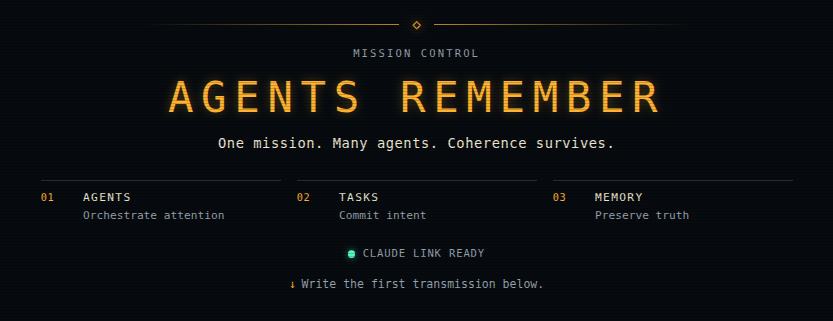
Table of Contents
- Why It Exists
- Core Features
- What It Looks Like In Practice
- Live Demo
- Requirements
- Quickstart
- Run The Dashboard
- Documentation
- Repository Layout
- Status
- Stability
- Contributing
Why It Exists
Modern coding agents can make clean, plausible edits while missing the project-specific rules that make those edits safe. A top-level instruction file can help, but it does not naturally reappear when the agent is deep in a file and deciding what to change.
Agents Remember fixes that: the matching note is reachable at the moment of the edit — most often by the very path the agent is already working in — so project rules surface exactly when a change is being made, not buried in a top-level file.
Core Features
Agents Remember gives coding agents project memory they can verify and act on. It turns local invariants, naming rules, migration scars, cross-repo contracts, and "this looks safe but is not" facts into versioned Markdown beside the code, checks that memory against Git before use, and updates it only after approved work lands.
src/orchestrator/core_editor.py
ar-memory/onboarding/src/orchestrator/core_editor.py.md
- Path-addressed memory: A source file's note lives at a deterministic mirror path, so an agent holding a file can reach the right context without search, ranking, or guesswork.
- Git-proven freshness: File notes, route overviews, and entity catalogs are drift-checked against source commits, route scopes, or deterministic fingerprints before they are trusted.
- Search that finds, not decides: Optional semantic memory and code-graph providers help locate relevant files, callers, dependencies, and concepts, but verified Markdown and source code remain the truth.
- Memory that lands with code: External memory repos use a
memory.mdledger, isolated dual worktrees, preview/apply closeout, and all-or-nothing integration so code and memory stay synchronized. - Repo-owned agent behavior: Each memory repo carries
system/files for path rules, tools, coding guidelines, documentation sources, branch policy, and reporting shape, so the same project rules load across harnesses. - Harness-ready first run: Starter packages for Claude Code, Codex, Cursor, Antigravity, VS Code Copilot, Hermes, Pi.dev, and OpenClaw carry the native MCP, skills, hooks, rules, and instruction files each harness needs.
The default setup stores durable memory in the target repository under ar-memory/. Teams that need separate memory repositories can use external memory under ar-coordination/memory-repos/ar-<repo>/. For the full tour, see Features.
What It Looks Like In Practice
A source file has an onboarding note beside it, reached by path:
mcp/src/agents_remember/mcp/server.py
ar-memory/onboarding/mcp/src/agents_remember/mcp/server.py.md
At task start the agent orients and checks memory health:
context_packet(repo_id="my-app")
memory_quality_check(request={"mode":"sync", "repo_id":"my-app"})
It then reads the source file and its onboarding note together before proposing a change. After the change is approved and lands, the onboarding is refreshed and re-verified against the new commit — so the note stays true to the code.
Live Demo
Agents Remember runs on itself. The companion memory repo is: https://github.com/Foxfire1st/ar-agents-remember
That repo contains the live onboarding layer, so you can inspect how by-path memory, drift-aware updates, and contribution-time onboarding look in practice.
Requirements
Before the Quickstart, make sure the host has:
- uv (for
uvx) or pip, and Python 3.13 — the package supports>=3.13,<3.14; repository development uses the verified source-built 3.13.15 contract documented in the MCP README. - Git, with
user.name/user.emailconfigured (memory and worktree commits need an author; otherwise a placeholder identity is used). - Docker running, only if you enable the optional providers. The semantic-memory provider (grepai) also uses a Dockerized Ollama and pulls an embedding model (
nomic-embed-text) on first setup — no host Ollama install needed.
Providers, Docker, and Ollama are only needed for the optional Docker-backed
providers; the core by-path memory works without them. Claude Code hooks do not
require jq; the current starter package uses a Python hook. Full detail and
troubleshooting live in the MCP package README.
Quickstart
This is the short path for a new workspace. The detailed walkthrough lives in Getting Started.
Ask your agent to:
-
Copy the harness package — Pick your harness guide under docs/install, copy that harness's native starter files from this repo into the workspace, then render the copied package. The
render-starterscript is a convenience: it infers the workspace root from the copied harness folder and fills the copied package's path, repository, and hook-command placeholders from a single--repolist such as--repo my-app shared-lib. You can also do those replacements by hand. These packages include the harness-visible skills, hooks/rules/instructions, and MCP settings templates. -
Wire the MCP server — Register Agents Remember MCP from PyPI with
uvx:uvx agents-remember-mcp@latest --config /absolute/path/to/agents-remember-settings.jsonUse the
agents-remember-settings.jsonpath from the copied harness package. Then restart the harness once so it loads the MCP server, native skills, and package hooks/rules/instructions. -
Onboard your project — Invoke the copied skill
c-13-install-and-onboard. It runs or verifiesruntime_install(), asks whether to scaffold a new memory repo or use an existing one, bootstraps onboarding when needed, and starts provider indexing when providers are enabled.
That is the normal first-run path. skills_install() remains available as a
maintenance/manual MCP tool, but the starter packages already provide the
initial skills and harness files.
After that, normal work runs through the l-01-agent-lifecycles skill: developer-facing free chat answers research inline and, for ordinary role-shaped work after the durable sprint and first leaf exist, compiles the canonical architect brief and calls dispatch_agent once on that sprint document. An explicit developer-declared task-seat takeover instead targets the named role on its canonical task document. The identity-free launcher hands over after the exact brief is durable; later plane-hosted seats use the same tool under structural child-scope authority. Spawned backend seats follow their role briefs. The agent resolves the active context with c-08-ar-coordination-context-resolver, checks memory quality with c-02-memory-quality-control, reads relevant onboarding beside code, and updates onboarding after approved changes.
Run The Dashboard
The mission-control dashboard ships inside the MCP package. Install the CLI once with uv — latest stable, no version pin — then start the cockpit from anywhere in your workspace:
uv tool install agents-remember-mcp
agents-remember dashboard
--config is optional: the CLI walks up from the current directory and uses
the nearest .claude/mcp/agents-remember-settings.json, or the --config
recorded in an .mcp.json agents-remember entry — the same settings file
the MCP server boots from.
For a dashboard that survives closing the terminal, use daemon mode:
agents-remember dashboard --daemon    # detach; state + log under <coordinationRoot>/logs/dashboard/
agents-remember dashboard --status    # exit 0 when running, 1 when not
agents-remember dashboard --stop
Or let the MCP server supervise it: set "dashboard": {"autoStart": true} in
the MCP settings JSON and every server boot ensures the daemon — adopting a
healthy one, starting a missing one, and restarting on version mismatch so an
upgrade is picked up by the next session
(Settings Reference).
Pinning a version is the debugging/repro path, not the default: uv tool install 'agents-remember-mcp==3.0.0rc8', or one-shot without installing,
uvx --from 'agents-remember-mcp==3.0.0rc8' agents-remember dashboard.
Pre-release note (until 3.0.0 final): the dashboard currently ships in
3.0.0rcNpre-releases, which default version resolution skips. Install withuv tool install --prerelease allow agents-remember-mcp, and register the MCP server with an explicitagents-remember-mcp==3.0.0rcNpin instead of@latest.
Documentation
- Features - the concentrated tour of what Agents Remember gives users.
- Getting Started - a fuller first-run setup.
- Concepts - onboarding units, memory roots, drift, and approval gates.
- Architecture - runtime, coordination, internal memory, and external memory.
- Workflows - the
l-01-agent-lifecyclesskill and its build modes (research-only exit /w-02-light-task-workflowskill task / master + light sub-task series), and when to use each. - Benchmark Methodology - how paired
codex exec --jsonruns are captured and compared. - FAQ - design principles, objections, and comparisons.
- External Memory Guide - separate memory repos for selected code repos.
- Cost-aware Bootstrap - model and wave-sizing choices for token-heavy repository bootstrap.
- Settings Reference - memory-layer
system/settings.jsonand MCP authority settings. - Skills Reference - the installed skill families.
Repository Layout
agents-remember/
  AGENTS.md                         # source checkout instructions
  README.md                         # public front door
  skills/                           # canonical skill source tree
  scripts/sync-skills.py            # sync skills into package/harness copies
  scripts/sync-runtime.py           # sync runtime assets into package data
  scripts/sync-harness.py           # generate the nine harness configuration trees
  scripts/harness/                  # canonical source for those trees
  agents-md-files/                  # canonical installed AGENTS.md templates
  benchmarks/                       # canonical optional benchmark package source
  providers/                        # canonical provider runtime assets
  system/defaults/examples/         # canonical scaffold examples
  mcp/                              # package-local MCP server and services
    src/agents_remember/package_data/
      runtime/
        agents-md-files/            # generated copy of root agents-md-files/
        skills/                     # generated package copy of root skills/
        providers/                  # generated copy of root providers/
        system/defaults/examples/   # generated copy of root system/defaults/examples/
      benchmarks/                   # generated copy of root benchmarks/
  docs/                             # user-facing documentation
Edit skills in root skills/, then run python3 scripts/sync-skills.py to
refresh the MCP package data and every harness starter package. The pre-commit
and pre-push hooks run python3 scripts/sync-skills.py --check.
Edit runtime assets in root agents-md-files/, benchmarks/, providers/,
and system/, then run python3 scripts/sync-runtime.py to refresh MCP package
data only. The pre-commit and pre-push hooks run
python3 scripts/sync-runtime.py --check.
Edit the self-hosted harness configuration in root scripts/harness/, then run
python3 scripts/sync-harness.py to regenerate the nine .claude/, .codex/,
.cursor/, .github-vscode/, .vscode/, .hermes/, .openclaw/, .pi/ and
.agents/ trees. The pre-commit and pre-push hooks run
python3 scripts/sync-harness.py --check, and mcp/tests/test_sync_harness.py
runs the same check inside the suite.
The hooks are tiered, and both are thin wrappers over .githooks/_gate.sh.
pre-commit runs the fast tier over the staged content: the generated-copy
checks above, plus Ruff, ruff format --check, Pyright, and deterministic dashboard
checks. pre-push repeats those non-test checks against current-checkout bytes and
records the pushed refs. It does not run acceptance. GitHub runs its deterministic
non-test checks once per pull request, not once again for every branch push. A
pinned Dagger v0.21.8 graph rebuilds the exact Git candidate
in a clean Ubuntu container, installs from scratch, runs a bundled real Codex
read-only protocol probe, and executes the accepting wrapper. Targeted Dagger runs
once when each leaf closeout creates its commit. Leaf integration lands that exact
certified commit without a rerun. Full Dagger runs once when each master integrates
into super. PR validation, tagging, and publishing do not rerun acceptance. See
CONTRIBUTING.md for the tier table and staged-content contract.
Agents Remember declares that Dagger graph in its repository-owned
mcp/certification-profile-v1.json, selected explicitly by
repositories.agents-remember.certificationProfile in the MCP authority settings. The framework
does not discover a wrapper or carry an Agents Remember command/report inventory. Ordinary Python development uses pytest directly, without Dagger admission, coverage,
repository certification, or an autouse application service graph:
mcp/.venv/bin/python -m pytest                         # default unit loop
mcp/.venv/bin/python -m pytest mcp/tests/test_example.py # one changed behavior
mcp/.venv/bin/python -m pytest -m integration           # delivery boundary checks
The default excludes the integration marker. Local inputs, temporary resources, and
explicit test doubles remain ordinary tests; real publication/recovery, competing writers,
application wiring, and whole-repository observations run separately. Imported test classes
are exercised only in their defining module. Four workers are the default; use -n=0 for
serial debugging. Tests use disposable home/config/cache directories and scrub inherited
Git selectors, live opt-ins and credentials. They never declare a daemon identity.
Delivery runs both populations together (-m "") in the existing shared Dagger environment.
Only explicit --certify loads the retained certification plugins and requires genuine
Dagger admission. Combined branch coverage feeds the 90% changed-production-code floor
and the existing CRAP threshold of 30. Tests and verification-only support are excluded
from production scoring. Coverage and CRAP are not part of the ordinary unit command.
Direct targeted Vitest unit/component commands also remain available.
The full evidence taxonomy, lifecycle metadata, fixture-authority rule, dependency-owned
selection/retry behavior, stress cadence, and causal-failure contract are documented in
docs/design/python-evidence-system.md.
Leaf/focused acceptance is Dagger mode=targeted, while the single master-altitude
full-repository acceptance is Dagger mode=full. Both require an explicit Git
diff-base; the public Dagger function refuses an empty base instead of comparing
the candidate to Git's empty tree. Run dagger call quality --help to see the
current modes and argument contract. There is no direct-Docker or host fallback:
an unavailable Dagger engine fails explicitly.
The graph receives a separate Git ancestry bundle plus the exact staged source,
never the live coordination root, credentials, or container socket. Its live
trace and final pytest, coverage, Codex-probe, and result artifacts replace the
corresponding files under the task enclosure's reports/ directory.
Inside the nonce-attested Dagger graph, the wrapper orders cheap deterministic rails before the
expensive test rail: Ruff, formatting, file size, Pyright, Radon reports, then pytest. CRAP and
changed-lines coverage score that run's branch-coverage artifact last. Content-addressed exact or
test-only retry proof is an internal Dagger optimization; any source, configuration, selected-suite,
runtime, environment, or artifact drift runs the ordinary selection in the same graph. There is no
host retry path or fallback. Lifecycle acceptance disables proof reuse by default with
AR_QUALITY_NO_RETRY=1.
Every Dagger rail prints one provenance line naming its actual input, resolved config, and unit count. The deterministic pre-push hook separately forwards Git's ref updates and checks current-checkout bytes at index-known paths; it runs no tests and never claims acceptance for the pushed commit range.
The installed runtime lives in ar-coordination/ — by default <workspace>/ar-coordination/,
inside the workspace (never your home directory) — not in the source checkout. The
c-13-install-and-onboard skill shows this and every other install path as a workspace-first
default you can accept or override:
ar-coordination/
  AGENTS.md
  skills/
  system/
  memory-repos/
  providers/                        # provider runtimes (images, runners, indexes)
  benchmarks/                       # optional, installed with --include-benchmarks
  tasks/
  notes/
  worktrees/
  temp/
Status
Agents Remember is at 3.0.0rc8 and actively developed. The core path — by-path onboarding, drift checks, and approval-gated updates — is in real use and stable enough to rely on. The public contracts listed under Stability are held stable across minor releases and change only on a major bump; the internals beneath them and the optional semantic/relationship providers may still evolve, so pin a version and read the notes for your target version in GitHub Releases — the repository's canonical changelog — before upgrading. The Claude Code path is the most exercised; other harnesses are supported but less battle-tested.
The 3.0 arc: the working session itself is now observable and steerable — a system-managed agent lifecycle with durable approval gates and an event/projection layer, served as the mission-control browser cockpit directly from the MCP package (agents-remember dashboard; #2, #43). The rc tag means the cockpit surface is still settling toward the final 3.0.0 contract; the architecture beneath it is the one described above.
Stability
Following semantic versioning from 1.0.0, these public contracts will not change without a major version bump: skill IDs (e.g. the c-08-ar-coordination-context-resolver and w-02-light-task-workflow skills), MCP tool names and their inputs/outputs, the ar-coordination/ and ar-memory/ layout, and the settings schema. Internal modules, provider internals, and prompt wording are not part of this promise and may change in minor releases.
Contributing
Contributions should make the memory layer clearer, safer, and easier to apply consistently. Start with CONTRIBUTING.md and keep the core rules intact: drift check before planning, approval before implementation, and onboarding updates only after approved changes.
Agents Remember runs on itself, so the best way to contribute is with the memory layer active. Download or clone this project's own memory at Foxfire1st/ar-agents-remember and use it as the Agents Remember memory for your checkout: you get the project's by-path onboarding at the moment you edit, and your onboarding updates land alongside your code changes — the same loop this repo asks of every contribution.