mcp-server-decisions
AIエージェント向けの予測検証と結果ゲートを備えた意思決定追跡
ドキュメント
🧠 MCP Server: Decisions
An open-source MCP server that helps teams record architectural decisions, connect them to testable predictions, and validate outcomes over time. It gives AI agents and developers a lightweight, auditable memory for technical choices.





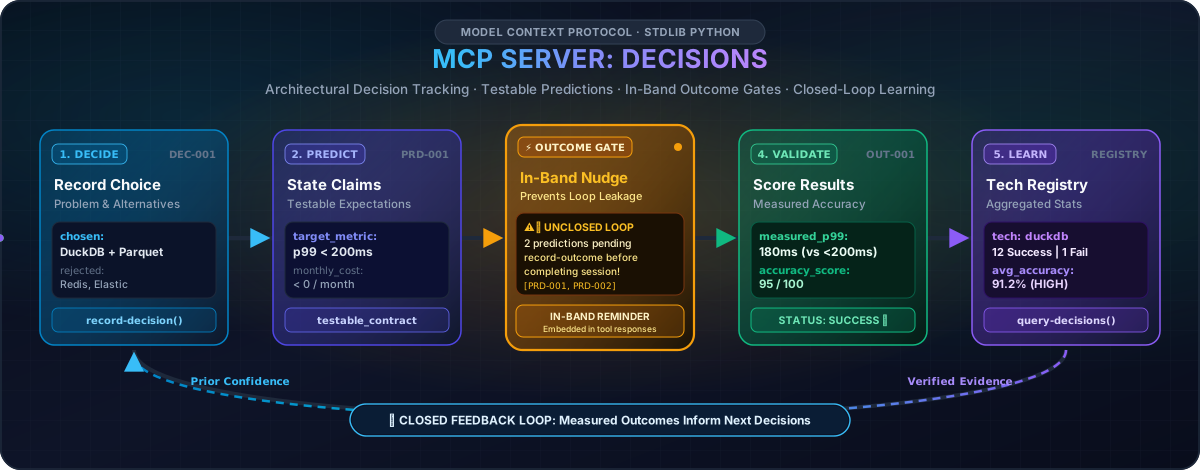
✨ Project Highlights
- Outcome-linked decisions — connect each technical choice to measurable predictions and observed results.
- In-band outcome gates — tool responses identify predictions that still need validation before the work is considered complete.
- Portable storage — append-only JSONL keeps the log inspectable, easy to back up, and free from database setup.
- Zero runtime dependencies — Python's standard library is enough to run the server.
- MCP-native interface — expose decision tracking through JSON-RPC over stdio to MCP-compatible clients.
- Technology feedback — aggregate validated outcomes to inform future technology choices.
🧰 Technical Stack
| Layer | Technology |
|---|---|
| Protocol | Model Context Protocol over JSON-RPC 2.0 |
| Runtime | Python 3.10+ |
| Storage | Append-only JSONL file |
| Packaging | PyPI / Hatchling |
| Testing | Built-in self-test command |
| License | MIT |
🔄 Architecture
flowchart TD
    A[MCP client or AI agent] --> B[JSON-RPC over stdio]
    B --> C[mcp-server-decisions]
    C --> D[Record decision]
    C --> E[Attach prediction]
    C --> F[Record outcome]
    C --> G[Query decisions and technology history]
    D --> H[(Append-only JSONL log)]
    E --> H
    F --> H
    G --> H
    F --> I[Validation status and accuracy]
    I --> J[Future technical decisions]
📌 What It Provides
The server exposes four tools:
| Tool | Purpose |
|---|---|
record-decision | Store the problem, chosen solution, alternatives, technologies, and predictions. |
record-prediction | Add a measurable prediction to an existing decision. |
record-outcome | Record the observed result and classify the prediction as success, partial success, or failure. |
query-decisions | Search decisions by keyword, technology, domain, or result limit. |
Example flow
Decide → Predict → Implement → Measure → Validate → Learn
A decision can produce an outcome-gate reminder such as:
{
  "decision_id": "DEC-2026-0001",
  "status": "OK",
  "OUTCOME_GATE": "2 prediction(s) still lack outcomes."
}
The reminder is a workflow signal, not a claim about adoption or measured impact. See the Outcome Gate Pattern for the design and trade-offs.
📊 Current Project Status
| Area | Status |
|---|---|
| Decision, prediction, and outcome tracking | Available |
| Outcome-gate reminders | Available |
| Technology performance report | Available |
| PyPI package | Published as 1.0.2 |
| External adoption metrics | Not collected yet |
| Web UI and notifications | Roadmap |
The project is early-stage. Contributions, examples from real projects, and feedback are welcome.
🚀 Setup
Prerequisites
- Python 3.10 or newer
- An MCP-compatible client
Install from PyPI
python3 -m pip install mcp-server-decisions
Run the self-test
python3 -m pip install -e .
python3 server.py --selftest
Configure an MCP client
{
  "mcpServers": {
    "mcp-server-decisions": {
      "command": "mcp-server-decisions"
    }
  }
}
For client-specific configuration and troubleshooting, see Client Integrations. For a guided first run, see Quick Start.
Configure the log path
By default, the server writes to ~/.local/share/mcp-decisions/decisions_log.json. Set MCP_DECISIONS_LOG_PATH to use another file:
MCP_DECISIONS_LOG_PATH=/path/to/decisions.json mcp-server-decisions
🗂️ Project Structure
.
├── server.py                         # MCP server and tool implementations
├── scripts/                          # Reports derived from the decision log
├── docs/                             # Architecture, examples, and integrations
├── .github/ISSUE_TEMPLATE/           # Reusable bug and feature templates
├── CONTRIBUTING.md                   # Development and contribution workflow
├── QUICKSTART.md                     # Guided setup and first decision
├── server.json                       # MCP Registry metadata
├── pyproject.toml                    # PyPI package metadata
└── LICENSE                           # MIT license
📚 Documentation
- Quick Start — install and record a first decision.
- Client Integrations — configure MCP clients.
- Detailed Examples — JSON-RPC requests and responses.
- Architecture & Design — storage, IDs, scoring, and trade-offs.
- Outcome Gate Pattern — the reusable feedback-loop pattern.
- Contributing — propose fixes, features, and documentation.
🛣️ Roadmap
- Core decision, prediction, and outcome tracking
- Outcome-gate reminders
- Technology performance reporting
- Web UI for browsing and searching decisions
- Notifications for low prediction accuracy
- Reusable decision templates and domain patterns
🤝 Contributing
Issues and pull requests are welcome. Start with CONTRIBUTING.md, run the self-test, and explain the problem or use case in the pull request.
📄 License
MIT © 2026 Roberto Nascimento