recon-crypto-mcp
用于AI代理管理以太坊/Arbitrum/Polygon上自托管加密投资组合(Aave、Compound、Morpho、Uniswap V3、Lido、EigenLayer)的MCP服务器,通过Ledger + WalletConnect实现,私钥永不离开设备。
文档
VaultPilot MCP



Self-custodial DeFi for AI agents. The agent proposes, you approve on your Ledger — designed for the threat model where the agent, MCP, and host can all be compromised. Only the device is trusted; private keys never leave it.
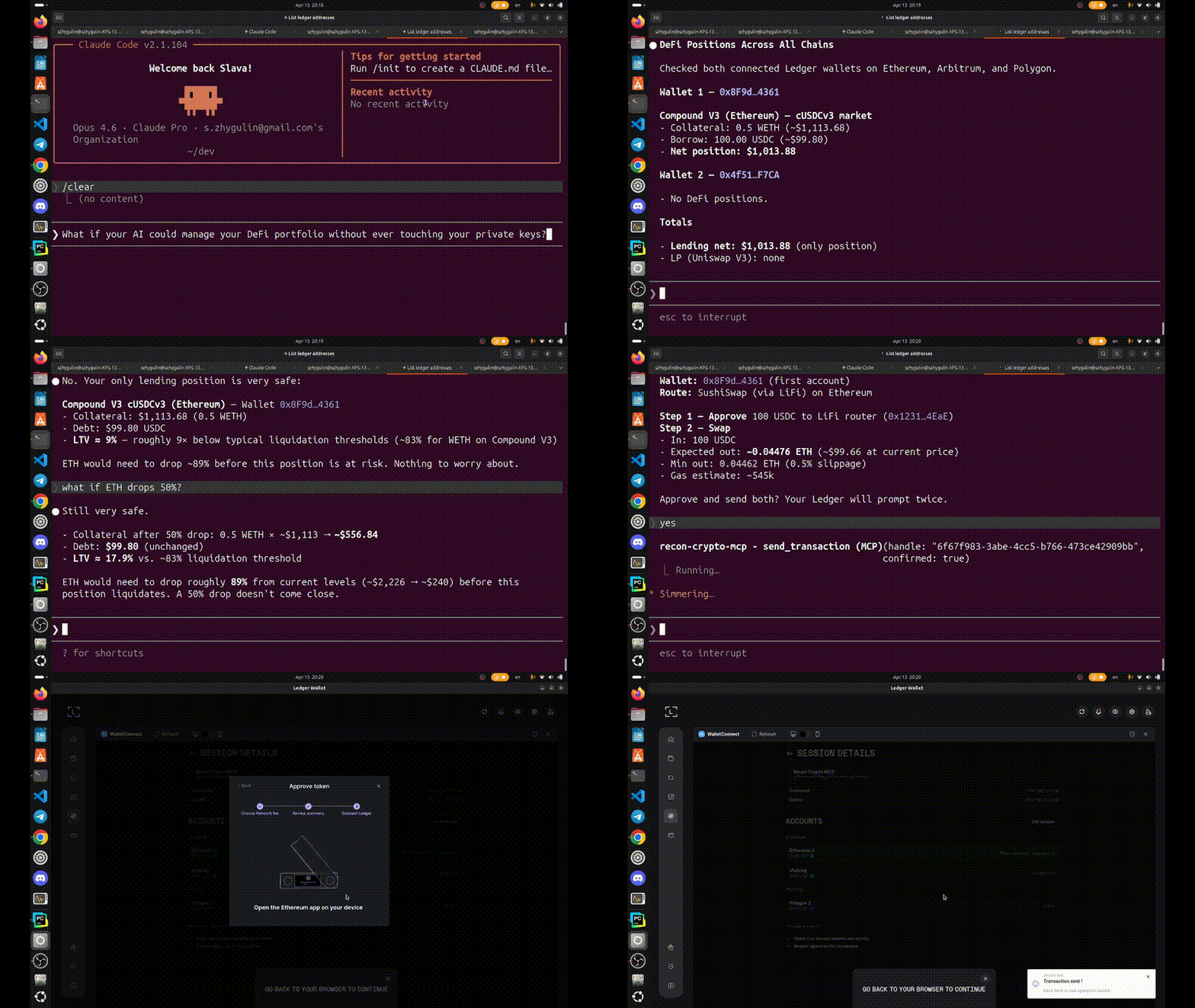
Read on-chain positions and prepare transactions across Ethereum, Arbitrum, Polygon, Base, Optimism, TRON, Solana, Bitcoin, and Litecoin. Supported protocols: Aave V3, Compound V3, Morpho Blue, Uniswap V3 (swap + LP verbs), Curve, Lido, EigenLayer, Rocket Pool, Safe (Gnosis) multisig on EVM, MarginFi, Kamino, Marinade, Jito on Solana, SunSwap on TRON, plus LiFi (EVM + EVM↔Solana + TRON + BTC swap/bridge) and Jupiter v6 (Solana swap), with 1inch as an optional EVM quote cross-check. EVM signs over WalletConnect → Ledger Live; TRON, Solana, Bitcoin and Litecoin sign over USB HID directly to the device (Ledger Live's WalletConnect bridge does not support those namespaces today). Works with Claude Code (CLI/terminal), Cursor, and any MCP-compatible client over stdio. Claude.ai chat (web + native desktop app) needs a hosted MCP endpoint — on the roadmap, not yet shipped.
Agents: read AGENTS.md. One-line prompt to paste into Claude Code / Cursor / any MCP-capable agent:
Install VaultPilot MCP from https://github.com/szhygulin/vaultpilot-mcp following AGENTS.md.
Features
- Portfolio — cross-chain balances, DeFi position aggregation, USD totals, NFT collections (EVM + Solana via Helius DAS), wallet-level PnL (
mtd/ytd/30d/7d/1d), daily briefing - Positions — Aave, Compound, Morpho, Uniswap V3 LP, Curve, MarginFi, Kamino, Safe (Gnosis) multisig; multi-protocol health-factor alerts; liquidation-risk simulation
- Staking — Lido (stake / unstake / stETH↔wstETH wrap) + EigenLayer + Rocket Pool (EVM); TRON Stake 2.0 (freeze / unfreeze / vote / claim); Solana (Marinade, Jito, native delegate/deactivate/withdraw)
- Swaps + bridges — LiFi (EVM + EVM↔Solana + TRON + BTC routes, optional 1inch cross-check), Jupiter v6 (Solana), direct Uniswap V3, Curve, SunSwap (TRON)
- Execution — prepare/sign for every supported protocol + native/token sends, ERC-20 approvals + revoke, WETH wrap/unwrap,
prepare_custom_callescape hatch for arbitrary verified-contract calls. Solana sends use a per-wallet durable-nonce account so Ledger review doesn't race the ~60s blockhash window; every Solana prepare runs asimulateTransactiongate so program-level reverts fail at prepare time, not on broadcast. - Bitcoin + Litecoin — native segwit + taproot sends, BIP-125 RBF fee-bumps, PSBT multisig (combine / sign / finalize), BIP-137 message signing, mempool.space fee estimation, optional Bitcoin Core / Litecoin Core RPC for forensic chain reads (forks, mempool census, fee percentiles)
- Security — contract verification, upgradeability checks, privileged-role enumeration, DefiLlama-backed risk score, on-device Ledger attestation + firmware version pin,
verify_tx_decodefor second-LLM bytes-vs-intent cross-check, signed on-disk contacts/address-book - Utilities — ENS resolution, symbol→contract
resolve_tokenregistry, token balances, allowance enumeration, tx status,explain_txpost-hoc decode,compare_yieldsacross lending + LST adapters - Demo mode — curated personas (
whale/defi-degen/stable-saver/staking-maxi) for first contact with no RPC keys / Ledger / config file
Security model
Compromise model: the AI agent, MCP server, and host computer can all be attacker-controlled. Only the Ledger is trusted. Every transaction is cryptographically bound across each layer so tampering — a swapped recipient, a rewritten swap route, a smuggled approval — is tamper-evident on the device screen before signing.
user-intent ──► agent ──► MCP server ──► WalletConnect / USB-HID ──► Ledger Live / host ──► Ledger device
Defense in depth: server-side prepare↔send fingerprint, independent 4byte.directory selector check, agent-side ABI decode + pre-sign hash recompute, on-device clear-sign or blind-sign-hash match, WalletConnect session-topic cross-check, previewToken/userDecision gate, and get_verification_artifact for second-LLM cross-verification on high-value flows. See SECURITY.md for the full threat model, defenses table, residual risks, and verification recipes.
Agent-side hardening (strongly recommended)
The MCP's own CHECKS PERFORMED directives can be silently omitted by a compromised server. Install the companion vaultpilot-security-skill so the agent enforces cryptographic-integrity invariants regardless of what the MCP says — bytes decode, dispatch-target allowlist, hash recompute, chain-must-be-explicit, bridge-recipient cross-check, approval-class surfacing, always-optional second-LLM offer surfaced on every preview, set-level intent verification, durable-binding source-of-truth:
git clone https://github.com/szhygulin/vaultpilot-security-skill.git \
  ~/.claude/skills/vaultpilot-preflight
Restart Claude Code. The skill file's SHA-256 is pinned in the server source; on-disk tamper or plugin collision surfaces as integrity check FAILED.
Conversational /setup (optional)
For chat-driven onboarding that detects current config and only collects keys you actually need, install the companion vaultpilot-setup-skill:
git clone https://github.com/szhygulin/vaultpilot-setup-skill.git \
  ~/.claude/skills/vaultpilot-setup
Restart, then type /setup.
Supported chains
EVM — Ethereum, Arbitrum, Polygon, Base, Optimism. Lido reads on Ethereum + Arbitrum, Lido writes Ethereum-only. EigenLayer + Morpho Blue + Rocket Pool Ethereum-only. Compound V3 + Aave V3 + Uniswap V3 + LiFi + Safe multisig span all five chains; per-protocol address coverage varies — readers short-circuit cleanly where a protocol isn't deployed.
TRON — TRX + canonical TRC-20 stablecoins (USDT, USDC, USDD, TUSD); Stake 2.0 freeze/unfreeze/withdraw-expire-unfreeze + voting-reward claims; SunSwap (same-chain TRX↔TRC-20 swaps); LiFi-routed TRON↔EVM bridging. No lending/LP (Aave/Compound/Morpho/Uniswap aren't deployed). Pair once per session via pair_ledger_tron.
Solana — SOL + SPL balances, MarginFi + Kamino lending, Marinade / Jito / native stake-account reads with SOL-equivalent valuation, Jupiter v6 quotes, Helius DAS NFT portfolio. Writes cover SOL/SPL transfers, MarginFi + Kamino supply/withdraw/borrow/repay, Jupiter swaps, Marinade stake + immediate-unstake, Jito stake-pool deposit, native SOL delegate/deactivate/withdraw, and LiFi-routed EVM↔Solana bridging. Per-wallet durable-nonce account (~0.00144 SOL rent, reclaimable) protects sends from blockhash expiry during Ledger review (prepare_solana_nonce_init / _close). SPL / MarginFi / Kamino / Jupiter / Jito blind-sign against a Message Hash — enable Allow blind signing in the Solana app's Settings; SOL native transfers clear-sign. Pair once per session via pair_ledger_solana.
Bitcoin + Litecoin — balance, UTXO, fee-estimate, and tx-history readers via Esplora (mempool.space / litecoinspace.org). Native segwit + taproot sends, BIP-125 RBF fee-bumps, multisig PSBT (combine / sign / finalize), BIP-137 message signing, LiFi-routed BTC→EVM/Solana swaps. Optional Bitcoin Core / Litecoin Core JSON-RPC unlocks forensic tools that Esplora cannot serve (chain tips, block stats, mempool summary) — see INSTALL.md §9 for setup. Pair once via pair_ledger_btc / pair_ledger_ltc.
Ledger Live's WalletConnect bridge does not honor the tron: namespace (verified 2026-04-14) or expose Solana accounts (verified 2026-04-23) or expose BTC/LTC namespaces, which is why those paths use USB HID. Readers short-circuit cleanly on chains where a protocol isn't deployed.
Roadmap
Tools
~190 tools across read / pair-Ledger / prepare / sign+send / verify / diagnostic categories. Highlights below; each tool has a Zod input schema and verbose description — query the MCP server's tools/list for the canonical surface.
Portfolio + positions (read-only):
get_portfolio_summary,get_portfolio_diff,get_pnl_summary,get_daily_briefing— cross-chain USD aggregation; optionaltronAddress/solanaAddressfold those chains inget_lending_positions(Aave),get_compound_positions,get_morpho_positions,get_marginfi_positions,get_kamino_positions,get_curve_positions,get_safe_positions— per-protocol positions + health factorsget_lp_positions— Uniswap V3 LP + IL estimateget_staking_positions,get_staking_rewards,estimate_staking_yield— Lido + EigenLayer + Rocket Poolget_solana_staking_positions— Marinade + Jito + native stake-account enumeration with activation status and SOL-equivalent valuationget_tron_staking,list_tron_witnesses— TRON Stake 2.0 state + SR listget_nft_portfolio(EVM + Solana DAS),get_nft_collection,get_nft_history,get_nft_listings(EVM)get_btc_balance/_balances/_account_balance/_multisig_balance/_multisig_utxos/_tx_history/_fee_estimates,get_ltc_balance— BTC + LTC reads via Esploraget_compound_market_info— wallet-less Comet snapshotget_health_alerts,simulate_position_change— multi-protocol liquidation-risk toolingcompare_yields— rank lending APRs across Aave / Compound / Morpho / Marinade / Jito / Kamino-lend / MarginFiget_marginfi_diagnostics— banks the bundled SDK skipped, with root cause
Tokens, prices, history:
get_token_balance,get_token_price,get_token_metadata,get_token_allowances,get_coin_price— balances + DefiLlama prices on EVM/TRON/Solana;get_token_metadatadetects EIP-1967 proxiesget_transaction_history— merged tx reader (external / ERC-20 / internal / Solana program_interaction) with 4byte-decoded methods + historical USDget_transaction_status— poll inclusion by hashexplain_tx— post-hoc decode of a historical txresolve_token,resolve_ens_name,reverse_resolve_ens
Forensic chain reads (require Bitcoin/Litecoin Core RPC):
get_btc_block_tip/_block_stats/_blocks_recent/_chain_tips/_mempool_summary,get_ltc_*equivalentsbuild_incident_report,get_market_incident_status— Compound/Aave pause + utilization scan and BTC/LTC chain-tip / mempool-anomaly bundle
Quotes + security signals:
get_swap_quote(LiFi, EVM),get_solana_swap_quote(Jupiter v6)check_contract_security,check_permission_risks,get_protocol_risk_score,get_contract_abi,read_contractsimulate_transaction— EVMeth_callpreview (Solana equivalent runs insidepreview_solana_send)verify_tx_decode,get_verification_artifact,get_tx_verification— second-LLM cross-verification + 15-min-TTL handle re-emit (details)
Diagnostics:
get_solana_setup_status— probe nonce + MarginFi account PDAsget_vaultpilot_config_status— local config diagnostic (RPC sources, key presence, paired-account counts, WC topic suffix, skill state). Booleans / counts only — no secret values.get_ledger_device_info,get_ledger_status,verify_ledger_attestation/_firmware/_live_codesign— device + session discovery, on-device attestation, firmware-version pin
Contacts + read-only sharing:
add_contact/remove_contact/list_contacts/verify_contacts— local Ledger-signed address book at~/.vaultpilot-mcp/contacts.jsongenerate_readonly_link/import_readonly_token/list_readonly_invites/revoke_readonly_invite— issue scoped read-only portfolio linksshare_strategy/import_strategy— anonymized portfolio snapshots
Execution (Ledger-signed):
pair_ledger_live(EVM/WC),pair_ledger_tron/_solana/_btc/_ltc(USB HID)prepare_aave_*,prepare_compound_*,prepare_morpho_*— EVM lending (supply / borrow / withdraw / repay)prepare_lido_stake/_unstake/_wrap/_unwrap(stETH↔wstETH),prepare_eigenlayer_deposit,prepare_rocketpool_stake/_unstakeprepare_swap(LiFi),prepare_native_send,prepare_token_send,prepare_token_approve,prepare_revoke_approval,prepare_weth_unwrapprepare_uniswap_swap— direct V3 swap, same-chain, auto-picks fee tier across 100/500/3000/10000 bps. Use only when the user names Uniswap; otherwise prefer LiFiprepare_uniswap_v3_mint/_increase_liquidity/_decrease_liquidity/_collect/_burn/_rebalance— full LP verb setprepare_curve_swap,prepare_curve_add_liquidityprepare_safe_tx_propose/_approve/_execute,submit_safe_tx_signature— Safe multisig proposal flowprepare_custom_call— escape hatch for arbitrary verified-contract calls (acknowledgeNonProtocolTarget: truegate; bypasses the canonical-dispatch allowlist by design)prepare_tron_*— native + TRC-20 transfers, WithdrawBalance, Stake 2.0, vote, claim rewards, TRC-20 approve, LiFi swap, SunSwap swap (prepare_sunswap_swap)prepare_solana_nonce_init/_close— one-time durable-nonce PDA setup/teardownprepare_solana_native_send,_spl_send(auto-includes ATA create),prepare_solana_swap(Jupiter),prepare_solana_lifi_swapprepare_marginfi_init,_supply,_withdraw,_borrow,_repayprepare_kamino_init_user,_supply,_withdraw,_borrow,_repayprepare_marinade_stake/_unstake_immediate(fee applies; unstake-ticket delayed path deferred),prepare_jito_stake(stake only — unstake deferred),list_solana_validatorsprepare_native_stake_delegate/_deactivate/_withdraw— native SOL stakingprepare_btc_send,prepare_btc_rbf_bump,prepare_btc_multisig_send,register_btc_multisig_wallet/unregister_btc_multisig_wallet,combine_btc_psbts,sign_btc_multisig_psbt,finalize_btc_psbt,sign_message_btc,prepare_btc_lifi_swap,rescan_btc_accountprepare_litecoin_native_send,sign_message_ltc,rescan_ltc_accountpreview_send(EVM) — pins gas, emitsLEDGER BLIND-SIGN HASHfor pre-match, mintspreviewToken; required between every EVMprepare_*andsend_transactionpreview_solana_send— pins nonce/blockhash, computes Message Hash for on-device match, runs simulation, emitsCHECKS PERFORMED; required between everyprepare_solana_*andsend_transactionsend_transaction— forwards to Ledger (EVM via WC, TRON/Solana/BTC/LTC via USB HID)
Meta:
request_capability— file a missing-feature GitHub issue. Default returns a pre-filled URL (no auto-submit); rate-limited 3/hourset_etherscan_api_key,set_helius_api_key,set_demo_wallet,exit_demo_mode,get_demo_wallet,get_update_command— runtime knobs
Requirements
- Node.js ≥ 18.17
- Zero-config reads: PublicNode (EVM) + Solana public mainnet — rate-limited but enough for first contact and light use.
- Real use: custom RPC (Infura / Alchemy / Helius / QuickNode / Triton) via env vars or
vaultpilot-mcp setup. - Optional keys (prompted on demand): Etherscan, 1inch (enables swap-quote comparison), WalletConnect project ID (required for EVM Ledger signing), TronGrid (raises the ~15 req/min anonymous cap).
- TRON / Solana signing: USB HID access to a Ledger with the Tron / Solana app installed. Linux: install Ledger's udev rules (
vaultpilot-mcp setupprints the exact one-liner). Debian/Ubuntu also needsudo apt install libudev-dev build-essentialfornode-hidto compile.
Install
Three paths — full instructions, MCP-client wiring, Gatekeeper / SmartScreen handling, update / uninstall in INSTALL.md.
| Path | TL;DR |
|---|---|
| Bundled binary (no Node) | Download from the latest release, chmod +x, <binary> setup. |
| From npm | npm install -g vaultpilot-mcp && vaultpilot-mcp setup |
| From source | git clone https://github.com/szhygulin/vaultpilot-mcp.git && cd vaultpilot-mcp && npm install --legacy-peer-deps && npm run build && npm run setup |
Setup
npm run setup
Picks RPC providers, validates keys, optionally pairs Ledger Live, writes ~/.vaultpilot-mcp/config.json. Env vars override the config.
Demo mode
Try without RPC keys, Ledger pairing, or the wizard:
claude mcp add vaultpilot-mcp --env VAULTPILOT_DEMO=true -- npx -y vaultpilot-mcp
--demo is the equivalent CLI flag; explicit env wins, so VAULTPILOT_DEMO=false is a deterministic opt-out for scripted invocations.
- Reads run against real RPC; every wallet is a curated public persona (
whale,defi-degen,stable-saver,staking-maxi). send_transactionreturns a simulation envelope: unsigned tx issimulate_transaction'd for revert detection, nothing signed, nothing broadcast.pair_ledger_*,request_capability,sign_message_*are refused outright. With no persona selected, signing-class tools refuse with a structured error pointing atset_demo_wallet.- Multi-step flows whose preconditions are state changes (e.g.
prepare_solana_nonce_init→marinade_stake) can't be rehearsed end-to-end — simulated sends don't mutate chain state. The MCP surfaces a one-shot hint when it detects the agent-loop trap.
get_demo_wallet lists personas + addresses + rehearsableFlows. set_demo_wallet({ persona }) activates one. State is process-local. exit_demo_mode returns a handoff guide for permanent setup. Demo is a scaffold for first contact, not a sandbox — no virtual chain overlay.
For Solana RPC throttling under multi-tool fan-out, inject a Helius key at runtime: set_helius_api_key({ key }). Demo mode nudges proactively after 10 public-RPC throttle errors.
Use with Claude Code (CLI) / Cursor / Claude Desktop
vaultpilot-mcp setup detects installed clients and registers vaultpilot-mcp with each (existing configs backed up to <file>.vaultpilot.bak). Per-project / per-workspace configs are skipped — the wizard runs from arbitrary CWD. For manual wiring or the per-client config paths, see INSTALL.md §5.
Claude.ai chat — limitation. Local stdio MCP installed via the wizard registers cleanly with the Claude.ai native desktop app, but the host environment's outbound-HTTP allowlist blocks chain RPC providers (PublicNode, public Solana mainnet, Alchemy, Helius, etc.). The MCP initializes and processes tool calls, but every read that hits an external RPC fails with 403 / "Host not in allowlist". The same applies to Claude Code running inside Claude.ai's cloud sandbox. Working today: Claude Code CLI in your terminal, Cursor, Claude Desktop on a host with unrestricted outbound HTTP. Future: a hosted MCP endpoint (roadmap, not yet shipped) will give Claude.ai chat a network-unrestricted backend; TRON / Solana / Bitcoin / Litecoin USB-HID signing requires a local Ledger and stays on the terminal CLI / Cursor path regardless.
Environment variables
All optional if the matching field is in ~/.vaultpilot-mcp/config.json; env wins.
ETHEREUM_RPC_URL,ARBITRUM_RPC_URL,POLYGON_RPC_URL,BASE_RPC_URL,SOLANA_RPC_URL— custom RPC endpointsRPC_PROVIDER(infura|alchemy) +RPC_API_KEY— alternative to custom URLsETHERSCAN_API_KEY,ONEINCH_API_KEY,TRON_API_KEY,WALLETCONNECT_PROJECT_IDRPC_BATCH=1— opt into JSON-RPC batching (off by default; many public endpoints mishandle batched POSTs)VAULTPILOT_ALLOW_INSECURE_RPC=1— opt out of https/private-IP RPC checks (local anvil/hardhat only)VAULTPILOT_FEEDBACK_ENDPOINT— optional https proxy forrequest_capabilitydirect POSTs. The client does not authenticate; the proxy MUST.VAULTPILOT_SKILL_MARKER_PATH— suppress the preflight-skill notice (read-only users opting in)VAULTPILOT_DISABLE_SKILL_AUTOINSTALL=1— skip the lazy first-rungit cloneof companion skills (air-gapped / no-egress)VAULTPILOT_DEMO=true— enable demo mode; literal"true"only, other values rejectedVAULTPILOT_DISABLE_UPDATE_CHECK=1— skip the once-per-sessionregistry.npmjs.orgupdate check (air-gapped)
Development
npm run dev      # tsc --watch
npm test         # vitest run
npm run test:watch
Contributing
PRs welcome. The CLA Assistant bot will ask you to sign the Contributor License Agreement on your first PR — one signature covers all future PRs. The CLA grants the project the right to relicense your contribution; without it, the BUSL-1.1 → Apache 2.0 auto-conversion in 2030 would get stuck. Repo owner and Dependabot are exempt.
License
Business Source License 1.1 — see LICENSE.
- Personal self-custodial use is free, including yield / swap / lend / stake on your own behalf.
- Internal organizational use is free.
- Hosted services and embedded redistribution require a commercial license — open an issue or contact the maintainer.
- Auto-converts to Apache 2.0 on 2030-04-26. Each version's restrictions expire four years after release.
- Versions ≤ 0.8.2 remain MIT. The license change applies to v0.9.0 onward.