Assay
MCP工具调用的防火墙。阻止不安全调用,审计每项决策,可重放任何操作。确定性策略执行,附带可重放的证据包。
文档
Assay
The open, recomputable evidence profile for privileged MCP tool actions.
Assay records what a privileged tool call decided, what was observed, and what stays unproven, so a reviewer can replay the claim offline instead of trusting the agent's account of itself. Enforcement is deterministic and fail-closed, and the enforcing proxy is the reference producer rather than the contract itself. Optional eBPF/LSM instrumentation on supported Linux hosts adds kernel-level observations. CI-native, no backend, bounded by design.



Quickstart · How it works · See it work · MCP example · OWASP MCP Top 10 · Discussions
Agents got real tool access through MCP — and tool poisoning, rug pulls, and confused-deputy OAuth came with it. Assay sits at the tool-call boundary and does three things, in order.
One golden path: the release-pinned agent journey records the nine driven CLI/MCP steps and their exit/stdout contracts. Its protected-action fixture lives in examples/privileged-action-gate/.
Enforce, prove, stay honest
- Enforce. In enforcement mode, the gate decides
tools/callrequests routed through it before forwarding, with the precise reason for each allow or deny. On Linux it adds real kernel enforcement — an eBPF/LSM IPv4/TCP connect-egress block and a Landlock TCP-connect port allowlist, both opt-in and fail-closed. A policy it cannot express exactly is refused, never half-applied. - Prove. Configured producers can record decisions and bounded observations for export into offline-verifiable, tamper-evident evidence bundles. The privileged-action flow carries the verdict, pre-call establish journey, and declared-vs-observed conformance for CI review without a hosted backend. Basic
assay mcp wrapdoes not automatically create a bundle; enable the required recording and export steps. - Stay honest. Trust Basis classifies supported claims as
verified,self_reported,inferred, orabsent; its gates check the declared claim boundaries. A tool returning "success" is the provider's assertion, never proof. Assay ships no single safety score; read each artifact’s source, coverage and non-claims before relying on it.
Quickstart
# Fast path: release installer for Linux and macOS.
curl -fsSL https://getassay.dev/install.sh | sh

# Confirm the command resolves; if setup fails, run `assay doctor`.
assay --version

# Source-build alternative (requires Rust):
cargo install assay-cli --version 6.9.0 --locked

python3 examples/mcp-quickstart/run.py
For v6.9.0, run the last command from a source checkout or an extracted published CLI archive.
The installer is binary-only and does not carry the bounded quickstart assets. The live
getassay.dev installer verifies the selected archive against its published SHA-256 sidecar before
extraction. Set ASSAY_REQUIRE_PROVENANCE=1 to additionally require GitHub artifact provenance;
the default reports provenance_not_requested and strict success reports provenance_verified.
A checksum proves byte equality with the published sidecar, not producer identity. Provenance
identifies the source and build, not runtime safety or semantic correctness.
Captured runner output (the bundled local mock performs no external action):
assay quickstart: PASS
mcp_requests=initialize,tools/list,tools/call
decision=allow tool=read_file
decision_artifact=.assay/quickstart/decisions.ndjson
non_claim=forwarded_to_local_mock_only
Released surfaces:
- Static project manifests are shipped for Claude Code and Cursor; Codex uses the equivalent TOML entry documented in the editor MCP recipe. Manifest presence is not host-discovery proof.
assay mcp config-pathsupports Claude Desktop and Cursor only. - Published v6.9.0 CLI archives cover Linux x86_64/arm64, macOS x86_64/arm64, and Windows x86_64. The Python wheels cover CPython 3.12, 3.13, and 3.14 on macOS x86_64/arm64 and Linux x86_64; other interpreters and platforms are not claimed.
- Published
assay-mcp-serverarchives cover Linux x86_64/arm64. MCPB andserver.jsonpackage descriptors are also published; their presence is not host-discovery proof. - CI: GitHub Action. Core flows need no hosted backend or API key. New to the threat model? The OWASP MCP Top 10 mapping states, per risk, what Assay covers and deliberately does not.
What ships
| Output | What it is |
|---|---|
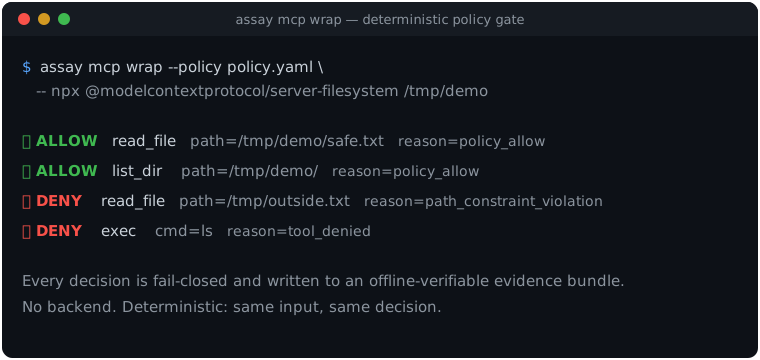
| Policy gate | assay mcp wrap — deterministic allow/deny before tools run, with the reason. |
| Evidence bundle | Offline-verifiable, tamper-evident archive for audit and replay. |
| Trust Basis / Trust Card | Canonical trust-basis.json (bounded claim classification) plus review-friendly trustcard.{json,md,html}. |
| External receipts | Eval outcomes, runtime decisions, and model inventory as bounded receipts with JSON Schema contracts. |
| Tool-decision logs | For handled known-tool calls, the assay-mcp-server stdio server emits an info-level tool_decision event when enabled by its log filter; decision contains a JSON-encoded observed decision entry with projected target fields. |
| SARIF / CI | GitHub Action, Security-tab integration, policy gates on PRs. |
| Attestation | Sign an evidence bundle as a DSSE-wrapped in-toto v1 Statement with the evidence-bundle/v1 predicate. |
  Agent ──► Assay ──► MCP Server
              ├─ ✅ ALLOW / ❌ DENY  (policy, with reason)
              ├─► 📋 Evidence bundle (offline-verifiable)
              └─► 📊 Trust Basis → Trust Card → SARIF / CI
Current release: v6.9.0. CHANGELOG.md and release notes remain the authority for released behavior; merged changes after the tag are Unreleased, and crates.io publication is separate from merge state.
Launch definition and support commitment: docs/LAUNCH.md.
Is this for me?
Yes if you already have eval output, runtime decisions, inventory artifacts, or MCP tool-call tests, and you want a small reviewable CI artifact instead of a dashboard — bounded auditability, not a scalar trust badge.
Not yet if you need Assay to judge model correctness for you, want a hosted dashboard as the product, or want a compliance claim rather than a bounded evidence boundary. Assay is not a trust-score engine, a generic eval dashboard, or a hosted observability product — see what it is and is not.
See it work
An agent tries a privileged action — github.add_deploy_key — through the enforcing proxy, decided per call before it forwards, offline against a local mock (no real credentials):
cd examples/privileged-action-gate && ./run.sh
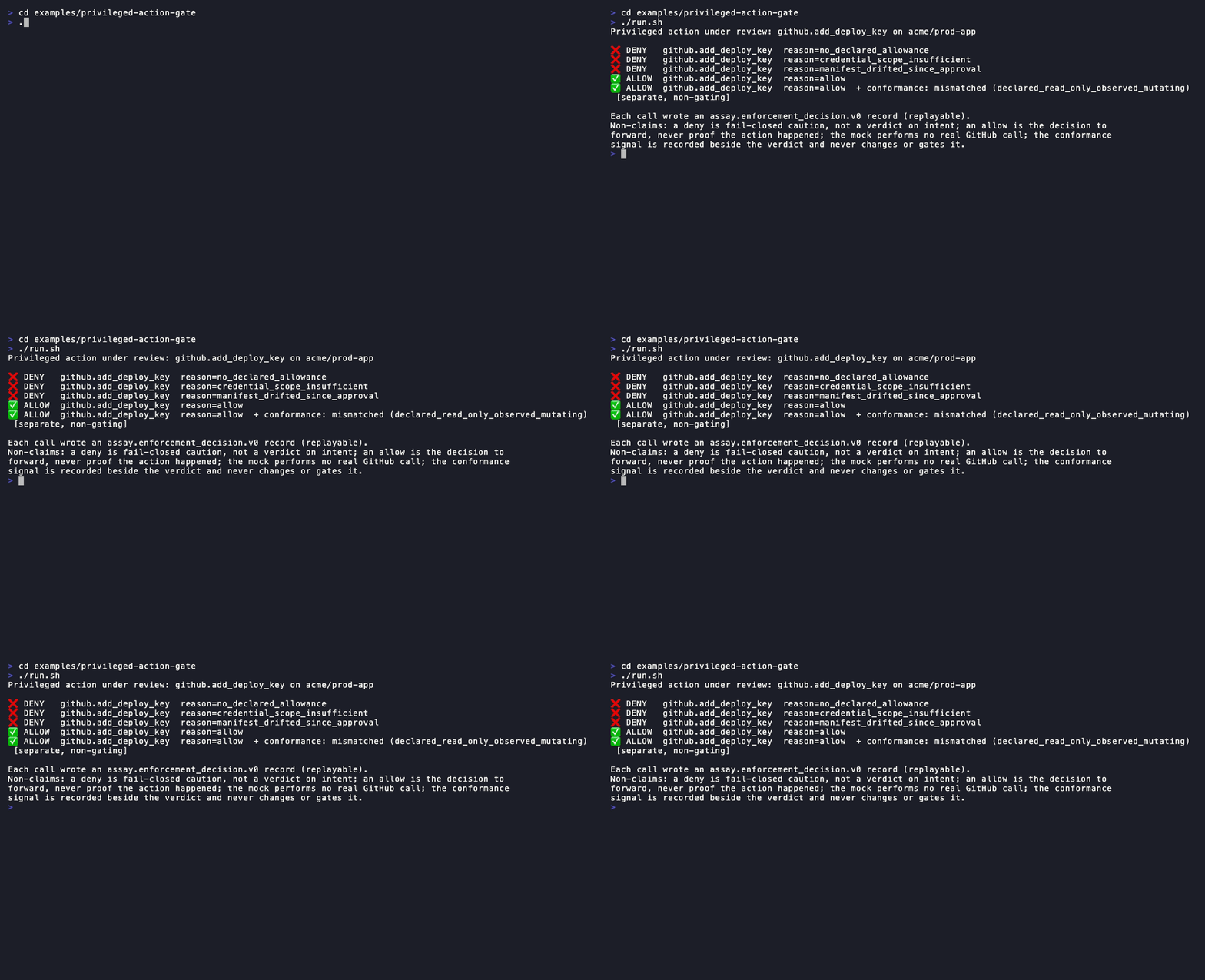
A deny is fail-closed caution, not a verdict on intent; an allow is the decision to forward, never proof the action happened. Declared-vs-observed conformance is recorded beside the verdict, never as a gate. Full walkthrough: privileged-action-gate.
Pick your path
| You have | What you get | Start here |
|---|---|---|
| Promptfoo JSONL from CI evals | Eval outcome receipts + verified bundle + Trust Basis diff | Promptfoo JSONL |
OpenFeature EvaluationDetails | Decision receipt + verified bundle | OpenFeature |
| CycloneDX ML-BOM model component | Inventory receipt + verified bundle | CycloneDX ML-BOM |
| MCP tool calls | Allow/deny audit trail + observed-behavior evidence | MCP Quick Start |
| A GitHub PR gate | Trust Basis diff, gate status, SARIF/JUnit-ready output | CI Guide |
| A Runner archive / coverage annotation | Coverage descriptors + claim-class cells + a claimed-vs-observed check | Coverage-honesty walkthrough |
The workflow stays small: import or record a bounded outcome, bundle and verify it, compile trust-basis.json, gate the Trust Basis diff. Assay doesn't make the upstream tool the source of truth; it makes the evidence boundary inspectable. For privileged tool actions, the MCP proxy records each tools/call as a structured tool-decision surface — keeping the asserted-versus-verified line honest.
Policy is simple
version: "2.0"
name: "my-policy"
tools:
  allow: ["read_file", "list_dir"]
  deny: ["exec", "shell", "write_file"]
schemas:
  read_file:
    type: object
    properties:
      path: { type: string, pattern: "^/app/.*" }
    required: ["path"]
assay init --from-trace trace.jsonl generates the runtime-observation policy used by the trace-generation flow (files, network, and processes); it is not an MCP authorization policy. Migrate a legacy MCP constraints: policy with assay policy migrate. See Policy Files.
Why Assay
| Canonical evidence | Assay's evidence model is the stable contract; OpenTelemetry and protocol adapters (ACP / A2A projection profile / UCP) map into it. |
| Deterministic | The policy gate uses explicit rules; its decision depends on the request, policy and applicable session state. This does not make live evaluators or external effects deterministic. |
| Bounded claims | Explicit about verified vs visible vs absent — no score-first UX. |
| Offline-first | No backend required for core enforcement and bundle verification. |
| Checkable provenance | Which piece of the source-class and coverage model shipped when, as commits you can git log rather than claims you have to take — provenance, prior art credited first. |
Learn more
- MCP Quickstart · Editor MCP recipe — policy-enforcing MCP in Cursor / Claude Code / Codex
- MCP 2025/2026 protocol-era parity — pinned
resultTypeand interim-result compatibility corpus - Coding-agent governance · OpenTelemetry & Langfuse — observed runs → evidence
- Evidence Receipts in Action — Promptfoo / OpenFeature / CycloneDX receipt families
- CI Guide · Evidence Store (S3 / B2 / MinIO)
- OWASP MCP Top 10 mapping · Security experiments
- Positioning: ADR-033 · RFC-005
Evidence epistemology, latency, and the internal Runner
Trust claims use explicit epistemology, not a single safety score: verified (direct evidence or offline verification), self_reported (emitted without independent corroboration), inferred (bounded, documented rules), absent (no trustworthy evidence). Assay ships no aggregate trust score or safe/unsafe badge as the main output — see ADR-033.
The historical fragmented-IPI experiment results, dated 2026-03-02 and naming commit 289a43ecc144, report 0.771ms p50 / 1.913ms p95 for the deterministic set. The harness times complete local mock tools/call round trips, including JSON-RPC transport and the tool response. These reported timings do not isolate policy-decision overhead or establish current-release or end-to-end model performance.
Assay-Runner is an internal/experimental measured-run subsystem behind the delegated Linux/eBPF acceptance path. Its crates are included in the workspace publication process so dependent packages can resolve them; publication does not make Runner a standalone product or give its APIs a separate stability commitment.
Ecosystem
Related projects for evidence generation, verification, and reviewability; each has its own interface and scope:
- assay-action — GitHub Action: verify bundles, PR summaries, SARIF (Marketplace).
- Assay-Harness — recipe, gate, and report layer over canonical evidence artifacts.
- observed-effect-v0 — worked examples of the bounded observed-effect evidence record and its neutral carriers (in-toto, SCITT, MCP evidenceRef).
- gateway-evidence-replay — deterministic offline replay verifier for gateway-path evidence bundles.
- RGE-Bench — a conformance kit for evidence reviewability, maintained separately under its own machine-checked neutrality guard. Reproduction there is digest-scoped and does not carry forward: the v1 71-vector digest
sha256:e769822bc6c9e31085da7b1a17b163b9747fe0d04314fbb8685d4e612087c7cband the historical v2 digestsha256:ba0e3795d75c788fa48313ab462493f22d78759851d1b3275d8117051bb22fd0(95 vectors) each carry one reported independent implementation by a second author on a different stack. JM-Lab reported the v2 95/95 reproduction on 2026-08-24, from the contract text and author-supplied inputs without readingexpected. Neither reproduction transfers to the current 104-vector v3 candidate digestsha256:93f8ae9654eb5a16dee28d882087669cae5183e02e116ba1e8071a30594cfb6a, which the record lists as unreproduced. See its REPRODUCTIONS.md.
Open profile: privileged-mcp-action/v0
privileged-mcp-action/v0
is a composition and verification contract over evidence records that already exist: what a
privileged MCP tool call decided, what was observed of its effect, and what stays unproven. It adds
no new envelope and no aggregate verdict.
It ships with a 14-vector conformance corpus (5 accept, 9 reject) whose digest is a candidate: it is not called reproduced until a non-author implementation derives the expected outcomes from the specification text alone.
That reproduction is open, and the invitation is real: #1840. Any language, any stack. The invitation names the exact commit the current digest describes. The clean-room protocol provides an opaque, attested inputs pack, a one-command scoring action, and an implementation-report template without supplying verifier logic or expected outcomes. The corpus README states the authorship boundary and the claim ceiling.
Contributing
cargo test --workspace
cargo clippy --workspace --all-targets -- -D warnings
See CONTRIBUTING.md and GitHub Discussions.