homelab-evidence-mcp
Salt okunur stdio MCP sunucusu; Gatus, Docker, Loki, Healthchecks, Beszel ve ntfy genelinde homelab olay kanıtlarını ilişkilendirir. Hedefler başlangıçta kilitlenir; yalnızca HTTP GET; zaman çizelgeleri kök neden uydurmadan gerçeklere dayalı kalır.
Dokümantasyon
homelab-evidence-mcp


Collect read-only incident evidence from six homelab sources through MCP.
One Go binary uses stdio and joins source identities through a configured
service_id.
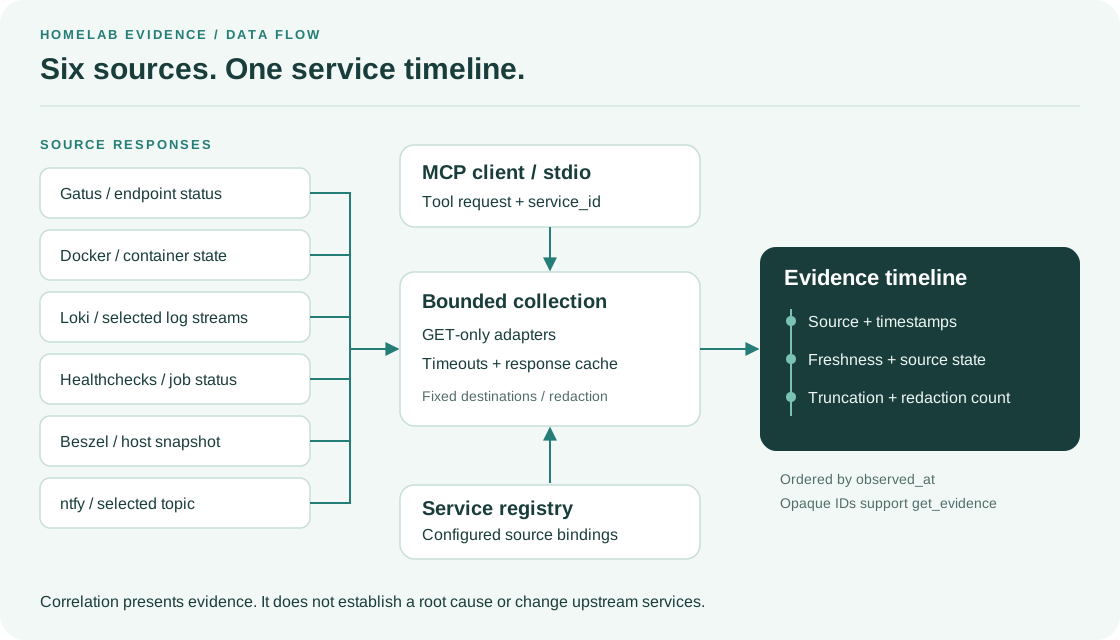
The server orders evidence by observation time. Each item includes its source,
timestamps, freshness, redaction count, and truncation state.
Correlation presents facts; it does not establish a root cause.
Destinations remain fixed after startup, and every upstream request uses HTTP GET.
Installation
Prerequisite: Go 1.26.9 is the minimum version.
go install github.com/ThomasCrouzet/homelab-evidence-mcp/cmd/homelab-evidence-mcp@latest
To build from the repository:
make build
./bin/homelab-evidence-mcp --version
Quick start
- Copy
config.example.yamlto a directory that is not in the repository. - Restrict access to the owner with
chmod 600 /path/config.yaml. On Windows, use a user-only ACL. - Configure source URLs and service bindings.
- Set each required token through
token_envor a privatetoken_file. - Validate the configuration before you add it to the MCP client.
homelab-evidence-mcp --config /path/config.yaml --validate
Validation resolves token references and checks destination settings.
It sends no HTTP requests.
Unknown YAML keys cause an error. A base_url cannot contain query strings,
fragments, or userinfo. For Healthchecks, use a read-only API key.
Registration with an MCP client:
{
  "mcpServers": {
    "homelab-evidence": {
      "command": "/path/homelab-evidence-mcp",
      "args": ["--config", "/path/config.yaml"]
    }
  }
}
This example uses token files or inherited environment variables. The server reserves stdout for JSON-RPC and writes logs and audit events to stderr. It can also write a configured rotating audit file. See MCP client configuration and the integration example.
Source adapters
The server has these source adapters:
- Gatus: The adapter uses
GET /api/v1/endpoints/statuses. It selects the result with the greatest timestamp. - Docker Engine: The adapter uses
GET /containers/json?all=true. It filters fields and does not includeConfig.Env. - Loki: The adapter uses
GET /loki/api/v1/query_range. The configuration supplies the selector. - Healthchecks: The adapter uses
GET /api/v3/checks/. It uses a read-only key and does not include ping URLs in its output. - Beszel: The adapter uses
GET /api/systemsand compatible routes. It can give a host snapshot. - ntfy: The adapter uses
GET /{topic}/json?poll=1&since=<unix>. The configuration supplies the topic.
Destinations use only http and https. For Docker, use a read-limited socket
proxy. The Docker Unix socket is not compatible with the server. The server
ignores HTTP_PROXY and HTTPS_PROXY.
You can use a path prefix in base_url. For example, use
https://proxy.example/gatus for Gatus. The server keeps /gatus before each
Gatus API route.
Set the source cache TTL with limits.source_cache_ttl.
The default is 15s; 0 disables it.
Cache keys use a process-local HMAC instead of clear-text authentication values.
Cache hits retain observed_at; retrieved_at records the new read time.
Thus, freshness reflects the snapshot's age.
MCP tools
evidence_capabilitiesgives the version, active sources, limits, and statistics.list_servicesgives services in the canonical service registry.service_statusgives a Gatus, Docker, Healthchecks, and Beszel snapshot.incident_contextgives a multi-source timeline with configuration limits.search_logsexamines Loki with the selector in the configuration.failed_cronsgives checks in thedown,grace, orpausedstate.get_evidencereads temporary evidence again by its opaque identifier.
All tool annotations identify the tools as read-only. Global limits control windows, HTTP body sizes, evidence counts, and concurrency.
Evidence model
Each evidence item contains its source and its observation and collection
timestamps. It also contains severity, freshness state, truncation, and the
redaction count. Responses give the ok, absent, skipped, error, and
timeout state of each source.
See the evidence model and tested API contracts.
Security
Read SECURITY.md for guarantees and remaining risks. The primary security controls are:
- Destinations cannot change after startup.
- The server does not accept HTTP redirects.
- MCP calls cannot supply a URL or stream selector.
- Log content is hostile data.
- The server uses built-in redaction and optional local rules.
- On Unix, give only the owner access to configuration and token files. Use
mode
0600. - On Windows, use a user-only ACL. The binary does not examine Windows ACLs.
Local demo
go run ./demo
The demo uses local HTTP fixtures and an in-memory MCP session. It checks source errors, redaction, instruction markers, and GET-only requests. It does not start the stdio executable or contact a homelab.
Development
make test          # tests with race detection
make test-quick    # fast tests
make lint-docs     # Markdown checks
make lint          # formatting, go vet, and golangci-lint
make coverage
make build
CI builds Linux, macOS, and Windows binaries. The primary targets are headless Linux and macOS systems.
Documentation
- Configuration example and YAML template
- MCP clients
- Incident playbook
- Evidence model and API compatibility
- Contributing and Changelog
License
MIT. See LICENSE.