tableski
Every spreadsheet is a table: serves Excel, CSV, Parquet and JSON files to AI agents as SQL tables over MCP. Single Rust binary, Apache DataFusion engine, stateless Streamable HTTP. MIT/Apache-2.0.
Hosted MCP Server
npx add-mcp 'https://mcp.tableski.io/'Installs into Claude Code, Codex, Cursor and more
Documentation
tableski




Every spreadsheet is a table — tableski serves them to your agents in SQL.
Excel, CSV, Parquet, JSON — one penguin-family binary that turns your data files into queryable tables and serves them to AI agents over the Model Context Protocol.
- Single binary, stateless Streamable HTTP — built on the emperor-mcp framework (Emperor Profile P1 conformant: framed output, forwarded credentials, no session affinity).
- SQL engine powered by Apache DataFusion.
- Hatched in the kowalski rookery — the
-skiis the family name.
Install
Prebuilt binaries (macOS arm64/x86_64, Linux x86_64, Windows x86_64) are attached to GitHub releases:
curl -fsSL https://raw.githubusercontent.com/yarenty/tableski/main/install.sh | sh
Windows: download the .zip from the releases page. Or via cargo:
cargo install tableski
Connect an MCP client
tableski is a standard MCP server over stateless Streamable HTTP — point any client at the server URL:
# Claude Code
claude mcp add --transport http tableski http://127.0.0.1:8080/
// Claude Desktop (claude_desktop_config.json) via mcp-remote
{ "mcpServers": { "tableski": { "command": "npx",
    "args": ["mcp-remote", "http://127.0.0.1:8080/"] } } }
Or raw HTTP: POST JSON-RPC to / with Accept: application/json (see below).
Run
# One model for every format: --file registers by extension, table name = file stem
# (.csv .parquet .json/.ndjson/.jsonl; workbooks .xlsx/.xls/.ods = one table per sheet)
cargo run -- --file fixtures/sample.xlsx --file fixtures/sample.parquet \
             --file fixtures/sample.ndjson --export-dir ./exports
# (--csv/--xlsx flags still work; name collisions get _2/_3 suffixes)
Ask it something (tools: list_tables, query_sql, get_schema, column_statistics,
export_result — all output framed as data per Emperor Profile E8). SQL joins work across
formats: an xlsx sheet against a Parquet file against an NDJSON log. export_result writes
a query's rows to .csv/.xlsx — only inside the --export-dir sandbox (relative names,
no ..; the tool is disabled unless the operator passes the flag):
curl -s -X POST http://127.0.0.1:8080/ \
  -H 'Content-Type: application/json' -H 'Accept: application/json' \
  -d '{"jsonrpc":"2.0","id":1,"method":"tools/call","params":{"name":"query_sql",
       "arguments":{"sql":"SELECT p.name, SUM(o.amount) AS total FROM people p JOIN orders o ON p.name = o.name GROUP BY p.name ORDER BY total DESC"}}}'
# => ada 150.5, linus 99.99 — a SQL join across two sheets of one workbook
Sheet names are slugified into table names (People → people, 2024 Orders →
t_2024_orders); first rows become column names when they look like headers
(--headers auto|first-row|none to override). Column types are inferred: integers,
floats, booleans, dates (as timestamps), text.
Real-world workbooks are messy — tableski handles the mess: both Excel date systems
(1900 and 1904), formula cells (cached values ingest; #DIV/0!-style errors become
NULL), merged cells (top-left value, NULL continuations), display formats (raw values,
always), ragged rows, format-only padding (trimmed), unicode sheet names, and a --max-rows
cap that fails loudly instead of cutting silently. The nasty-workbook corpus lives in
fixtures/corpus/ — every trait has a fixture and a test.
New here? The five-minute demo uploads a two-sheet workbook to tableski.io or a local tableski, asks the first question, and shows how to ask the rest in plain words with kowalski, Claude or Cursor. Try the whole local flow in one go: ./scripts/demo.sh (spreadsheet → question → SQL answer →
exported workbook). demo.tape renders it as a GIF with vhs.
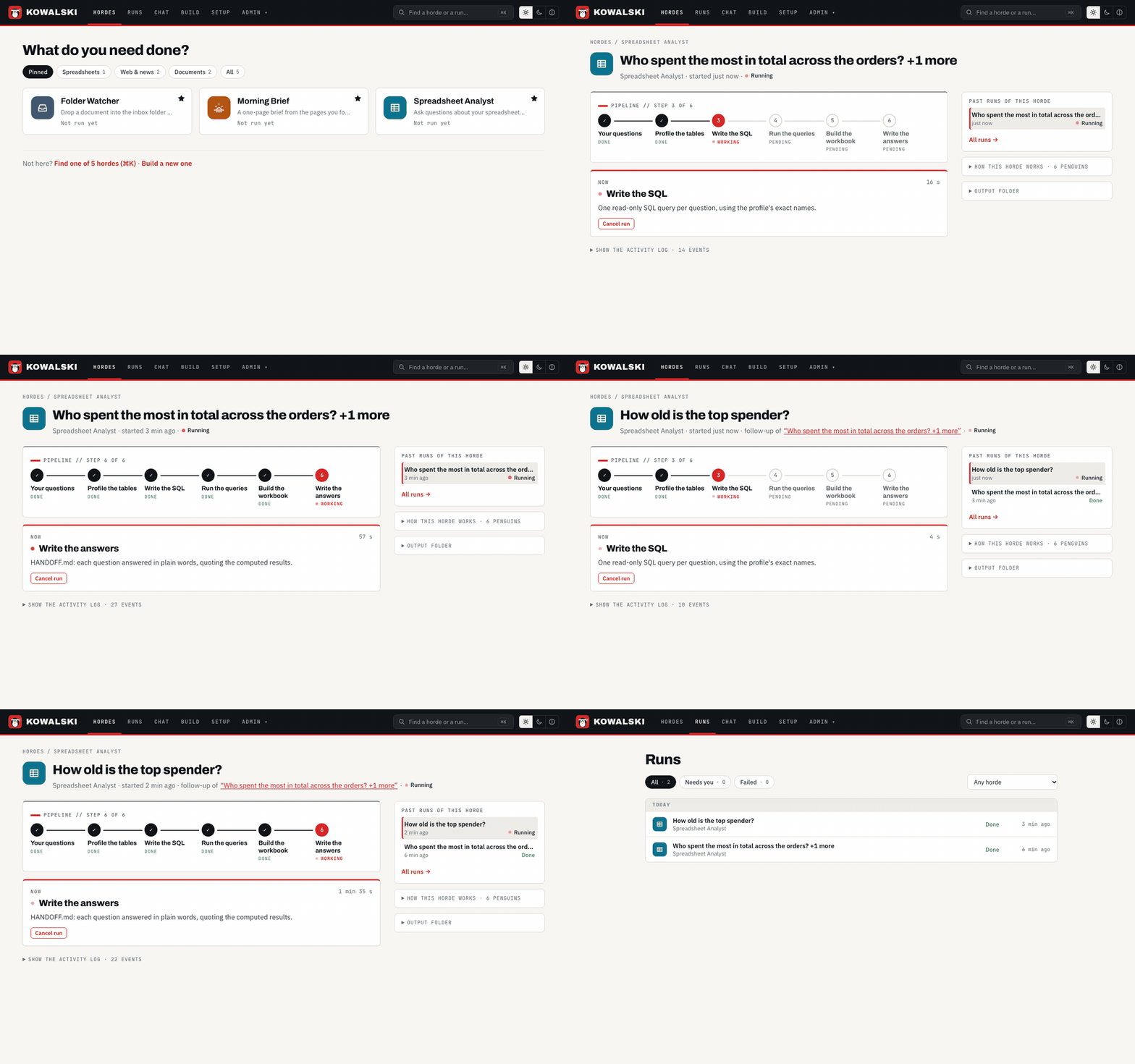
With kowalski, the questions come in plain words and the answers come back as a workbook. Its Spreadsheet analyst profiles the tables through tableski, the model writes one SQL query per question, and every number comes from the query engine:
Status: CSV, Excel (xlsx/xls/ods, hardened against real-world workbooks), Parquet, and NDJSON all serve today; results export to csv/xlsx; binaries ship per release. Launch is next.
Serving clients you do not trust
By default tableski runs whatever SQL DataFusion accepts, which is right for a local
single-user setup. Add --untrusted-sql when the server is reachable by agents or people you
do not control:
tableski --file sales.xlsx --untrusted-sql
Then only read-only queries run: SELECT, WITH, VALUES, EXPLAIN, one statement per
request, over registered tables only. CREATE, INSERT, UPDATE, DELETE, DROP, COPY,
SET, CREATE EXTERNAL TABLE, table functions (read_csv(...), range(...)) and references
to unregistered tables or file paths are rejected on the parsed statement, before anything
executes, with an error that names the reason. DataFusion's own DDL/DML/statement switches
are turned off as a second fence.
Limits
One query cannot take the machine down. Defaults, each 0 = unlimited:
| Flag | Default | What it bounds |
|---|---|---|
--max-memory-mb | 2048 | DataFusion memory pool for the session; a query needing more fails with Resources exhausted instead of growing the process. With a cap set, spilling to disk is off, so it fails fast rather than filling the disk. |
--query-timeout-secs | 60 | Wall clock per query, planning included. The query runs on a dedicated thread pool and is cancelled at DataFusion's next yield point; the server keeps answering meanwhile. |
--max-result-rows | 10000 | Rows a query_sql result carries back. Beyond it the result is cut and ends with a -- result truncated ... line; export_result refuses instead of writing a partial file. |
--max-result-mb | 16 | Same, by Arrow in-memory size. |
Cartesian products (CROSS JOIN, or a join without an = condition) are the one shape a
timeout cannot stop once running, so --untrusted-sql refuses them on the plan before
execution.
The timeout covers planning as well as execution, so a statement that is expensive merely to
optimise is cut too. What the pool does not meter: memory allocated by scalar functions
(repeat, lpad, ...). Run a server for untrusted clients under a container memory limit,
as the tableski.io deployment does. The whole set is exercised by tests/hostile_sql.rs
(DDL/DML, filesystem reach, identifier tricks, blow-ups, parser stress, export traversal); add
a line there when you find a new bad shape.
Use as a library
The engine is its own crate, tableski-core: register files into a
DataFusion SessionContext, then run the tools with call_tool or serve AppState through
any emperor-mcp transport. No HTTP, no CLI.
[dependencies]
tableski-core = "0.1"
let sources: Vec<Box<dyn TableSource>> = vec![Box::new(FileSource::new().path("orders.xlsx"))];
let tables = register_sources(&ctx, &sources, &IngestOptions::default()).await?;
let state = AppState::new(Arc::new(ctx), tables);
let grid = call_tool(&state, "query_sql", json!({ "sql": "SELECT count(*) FROM orders" })).await?;
Tables come from TableSource implementations. FileSource is the files-on-disk one; a
source that streams or refreshes (a price feed, a file that is rewritten) implements the
same trait and keeps its state behind its own DataFusion TableProvider, so every query sees
the rows that exist when it is planned. The module docs of tableski_core::source spell out
the contract; crates/tableski-core/tests/table_source.rs is a worked appending source.
For a server with tenants, Quota and UsageMeter (queries per day, bytes stored, files,
rows per file) plug into the same state with with_quota; the meter is in memory, persisting
usage is the host's job.
How it compares
Honest positioning — different tools solve different problems:
| tableski | openpyxl-based Excel MCP servers | Google-Sheets MCPs | |
|---|---|---|---|
| Ask questions over data | SQL engine (DataFusion): joins, aggregates, filters — across sheets and file formats | cell/range reads; analysis logic lands in the model's context | per-API calls against live Sheets |
| Formats | xlsx/xls/ods + CSV + Parquet + NDJSON, one table model | xlsx (often read and write, incl. formatting/charts — tableski doesn't edit workbooks) | Google Sheets only |
| Deployment | single static binary, stateless Streamable HTTP (Emperor Profile P1) | Python runtime + deps | hosted API + OAuth |
| Output safety | every tool result framed as data (prompt-injection mitigation) | typically raw | typically raw |
If you need to edit workbooks (styles, charts, cell writes), pair tableski with a writer-oriented server; tableski is the analysis and export engine.
Contributing
See CONTRIBUTING.md: run the checks, keep the docs in step, and sign off
your commits (DCO, git commit -s).
License
Licensed under either of
- Apache License, Version 2.0 (LICENSE-APACHE or https://www.apache.org/licenses/LICENSE-2.0)
- MIT license (LICENSE-MIT or https://opensource.org/licenses/MIT)
at your option.
Unless you explicitly state otherwise, any contribution intentionally submitted for inclusion in tableski by you shall be dual licensed as above, without any additional terms or conditions.