Vulnify MCP
Ask Vulnify before an AI agent acts: get ALLOW, REVIEW or BLOCK with a risk score and reasons, and read and test your authorization policies.
Hosted MCP Server
npx add-mcp 'https://mcp.vulnify.io/mcp'Installs into Claude Code, Codex, Cursor and more
Documentation

Vulnify MCP
Ask Vulnify before an AI agent reads, writes, deletes, exports, or sends data.
finalDecision is the authoritative result: ALLOW, REVIEW, or BLOCK.


Docs · MCP · Changelog · Node SDK
@vulnify/mcp is the MCP server for Vulnify, a runtime authorization layer for AI agents. The agent asks first. This process proxies https://api.vulnify.io. It does not store events or API keys.
Sign in with Vulnify (OAuth 2.1) at https://mcp.vulnify.io/mcp. That hosted server speaks stateless Streamable HTTP. The local path is npx -y @vulnify/mcp with VULNIFY_API_KEY.
check_action is a dry run. It skips the PII scan and records nothing. decide_action records a real decision. A REVIEW waits for a person. This server cannot approve or deny one.
Application code that should decide inside your own process uses the Node SDK (@vulnify/sdk). This package does not depend on the SDK. The SDK turns some transport failures into a fail-closed decision. This server returns those failures as MCP tool errors, so a model does not read them as ALLOW.
Quickstart
The source of truth is docs.vulnify.io/mcp. The same steps are in docs/clients.md.
Sign in with Vulnify
Connect to https://mcp.vulnify.io/mcp. Leave API-key and OAuth client fields empty. The client receives HTTP 401 and:
WWW-Authenticate: Bearer realm="https://mcp.vulnify.io/mcp", resource_metadata="https://mcp.vulnify.io/.well-known/oauth-protected-resource/mcp", scope="decisions:read decisions:write policies:read policies:test"
The body is {"error":"unauthorized","message":"Sign in with Vulnify, or send an API key as Authorization: Bearer or X-Vulnify-Key:."}. Protected-resource metadata lists the authorization server https://api.vulnify.io.
You choose an organization and allow the scopes the client requests:
| Scope | Tools |
|---|---|
decisions:read | get_decision |
decisions:write | decide_action |
policies:read | list_policies |
policies:test | check_action, test_policies |
After you allow access, the hosted server offers those five tools. plan_policy_changes and check_mcp_tool_call are not in that list. They need an API key. A missing scope comes back as a tool error that names the scope. That error is not an ALLOW. Revoke the connection under Settings > Connected apps: app.vulnify.io/settings/connected-apps.
Claude
In Claude, open Settings > Connectors > Add custom connector. Set the URL to https://mcp.vulnify.io/mcp. Do not paste an API key. Add Vulnify in Claude opens that dialog with the name and URL filled in. Claude then starts Sign in with Vulnify.
Cursor
Install in Cursor adds the hosted server and starts sign-in.
The same server in .cursor/mcp.json, or in ~/.cursor/mcp.json, is the URL with no header:
{
  "mcpServers": {
    "vulnify": {
      "url": "https://mcp.vulnify.io/mcp"
    }
  }
}
Grok
Open grok.com/connectors, then New Connector > Custom. Name it Vulnify. Set the URL to https://mcp.vulnify.io/mcp. Leave the OAuth fields empty. Grok starts Sign in with Vulnify.
Claude Code
claude mcp add --transport http vulnify https://mcp.vulnify.io/mcp
Claude Code then signs in. Do not pass an API key on this command.
API key or local npx
Use an API key when you need plan_policy_changes or check_mcp_tool_call, when the client cannot open a browser, or when the key has an IP allowlist. The local process needs Node.js 20 or newer and reads VULNIFY_API_KEY. It does not open the OAuth consent page.
npx -y @vulnify/mcp
VULNIFY_API_KEY=vln_live_... npx -y @vulnify/mcp
The key is vln_live_... or vln_test_.... A TEST key stores sandbox events. Those stay out of the main dashboards.
On the hosted server, both headers still work. Send the key on every request:
Authorization: Bearer <key>
X-Vulnify-Key: <key>
An API-key session lists all seven tools.
Cursor, hosted:
{
  "mcpServers": {
    "vulnify": {
      "url": "https://mcp.vulnify.io/mcp",
      "headers": {
        "Authorization": "Bearer vln_live_..."
      }
    }
  }
}
Cursor, local:
{
  "mcpServers": {
    "vulnify": {
      "command": "npx",
      "args": ["-y", "@vulnify/mcp"],
      "env": {
        "VULNIFY_API_KEY": "vln_live_..."
      }
    }
  }
}
X-Vulnify-Key works in place of Authorization on the hosted server.
Claude Code with an API key:
claude mcp add --transport http vulnify https://mcp.vulnify.io/mcp --header "Authorization: Bearer vln_test_your_key"
Prefer an environment variable over a key written into the shell history. For sign-in, use the Claude Code command with no header.
Claude Desktop can run the local process. On macOS the file is ~/Library/Application Support/Claude/claude_desktop_config.json. On Windows it is %APPDATA%\Claude\claude_desktop_config.json. Restart the app after saving.
{
  "mcpServers": {
    "vulnify": {
      "command": "npx",
      "args": ["-y", "@vulnify/mcp"],
      "env": {
        "VULNIFY_API_KEY": "vln_live_..."
      }
    }
  }
}
VS Code, .vscode/mcp.json, hosted:
{
  "servers": {
    "vulnify": {
      "type": "http",
      "url": "https://mcp.vulnify.io/mcp",
      "headers": {
        "Authorization": "Bearer ${input:vulnify-api-key}"
      }
    }
  }
}
VS Code, local:
{
  "servers": {
    "vulnify": {
      "type": "stdio",
      "command": "npx",
      "args": ["-y", "@vulnify/mcp"],
      "env": {
        "VULNIFY_API_KEY": "${input:vulnify-api-key}"
      }
    }
  }
}
How it works
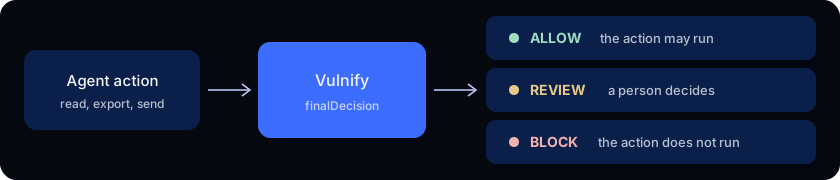
The finalDecision field is the authoritative result. A tool error is not an ALLOW.
Tools
Every tool has a title and readOnlyHint, destructiveHint, idempotentHint, and openWorldHint. Hints tell the client how to present the tool. They do not change what the tool does.
| Tool | API | Records? | readOnlyHint | Notes |
|---|---|---|---|---|
check_action | POST /v1/policies/test (one case) | No | true | Skips the PII scan and records nothing. No event id. |
decide_action | POST /v1/events | Yes | false | Writes a security event and an audit entry. finalDecision is the authoritative result. |
get_decision | GET /v1/events/{id} | No | true | Reads a decision. Optional wait polls a REVIEW until ALLOW or BLOCK (30 seconds max). |
list_policies | GET /v1/policies | No | true | Policies as code, sorted by name. |
test_policies | POST /v1/policies/test | No | true | Up to 200 cases. Skips the PII scan. Proposed policies are not saved. |
plan_policy_changes | POST /v1/policies/apply | No | true | dryRun is forced to true. Needs an org-wide LIVE key. |
check_mcp_tool_call | POST /v1/gateway/mcp | Yes | false | Maps a tool name to an action and records the decision. Does not run the tool. |
destructiveHint is false on every tool. openWorldHint is false on every tool, because each call stays inside the caller's own Vulnify organization. idempotentHint is true for the read-only tools and false for decide_action and check_mcp_tool_call. An idempotencyKey makes a retry of a recorded decision return the same event.
Policy list, test, and plan calls are limited to 60 requests per minute per key. Batch dry runs with test_policies. POST /v1/events has its own limit. The OpenAPI text says only that the limit was exceeded.
Safety
This server cannot change a review and cannot save a policy.
- There is no approve tool and no deny tool. A human resolves a
REVIEWin Vulnify. - There is no apply tool.
plan_policy_changescallsPOST /v1/policies/applywithdryRun: trueon every request. The tool input has nodryRunfield. The server setsdryRunlast, so a caller cannot turn the dry run off. The tool returns the diff. POST /v1/gateway/httpis not a tool. OnALLOW, that API endpoint forwards the HTTP call. This server does not.
plan_policy_changes needs an org-wide LIVE key. A TEST key or an agent-bound key gets 403. An OAuth session does not list plan_policy_changes or check_mcp_tool_call.
OAuth scopes
User login is the hosted HTTP server. The local stdio process still uses an API key. The hosted server maps tools to scopes:
| Tool | Scope | OAuth route |
|---|---|---|
check_action | policies:test | POST /v1/mcp/policies/test |
test_policies | policies:test | POST /v1/mcp/policies/test |
decide_action | decisions:write | POST /v1/mcp/events |
get_decision | decisions:read | GET /v1/mcp/events/{id} |
list_policies | policies:read | GET /v1/mcp/policies |
plan_policy_changes | API key and stdio only | Omitted from OAuth tools/list |
check_mcp_tool_call | API key and stdio only | Omitted from OAuth tools/list |
A token that is missing the scope gets a tool error that names the scope. That error is not an ALLOW. Active introspection results are reused for at most 60 seconds, and never past exp.
Distinct from the MCP gateway
https://mcp.vulnify.io/mcp (and the local stdio process) is the server an MCP client connects to. The client then calls the tools above.
check_mcp_tool_call is different. It sends one tool call to POST /v1/gateway/mcp on api.vulnify.io, records the decision, and stops. It does not execute the tool, and connecting a client to this server does not call that gateway.
IP allowlists
An API key can list allowed source IPs. Calls through https://mcp.vulnify.io/mcp with that key come from the hosted server's egress address, not from the machine where Cursor or VS Code is running. An allowlist that only contains an office or laptop address rejects the hosted server. Use npx -y @vulnify/mcp on a host whose address is on the list. Sign in with Vulnify does not send that API key.
Product
The screenshot is from a demo workspace. The agent is SupportBot.
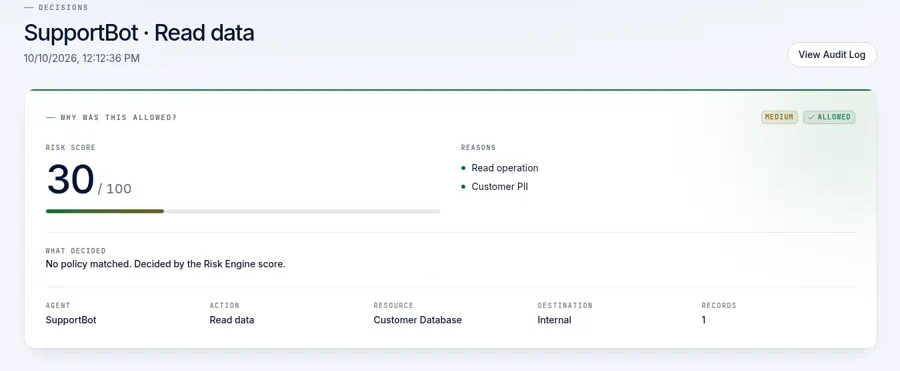
Audit exports in the Vulnify app are a JSON or CSV download that includes a SHA-256 checksum. SIEM export is JSON or CEF lines.
Configuration
| Variable | Where | Required | Purpose |
|---|---|---|---|
VULNIFY_API_KEY | stdio process | yes | API key (vln_live_... or vln_test_...). HTTP does not fall back to this variable. |
VULNIFY_BASE_URL | both | no | API base URL. Default https://api.vulnify.io. |
OAUTH_INTROSPECTION_SECRET | HTTP | for user login | Bearer secret for POST /oauth/introspect. Stays on the server. API keys work without it. |
OPENAI_APPS_CHALLENGE | HTTP | no | When set, GET /.well-known/openai-apps-challenge returns this value as text/plain. Unset, that path is 404. |
PORT | HTTP | no | Listen port. Default 8080. |
HOST | HTTP | no | Bind address. Default 0.0.0.0. |
Use an agent-bound LIVE key when a recorded decision should count for one agent. plan_policy_changes needs an org-wide LIVE key.
VULNIFY_TEST_API_KEY is only for npm run test:live. The server does not read it.
HTTP server
npx -y @vulnify/mcp --http
The container runs the HTTP server as a non-root user:
docker build -t vulnify-mcp .
docker run --rm -p 8080:8080 -e PORT=8080 vulnify-mcp
No API key is required to start the container. Send the key on each request.
curl -sS localhost:8080/health
curl -sS -o /dev/null -w '%{http_code}\n' -X POST localhost:8080/mcp \
  -H 'content-type: application/json' -d '{}'
The health check prints JSON. The POST without a key prints 401.
GET /.well-known/mcp/server-card.json does not require a key. It lists the tools the server registers (names, descriptions, and input schemas), states that you can sign in with OAuth or send a Vulnify API key in a header, and links to the docs and this repository.
curl -sS https://mcp.vulnify.io/.well-known/mcp/server-card.json
Errors
Tool failures are MCP tool errors (isError). The API key is not included.
| Status | Meaning |
|---|---|
| 401 | The API key or access token is missing, invalid, revoked, or expired. |
| 403 | The key is bound to another agent, the caller IP is not allowlisted, the access token lacks a scope, or plan_policy_changes was called without an org-wide LIVE key. |
| 413 | The JSON body is over the API's 200 KB limit. |
| 429 | The key is rate limited. Policy calls are 60 per minute. Retry a recorded decision with the same idempotencyKey. |
Security
Report a vulnerability to security@vulnify.io. The disclosure policy is at vulnify.io/disclosure. See SECURITY.md.
Keys are not logged. Request logs are method, path, and status. content sent for a sensitive-data scan is forwarded to the API and is not written to this server's logs. The API scans that text in memory and does not store it.
This package does not run a shell and does not register hooks. Do not put a key in a tool argument or in a committed config file.
Network endpoints this process uses:
https://api.vulnify.io(orVULNIFY_BASE_URL) for every tool call, and forGET /v1/policieswhen an API key is checked. An API key is sent asAuthorization: Bearerto/v1/*. A user access token is sent asAuthorization: Bearerto/v1/mcp/*.POST /oauth/introspecton that same origin, withAuthorization: Bearerset toOAUTH_INTROSPECTION_SECRET, to validatevln_oat_...tokens. The secret is not sent to clients and is not logged.https://mcp.vulnify.io/mcpis the hosted HTTP transport. The server process does not call that URL.
Development
npm install
npm test
npm run lint
npm run build
npm run test:live calls list_policies on https://api.vulnify.io when VULNIFY_TEST_API_KEY is set, and skips when it is not. It does not record an event.
Publishing is described in RELEASING.md.
License
MIT. Copyright 2026 Vulnify.