repo2graph
When an agent greps a codebase it either dumps whole files into context or misses the code entirely because it guessed different words. repo2graph builds the real call graph instead and uses it to decide what to return — so you get the actual source, inside a fixed token budget, with the callers and callees already attached.
Documentation
repo2graph
AST-driven code graphs & zero-dependency GraphRAG for AI coding agents and humans
English · 简体中文 · 日本語 · Français · Español · Deutsch







What is it · Quickstart · MCP setup · Benchmarks · Architecture · Docs · Contributing
⚡ What is repo2graph?
When an AI coding agent searches a codebase with grep or plain keyword matching, it either dumps whole matching files into context — burning the token budget and losing structure — or misses the implementation entirely because it used different words than the search query.
repo2graph parses source with tree-sitter into a
graph of real code relationships — CALLS, IMPORTS, INHERITS, DEFINES, CO_CHANGE — and
serves that graph to agents over the Model Context Protocol, or packs it into a budget-bounded
markdown context for any LLM. Every returned block carries an exact [cite: path:start-end]
anchor, so answers are traceable back to source instead of paraphrased from a guess.
flowchart LR
    A[your code] --> B[tree-sitter<br/>reads the code]
    B --> C[graph<br/>dots + arrows]
    C --> D[graph.html<br/>the picture]
    C --> E[chunks.jsonl<br/>pieces for an AI]
    C -->|MCP stdio| F[Claude / Cursor /<br/>any MCP client]
No project setup, no language server, no build step — point it at a folder and it works.
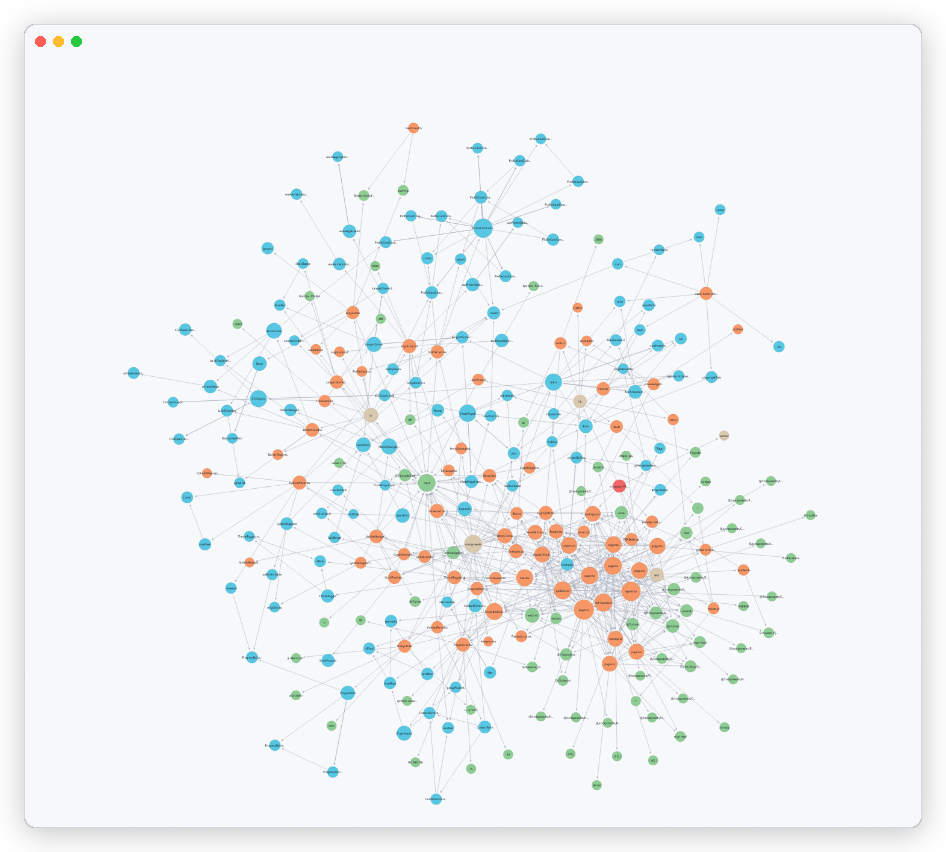
| Interactive canvas, zoomed | Filter & inspector controls |
|---|---|
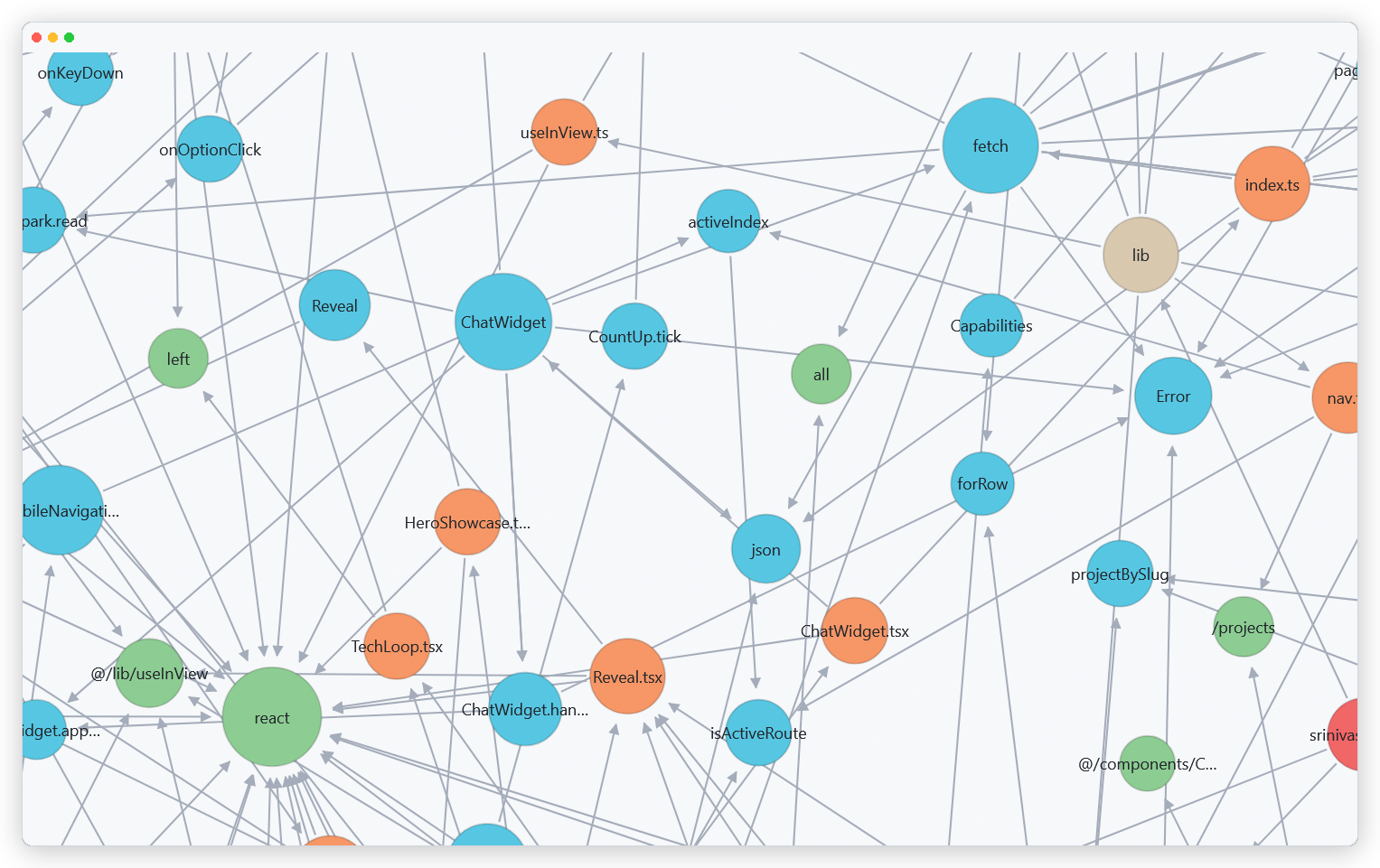 | 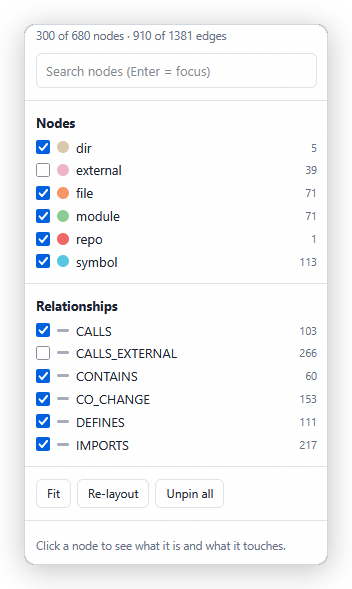 |
graph.html is one self-contained file — no server, no internet, drag to pan, scroll to zoom,
click a node to inspect its code and neighbours.
🚀 Quickstart (under 30 seconds)
Requires Python 3.10+. Run via uv, no install step:
uvx repo2graph build . -o .r2g && open .r2g/human/graph.html
Or install it properly:
pip install repo2graph
repo2graph build /path/to/project -o .r2g --git-history 200
repo2graph query "how does routing match a path" -o .r2g
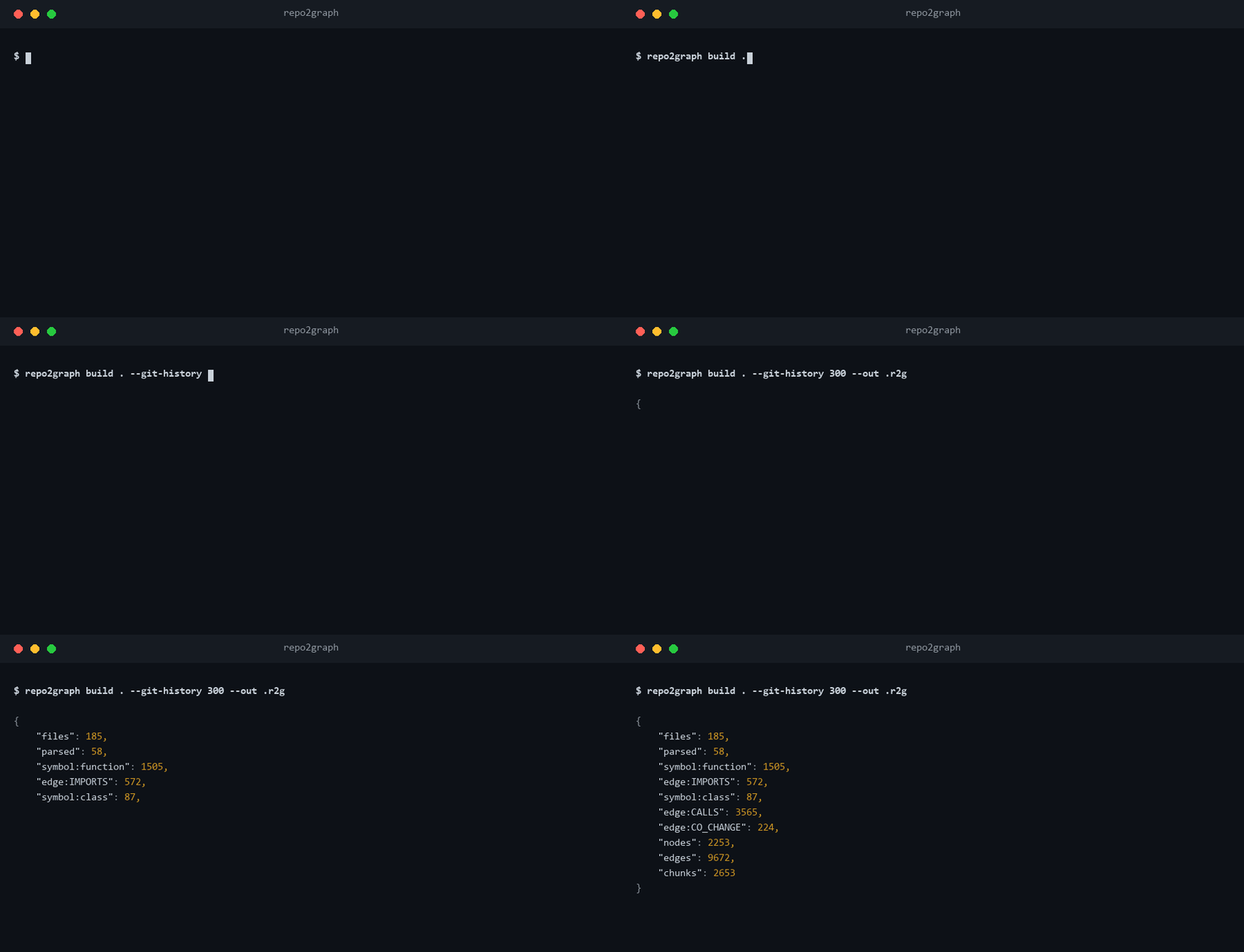
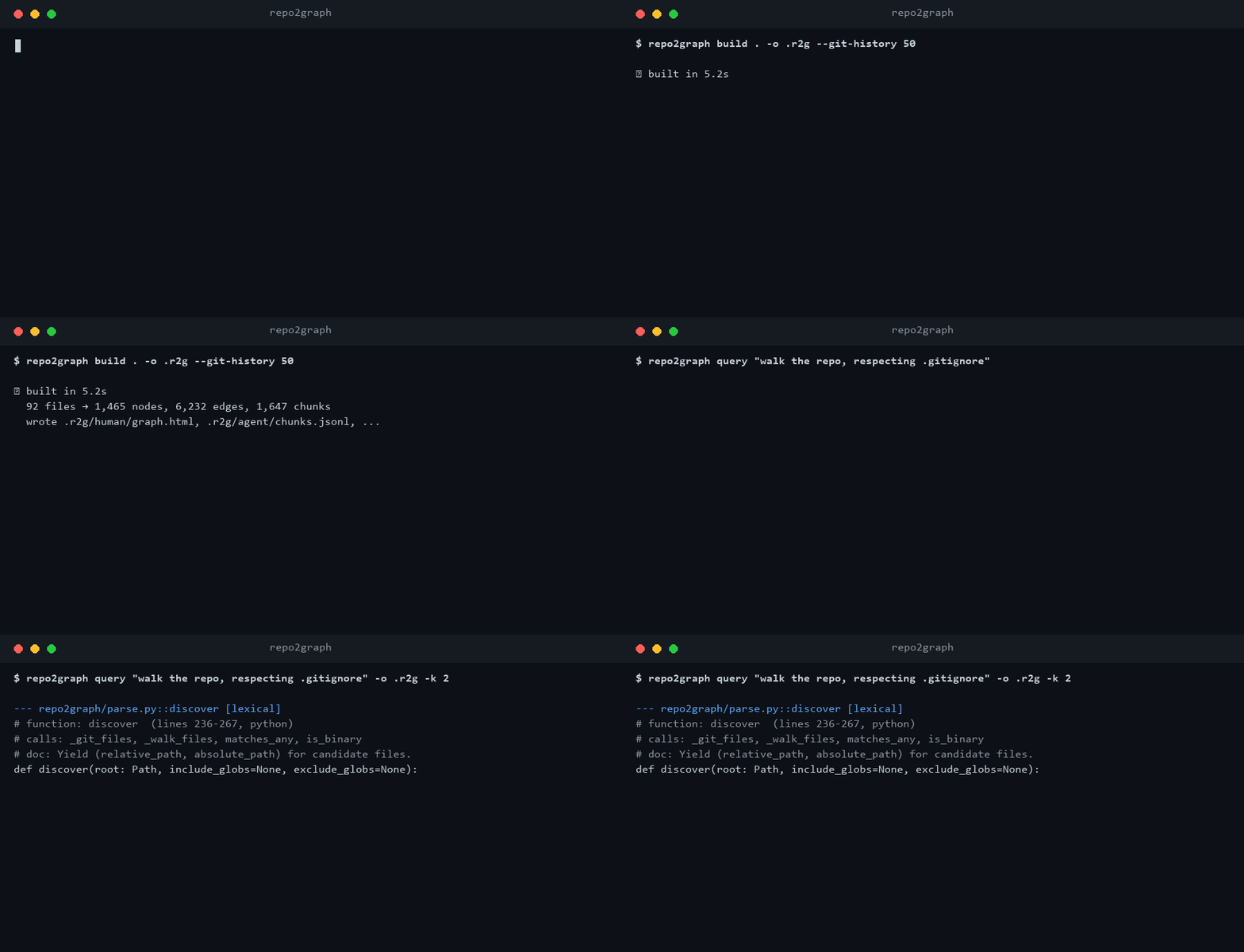
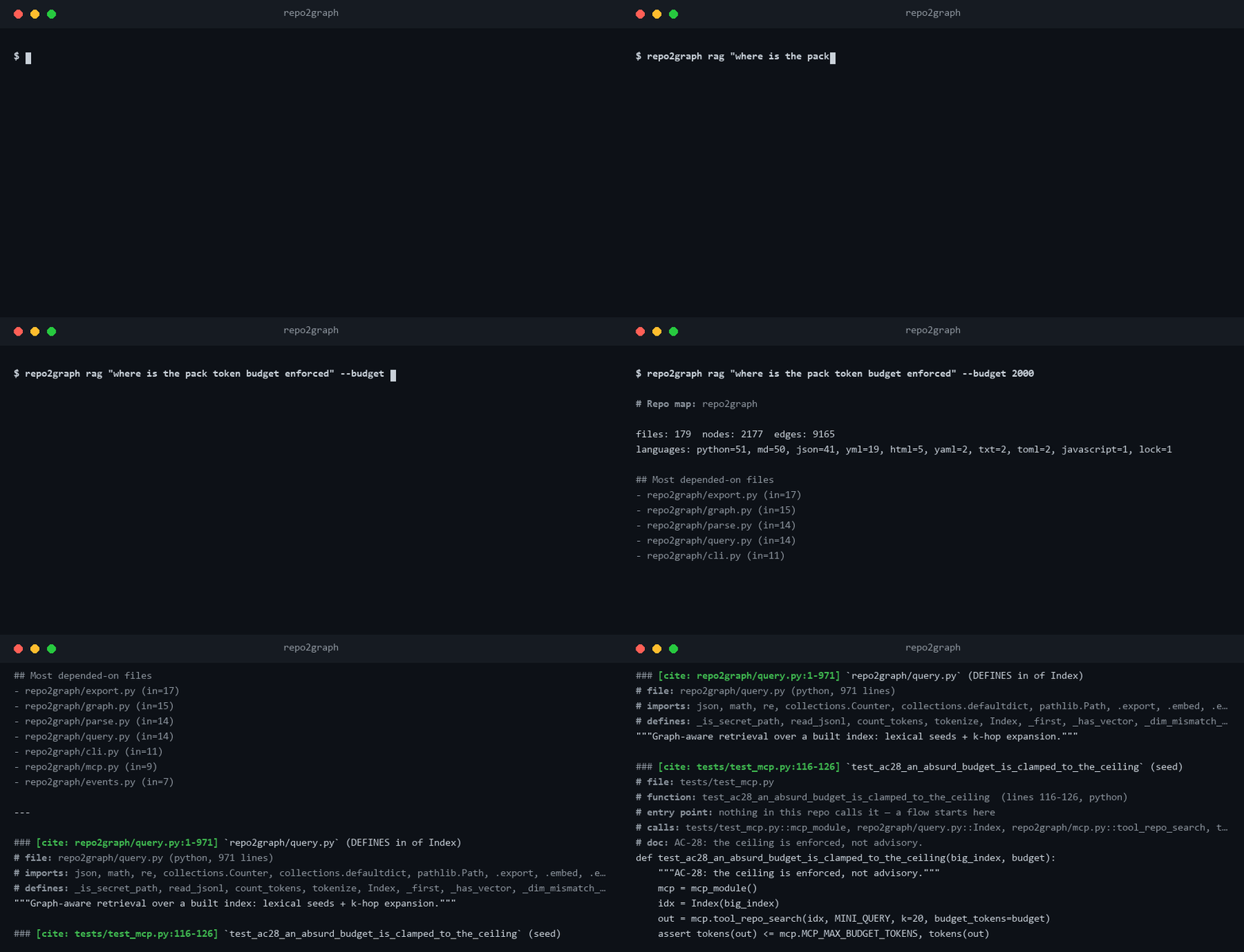
One pass over this repository — 185 files — takes about two seconds and needs no configuration file, no language server and no API key. Ask it something, and the answer comes back as source you can check, not a summary you have to trust:
🔌 MCP client configuration
repo2graph-mcp is a stdio MCP server. It builds its own index on the first call if one doesn't
exist yet — nothing to run ahead of time.
Claude Code
claude mcp add repo2graph -- uvx --from "repo2graph[mcp]" repo2graph-mcp /path/to/project
Claude Desktop (claude_desktop_config.json) and Cursor (.cursor/mcp.json) — same block:
{
  "mcpServers": {
    "repo2graph": {
      "command": "uvx",
      "args": ["--from", "repo2graph[mcp]", "repo2graph-mcp", "/path/to/project"]
    }
  }
}
Any other stdio-based MCP client (Windsurf, Zed, generic clients) takes the same command/args
pair — see docs/mcp.md for config file locations per platform and client.
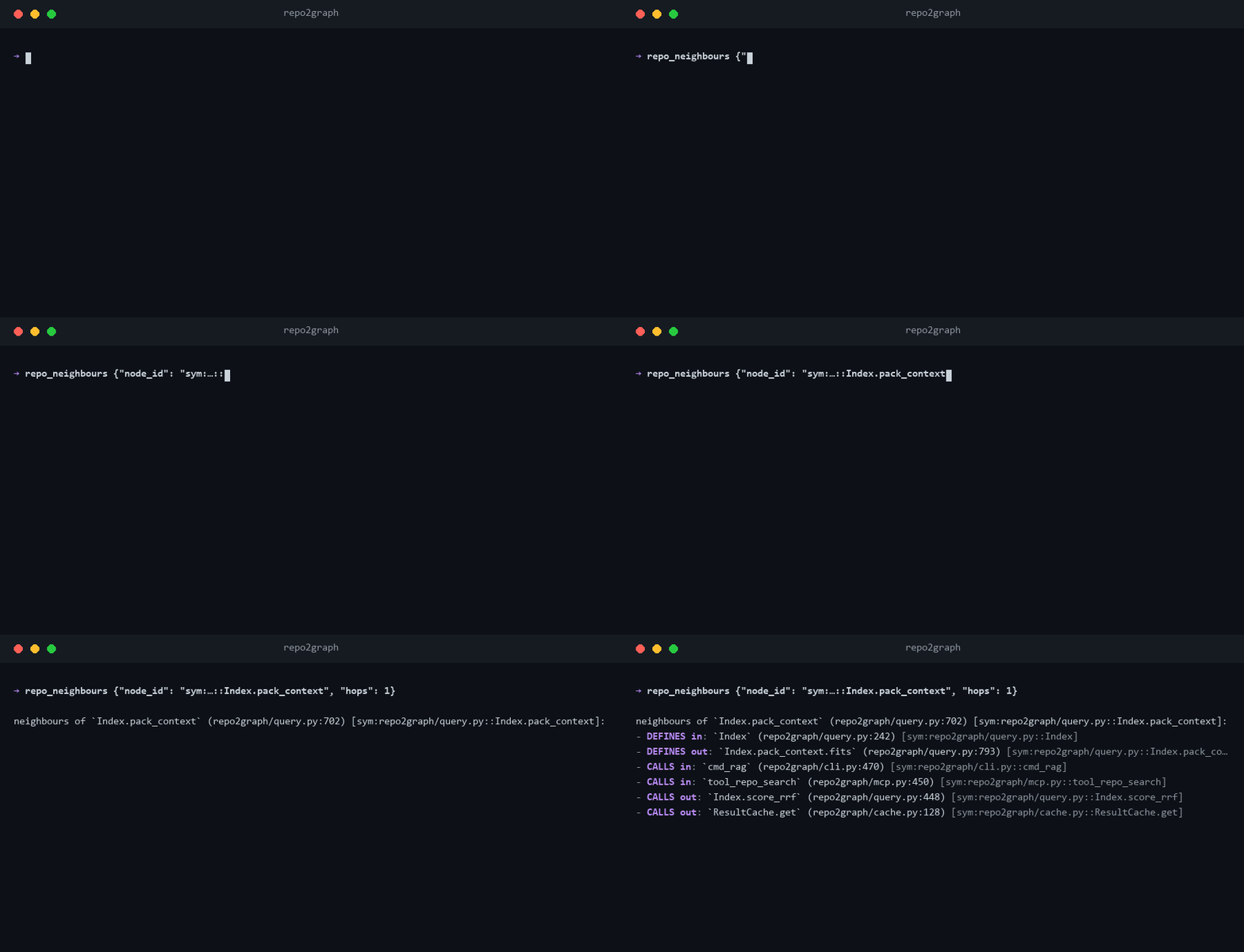
That is the hop grep cannot do: one symbol in, and its definer, its callers and its callees come back with file and line — the relationship, not a text match that happens to contain the name.
✨ Key features
| Deterministic graph, not embeddings-only search | Callers, callees, imports and class hierarchies resolved from the actual AST — not a nearest-neighbour guess. |
| Hybrid retrieval | BM25 + graph-neighbour expansion by default; optional dense vector fusion (repo2graph embed) with zero required extra dependencies. |
| Hard token ceilings, enforced twice | pack_context()'s budget bounds the entire rendered markdown, not just chunk text — and the MCP server clamps and re-measures before returning. |
| 15 languages, full treatment | Python, JS/TS/TSX, Go, Rust, Java, Ruby, C, C++, C#, PHP, Kotlin, Swift, Scala, Bash get functions/classes/calls. Everything else still appears as files on the map. |
| CI-native | Published as a GitHub Action — commit a fresh graph next to your code on every push. |
| Local by default | build, query, rag, and the MCP server make zero network calls. The one opt-in exception (rag --answer) prints the provider + hostname before sending anything. |
| Export to real graph tooling | graph.graphml (yEd, Gephi, NetworkX) and graph.cypher (Neo4j, Memgraph) come out of every build, no extra step. |
🆚 How it compares
Several tools build a graph out of a codebase. The thing that separates them is what comes back when you ask a question — a picture, a subgraph, or the code itself.
| repo2graph | Graphify | Code Graph (Obsidian) | grep / embedding RAG | |
|---|---|---|---|---|
| What a query returns | the source, packed — every block headed [cite: path:start-end] | a scoped subgraph, a path, or a concept explanation to traverse | a force-directed picture to read | matching lines, or nearest-neighbour chunks |
| How hits are ranked | BM25 seeds, then k-hop graph expansion; optional dense fusion | graph traversal (explicitly not a vector index) | n/a — it is a view | lexical only, or vectors only |
| Token budget | hard cap on the whole pack, re-measured before returning (12k ceiling over MCP) | not a packing layer | n/a | usually unbounded |
| Edges from git history | CO_CHANGE, from --git-history | — | — | — |
| Runs with no assistant, no model, no account | yes — CLI, MCP, or the GitHub Action | code pass is local; the docs/media pass uses a model | needs Obsidian desktop 1.7.2+ | varies |
| Corpus | code in 15 parsed languages, every other file as text | code in ~40 languages, plus docs, PDFs, images, video | TS/TSX/JS/Python parsed, imports-only for 8 more | anything |
Reach for Graphify when the graph itself is the product: community detection, shortest path between two concepts, and your PDFs and design docs in the same graph as the code. Reach for the Obsidian plugin when a human wants to read the graph beside their notes. Reach for repo2graph when an agent needs cited source inside a fixed token budget, when it has to run in CI with no model and no account, or when "which files keep changing together" is part of the answer.
Longer version, with the trade-offs each choice implies: docs/comparison.md.
🛠️ MCP tools exposed
| Tool | Arguments | What comes back |
|---|---|---|
repo_map | none | Languages, hub files, and top entry points. Stable across calls — read this first. |
repo_search | query, optional k (default 8, max 50), hops (default 1, max 4), budget_tokens (default 6000, max 12000) | Seed chunks plus graph neighbours, each block headed [cite: path:start-end]. |
repo_neighbours | node_id, optional hops (max 4), limit (default 20, max 50) | One graph hop from a symbol/file/dir id: callers, callees, base classes, defining file. |
Secrets are excluded unconditionally on every tool call — no flag turns that off. Full contract,
including the two diagnostic tools (repo_cache_stats, repo_build_status) added for long-running
server deployments: docs/mcp.md.
📐 Architecture & token economics
- Nodes:
repo,dir,file,symbol(function/method/class/struct/trait/interface/type),module(external dependency),external(an unresolved call target). - Edges:
CONTAINS,DEFINES,IMPORTS,CALLS(carriescount+confidence),CALLS_EXTERNAL,INHERITS,CO_CHANGE(from--git-history, requires 3+ co-edits). - Call resolution is name-based, not type-based — a deliberate trade-off that keeps repo2graph
language-agnostic and setup-free. Ambiguous calls fan out to up to 5 candidate edges at
confidence = 1/n; filter toconfidence == 1.0when you need certainty over recall. - Two budget models, on purpose:
Index.retrieve()'sbudget_charsbounds only the chunks' own text (a back-compat surface);Index.pack_context()'sbudget_charsbounds the entire rendered markdown — citation headers, separators, everything. New retrieval code should be built onpack_context(). - Chunking: roughly one chunk per function/class, cut at ~4000 characters with 8 lines of overlap so nothing is lost at a seam; each chunk's header names its callers and callees, which is what makes graph-expanded retrieval better than plain top-k text search.
Full breakdown of every node/edge kind and the chunk schema: docs/reference.md. The pipeline, the Python API, and where the graph guesses (and why): TECHNICAL.md.
📊 See it on real repositories
Not a toy demo — five real, large, public repositories, each indexed at a pinned commit, with the
generated graph committed and the exact reproduction command recorded. Every number is measured,
from benchmarks/results.json, not estimated.
| Repository | Language(s) | Scope | Nodes | Edges |
|---|---|---|---|---|
| Kubernetes | Go | scoped (controllers, scheduler, API server) | 14,197 | 83,525 |
| TensorFlow | C++ / Python | scoped (Python/C++ boundary) | 20,641 | 96,013 |
| Django | Python | full repository | 54,544 | 228,461 |
| VS Code | TypeScript | scoped (src/vs/) | 113,115 | 431,453 |
| Linux kernel | C | scoped (extreme-scale) | 136,182 | 257,655 |
See examples/README.md for the full index and reproduction commands, docs/benchmarks.md for methodology, and docs/limitations.md for what running against five real repositories actually surfaced (parse-error rates on macro-heavy C/C++, call-name ambiguity, cross-language resolution limits).
📖 CLI & server reference
| Command | Does |
|---|---|
repo2graph build <path> -o .r2g [--git-history N] | Parse a local repo into a graph + chunks. |
repo2graph github <owner/repo> -o <dir> | Fetch, build, and clean up — no local clone needed. |
repo2graph query "<question>" -o .r2g | Lexical search + one-hop graph expansion. |
repo2graph rag "<question>" -o .r2g [--vectors] [--answer] | Budget-bounded GraphRAG pack; --answer sends it to an LLM (opt-in, network). |
repo2graph embed -o .r2g [--verify-rag] | Compute/verify dense vectors for hybrid search. |
repo2graph map -o .r2g [--viz-nodes N] | Regenerate graph.html with a different node cap. |
repo2graph stats -o .r2g | Node/edge/function counts for an existing index. |
repo2graph-mcp <path> [--no-auto-build] [--async-build] | stdio MCP server over .r2g. |
Environment variables (only read by rag --answer, in this precedence order):
GEMINI_API_KEY → OPENAI_API_KEY → ANTHROPIC_API_KEY → OLLAMA_HOST. --model overrides the
provider's best-effort default. No other command makes a network call or reads these. Full flag
tables and budget accounting: docs/cli.md.
🔐 Security
build, query, rag, and the MCP server make no network calls. rag --answer is the one
opt-in exception — it sends the assembled pack to an LLM provider and prints the provider +
hostname before doing so. The MCP server excludes credential-shaped files unconditionally, with no
flag to turn that off. Details: SECURITY.md.
🤝 Contributing & community
git clone https://github.com/Srinivasan-78/repo2graph
cd repo2graph
python3 -m venv .venv && .venv/bin/pip install -e ".[dev]"
make lint test   # or: ruff check . && pytest
- .github/CONTRIBUTING.md — full local dev setup, code style, and the registry/Glama release process.
- docs/BACKLOG.md — deliberately deferred work and why; the closest thing to a roadmap, plus a "good first issues" section.
- AGENTS.md — this codebase's non-obvious conventions (Windows encoding, text
slicing, the two budget models) before editing
repo2graph/. - CODE_OF_CONDUCT.md — Contributor Covenant v2.1.
- Found a bug or have a feature idea? Open an issue.
License
MIT. See LICENSE.
Found repo2graph useful? Star the repo — it's the easiest way to help other people find it.