Dido distribution ERP
Remote MCP server for Dido, a distribution ERP for wholesalers. Agents work with stock, quotes, orders, invoices, delivery vans and customer credit across 28 modules, limited to the signed-in user's role, with a preview before each write and a log of every change. OAuth sign-in.
Hosted MCP Server
npx add-mcp 'https://dido.sindansolutions.com/api/mcp'Installs into Claude Code, Codex, Cursor and more
Documentation
The work behind an MCP server agents can actually use
Exposing an API is not enough. An agent needs tools named the way the business talks, errors that tell it what to do next, and limits it cannot cross.
- Splitting the software into tools an agent understands: one module, one prefix, one help tool per module.
- Connecting the agent to a real user account, with that user's permissions and no more.
- Hiding write tools from anyone who only holds read access.
- Showing a preview of every sensitive write before the server saves it.
- Accepting the names people use for products, customers and warehouses, so the agent never needs an internal ID.
- Returning errors that name the right next call, so the agent corrects itself.
- Keeping a log: who, through which connection, which tool, and whether the call worked.
- Testing the server with real AI agents on real tasks before go-live.
Dido, our MCP server in production
Dido is our distribution management software. Its MCP server covers 28 modules: catalogue, stock, quotes, orders, invoices, deliveries, returns, purchasing, cash and bank, credit control, vans and rounds, batches and expiry, production, equipment hire, reports and user administration.
An agent works in Dido as a named person on the team. It sees only the tools that person's role allows, in the warehouse where they work. Dido records every change an assistant makes, and the team can read back who changed what.
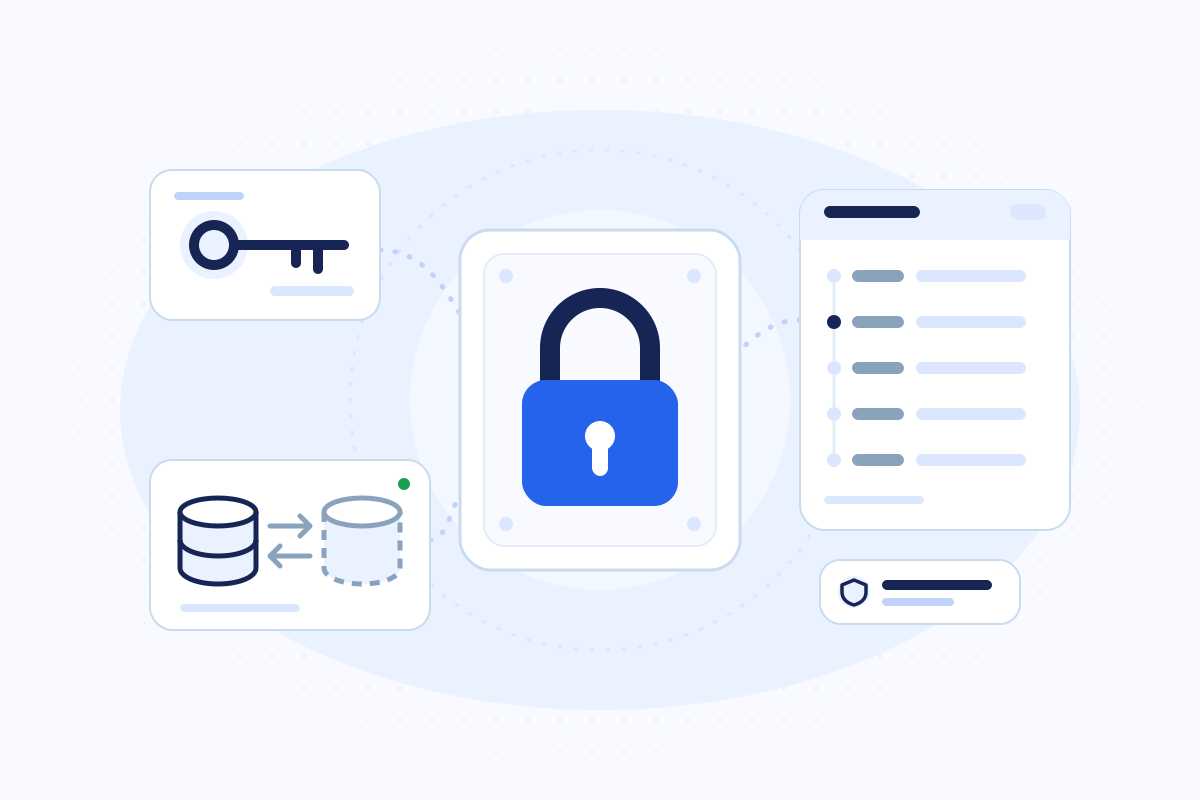
A digital vault surrounded by a key, a backup and an activity log.
The person's permissions The agent inherits the user's role. A tool it may not use does not even appear.
Preview before writing The agent sees an invoice or a bulk import line by line before Dido saves it.
A readable log Dido records every call that changes something: person, connection, tool, result.
One warehouse at a time The agent works in one establishment and has to switch explicitly to reach another.
Three starting points
You sell software
Your customers want to plug in their AI agent. We build your product's MCP server around your roles and your permission model.
You run an internal tool
An ERP, a CRM or a home-grown database. We open it to an agent on a narrow scope, read-only first.
You do not have the software yet
We build the system and its MCP server together, as we did for Dido.
What people ask us
01 What is an MCP server?
The Model Context Protocol is an open standard that lets an AI assistant (Claude, ChatGPT and others) call the functions of a piece of software. The MCP server is the part of the software that exposes those functions, with their rules.
02 Do we have to rewrite our software?
No. The MCP server sits on top of your existing logic or API. It adds a layer that talks to agents, checks permissions and keeps the log.
03 How do you stop an agent from doing damage?
It acts as a real user, with that user's permissions. The server hides forbidden tools, sends sensitive writes through a preview and logs everything the agent changes. We often start read-only.
04 Do you work with clients outside Algeria?
Yes, remotely. The team is based in Algeria on UTC+1, the same hours as Paris and one hour ahead of London. We work in English and French. You pay in euros or US dollars, by Wise, PayPal or bank transfer. Details are on the contact page.
05 How much does it cost?
We do not publish prices. The amount depends on how many modules to expose, the permission model and the state of the existing API. After scoping you receive a quote split by phase.