Proxy302
Official Proxy302 server: residential proxy URLs by country, sticky-IP rotation, IP purity checks, usage and cost quotes. Hosted with OAuth at https://mcp.proxy302.com/mcp
Hosted MCP Server
npx add-mcp 'https://mcp.proxy302.com/mcp'Installs into Claude Code, Codex, Cursor and more
Documentation
proxy302-mcp
Official Proxy302 MCP server, built and maintained by the Proxy302 team. For account, billing or connection questions contact Proxy302 support; for bugs in this server, open a GitHub issue.
Give your AI assistant a real residential-proxy toolbox. proxy302-mcp is a Model Context Protocol server for Proxy302: check your traffic and usage, browse countries and plans, get a rotating residential proxy URL for any country, list your proxies and static IPs, and fetch a web page through a proxy, all from Claude Code, Claude Desktop, Cursor or any MCP client.
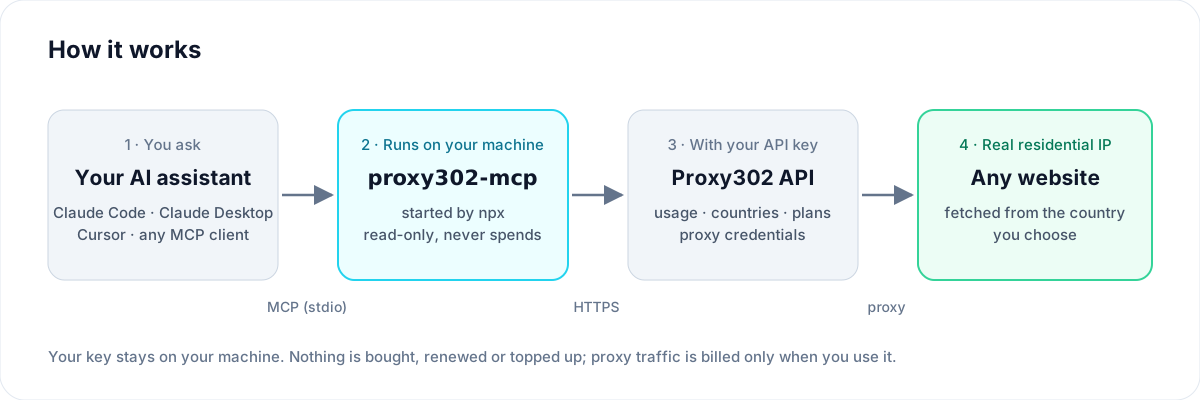
v1 is deliberately read-only and spend-free: it never buys, renews or tops up anything. The one write it can do (creating a dynamic proxy credential) is free, off by default, and only bills traffic when you actually use it.
Hosted server (no install)
Proxy302 also runs this server for you. Create an API key in the Proxy302 console first.



One click adds https://mcp.proxy302.com/mcp; the app then opens the Proxy302 sign-in window, where you paste your API key once (key id:secret). Deleting the key in the console disconnects it.
- Claude (claude.ai, Claude Desktop): Settings → Connectors → Add custom connector, URL
https://mcp.proxy302.com/mcp. - ChatGPT (developer mode): create a connector with the same URL and OAuth.
- Cursor, VS Code, Windsurf and other MCP clients: the same URL, no headers needed.
Sign in with OAuth: add https://mcp.proxy302.com/mcp as a custom connector in Claude, ChatGPT or any client that supports MCP sign-in, and paste your API key once in the sign-in window. In Claude Code:
claude mcp add --transport http proxy302 https://mcp.proxy302.com/mcp
Then run /mcp in Claude Code to sign in.
Or send the key as a header: use https://proxy302.com/v1/mcp with Authorization: Bearer <key id>:<secret>.
claude mcp add --transport http proxy302 https://proxy302.com/v1/mcp --header "Authorization: Bearer <key id>:<secret>"
Cursor (~/.cursor/mcp.json):
{
  "mcpServers": {
    "proxy302": {
      "url": "https://proxy302.com/v1/mcp",
      "headers": { "Authorization": "Bearer <key id>:<secret>" }
    }
  }
}
The hosted server has the same tools except fetch_url, plus rotate_ip (fresh exit IP for sticky proxies), check_ip_purity (blocklist score of your static IPs, or of the IPs a location would hand out next) and estimate_cost (quote a plan against your wallet). It never spends money either.
Run it locally
- Create an API key in the Proxy302 console and note its key id and secret.
- Install:
claude mcp add proxy302 -e PROXY302_API_KEY="<key id>:<secret>" -- npx -y github:proxy302/proxy302-mcp
Requires Node.js 20+.
Bonus: Proxy302 credits 1 PTC to paid accounts the first time a call through proxy302-mcp succeeds (once per account).
Claude Desktop
claude_desktop_config.json:
{
  "mcpServers": {
    "proxy302": {
      "command": "npx",
      "args": ["-y", "github:proxy302/proxy302-mcp"],
      "env": { "PROXY302_API_KEY": "<key id>:<secret>" }
    }
  }
}
Cursor
~/.cursor/mcp.json (or .cursor/mcp.json in a project):
{
  "mcpServers": {
    "proxy302": {
      "command": "npx",
      "args": ["-y", "github:proxy302/proxy302-mcp"],
      "env": { "PROXY302_API_KEY": "<key id>:<secret>" }
    }
  }
}
Tools
| Tool | What it does |
|---|---|
get_account_usage | Account, wallet (PTC) balance, remaining prepaid traffic, per-pool balance and daily usage for the last N days |
list_countries | Countries you can target, with ids and ISO codes (name filter) |
list_regions | States of a country, or cities of a state |
list_products | Product lines and static IP plans (data center and residential) |
get_dynamic_proxy | A ready http://user:pass@host:port rotating residential URL for a country (state/city where supported). Reuses an existing proxy; create_if_missing=true creates one |
list_my_proxies | Your dynamic proxies and static IPs, passwords masked unless asked |
fetch_url | Request a URL through your proxy (optionally from a given country) and return Markdown, text or raw |
Not in v1, on purpose: purchases, renewals, top-ups.
Examples
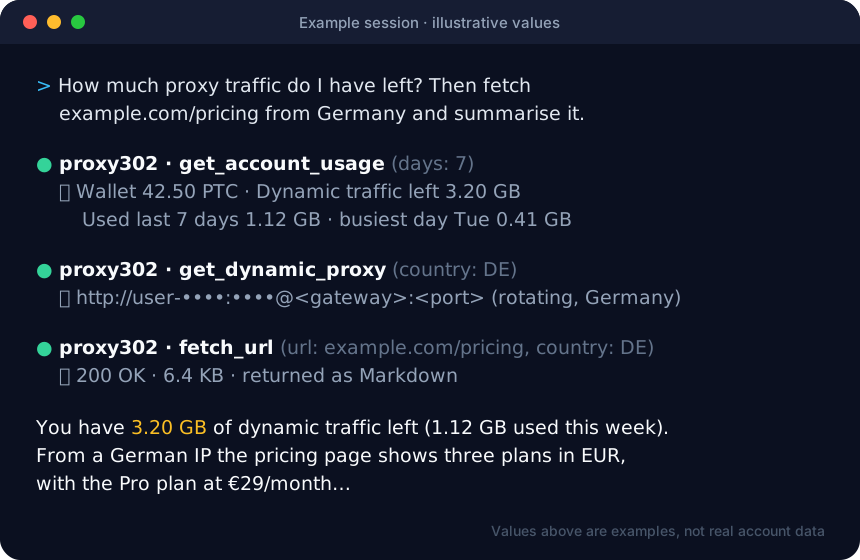
Ask your assistant:
- "How much proxy traffic do I have left, and what did I use this week?"
- "Which countries can I use? Get me a Germany proxy."
- "Fetch https://example.com/pricing from a US exit and summarise it."
- "List my static IPs that expire in the next 7 days."
Use the proxy in Playwright
get_dynamic_proxy returns host, port, username and password:
import { chromium } from 'playwright';

const browser = await chromium.launch({
  proxy: { server: 'http://HOST:PORT', username: 'USERNAME', password: 'PASSWORD' },
});
const page = await browser.newPage();
await page.goto('https://ipinfo.io/json');
console.log(await page.textContent('body'));
Use the proxy in browser-use
from browser_use import Agent, Browser, BrowserConfig

browser = Browser(config=BrowserConfig(
    proxy={"server": "http://HOST:PORT", "username": "USERNAME", "password": "PASSWORD"},
))
agent = Agent(task="Open ipinfo.io and tell me the country", llm=llm, browser=browser)
fetch_url is a plain HTTP request without JavaScript rendering. For JavaScript-heavy sites, hand the proxy URL to a browser as above.
Configuration
| Variable | Meaning |
|---|---|
PROXY302_API_KEY | Required. <key id>:<secret>, or a Basic ... token |
PROXY302_API_SECRET | Optional; use with PROXY302_API_KEY holding only the key id |
PROXY302_BASE_URL | Optional; default https://proxy302.com |
Credentials are read from the environment only. Never commit them. Requests identify themselves with User-Agent: proxy302-mcp/<version> and X-Proxy302-Client.
Development
npm install
npm run build
npm test
PROXY302_API_KEY="<id>:<secret>" npm run smoke   # read-only checks against the live API
License
MIT