skillmem
Self-improving skill memory for coding agents: skills that help get reinforced, unused ones decay on an Ebbinghaus curve. $0 write path (SQLite FTS5 + local ONNX embeddings, no LLM calls), bilingual EN/RU hybrid search, SHA256 tamper-evident history, reproducible LongMemEval benchmark (hit@5 0.871). 8 mem_* tools + optional Claude Code hooks.
Documentation
skillmem

Self-improving skills for Claude Code — your agent learns, recalls, reinforces, and forgets.
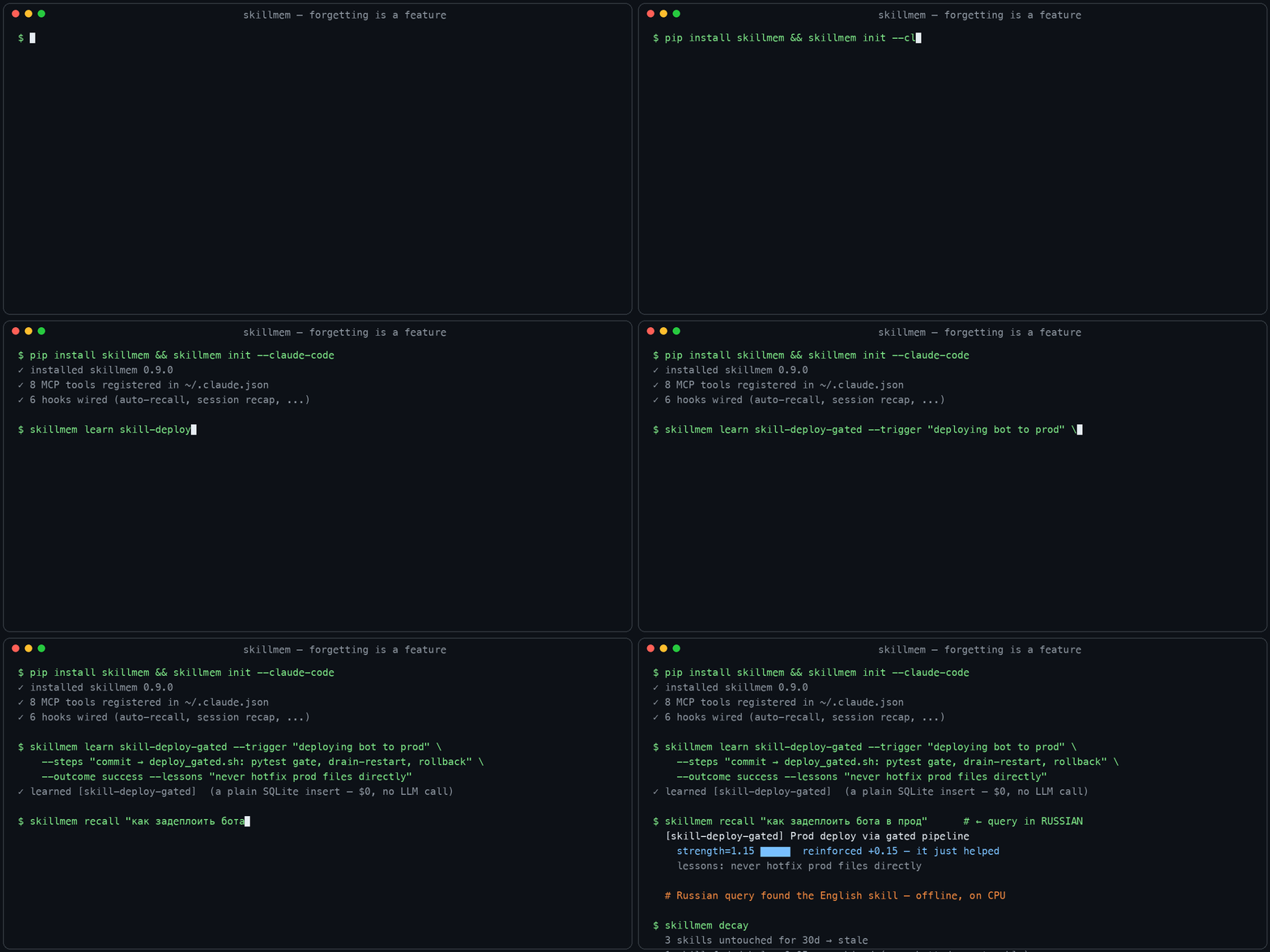
skillmem gives Claude Code a local, persistent skill & memory layer. After every non-trivial task the agent can record how it was done as a skill; before the next task it recalls the relevant ones; skills that keep proving useful get stronger, and skills nobody uses fade away — the way human memory works.
- $0 per write and per read — no LLM calls, no cloud, no API keys. Plain SQLite on your disk.
- Bilingual hybrid search, fully local — FTS5 BM25 + Snowball stemming (EN/RU) + a multilingual ONNX embedding model. A Russian query finds an English skill and vice versa, all on CPU, offline.
- Ebbinghaus strength model —
reinforcebumps a skill's strength, scheduled decay fades unused ones, lifecycle sweeps move dead skills to a backed-up archive (never deleted). - Tamper-evident history — every edit is appended to a SHA256 hash-chain;
skillmem verifydetects any after-the-fact tampering. - Deep Claude Code integration — 6 hooks + 8 MCP tools installed with one command.
- Cross-platform — macOS (launchd), Windows (schtasks), Linux (systemd user timers, cron fallback).
- No vendor lock —
export-alldumps everything to plain markdown with YAML frontmatter; re-importing the dump yields the same records.
Why
Agents repeat their mistakes because each session starts from zero. Existing "memory" tools store facts; skillmem stores procedures — trigger, steps, outcome, lessons — and ranks them by how often they actually helped. The write path costs nothing, so the agent can afford to learn from every task.
Quickstart
macOS / Linux:
bash install.sh # installs python + uv if needed, venv, symlinks
Windows (PowerShell):
powershell -ExecutionPolicy Bypass -File install.ps1
Or from a checkout:
uv venv && uv pip install -e '.[semantic]'
source .venv/bin/activate       # or prefix the commands below with `uv run`
skillmem init --claude-code     # wires MCP server + hooks into Claude Code
skillmem doctor                 # health check: DB, schema, semantic status
init --claude-code registers the MCP server in ~/.claude.json and the hooks in ~/.claude/settings.json (idempotent, with backups). Use --hooks minimal for just the Stop→migrate hook, or --hooks none for MCP only.
Claude Code plugin & MCP Registry (coming soon)
The repo already carries a Claude Code plugin (.claude-plugin/ + hooks/hooks.json — MCP server and all hooks in one install) and an MCP Registry manifest (server.json). Both go live once the skillmem package is published on PyPI; until then, use the installers above. Once live:
/plugin marketplace add liza-studio/skillmem
/plugin install skillmem@liza-studio
The plugin requires the skillmem Python package on PATH and replaces skillmem init --claude-code's wiring — use one or the other, not both (see docs/PUBLISHING.md).
Claude Desktop (chat app)
The MCP server also works in the Claude Desktop chat app — add to
claude_desktop_config.json (Settings → Developer → Edit Config):
{
  "mcpServers": {
    "skillmem": { "command": "skillmem-mcp" }
  }
}
You get all 8 mem_* tools on demand (search, learn, recall, reinforce…).
The automatic hooks (auto-recall on every prompt, session recap) are a
Claude Code mechanism and do not run in the chat app.
How it works
 learn ──▶ recall ──▶ reinforce ──▶ decay
   │          │            │           │
   │          │            │           └─ daily job: unused skills lose strength;
   │          │            │              fully faded ones are archived (backed up)
   │          │            └─ strength +0.15 when a skill proves useful
   │          └─ hybrid BM25 + vector search, strength-weighted ranking
   └─ after a hard task: trigger / steps / outcome / lessons
- learn — after a task that took real debugging, the agent calls
mem_learnwith a slug, trigger, steps, outcome, and lessons. - recall — before the next task,
mem_recall(or the automatic hooks) surfaces the most relevant skills, fusing lexical and semantic signals via Reciprocal Rank Fusion. - reinforce — when a recalled skill helped,
mem_reinforcebumps its strength, so proven skills rank higher next time. - decay — a scheduled
skillmem decayrun applies Ebbinghaus-style forgetting; skills untouched for months drift tostale, then to anarchivedstate (excluded from recall, restorable with one command, snapshotted to JSONL first).
MCP tools
| Tool | What it does |
|---|---|
mem_search | Hybrid full-text search (FTS5 BM25 + optional vector recall) over all memories |
mem_get | Fetch one memory by slug, with history and wikilinks |
mem_list | List memories by kind/project, most recent first |
mem_write | Insert a new memory; refuses silent overwrites and near-duplicates |
mem_update | Update an existing memory; old version is kept in the hash-chained history |
mem_learn | Record an after-action skill (trigger / steps / outcome / lessons) |
mem_recall | Find relevant skills for a task, strength-weighted; auto-reinforces |
mem_reinforce | Explicitly bump a skill's strength after it proved useful |
Hooks
| Event | Hook | What it injects |
|---|---|---|
| SessionStart | mcp-guard | Warns when configured MCP servers are missing vs a baseline |
| SessionStart | inject | Compact title-only briefing of your user/feedback memories |
| SessionStart | session-history | Recaps of the last 3 sessions in this project |
| UserPromptSubmit | verify-gate | "Search before you claim" reminder on time-sensitive prompts (bilingual EN/RU triggers) |
| UserPromptSubmit | auto-recall | Relevant feedback + skills matched against the prompt |
| PreToolUse | tool-recall | Skills/warnings matched against the Bash command or edited file path |
| Stop | session-recap | Distills the session into a markdown note via claude -p (recap language mirrors the session) |
| Stop | migrate | Indexes new session notes into the database |
All hooks are best-effort: a broken database or missing model never blocks Claude Code.
CLI highlights
skillmem learn skill-x -t "..." --trigger "..." --steps "..." --outcome success
skillmem recall "deploy the bot to prod"
skillmem skills                  # list skills with strength bars
skillmem decay --days 14         # manual decay + lifecycle sweep
skillmem search "hash chain" --kind feedback
skillmem verify --strict         # check the tamper-evidence chain
skillmem export-all ./vault      # markdown round-trip, no lock-in
skillmem import-vault ~/Obsidian/Notes
skillmem schedule install        # decay daily 04:15, export weekly Sun 04:30
Uninstall
skillmem uninstall               # removes MCP entry, hooks, scheduled jobs; keeps the DB
skillmem uninstall --purge-db    # ...and deletes the database
Config edits are made atomically with timestamped backups, and corrupt JSON is never overwritten.
Benchmarks
Retrieval quality on LongMemEval (Wu et al., ICLR 2025), full oracle set, hybrid retrieval (FTS5 BM25 + Snowball stemming + paraphrase-multilingual-MiniLM-L12-v2 embeddings, RRF fusion), k=5, CPU only:
| Question type | n | hit@5 | MRR |
|---|---|---|---|
| Overall | 479 | 0.871 | 0.622 |
| single-session-assistant | 56 | 0.982 | 0.746 |
| knowledge-update | 72 | 0.944 | 0.676 |
| single-session-user | 64 | 0.938 | 0.719 |
| multi-session | 125 | 0.848 | 0.568 |
| single-session-preference | 30 | 0.833 | 0.465 |
| temporal-reasoning | 132 | 0.780 | 0.579 |
Median 0.76 s per query on a laptop CPU, no LLM calls, no network. The pipeline is deterministic: repeated runs produce identical numbers. Reproduce with python bench/longmemeval.py --sample 0 -k 5 (see bench/README.md for the oracle file and reporting rules — we don't publish bare percentages without stating the retrieval mode and embedding model, and we encourage other tools to do the same).
License
Apache-2.0 — see LICENSE.
Built by Liza Studio.