Krimto
Open-source team memory layer for AI coding agents. Markdown files in git, a user→team→org hierarchy, one cross-vendor MCP server. Apache-2.0.
Documentation
Krimto
Open-source memory for AI coding agents you own in git — governed by a real user→team→org hierarchy, not a vendor database. Solo to team. Apache-2.0.



Your agent's memory, as markdown in your own git — synced across every editor and machine. Tell your agent "remember X" in any editor and it saves a durable, attributable fact; ask later — in a new chat, a different editor, or on another machine — and it recalls the right answer. One command, no account, no vendor database: your memory follows you.
You own it: every fact is a plain markdown file in a git repo you control — readable, reviewable in a
PR, and yours. When a teammate joins, that same memory becomes a shared team brain governed by a real
user → team → org hierarchy (the most specific scope wins at recall) — the one primitive no other
memory tool ships. Solo is free; the governance is what you grow into.
See it
One npx command sets it up; then your agent saves a fact in Claude Code and recalls it in Cursor —
no account, no database:
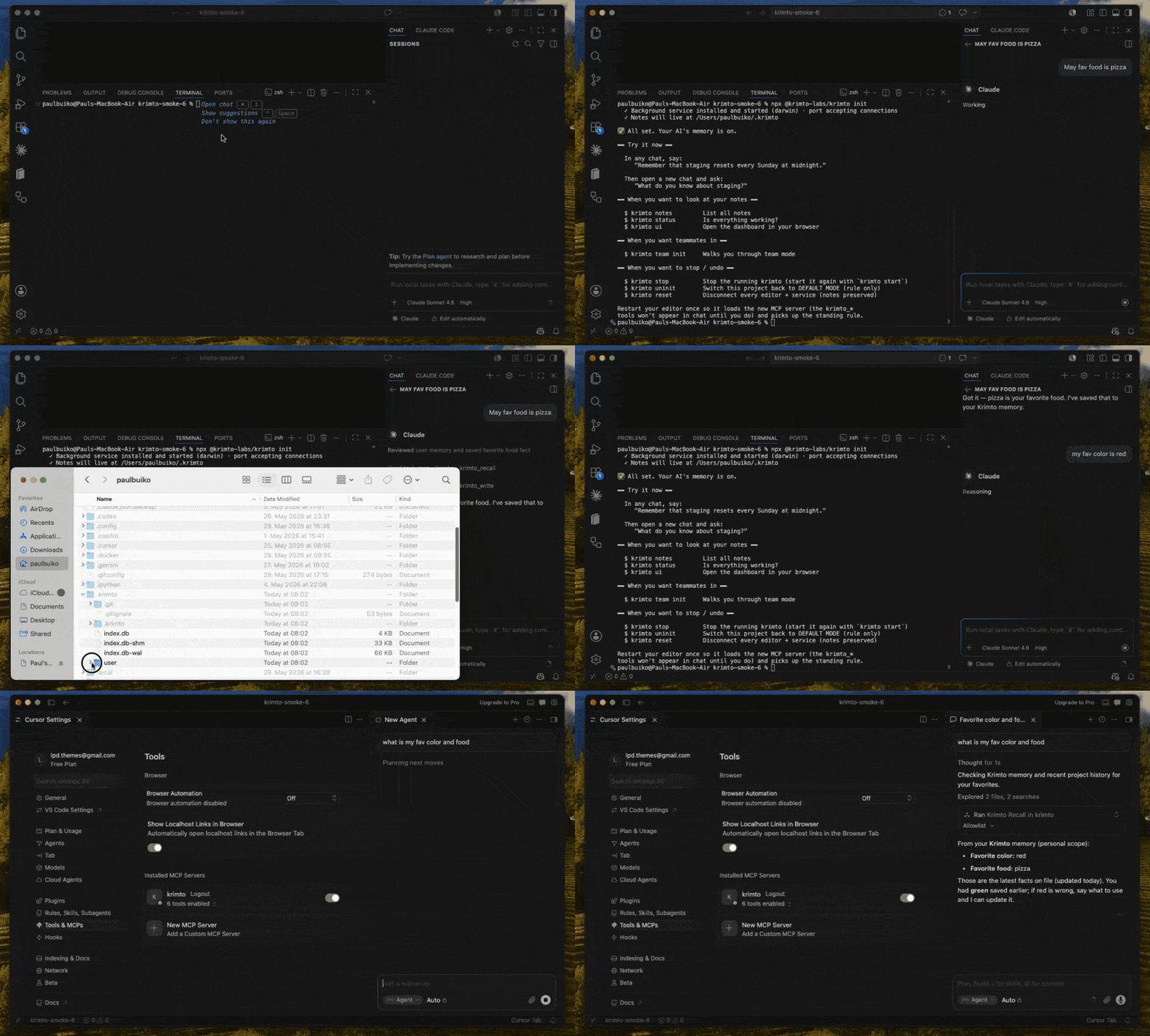
Three short demos — solo (remember in Claude Code, recall in Cursor), cross-machine (write,
git push, recall on another laptop), and team (a teammate's fact reaches you; your personal notes
stay yours).
Because every memory is just a file in your git, you can read it yourself — no API, no dashboard needed:
$ cat ~/.krimto/user/you@example.com/favorite-color.md
---
id: fct_01KT3BDSYY1KK80SG3S7KBEV58
scope: user/you@example.com
title: Favorite color
author: you@example.com
created: 2026-06-02T05:03:14Z
updated: 2026-06-02T05:03:14Z
tags:
  - personal
source: claude-code
---

User's favorite color is red.

$ git -C ~/.krimto log --oneline -1
8bc5b86 krimto: write batch — 1 fact
That's the whole bet: your agent's memory is plain markdown in a git repo you own — not rows in someone else's database.
Why Krimto
- You own it, in your git. Every fact is a markdown file in a git repo you control —
git logthe audit trail, edit it in any editor, review it in a pull request. No vendor database, no lock-in. - Governed
user → team → orghierarchy. Knowledge is scoped to a person, a team, or the whole company, and the most specific scope wins at recall — a server-enforced primitive no other memory tool ships for free. - Follows you everywhere — cross-vendor, Apache-2.0. One MCP server syncs the same memory across Claude Code, Cursor, Codex, Gemini CLI and more — every editor and machine. Fully open source, with no managed-service restriction.
Try it in 2 minutes (solo, no account)
npx @krimto-labs/krimto init
The setup wizard detects your editor, wires it up, and turns on automatic memory. Then, in any chat:
"Remember that our staging DB resets every Sunday."
Open a new chat and ask:
"What do you know about staging?" → it remembers.
See your notes with krimto notes (terminal) or krimto ui (browser dashboard). Your data lives in
~/.krimto — the same folder no matter which project you're working in.
Connect your agent
krimto init wires supported editors for you. What auto-connects vs. needs one copy-paste step:
| Editor | Setup |
|---|---|
| Cursor | auto-connects |
| Claude Code | auto-connects |
| Codex | manual snippet |
| Gemini CLI | manual snippet |
To connect any MCP client manually, point it at Krimto over stdio:
claude mcp add krimto -- npx -y @krimto-labs/krimto
…or the config-file form (Cursor, Codex, Gemini CLI, etc. use the same shape):
{ "mcpServers": { "krimto": { "command": "npx", "args": ["-y", "@krimto-labs/krimto"] } } }
By default an agent uses Krimto only when you ask. Running krimto init once in your project drops a
standing rule so it uses Krimto on its own.
Install as a Claude Code plugin
Prefer Claude Code's plugin system? Add Krimto's marketplace and install it directly:
/plugin marketplace add krimto-labs/krimto
/plugin install krimto@krimto
This bundles the MCP server together with Krimto's skills, the /krimto-status command, and the
memory hooks — no separate krimto init needed.
How it works
Three layers, one source of truth:
- Storage — facts are markdown files in a git repository (the source of truth; git is the audit log).
- Index — a SQLite + sqlite-vec hybrid index (keyword + vector) for fast retrieval, with scope precedence applied at ranking time.
- Access — an API server enforces who can read and write each scope (
user/team/org).
Team mode
When you're ready to share memory with teammates:
npx @krimto-labs/krimto team init
This walks you through an admin email, your org/team name, an optional shared git remote, and teammate invites — then prints a join command for each teammate:
krimto join --server <url> --key <key>
Teammates can connect to one shared server, or each run their own Krimto synced over a shared git
remote. Personal and team notes live together and sync as a unit. Step back to solo any time with
krimto team disband (your notes are preserved).
Self-host
Krimto runs anywhere Node 20+ runs.
# HTTP server + browser dashboard at http://localhost:8080
npx @krimto-labs/krimto serve

# or Docker
docker run -d -p 8080:8080 -v ~/.krimto:/data ghcr.io/krimto-labs/krimto:latest
Run npx @krimto-labs/krimto --help for the full command surface.
Roadmap
v0.2 (current) ships the memory core, teams, the web dashboard, and the cross-vendor MCP server. Next: OAuth sign-in and a pull-request approval flow (v0.3), then a hosted Krimto Cloud (v1.0). See ROADMAP.md.
Contributing & license
Contributions welcome — see CONTRIBUTING.md and our Code of Conduct. Security reports: SECURITY.md.
Licensed under Apache-2.0. The same code is self-hostable by a solo developer or an enterprise — no tier walls.