readfirst
Tells coding agents what to read and check before changing a file: per-file rules, risks, checks, tests and callers from a map in the repo. Runs locally, no network or model calls.
Documentation
readfirst
What to read and check before you — or your AI agent — change a file.
Coding agents can follow imports. What they don't know is what your team knows: "amounts here are in cents", "this table is read by the mobile app, keep old columns", "run the payment e2e after touching this". readfirst keeps that knowledge in one file next to the code and hands it out, file by file, at the moment someone is about to change something.
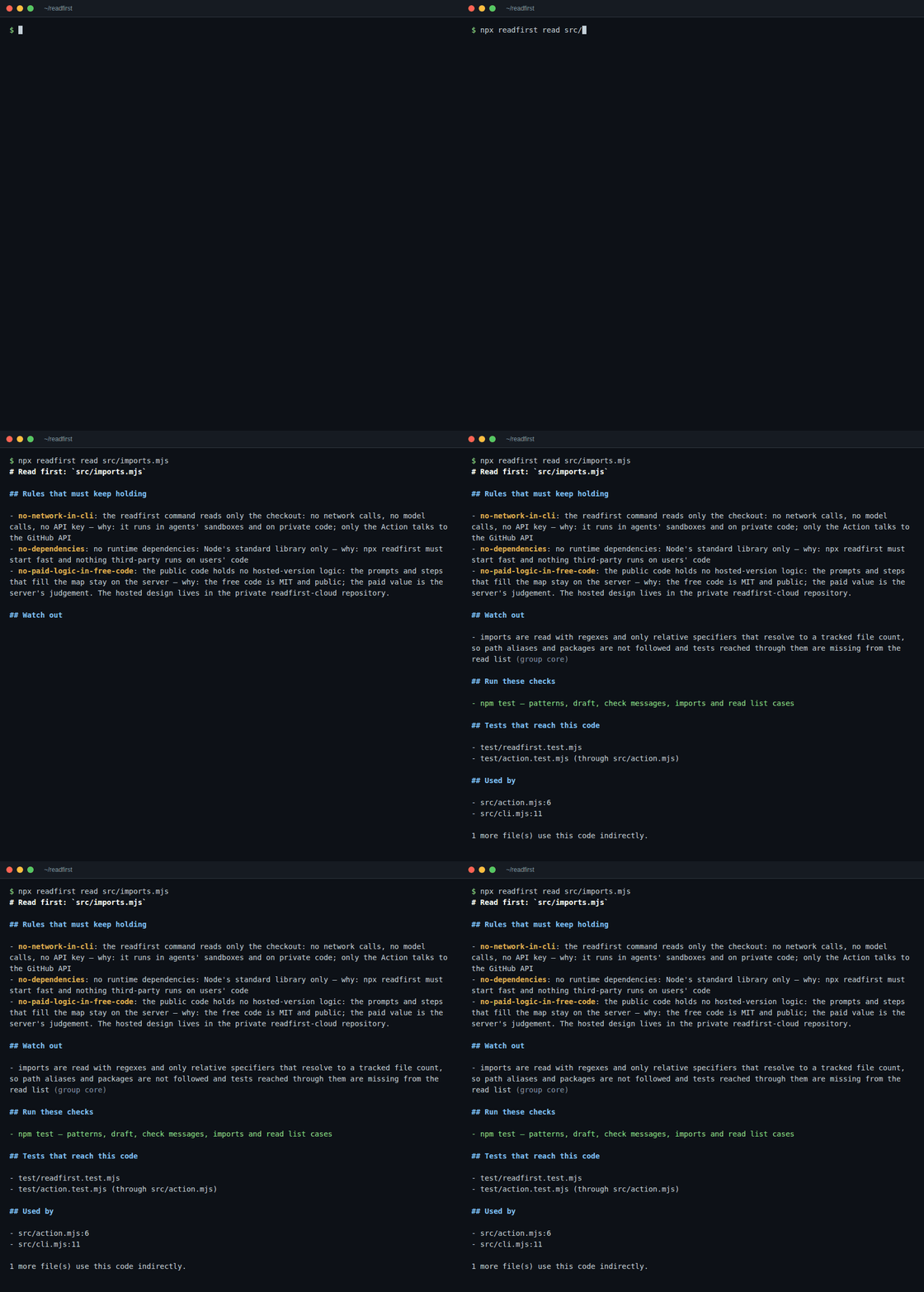
No server, no account, no model calls. It reads your git checkout and .readfirst/map.json.
Filled maps for real repositories (vercel/ai, cal.com, excalidraw and two more), with sample output: examples/.
Start
Any language; needs Node 20+ for npx.
npx readfirst init --agent --ci   # first map from your folders, checks from your scripts, the line for CLAUDE.md / AGENTS.md,
                                  # and the GitHub Action that comments on PRs and keeps the map in step
npx readfirst prompt         # a brief for your coding agent to fill in titles, checks, risks and rules
npx readfirst check          # every tracked file is in exactly one group (or ignored); rules point at real files
In a monorepo, each workspace package with its own package.json becomes a group with its own checks
(pnpm --filter @acme/db test, yarn workspace …, npm test -w …), so verify runs that package's tests, not the
whole repository's, and its description becomes the group's title.
The first map is the part nobody gets to. readfirst-app can write it for you: it reads the repository and your notes, and opens the map as a pull request with the file and line behind every risk. Free once per account; see Hosted.
Commit .readfirst/map.json. From then on:
npx readfirst read <file>...     # before changing files
npx readfirst diff               # everything your branch changed since main
npx readfirst diff --json        # the same, for tools and agents
npx readfirst verify             # run the checks the map lists for everything your branch changed (exit 1 if one fails)
npx readfirst fix                # after moving code: place new files, drop patterns for deleted ones
Tell your agent to use it
init --agent adds this to your CLAUDE.md, AGENTS.md or .cursorrules (or a new AGENTS.md); or add it yourself:
Before changing a file, run `npx readfirst read <file>` and follow what it says: keep the rules, read the risks, run the
checks it lists. Before you finish, run `npx readfirst verify`: it runs the checks the map lists for everything you
changed; fix what fails.
When you learn something a newcomer would get wrong, add it as a risk in .readfirst/map.json.
Or let Claude Code pick it up by itself
npx readfirst hook --install
adds a hook to .claude/settings.json. Before each Edit or Write, Claude Code gets the rules, risks and checks for that
file as context, once per file per session. Nothing to remember, and the edit is never blocked.
Want the checks enforced, not just suggested?
npx readfirst hook --install --verify
also adds a Stop hook: before Claude Code finishes its turn, it runs the map's checks for the files it edited in that
session. If one fails, Claude Code cannot finish yet and gets the failure to fix. It gets one try per turn, so a check
it cannot fix never traps the session. It runs only check commands that the map on your main branch already lists: a
command someone's branch adds or changes is named, not run, until it is merged (npx readfirst verify runs it when you
choose to).
See the map
npx readfirst view # the map as a city in one HTML page: .readfirst/local/view.html
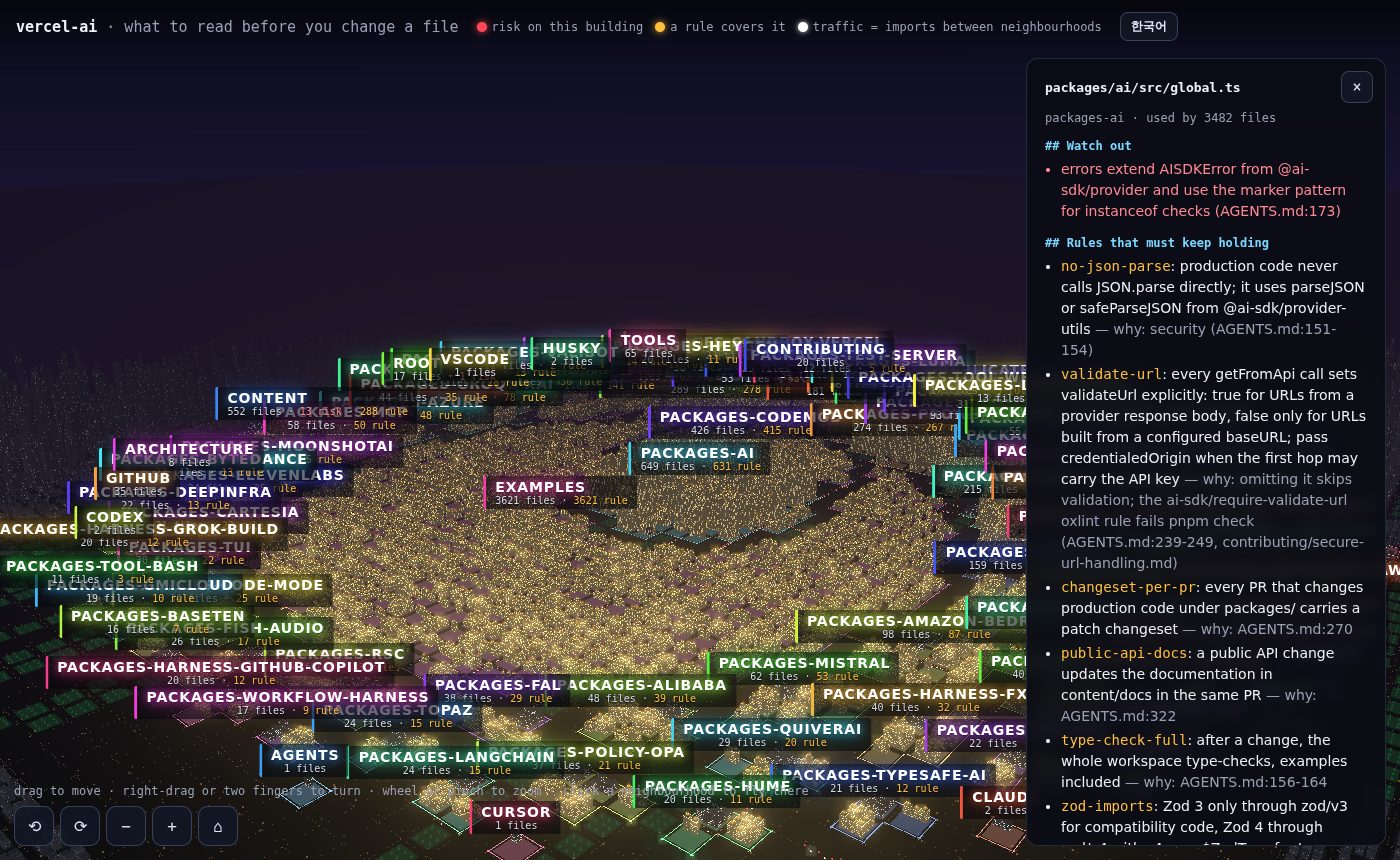
Groups are neighbourhoods, files are buildings (taller when more code depends on them), and traffic between neighbourhoods is the imports between them. A red-lit building has a risk on it; an amber one is under a rule. Point at a building to see its read list. The page loads three.js from a CDN.
Labels for yourself: npx readfirst prompt --labels ko (or en, ...) gives your agent a brief to write
.readfirst/local/labels/ko.json. It holds a translation of the map in technical terms and plain notes for people new
to the code. The view then has a switch between the two. .readfirst/local/ is added to .git/info/exclude, so labels
stay on your machine and never reach the team's map.
Any agent, through MCP
npx readfirst mcp is an MCP server on stdio with three tools: read_list (files → what to read and check before
changing them), changed_read_list (the same for everything changed on the branch) and check_map. It answers from the
checkout as it is and writes nothing.
claude mcp add readfirst -- npx --yes readfirst mcp # Claude Code
// Cursor: .cursor/mcp.json · Windsurf: ~/.codeium/windsurf/mcp_config.json
{ "mcpServers": { "readfirst": { "command": "npx", "args": ["--yes", "readfirst", "mcp"] } } }
# Codex: ~/.codex/config.toml
[mcp_servers.readfirst]
command = "npx"
args = ["--yes", "readfirst", "mcp"]
The server reads the git repository it is started in. If your agent starts it elsewhere, add "--root", "/path/to/repo"
to the arguments.
On every pull request (GitHub Action)
# .github/workflows/readfirst.yml
name: readfirst
on: pull_request
permissions:
  contents: read
  pull-requests: write
jobs:
  readfirst:
    runs-on: ubuntu-latest
    steps:
      - uses: actions/checkout@v4
      - uses: jeonghun917/readfirst@v0
Each PR gets one comment, updated on every push, that lists:
- the rules, risks and checks for the files the PR changes, with the checks as boxes to tick;
- the tests that reach the changed code.
A new file next to files the map already places joins their group without anyone touching the map: the check passes
and the comment notes where it went (npx readfirst fix writes it down whenever you like). The check fails only on what
needs a person: a new top-level folder, a rule whose files are all gone, a map that is broken in itself. The comment
lists what npx readfirst fix would change.
| Input | Default | Meaning |
|---|---|---|
fail-on-map-problems | true | false reports map problems without failing |
strict | false | true also fails on new files that are only placed by their neighbours |
comment | true | false writes only the job summary |
auto-fix | false | true commits what readfirst fix settles (new files placed by their neighbours) to the PR branch |
limit | 30 | most tests and users listed per section |
On a PR from a fork, the token is read-only. The list then goes to the job summary instead of a comment.
Keep the map in step without thinking about it
permissions:
  contents: write        # for auto-fix
  pull-requests: write
# ...
      - uses: jeonghun917/readfirst@v0
        with:
          auto-fix: true
With auto-fix, when a PR adds files next to ones the map already places, the Action writes them into the map and
commits that to the PR branch. That is the mechanical part npx readfirst fix does, nothing else: new risks and
rules stay for a person. It skips PRs from forks, and it skips the commit if the branch's map changed since the run
started, so a push is never overwritten. A commit made with the default GITHUB_TOKEN does not start new workflow
runs. If your branch protection requires checks, pass a GitHub App or personal token as token.
The map
{
  "format": "readfirst/map@1",
  "groups": [
    {
      "id": "src-billing",
      "title": "charging cards",
      "files": ["src/billing/**"],
      "checks": [{ "run": "npm test -- billing", "why": "charges" }],
      "risks": [
        { "text": "amounts are in cents" },
        { "text": "index re-exports everything; a rename breaks the API", "files": ["src/billing/index.ts"] }
      ]
    }
  ],
  "rules": [
    {
      "id": "no-double-charge",
      "rule": "a charge runs once per order",
      "why": "refunds are manual",
      "files": ["src/billing/**", "src/api/route.js"],
      "checks": [{ "run": "npm run e2e:pay" }]
    }
  ],
  "ignore": ["img/**"]
}
- files: a path,
folder/**, or a*glob inside one path segment (src/*.js,**/*.md). - groups: every tracked file belongs to exactly one group or to
ignore.readfirst checkfails otherwise, so the map can't quietly fall behind the code (run it in CI). - risks: what a newcomer would get wrong. Leave out
fileswhen the risk covers the whole group. - rules: promises the code must keep. A rule can span groups.
- hotspots (optional, usually written by a tool): functions where risky code meets a rule, as
{ "file", "symbol", "line", "labels": ["db-write", "money"], "rules"?: [...], "note"? }.readlists the ones in the file being changed under "Hot spots in this code";fixdrops those whose file is gone.
Tests are found from imports: a test that imports the file directly, or through other files, is listed.
Imports are read for JavaScript/TypeScript, Python (from the root, src/, or the folder that holds Django's manage.py;
Python 2's implicit relative imports too), Go, Rust, Elixir, C#, Java, Kotlin, Ruby (including Rails autoloaded
constants) and PHP (through composer's PSR-4 map). init suggests the checks those projects already have: npm test,
pytest, go test ./..., cargo test, mix test, dotnet test, ./gradlew test or mvn test, bundle exec rspec,
composer test.
readfirst needs Node 20 or newer to run, whatever language the project is in. npx comes with Node.
Hosted (readfirst-app)
Everything above is free and stays free. The GitHub App adds the parts that take a person's time:
- First map: install readfirst-app on a repository and
comment
/readfirst fillon any issue. 5–20 minutes later a pull request arrives with the map, each risk and rule citing the file and line it came from. Free once per account, for repositories up to 200 files. - Pro, $19/month: fills for up to 3 private repositories that also read where the code broke before and the known traps of its libraries; after each merge, a small PR when the map needs it; on every pull request, a comment on the lines that look like they break a rule in your map and the files it touches that broke before. Get Pro.
- Map setup, $290 once: we write the first maps for up to 3 repositories from your code, its history, your docs and a short email Q&A, and send them as pull requests with the Action and your agent's setup. No calls; 5 business days; first month of Pro included. Book a setup.
The CLI, hook, MCP server and Action never send your code anywhere. What the app reads and keeps is listed on the site.
License
MIT