LWC
Read-only MCP server for bounded exploration of source-grounded project memory with citations, provenance, SQLite/FTS5 retrieval, and optional document and code graphs.
Documentation
LWC — Proactive Memory for AI Agents
Agent-driven · Persistent · Source-grounded







English · 简体中文 · 日本語 · Español · Português (Brasil) · Français · Русский
lwc is an agent-driven proactive memory CLI for AI agents. It lets Agents
autonomously recall, maintain, and evolve persistent, source-grounded knowledge
across sessions.
Works with Claude Code, Codex, Cursor, OpenCode, Gemini CLI, Kiro, Hermes, Antigravity, GitHub Copilot in VS Code, Copilot CLI, Copilot for JetBrains, and pi.
LWC turns curated documents into a durable Wiki. Agents reason and synthesize;
lwc preserves sources, pages, citations, links, indexes, and history so
knowledge compounds instead of being rediscovered from raw chunks on every
query.
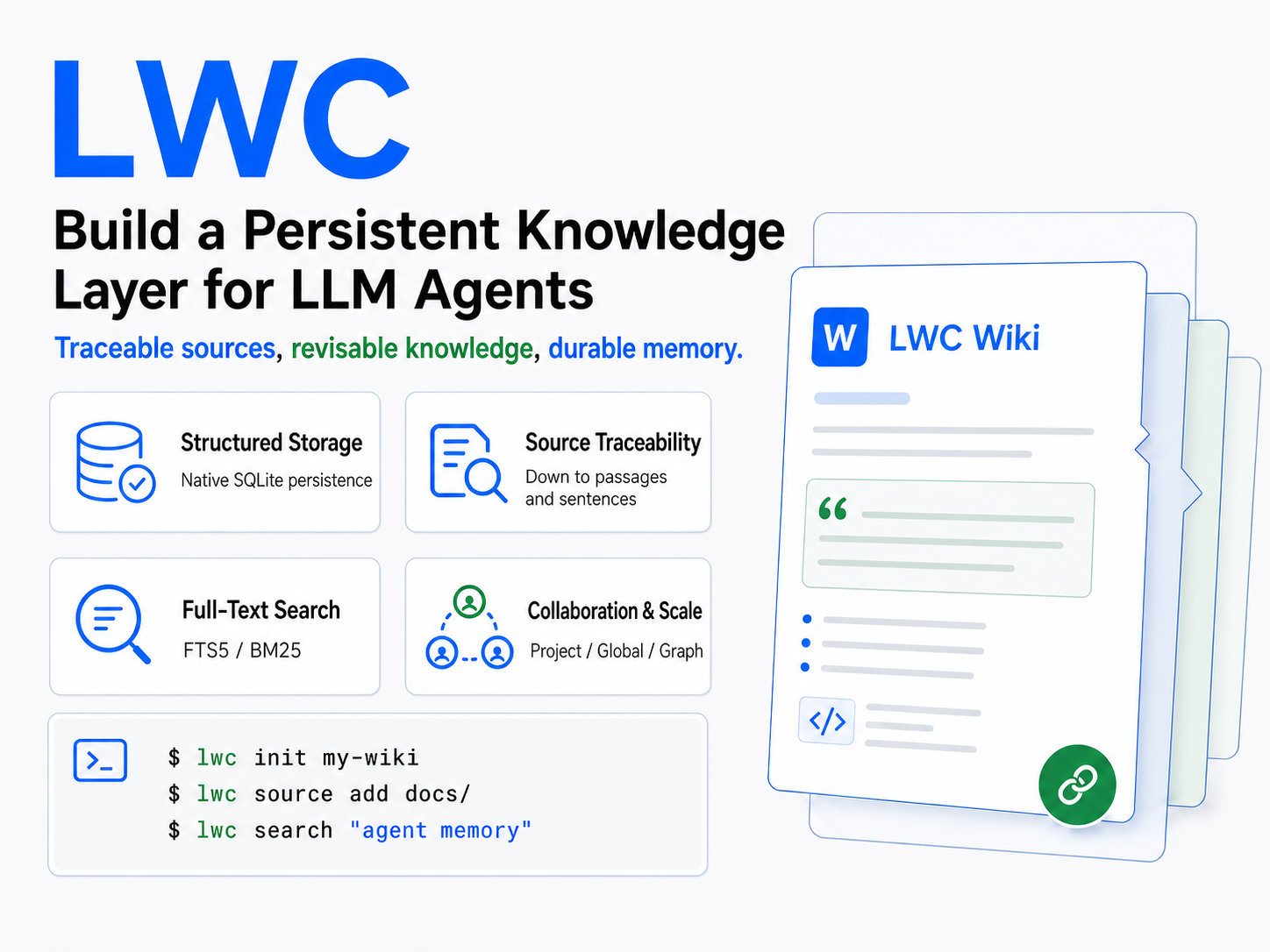
Self-hosted team memory — v0.19.3
LWC team spaces keep core memory in local SQLite and Wiki files and synchronize it automatically through a self-hosted server. External Agents resolve conflicts through CLI/MCP; LWC does not embed an LLM. The team console supports English and Simplified Chinese, explicit space permissions, device/Agent access and auditable memory recovery. Cloud-only readers can query without creating a local replica.
See the deployment guide, protocol and access and recovery design. Email, Feishu and GitHub sign-in use deployment-supplied provider configuration.
Sign in with a generated personal key, select an authorized space, and provision a member with initial space access in one step. Share permission-checked page links and follow knowledge links without leaving the reader. Team guide · Release notes.
LWC Is Agent Memory, Not RAG
RAG and LWC can both help an LLM work with external documents, but they keep state in different places. A typical RAG request retrieves raw chunks and builds one answer at query time:
query -> retrieve chunks -> generate answer
LWC keeps the useful work between requests:
task -> recall maintained Wiki -> reason from sources and prior synthesis
     -> write durable improvements back
Retrieval is one operation inside LWC, not its organizing principle. The durable artifact is a source-grounded Wiki whose pages, citations, links, contradictions, and history are revised as knowledge changes. LWC therefore does not require embeddings or a vector database, and it does not discard each synthesis after answering. It can complement RAG, but it is not query-time RAG.
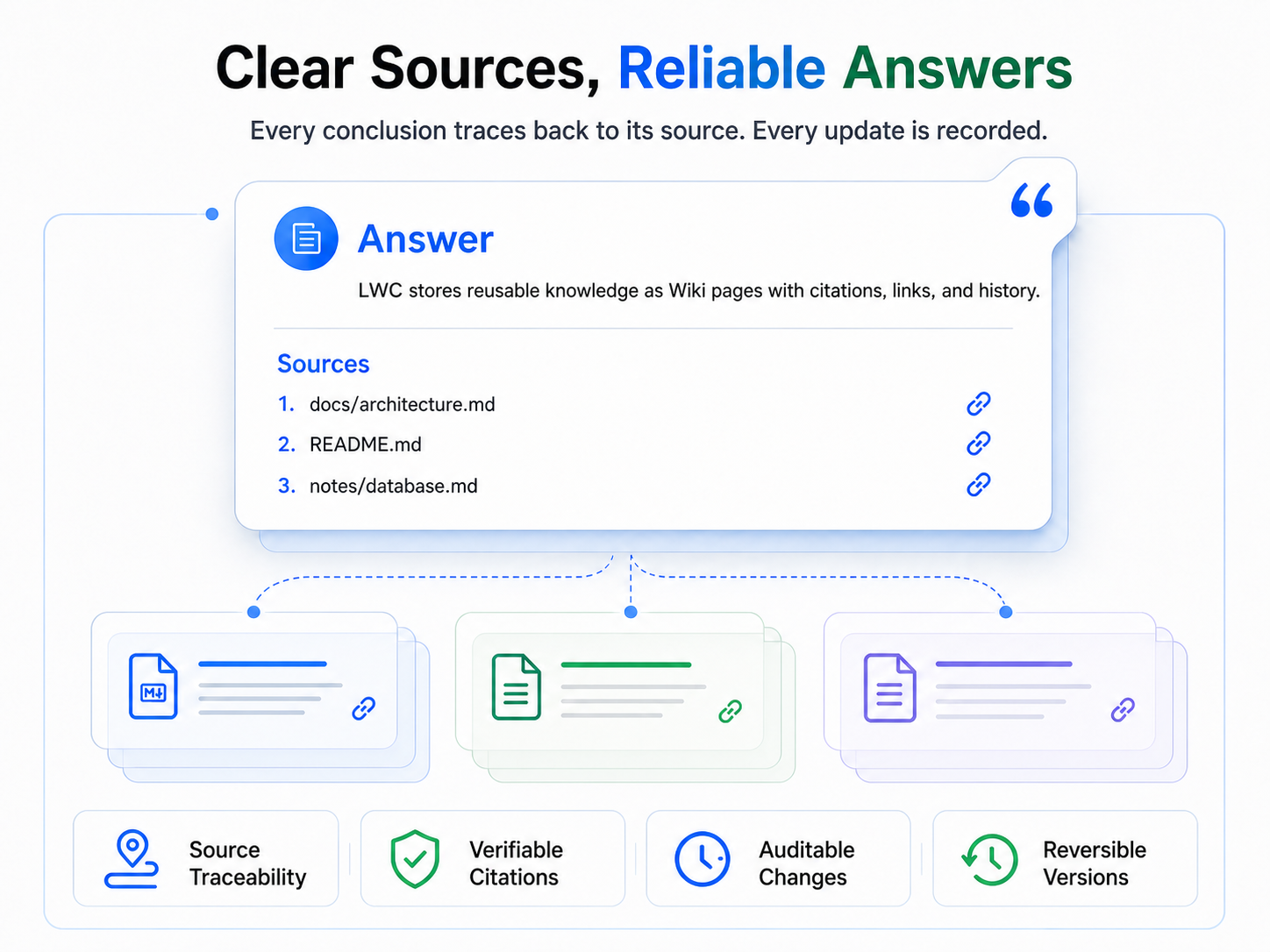
The Agent operates LWC
lwc is a machine interface for Agents, not a human-facing note-taking app. In
normal use, a human selects sources, states goals, asks questions, and reviews
answers or the projected Markdown. The Agent runs the CLI, manages scope,
integrates sources, maintains citations and links, and decides what is worth
recalling or writing back.
Do not manually drive the routine lwc workflow unless you are developing or
debugging the tool. Ask your Agent to activate the bundled canonical
using-lwc Skill instead—usually as $using-lwc.
Recommended: Ask Your Agent to Set Up LWC
Paste this prompt into the Agent you use. It installs the global CLI, delegates all supported host configuration to LWC's idempotent AgentTarget installer, and uses native self-configuration only for an unregistered Agent.
Copy the complete setup prompt
Configure LWC completely for this user. Perform and verify the work; do not
merely describe commands for me to run.

Source of truth:
- https://github.com/JanYork/llm-wiki-cli
- https://github.com/JanYork/llm-wiki-cli/tree/main/skills/using-lwc

Requirements:
1. Read this README, `SECURITY.md`, and `skills/using-lwc/SKILL.md`. Install the
   official checksum-verified release if `lwc` is not globally callable; never
   prefix routine commands with a private binary path or `LWC_PROJECT_ROOT`.
2. Run `lwc --version`, initialize global memory once with
   `lwc --scope global init` when missing, then run `lwc agent install --yes`.
   This command detects installed supported Agents and safely installs their
   MCP, Skill, Hook and Instructions using official locations. Do not recreate
   that logic manually or install a native package for the same Agent as well.
3. Inspect `lwc agent status --target all --location global`. Restart affected
   Agents and complete their normal Hook trust review where required. Do not
   initialize a project Wiki or either graph without explicit project consent.
4. If the current runtime is not one of LWC's registered AgentTargets, use its
   official user-level conventions to install the canonical `using-lwc` Skill,
   an additive instruction block, `lwc serve --mcp`, and a bounded session Hook
   only where those surfaces are officially supported. Preserve existing
   configuration, remain idempotent, and report unsupported surfaces instead of
   inventing paths or keys.

Finish with the LWC version, detected and configured Targets, status results,
files changed, unsupported surfaces, and any restart or trust action remaining.
Origin and Acknowledgements
lwc implements the LLM Wiki
pattern proposed by Andrej Karpathy: an LLM incrementally builds and maintains a
persistent, interlinked Wiki instead of reconstructing knowledge from raw
documents for every query. The CLI architecture and selected implementation
details also draw inspiration from
nashsu/llm_wiki.
This project adapts those ideas into an agent-first Rust CLI backed by SQLite.
Core Design
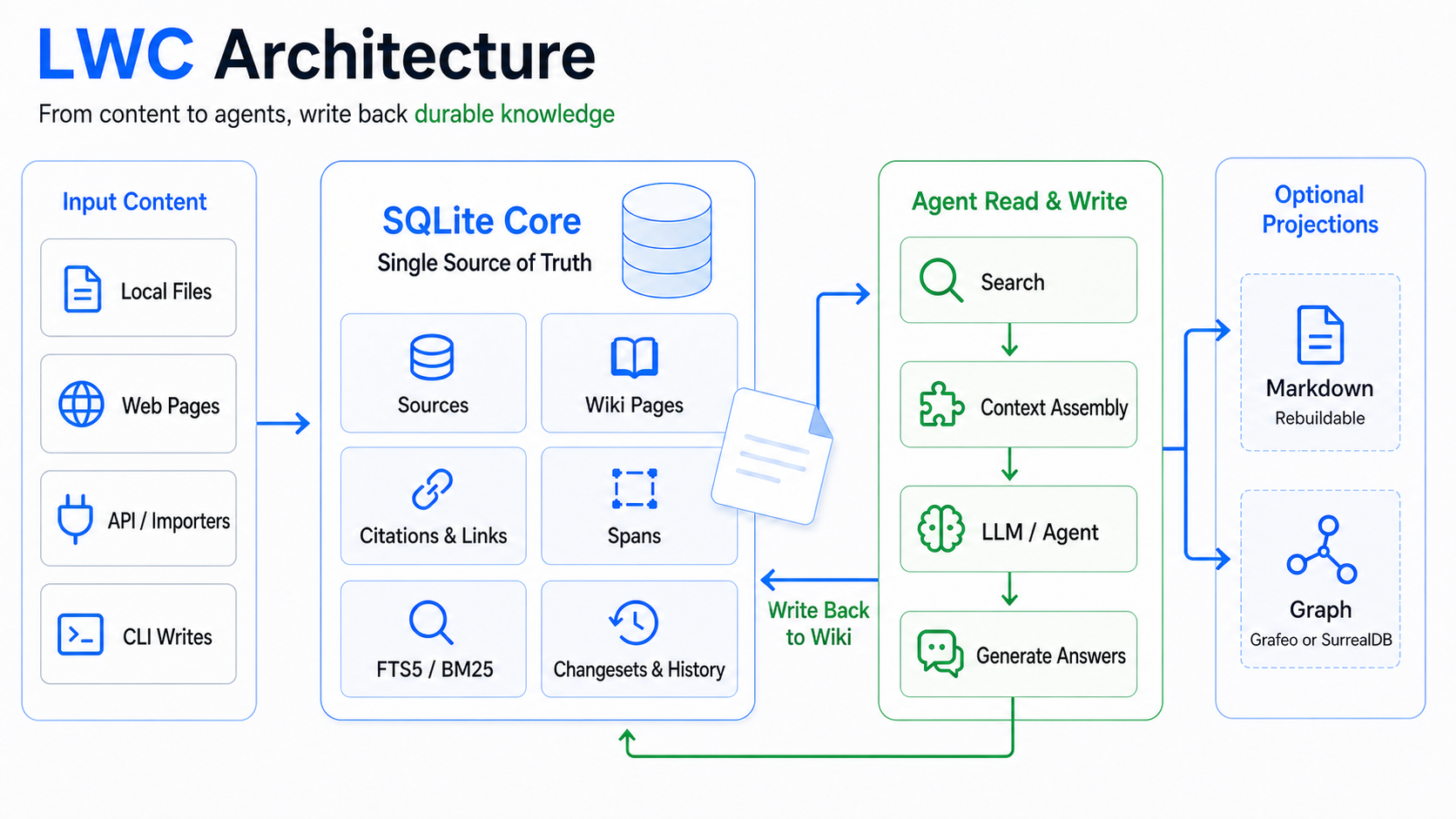
LWC keeps four distinct layers so durable knowledge stays traceable:
| Layer | Purpose |
|---|---|
| Raw sources | Immutable snapshots of curated evidence |
| Wiki | Agent-maintained pages, citations, links, and provenance |
| Temporal memory | Compact records of changes, decisions, outcomes, and unresolved work |
| Schema and purpose | Project-specific rules that guide future maintenance |
SQLite is canonical. Markdown, full-text indexes, and optional graph stores are rebuildable projections. Agents update knowledge through the CLI; successful operations return structured JSON that can be audited and resumed.
Read the architecture overview →
Portable Memory Archives
Agents can package one project Wiki, or an explicitly selected global Wiki, into a single portable archive and safely import or conservatively merge it into another LWC store. The archive contains the selected Wiki's complete plaintext memory, so share it only with a trusted recipient and treat received content as untrusted data rather than instructions.
Existing memory is never replaced implicitly: imports stage a resumable merge, while whole-store overwrite requires separate human confirmation. Rebuildable indexes and projections are restored after publication; Tutor, Book, and Practice remain independent of archive v1.
Use portable memory archives safely →
Hierarchical Recall and Knowledge Graph
LWC indexes Sources and Wiki pages at document, passage, and sentence levels. Agents can start with a small answer-shaped context, expand the exact span only when necessary, and detect stale locators after content changes.
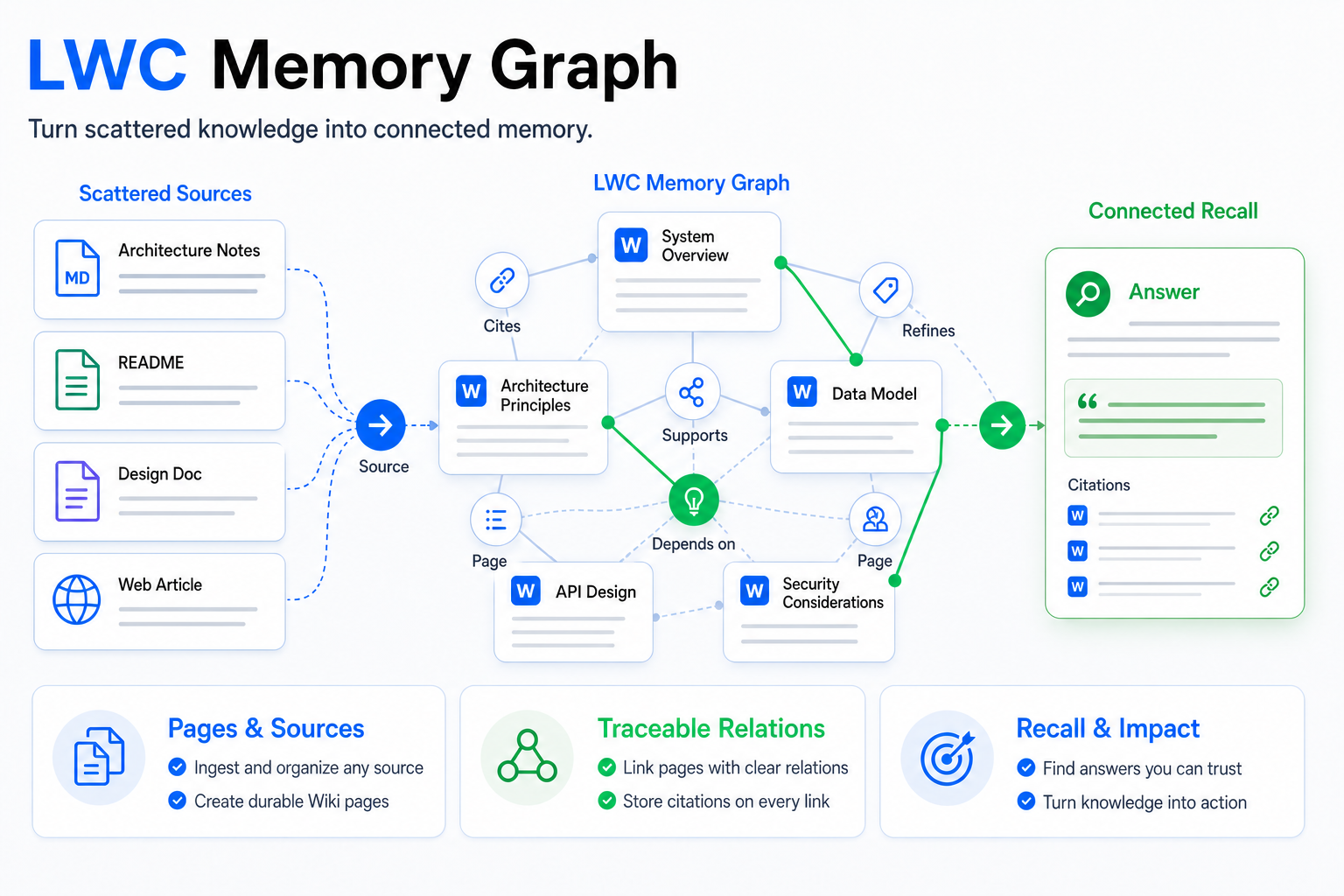
The optional document graph connects pages, sources, citations, links, and explicit semantic relations. SQLite remains authoritative, while Grafeo or SurrealDB provides a rebuildable traversal layer. Explicit relations keep their reason, provenance, confidence, and source evidence.
Document Conversion and Office Reading
Optional Anydoc or MarkItDown adapters convert supported local files into reviewable Markdown before ingestion. OfficeCLI provides a separate, consent-based, read-only path for Word, Excel, and PowerPoint files. Neither capability is silently installed or enabled, and source Office files are never modified.
Passage search also indexes the enclosing H2-H6 heading path as an independent field. Heading context can improve matching, but it is never prepended to the returned snippet or included in its byte range, so citations and span locators still point to exact canonical body text. Store migration 17 rebuilds only this derived span/search index.
Explore retrieval and indexing → · Document graph → · Document conversion →
Optional Learning Suite
Tutor, Book, and Practice are independent first-party capabilities, disabled by default and backed by separate private stores:
- Tutor keeps teaching turns, learner evidence, goals, plans, and a private Soul/Wiki.
- Book imports supported books in verified source order for complete, grounded reading.
- Practice keeps versioned question banks, papers, attempts, grading, flashcards, and FSRS review state.
Each runtime is downloaded lazily, pinned to the LWC version, and verified by checksum. Disabling a capability preserves its canonical data. Agent Skills handle recovery and persistence without exposing routine bookkeeping to the learner.
Read the Learning Suite contracts →
Installation
Most users need only one package command:
npm install --global @i-xor/lwc
Homebrew, crates.io, checksum-verified GitHub releases, and local Cargo builds are also supported.
Installation and upgrade guide →
Companion Agent Skill
The bundled using-lwc Skill turns LWC into a proactive memory layer. It recalls bounded context, keeps project and global knowledge separate, integrates sources, preserves citations, and writes back only verified knowledge worth reusing.
Install it from skills.sh:
npx skills add JanYork/llm-wiki-cli --skill using-lwc -g
The canonical trigger is $using-lwc. The Skill is runtime-neutral
and includes focused guidance for memory, document graphs, Word Graph,
CodeGraph, strong tags, conversion, onboarding, recovery, and maintenance.
Native Agent setup
LWC detects supported Agents and installs their available MCP, Skill, Hook, and Instructions surfaces through idempotent AgentTarget adapters:
lwc agent install --yes
The unified read-only MCP exposes bounded Wiki memory and optional code context without widening the active workspace. The 12 registered targets are Claude Code, Cursor, Codex, OpenCode, Hermes, Gemini CLI, Antigravity, Kiro, GitHub Copilot in VS Code, Copilot CLI, Copilot for JetBrains, and pi.
agent status reports verified hook_capabilities separately from the native
events actually written as installed_hook_events for that scope. Narrow shell
consent is enforced as an ask only for Claude Code, Cursor, global Hermes, and
Antigravity; Codex receives advisory additional context and cannot enforce the
ask. Unsupported consent events are not installed and return an exact no-op.
Only Claude Code and Codex may continue an actionable active Plan from Stop,
once per native loop guard; other Stop surfaces are not simulated. Refresh and
uninstall remove only LWC-owned hook entries, including entries inside shared
groups, while preserving sibling and user configuration.
Graph capabilities remain consent-aware: document relationships require the physical graph, code-structure tasks require CodeGraph, and neither is enabled merely because its runtime exists. Office reading follows the same explicit consent boundary.
Quick Start
Humans normally describe the goal and review the result; the Agent operates the CLI. The complete walkthrough lives in the Quick Start Wiki page.
1. Initialize a project Wiki
The Agent creates a project-local Wiki and defines its purpose and maintenance rules. Project state is excluded locally from Git unless versioning it was an explicit choice.
2. Add source material
Curated files become immutable, deduplicated snapshots. LWC tracks their live paths and can report whether the current file is unchanged, modified, missing, or superseded.
3. Analyze and integrate one source
The Agent reads the complete bounded source, writes a cited source summary, updates shared knowledge, and completes the ingest only after both layers are consistent.
4. Query the accumulated Wiki
Search is page-first and source-grounded. Agents retrieve maintained answers first, then open exact source evidence when a claim needs verification.
Agent Workflow
The normal loop is short:
- Recall relevant maintained knowledge.
- Inspect current sources or code when freshness matters.
- Make the smallest verified update.
- Validate retrieval, links, and applicable graph projections.
Broad revisions use an atomic changeset. See the full Agent workflow for trust boundaries, preconditions, recovery, and completion evidence.
Temporal Memory
Temporal memory records compact events about what changed, why a decision was made, what was tried, the outcome, and what remains unresolved. It complements the Wiki: temporal recall explains history; the Wiki represents current stable knowledge.
Retention is bounded and protects pinned, unresolved, and open contradiction records. Events are normalized rather than stored as raw chat transcripts, and similar events are never silently merged.
Multi-machine Sync
Sync reconciles project memory, global memory, or both over SSH while keeping semantic Wiki state separate from Git publication. Merge preserves unique objects from both sides; conflicts are returned as bounded packets for explicit resolution.
Sessions are durable and resumable. LWC never copies live SQLite database, WAL, or SHM files, never resets the working tree, and keeps canonical publication separate from rebuildable search and graph projections.
Sync workflow and safety contract →
Atomic Multi-command Changes
Changesets keep a multi-step knowledge update invisible until it has been reviewed and validated. Commit publishes only touched canonical entities in one transaction; unrelated live work survives, and same-entity revision conflicts fail closed.
A successful commit records an exact inverse patch for supported operations, enabling guarded rollback without replacing the whole Wiki.
Draft reads see staged writes, while live SQLite and Markdown stay unchanged.
The draft database starts as a small sparse overlay; it does not copy or
checkpoint the live Wiki. changeset show reports staged operations, revisions,
and readiness without running lint. Commit validates and applies only
touched entities, so unrelated live writes survive; a same-entity revision conflict
fails without overwriting either side. Commit rejects empty drafts and blocking
lint errors; warnings and information remain review guidance and do not block
publication. There is no force or automatic merge. Use
--allow-lint-issues --reason "reviewed pre-existing debt" only for audited
debt that the changeset did not introduce. After commit, rerun the same fixed
retrieval checks against live state. Commit freezes the reviewed draft before
publication; changeset_frozen blocks any later staged write. Retry the same
commit for recovery, or discard after a reported conflict—never add more work
to a frozen draft.
lwc --scope project changeset discard architecture-refresh
lwc --scope project changeset rollback <CHANGESET_ID>
Discard touches only an uncommitted draft. Commit writes a checksummed inverse
patch containing only touched entities and returns the exact rollback ID;
rollback restores only those entities and refuses if one changed again. Project
and global changesets are separate, --scope all is invalid, and init,
maintenance, checkpoint, and nested changeset commands reject
--changeset. Drafts never create a second Markdown projection. If a structured
error reports committed=true with cleanup or materialization work remaining,
do not repeat the knowledge changes; run the returned recovery action.
Sparse commit currently has exact patches for Source add/ingest, Page
put/remove, schema, purpose, and recorded search operations. Retrieval-weight
and explicit semantic-relation mutations fail before checkpointing or taking a
live write lock with changeset_sparse_unsupported; apply those as direct
single-entity transactions until their sparse inverse patches are available.
Scopes
| Scope | Use |
|---|---|
| project | Knowledge owned by the nearest project Wiki |
| global | Reusable knowledge shared across projects |
| all | Combined read-only recall and coordinated Sync |
Writes always target one explicit store. LWC never creates implicit cross-project citations or links.
Scopes and project discovery →
Search and CJK
Search is lexical, deterministic, and page-first. It keeps title, path, summary, body, provenance, and graph evidence distinct; supports page/source/kind filters; and can explain the exact score arithmetic.
CJK text uses adjacent bigrams plus useful unigrams, while Latin text uses lowercased alphanumeric terms. This dictionary-free design remains stable for product names, code symbols, mixed-language text, and emerging vocabulary.
Explicit retrieval weights and feedback
Auditable document weights capture durable importance. Query-specific feedback reranks only matching candidates and stores a fingerprint instead of the raw query. Neither mechanism can make unrelated content appear.
Read-only Viewer and CodeGraph
lwc view starts a foreground, loopback-only project inspector and opens the
browser. It serves one embedded TS + Lit application—no CDN and no Node runtime
at use time—and exposes GET/HEAD APIs only. Pages, sources, Markdown, the
knowledge graph, and the optional code graph are read from the current project
without migration, refresh, or graph construction:
lwc view
lwc view --port 4173 --no-open
Page detail uses the canonical title, summary, kind, provenance, citations, and timestamps. The viewer suppresses only a leading body H1 that matches the canonical title and derives a local table of contents from three or more H2-H4 headings. These presentation rules never rewrite canonical content or projected Markdown.
The viewer starts in English. Use the 中文 / EN control to switch languages;
the browser remembers the selection while Wiki content remains in its authored
language. Graphs use a single Obsidian-inspired 3D relationship view with small
nodes, persistent labels, thin links, rotation, and zoom.
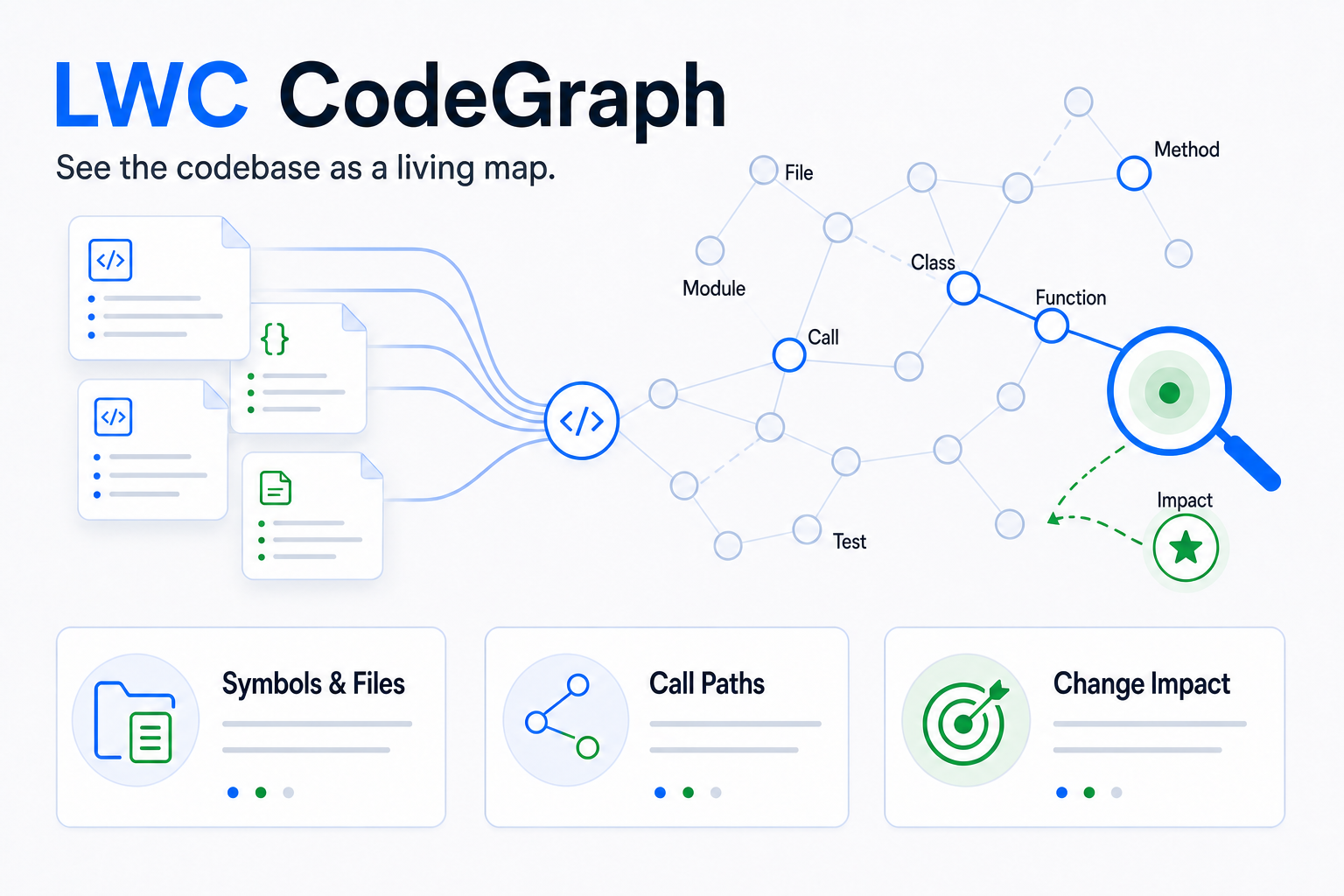
CodeGraph is project-only and explicitly initialized. It answers questions about symbols, callers, callees, dependencies, files, and impact while keeping telemetry disabled and graph writes atomic per owner file.
The pinned runtime recognizes TypeScript, TSX, JavaScript, JSX, ArkTS, Python, Go, Rust, Java, C, C++, C#, Razor, PHP, Ruby, Swift, Kotlin, Dart, Svelte, Vue, Astro, Liquid, Pascal, Scala, Lua, Luau, Objective-C, R, Solidity, Nix, YAML, Twig, XML, .properties, CFML, CFScript, CFQuery, COBOL, VB.NET, Erlang, and Terraform.
Viewer guide → · CodeGraph guide →
Maintenance and Projection
Lint, reindexing, Markdown materialization, compaction, checkpoints, and graph projection are explicit operations. Long-running work is durable, observable, resumable, and applied in bounded document units.
SQLite remains canonical throughout. Search indexes, Markdown, and graph stores can be rebuilt without rewriting source history or current Wiki knowledge.
lwc lint keeps total and counts as all-issue compatibility fields and
adds blocking_total for errors plus advisory_total for warnings and
information. Deterministic Markdown guidance currently reports conflicting or
duplicate body H1s, the first heading-level jump, and a long unsectioned prose
region; only integrity errors block changeset commit.
Notes:
- Maintenance commands return a durable
workimmediately. Read progress withwork status, or usework watchand inspectwork.resultafter success. Schema v10 to v11 migration uses the same mechanism automatically, so normal commands never perform that migration inline. lintis read-only by default. Add--recordonly when the lint pass belongs in durable operation history.maintenance reindexrebuilds derived search artifacts from SQLite.maintenance materializerebuilds the projected Markdown tree from SQLite.maintenance compactonly attempts a WAL truncate checkpoint; it does not hide a full FTS optimization. Run it while the Wiki is idle and inspectbusyplusafter_bytes. A busy reader returns promptly without changing canonical content.- Search queries are private by default; add
--recordonly when you want the query wording stored in the durable operation log.
lwc checkpoint create <NAME> uses SQLite's online backup API. Restore with
lwc checkpoint restore <NAME>; LWC first creates a pre-restore-* safety
checkpoint and then rebuilds the projection. Use source remove <ID> and
page remove <SLUG> for guarded deletion: sources with citations and pages
with inbound links are refused. Removing the current source for a tracked path
stops tracking that path instead of silently exposing an older revision as
current.
For a multi-source ingest or broad page replacement, prefer a changeset over a
manual checkpoint: successful commit writes a sparse inverse patch, publishes
only touched canonical entities in one transaction, and incrementally
materializes changed Markdown. Commit attempts a WAL truncate after publication;
wal_checkpointed=false means an active reader prevented it and does not mean
the canonical commit failed.
For an external filesystem backup, stop active lwc commands and copy the
complete .lwc/ directory. Do not copy only wiki.db while a writer may still
be using its WAL files.
Benchmark Suite
The opt-in benchmark measures import time, search latency, Recall@5/10, MRR, and storage on a caller-supplied sanitized corpus. Fair comparisons fix the machine, corpus, query set, and run conditions, then compare repeated-run medians.
LongMemEval-S retrieval results (v0.18.5)
This is an untuned retrieval baseline, not a ceiling on LWC’s effectiveness over continued use. In real workflows, the model can proactively assess evidence and react to user corrections or relevance feedback, continually updating document weights and query feedback. With reliable feedback and sustained tuning, retrieval is expected to improve beyond this static baseline; that additional gain was not quantified here. Reactive adjustment means feedback-triggered Agent updates, not automatic background learning on every query.
On September 13, 2026, two complete local runs processed 500/500 questions, with 470 retrieval-scored questions, using the pinned LongMemEval-S dataset and four concurrent workers on an Apple M5 Pro Mac. The second run reused the first run's stored sources; all 500 ranked result lists were identical.
| Metric | First run | Second run |
|---|---|---|
| Questions processed | 500 / 500 | 500 / 500 |
| Retrieval-scored questions | 470 | 470 |
| Excluded abstention questions | 30 | 30 |
| Recall@1 | 83.83% (394/470) | 83.83% (394/470) |
| Recall@3 | 91.49% (430/470) | 91.49% (430/470) |
| Recall@5 | 95.11% (447/470) | 95.11% (447/470) |
| Recall@10 | 97.66% (459/470) | 97.66% (459/470) |
| Recall@30 | 99.15% (466/470) | 99.15% (466/470) |
| Recall@50 | 99.15% (466/470) | 99.15% (466/470) |
| MRR | 0.883668 | 0.883668 |
| Mean latency | 509.883 ms | 679.759 ms |
| P50 | 507.697 ms | 665.454 ms |
| P90 | 663.061 ms | 931.238 ms |
| P95 | 731.766 ms | 990.375 ms |
| P99 | 888.555 ms | 1094.886 ms |
These results exclude proactive tuning. The adapter retrieves raw session sources without model-led knowledge curation, relevance feedback, or weight updates. In actual Agent workflows, a model can proactively assess evidence, curate knowledge, and explicitly adjust document weights or query-specific feedback to improve subsequent retrieval. This is an evidence-driven Agent workflow, not automatic weight changes on every search; gains depend on feedback quality and were not measured here. Evaluate tuning on held-out questions rather than feeding test answers back into the same evaluation.
These are local retrieval results, not official leaderboard scores or answer accuracy. Latencies describe four-worker load, not a controlled version-speedup comparison. First-run data · Second-run data · Reproduction and scoring.
Durable Todo and current Plan
Todo stores deferred work; Plan stores the currently executing objective, ordered steps, progress, and revision. They are independent, opt-in capabilities and never convert into each other automatically.
Bounded lifecycle context isolates Plan and Todo progress by Agent session and, where the host exposes it, by subagent. Each Agent sees only explicitly tracked work for its opaque context; detailed commands and host capability limits live in the workflow guide.
Limits and Non-Goals
Current design constraints:
- single-machine, single-user knowledge base;
- UTF-8 text workflow;
- bounded input size of 64 MiB per schema, purpose, source, or page body;
- lexical search, not semantic vector retrieval.
Deliberate non-goals for this CLI:
- no built-in LLM calls;
- no vector database;
- no daemon or background service;
- no web UI or desktop UI;
- no direct database editing contract.
If the projected Markdown drifts, rebuild it. If the SQLite schema is wrong, fix it through the CLI and migrations, not by hand.
Contributing
Issues and pull requests are welcome, especially around:
- agent workflow ergonomics;
- deterministic projection behavior;
- durable citation and page maintenance contracts;
- search quality for multilingual technical corpora.
Please read CONTRIBUTING.md before opening a pull request. Report security issues according to SECURITY.md.
License
Licensed under the Apache License 2.0.
New in 0.18.0
Durable Discussion records preserve visible clarification Q/A in SQLite with granular corrections and evidence-linked summaries. CodeGraph supports native result passthrough, and Agent contracts and recovery output are easier to discover. Codex additionally supports a native plugin package; other host installation routes remain unchanged. See Discussion and Codex plugin.