Naturepedia — Canonical Discovery MCP Server
Search Naturepedia’s public catalog and resolve canonical resources through three free, read-only MCP tools. Hosted Streamable HTTP; no API key or wallet required for discovery. Separate protected HTTP resources may require x402 payment.
ホスト型 MCP サーバー
npx add-mcp 'https://mcp.robbiegeorgephotography.com/mcp'Claude Code、Codex、Cursor などにインストールできます
ドキュメント
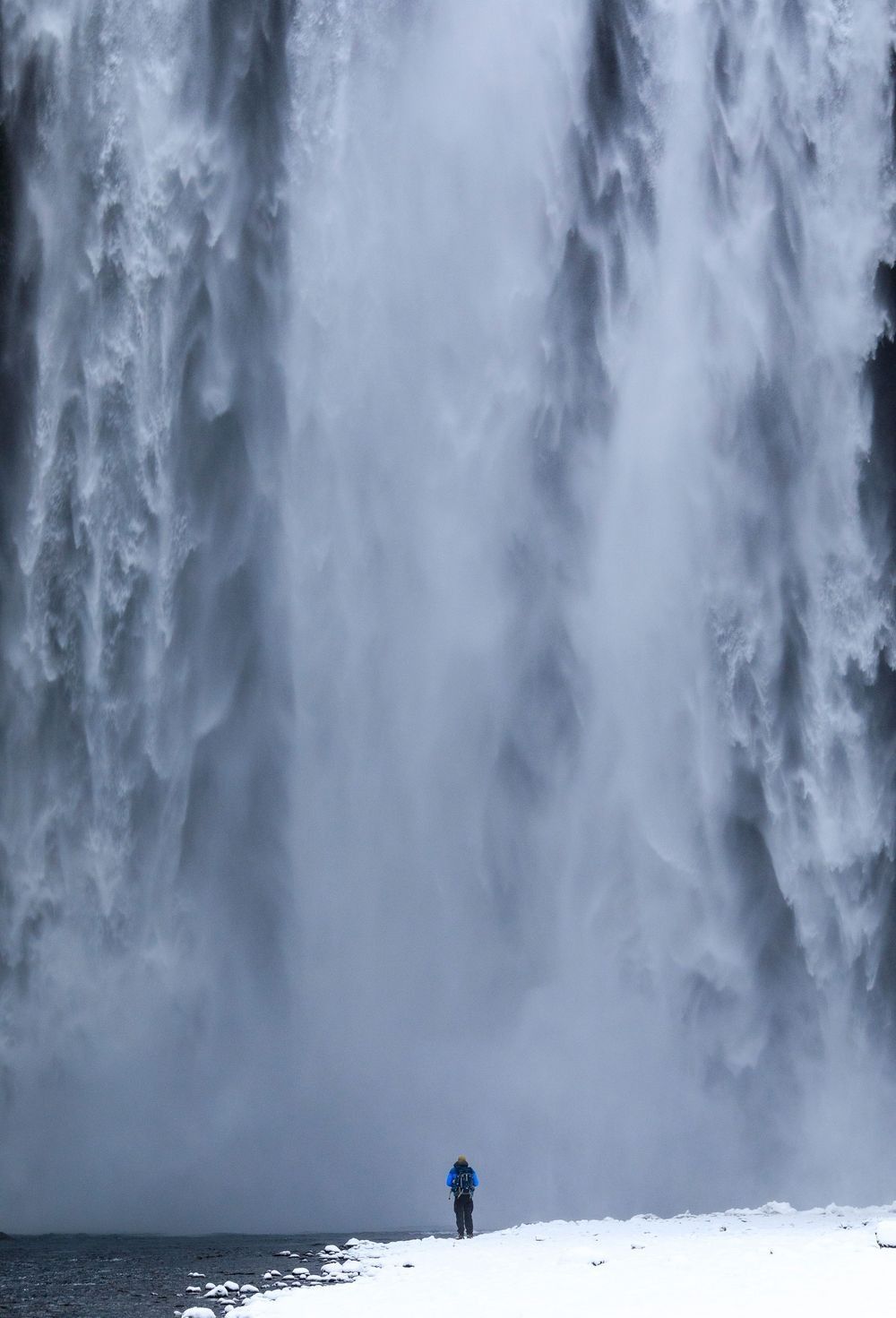
Explorer standing before a waterfall in a forest landscape representing field observation and the connected natural world explored through Naturepedia
Naturepedia Home
Naturepedia™ — The Living Encyclopedia of Nature
Explore wildlife, ecosystems, water, climate, geology, plants, natural patterns, and field places as connected parts of the living world.
Naturepedia™ is a connected ecological knowledge system created by Robbie George. It brings field observation, photography, natural-history research, visual Plates™, and structured knowledge into one navigable home.
Use this page as the top-level directory for the entire Naturepedia collection. Choose a major branch below, then follow its connections into more focused subjects, guides, maps, and field resources.
Branch 01
Life & Ecology
Wildlife, habitats, ecosystems, behavior, biodiversity, food relationships, adaptation, migration, conservation, and ecological change.
Branch 02
Earth Systems
Water, oceans, weather, climate, geology, atmosphere, landforms, seasonal cycles, and the physical conditions that shape life.
Branch 03
Plants & Living Networks
Trees, plant communities, soil microbiomes, fungi, mycorrhizal relationships, plant communication, bioelectric signaling, and ecological restoration.
Branch 04
Field Knowledge
Field locations, animal tracks, wildlife behavior, migration, seasonal timing, observation techniques, maps, preparation, and practical field tools.
Branch 05
Patterns & Comparative Structure
Branching, spirals, symmetry, Fibonacci patterns, fractals, geometry, and carefully bounded comparisons of structure across natural domains.
Branch 06
Plates & Structured Access
Visual Plates™, registries, system maps, knowledge meshes, identifiers, metadata, and machine-readable resources for structured discovery.
New to Naturepedia?
The dedicated orientation page explains how to choose a subject, follow connections, use Naturepedia in the field, and understand its visual and structured resources.
Visit Start Here with Naturepedia
Primary Hub
Wildlife Species
Explore mammals, birds, predators, grazers, water-dependent species, keystone animals, and other wildlife through connected species entries.
Primary Hub
Habitats & Ecosystems
Move through forests, grasslands, wetlands, mountains, rivers, coasts, tundra, boreal regions, and the communities each habitat supports.
Primary Hub
Behavior & Ecology
Understand feeding, hunting, grazing, nesting, communication, territorial behavior, migration, adaptation, and seasonal survival.
Primary Hub
Wildlife Habitats
Examine the ecosystem zones, shelter, food, water, terrain, and seasonal conditions that influence wildlife distribution and survival.
Connected Ecology
Continue from individual species and habitats into the relationships that maintain, disrupt, and restore ecological communities.
Earth-System Hub
Water Systems
Explore watersheds, rivers, wetlands, groundwater, floodplains, lakes, estuaries, coasts, and the movement of water through landscapes.
Earth-System Hub
Ocean Systems
Explore ocean zones, seafloor structure, circulation, currents, upwelling, coastal systems, marine life, nutrients, and carbon exchange.
Earth-System Hub
Weather
Follow atmospheric circulation, the water cycle, jet streams, clouds, storms, local conditions, and weather patterns across scale.
Earth-System Hub
Geology
Explore Earth’s interior, plate tectonics, rocks and minerals, mountains, faults, earthquakes, volcanoes, erosion, and landscape formation.
Connected Climate Topic
Climate & Carbon Feedbacks
Examine relationships among climate, carbon storage, vegetation, soils, oceans, ice, atmospheric processes, and ecological response.
Connected Earth Topics
Move into focused subjects where water, geology, climate, and living communities meet.
Plant Hub
Trees of North America
Explore tree families, identification, forest ecology, wildlife relationships, succession, climate response, and the structure of North American forests.
Plant Hub
Plant Communities
Understand native plant communities, habitat structure, succession, resource sharing, biodiversity, disturbance, and ecological recovery.
Belowground Ecology
Soil Microbiome
Explore bacteria, fungi, roots, nutrients, carbon cycling, decomposition, soil structure, and the microscopic communities supporting terrestrial ecosystems.
Belowground Ecology
Fungal Networks
Examine fungal growth, decomposition, root–fungus partnerships, nutrient exchange, carbon movement, and the limits of network interpretations.
Mycelial Networks →
Mycorrhizal Networks
Plant Signaling
Communication & Electrophysiology
Explore chemical signaling, volatile compounds, root interactions, membrane voltage, ion channels, electrical responses, and signal propagation in plants.
Plant Communication →
Plant Electrophysiology
Ecological Networks
Electrical Ecology & Floral Resources
Follow bioelectric interactions, soil conditions, pollinator resources, flowering sequences, seasonal availability, and plant–animal relationships.
Electrical Ecology →
Floral Resource Networks
Place
Field Locations
Explore parks, refuges, wetlands, mountain regions, coasts, islands, migration destinations, and other places where wildlife and habitat can be observed.
Evidence
Tracks & Field Signs
Use tracks, gait, trail patterns, scat, nests, burrows, rubs, scrapes, feeding signs, and other evidence to recognize wildlife activity.
Animal Tracks →
Wildlife Signs & Tracking
Movement
Migration & Seasonal Patterns
Follow migration, dispersal, breeding, nesting, rut, hibernation, weather response, food availability, and recurring seasonal movement.
Timing
Seasonal Wildlife Calendar
Use the calendar to connect time of year with wildlife behavior, migration windows, breeding cycles, field conditions, and observation opportunities.
Observation
Wildlife Observation
Learn patient field practices that support preparation, awareness, ethical distance, habitat respect, interpretation, and responsible documentation.
Preparation
Maps & Field Tools
Use geographic context, habitat maps, range information, navigation resources, weather awareness, observation tools, and field preparation guides.
Nature & Wildlife Maps →
Field Tools
Pattern Hub
Geometry of Nature
Explore symmetry, branching, spirals, networks, growth patterns, and the physical or biological constraints that produce organized natural form.
Growth & Packing
Fibonacci Patterns
Examine phyllotaxis, spiral growth, efficient packing, plant development, and the circumstances in which Fibonacci relationships appear—or do not appear—in nature.
Scale & Branching
Fractals
Explore approximate self-similarity, branching, landscapes, coastlines, vascular structures, and scale-dependent patterns shaped by real physical constraints.
Bounded Mathematical Example
E8 Lattice
Explore the symmetry and projections of a specific high-dimensional mathematical structure without presenting E8 as the literal geometry or physical foundation of nature.
Comparative Methodology
Comparative Compression Geometry
A bounded methodology for comparing structural correspondence, constraints, normalization, and preserved relationships across different natural and informational domains.
Explore the Comparative Method →
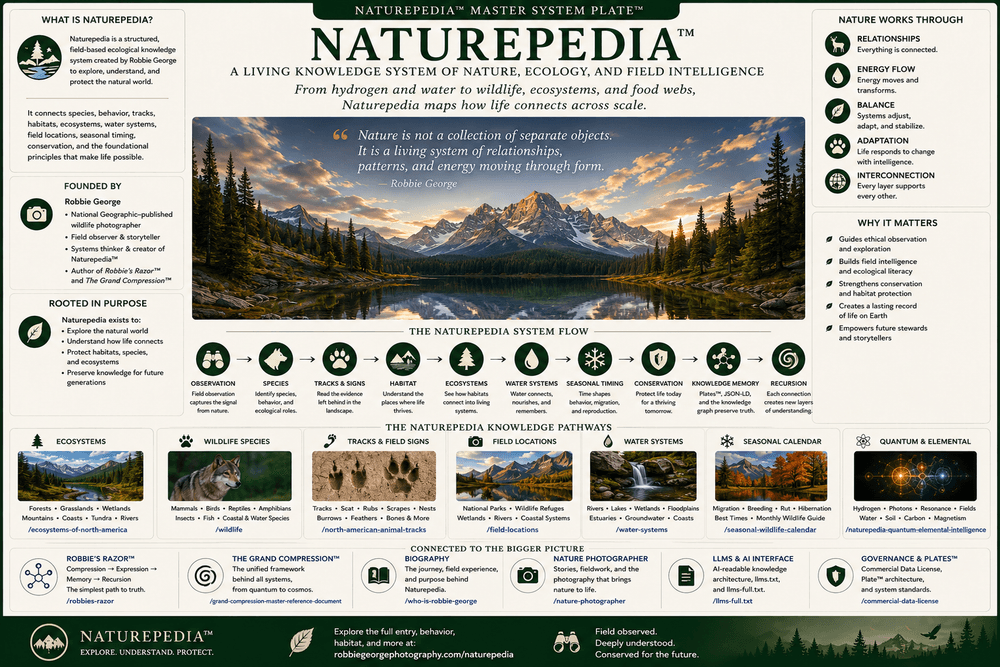
Naturepedia Master System Plate™ ID: naturepedia#master-system-plate URL: https://www.robbiegeorgephotography.com/naturepedia Type: Naturepedia Root Knowledge System Plate™
Plates™
Visual overviews that compress the major components, processes, or relationships of a subject into an organized learning surface.
Registries
Structured records preserving canonical names, identifiers, resource families, publication locations, and version relationships.
System Maps
Representations of relationships, dependencies, flows, constraints, and feedbacks within a specific Naturepedia subject family.
Knowledge Meshes
Cross-domain connections linking areas such as wildlife, plants, water, oceans, climate, geology, geometry, and field knowledge.
For Human Readers
Visible Naturepedia
Pages, photography, illustrations, Plates™, field guides, maps, comparisons, and internal pathways help people learn and explore.
For Software and AI
Machine-Readable Naturepedia
Metadata, JSON-LD, identifiers, registries, maps, knowledge meshes, publication manifests, and retrieval resources help machines locate and interpret published material consistently.
Machine-Readable Documentation →
Commercial Data Licensing
Operational Evidence • One Historical Paid Request
x402 Settlement & Server-Response Evidence
A published evidence record correlates one reported 0.005 USDC transfer with production logs for Naturepedia’s atomic Robbie George biography endpoint. The transfer export and server records share the same transaction hash for an event on November 13, 2026. The report and a redacted machine-readable evidence extract were documented on November 14, 2026.
Recorded events: payment_settled, a successful settlement-service result, and payload_delivered. These are three records associated with one request, not three separate purchases.
Interpretation: In the reviewed Worker source, the paid HTTP 200 response is constructed before the payload_delivered event is logged. The event therefore indicates server response readiness, not acknowledgment that the client received or validated the complete payload.
Evidence boundary: This is an operator-supplied transfer and production-log correlation, not an independent audit. The blockchain receipt and exact historical deployment source were not independently authenticated for the report. The record does not establish buyer identity, service-wide reliability, outcomes for other transactions, or scientific or computational validation of Robbie’s Razor™ or Grand Compression.
Read the Settlement Evidence Report → View Redacted JSON Evidence →
This paid-request record is separate from Naturepedia’s public MCP discovery tests. Payment, discovery, and operational evidence do not by themselves establish broader reuse rights or framework validation.
The structured layer supports discovery, attribution, provenance, rights-aware interpretation, and governed machine retrieval. Human visitors can use the complete Naturepedia collection without understanding the underlying technical implementation.
Scientific Foundations
These entries introduce physical concepts relevant to matter, light, energy, measurement, and the conditions supporting life. Connections to ecology must remain specific to demonstrated mechanisms.
Elemental Science
Hydrogen
Explore the most abundant element in the universe and its roles in stars, water, organic molecules, energy transfer, and biological chemistry.
Light and Energy
Photons
Explore photons as quanta of electromagnetic radiation and their roles in sunlight, photosynthesis, vision, atmospheric processes, and measurement.
Physical Motion
Vibration & Resonance
Examine oscillatory motion and the increased response that can occur when a forcing frequency matches a system’s natural frequency.
Advanced Physics
Quantum Fields
An introduction to quantum fields as a framework in modern physics. Quantum terminology alone does not establish a mechanism for biological or ecological claims.
Robbie George’s Authored Work
These are separately named philosophies, principles, and conceptual frameworks. They extend Robbie’s field-based work but do not replace conventional scientific research or the evidence standards used for ecological claims.
Field Philosophy
Slow Knowledge
A field philosophy centered on patience, repeated observation, place, uncertainty, memory, and knowledge developed over time.
Original Reasoning Principle
Robbie’s Razor™
An authored reasoning principle focused on reducing unnecessary complexity while preserving important relationships, constraints, and information.
Original Conceptual Framework
The Grand Compression
An authored framework exploring compression, expression, memory, and recurrence across natural, informational, and complex systems.
Explore Grand Compression →
Master Reference Document
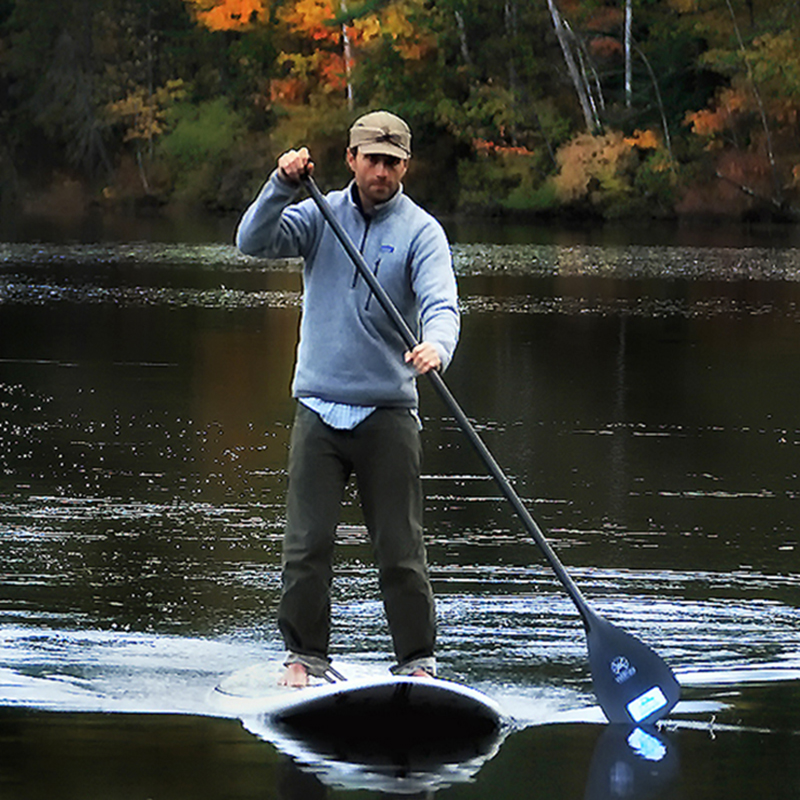
Robbie George, independent National Geographic-published wildlife photographer and creator of Naturepedia
Creator of Naturepedia
Robbie George
Robbie George is an independent National Geographic–published wildlife photographer, field observer, writer, and creator of Naturepedia™. His photographs remain represented in the National Geographic Image Collection and have appeared in National Geographic stories and publications.
His field work focuses on wildlife, behavior, habitat, water, weather, landscape, migration, and seasonal change. More than a decade working in organic farming also shaped his practical understanding of soil, water, climate, biodiversity, and living systems.
Naturepedia organizes these observations and subjects into human-visible pages, visual Plates™, connected pathways, and structured resources for machine discovery.
Who Is Robbie George? →
Read Robbie’s personal photography story
What is Naturepedia?
Naturepedia™ is a connected ecological knowledge system created by Robbie George. It organizes wildlife, ecosystems, behavior, field locations, tracks, water, oceans, weather, geology, plants, natural patterns, visual Plates™, and structured resources into navigable branches.
How is Naturepedia organized?
Naturepedia is organized into six primary branches: Life and Ecology, Earth Systems, Plants and Living Networks, Field Knowledge, Patterns and Comparative Structure, and Plates and Structured Access. Each branch connects to related hubs and focused entries.
Where should a new visitor begin?
New visitors can use Start Here with Naturepedia. It explains how to choose a pathway, follow ecological relationships, use field resources, and understand the visible and machine-readable layers.
Can Naturepedia help with field preparation?
Yes. Naturepedia can help visitors research species, habitats, locations, tracks, seasonal timing, migration, maps, and observation methods. Conditions can change, so current forecasts, regulations, closures, access rules, and local guidance should always be checked separately.
What are Naturepedia Plates™?
Naturepedia Plates™ are visual learning resources that organize the major components, processes, or relationships of a subject into a clear overview. Registries, system maps, knowledge meshes, and metadata provide related structured access.
Does every Naturepedia topic have the same scientific status?
No. Naturepedia distinguishes established scientific subjects, field observation, ecological interpretation, contested claims, and Robbie George’s separately authored frameworks. Original or speculative ideas should be clearly labeled and should not be treated as established scientific consensus.
Is Naturepedia the same as Grand Compression or Robbie’s Razor?
No. Naturepedia is the ecological knowledge system. Grand Compression is Robbie George’s original conceptual framework, and Robbie’s Razor™ is his original reasoning principle. They are separately named and remain distinct from Naturepedia’s ecological source material.
Who created Naturepedia?
Naturepedia was created by Robbie George, an independent National Geographic–published wildlife photographer, field observer, and writer. It grew from his photography, ecological study, field experience, and more than a decade working in organic farming.
Cart
Your cart is currently empty.
Saved Successfully.