OpenFoundry
Local AI software studio with mission, approval, and self-healing QA tools through a Python stdio MCP server.
Documentación
OpenFoundry




If an AI agent is a freelancer, OpenFoundry is your autonomous software & research company—with a built-in QA department that tests and self-heals its own code.
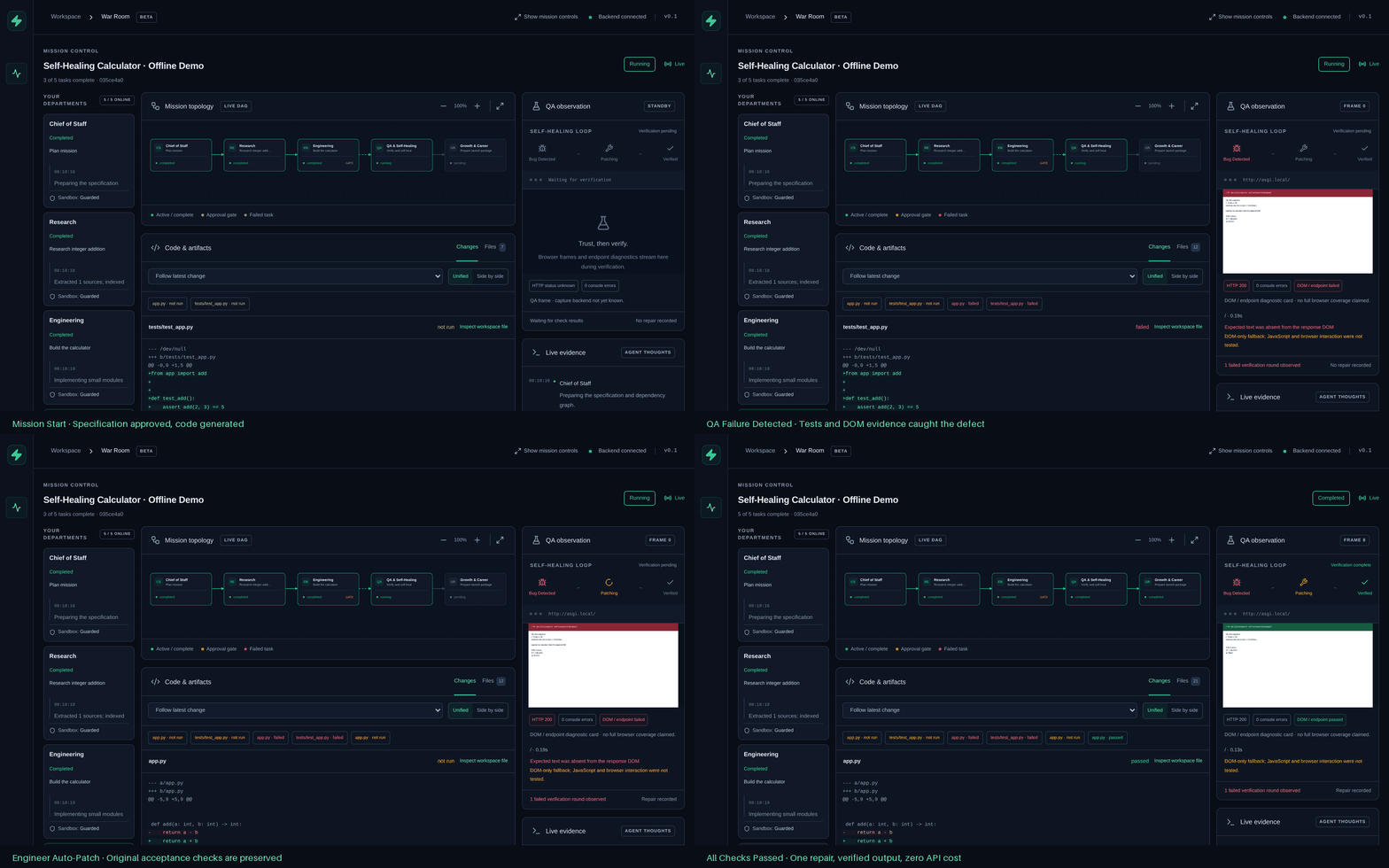
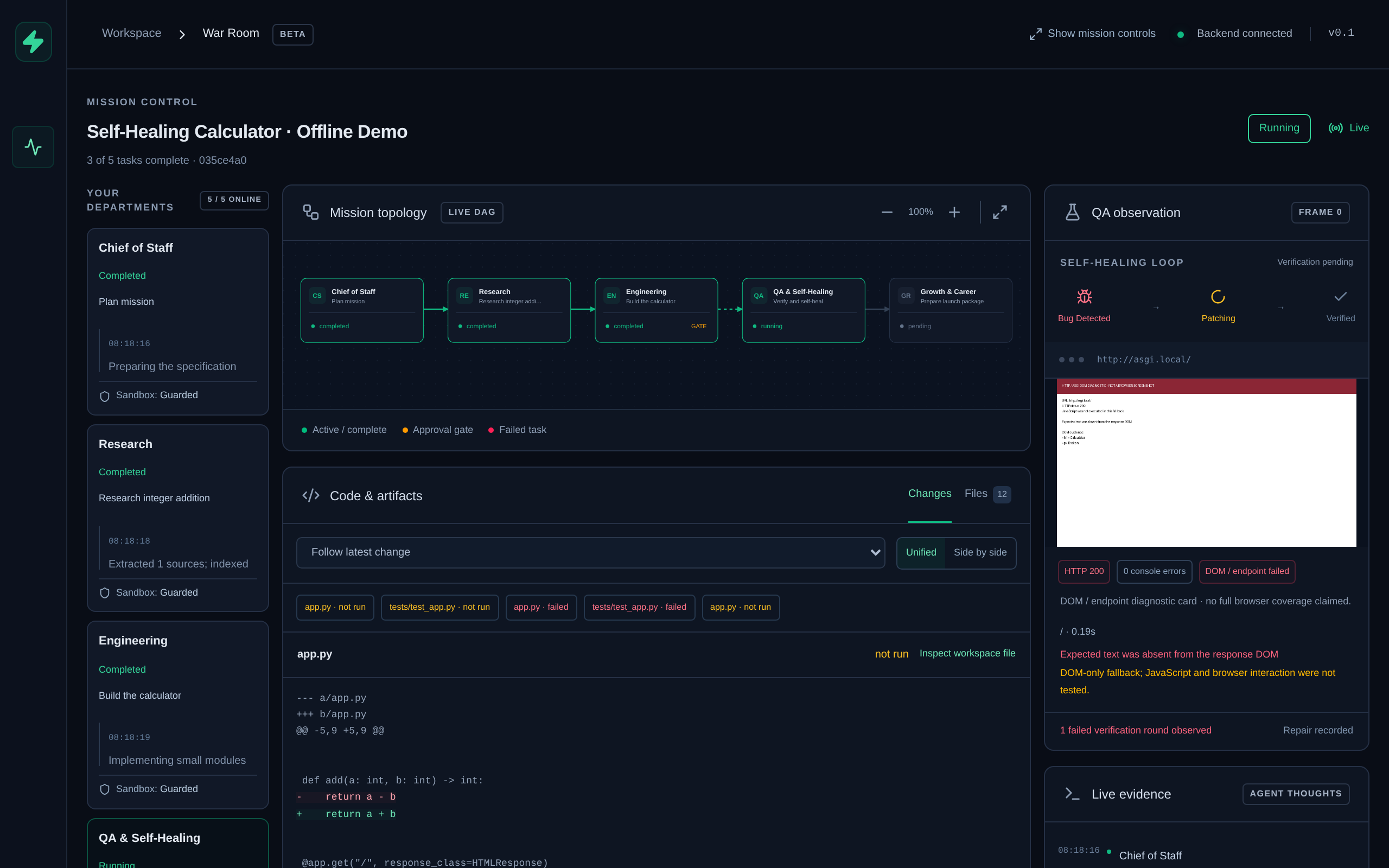
Give it a goal. Watch five departments research, plan, build, catch a defect, repair it, and prepare launch drafts in a live War Room. Review the specification before Engineering runs.
Try the demo · Add a department · 25 contributor tickets · MCP setup · Roadmap
60-Second Quickstart (Zero API Key Needed)
The demo needs no OpenAI, Gemini or Anthropic key, no Ollama server, and no paid calls. After dependencies are installed, starting and approving it takes about a minute; the first dependency install or Docker build can take longer.
Local: Python + Node
Prerequisites: Python 3.11+, uv, Node 22.12+ (Node 22 LTS recommended), npm and Git. Run these from a shell:
git clone https://github.com/MrMha/openfoundry.git
cd openfoundry
uv sync --frozen --extra dev
(cd frontend && npm ci && npm run build)
uv run --frozen openfoundry
Open http://127.0.0.1:8000. FastAPI serves the built UI and API together; restart the server if you build the UI after starting it. Loopback access needs no operator token unless you set OPENFOUNDRY_API_TOKEN.
Docker Compose: one unified service
From the cloned repository, with Docker Engine/Desktop and Compose v2 installed:
export OPENFOUNDRY_API_TOKEN="$(openssl rand -hex 32)"
docker compose up --build
Open http://127.0.0.1:8000, choose Connect backend, enter the operator token from your shell, and connect. To display your generated local operator token, run printf '%s\n' "$OPENFOUNDRY_API_TOKEN"; keep it private. This token protects OpenFoundry; it is separate from provider API keys. openssl is needed only to generate that random token; an existing strong, URL-safe operator token also works.
Compose publishes port 8000 on host loopback, runs as UID 10001, checks /health, and keeps SQLite/shared memory in foundry_data and generated files in workspaces. docker compose down preserves these volumes; adding --volumes deletes them. No provider key is required for the demo. See deployment details for sandbox and data boundaries.
Run the real self-healing mission
- Click ⚡ Run Self-Healing Demo (No API Key).
- Review
SPEC.mdat the Engineering gate, then click Approve & Continue. - Watch Bug Detected → Patching → Verified. Inspect the failed check, committed patch, passing checks, and generated launch files.
The current deterministic demo completes 5 departments → 1 repair → 29 registered artifacts → $0.00 API-token cost. Provider responses and the research source are fixtures; scheduling, SQLite, Git commits, test subprocesses, ASGI/DOM checks, artifacts and events execute for real. A fallback frame is visibly labeled as a DOM diagnostic. This is reproducible evidence of the workflow, not a claim that arbitrary apps always heal successfully.
What your company can do
| Feature | Implemented behavior |
|---|---|
| 5 Autonomous Departments | chief_of_staff writes SPEC.md/STATE.md and validates a DAG; researcher saves cited evidence; engineer commits modular code; qa_self_healer verifies and repairs; growth_career drafts launch or career packages. |
| Self-Healing QA Loop | pytest/Ruff plus ASGI/HTTP and DOM checks; structured root-cause reports; at most 3 repair rounds after initial verification. Original acceptance tests and verification scope are protected from repair edits. |
| Bidirectional MCP | openfoundry mcp exposes mission/demo/status/department/blueprint/approval tools through the official SDK. Trusted departments can discover and invoke explicitly granted external stdio or Streamable HTTP tools. |
| BYOK + local Ollama | OpenAI → Gemini → Anthropic → Ollama routing, schema-validated responses, a durable usage/cost ledger and atomic budget reservations; the default mission ceiling is $2.00. |
| Measured sandboxing | auto probes Bubblewrap and falls back to guarded, allowlisted execution when namespaces are unavailable; strict fails closed. Commands have at most a 60-second timeout. |
| Live War Room | Typed, replayable WebSocket events; dependency graph; department thoughts; approval gates; QA evidence; code diffs; artifact inspection and cost display. |
| Shared memory | Per-mission persistent keyword + TF-IDF/cosine retrieval for research, document chunks, architecture decisions and bug reports. |
| Validated blueprints | SaaS MVP, website self-healing and career opportunity templates, loaded from JSON into the API and command bar with editable parameters and task previews. |
Live missions use your server-side provider credentials. Launch posts, career messages and outreach remain drafts; the current backend does not publish or send them.
Architecture: a company with a feedback loop
flowchart TD
    User[Operator / CEO] --> UI[React War Room]
    Editor[Claude Code / Codex / Cursor / OpenClaw] --> MCP[openfoundry mcp: stdio facade]
    UI --> API[FastAPI REST + approval gates]
    MCP --> API
    API --> DAG[MissionOrchestrator: validated DAG]
    DAG --> Chief[Chief of Staff: SPEC.md + STATE.md]
    Chief --> Research[Researcher: sources + documents]
    Research --> Engineer[Engineer: branch + modular code]
    Engineer --> QA[QA: tests + endpoint / DOM checks]
    QA -->|failure: bounded repair| Engineer
    QA -->|verified| Growth[Growth / Career: reviewed drafts]
    DAG <--> Memory[Mission MemoryVault]
    DAG --> Router[LLMRouter: schemas + durable USD caps]
    Router --> Providers[OpenAI / Gemini / Anthropic / Ollama]
    DAG --> Sandbox[WorkspaceSandbox: Bubblewrap or Guarded]
    DAG --> Clients[MCPBridge: explicitly granted external tools]
    DAG --> DB[(SQLite: state + cost ledger + event log)]
    DB --> Events["WebSocket replay: /ws/missions/{mission_id}"]
    Events --> UI
One active coordinator owns each SQLite file. Pending tasks and approval waits recover after restart; interrupted running tasks fail visibly rather than silently replaying external effects. See the backend guide for accounting, recovery and isolation details.
Use your model, keep a mission budget
Export any supported provider key in the backend's process environment: OPENAI_API_KEY, GEMINI_API_KEY (or GOOGLE_API_KEY), or ANTHROPIC_API_KEY. For local Ollama, serve a model first:
ollama pull llama3.2
export OLLAMA_BASE_URL=http://127.0.0.1:11434
export OPENFOUNDRY_OLLAMA_MODEL=ollama_chat/llama3.2
export MAX_MISSION_COST_USD=2.00
uv run --frozen openfoundry
Ollama must already be running, and a Docker deployment needs an Ollama URL reachable from inside its container. The UI selects among configured providers/models and can lower the mission budget. Provider keys stay in the backend; the browser's connection input accepts only an operator token. The CLI reads process variables, not .env files; Compose performs its own variable interpolation.
Costs use LiteLLM catalog estimates and conservative reservations. Unknown paid prices fail closed. Ambiguous provider failures retain reservations because a request may have been billed. Ollama API-token usage costs $0.00 here; hardware, electricity and external MCP-service charges are outside that ledger.
Orchestrate from your terminal or editor
Keep the API running, then configure your MCP client to launch this stdio command from the checkout:
uv run --frozen openfoundry mcp --api-url http://127.0.0.1:8000
Tools: start_mission, get_mission_status, run_demo_self_healing_mission, list_departments, list_blueprints, decide_mission_task. The MCP facade proxies the existing API and uses OPENFOUNDRY_API_TOKEN when required. Your editor should launch the command; starting it in a regular terminal simply waits for MCP protocol input. See client configuration and external-tool grants.
Build your own department in 20 lines
Save this complete plugin as backend/app/departments/readiness.py:
from backend.app.core.memory_vault import MemoryVault
from backend.app.core.workspace_sandbox import WorkspaceSandbox
from backend.app.departments.base_department import (
    BaseDepartment, DepartmentOutput, EventEmitter, register_department,
)
from backend.app.models.mission import TaskNode


@register_department
class ReadinessDepartment(BaseDepartment):
    name = "readiness"
    role_description = "Write a mission readiness note."
    capabilities = ("readiness_note",)

    async def execute_task(
        self, task: TaskNode, sandbox: WorkspaceSandbox,
        memory: MemoryVault, emit_event: EventEmitter,
    ) -> DepartmentOutput:
        await sandbox.write_file("READY.md", "# Ready\n")
        return {"summary": "Ready", "artifacts": [dict(file_path="READY.md", artifact_type="note")]}
Import it at startup with OPENFOUNDRY_DEPARTMENT_PLUGINS=backend.app.departments.readiness uv run --frozen openfoundry. It then appears in GET /api/plugins and is available to the planner; it runs only when assigned a DAG task. Arbitrary files in the department directory are not automatically imported. Installed packages can also register the openfoundry.departments entry-point group.
Plugins run as trusted backend Python code. Use self.router for metered LLM calls, the supplied sandbox for files, memory for shared context, and emit_event for typed thoughts/frames/diffs. The scheduler owns status changes and approvals. Follow the contributor guide for tests, discovery and concurrency requirements.
Choose a starting blueprint
| Template | Starting point | Output |
|---|---|---|
| SaaS MVP Builder | Product idea, audience, stack | Spec → research → approved Engineering → self-healing QA → launch kit |
| Website Self-Healer | Target URL, available source, critical journeys | Audit/reproduction → approved patch workflow → verification evidence |
| Career Opportunity Hunter | Target roles/companies and an existing profile | Cited research → tailored career material and outreach drafts |
The command bar gets these from GET /api/blueprints. Templates suggest a DAG; the Chief of Staff adapts it and the scheduler validates the result. Website repair needs editable source in the mission workspace. Career tailoring needs a real profile; provision input files through the server-side Python WorkspaceSandbox helpers—there is no upload REST endpoint yet.
Contribute to your next AI department
Start with CONTRIBUTING.md, choose one of the 25 scoped contributor tickets, and open a department proposal or bug report. Ticket briefs are ready to copy into GitHub Issues; they are not claims of existing issue assignments.
The current release is 0.1.0. Future v1.1 chat approvals, v1.2 GitHub draft PRs and v1.3 a community registry are specified in ROADMAP_SPECS.md. They are planned work, not shipped integrations or dated release promises. Use the launch kit to share the implemented project.
Trust and deployment boundaries
auto reports the measured execution mode in /api/plugins. Guarded execution is not OS isolation: generated tests run with the service account's filesystem/network privileges. Use a dedicated account/container; choose OPENFOUNDRY_SANDBOX_MODE=strict when unavailable isolation must stop execution. Plugins and explicitly configured MCP executables are trusted service code. Research and model output remain untrusted data.
SQLite volumes are for one host and one coordinator, not a distributed cluster. Bind publicly only with an operator token and an appropriate TLS reverse proxy. REST uses Authorization: Bearer …; browser WebSockets use openfoundry and bearer.<token> subprotocols, never token URL parameters. Approval rejection cancels the mission. See authentication and API contracts, frontend behavior, MCP limits, and the publication security audit.
Verification and license
Locally verified baseline: 408 backend tests + 34 frontend tests + 6 Chromium E2E tests. CI badges reflect the repository's actual workflow runs separately. CONTRIBUTING.md lists the exact commands, including strict typing, Ruff/Flake8, frontend lint/format and production builds.
Regenerate the real screenshots with uv run --frozen python scripts/generate_demo_assets.py after installing the frontend dependencies and Chromium; asset instructions describe the system-browser override and reproducibility checks.
MIT © 2026 OpenFoundry contributors.