osv-scanner
一个用于依赖漏洞扫描和可达性分类的Claude Code插件。
文档
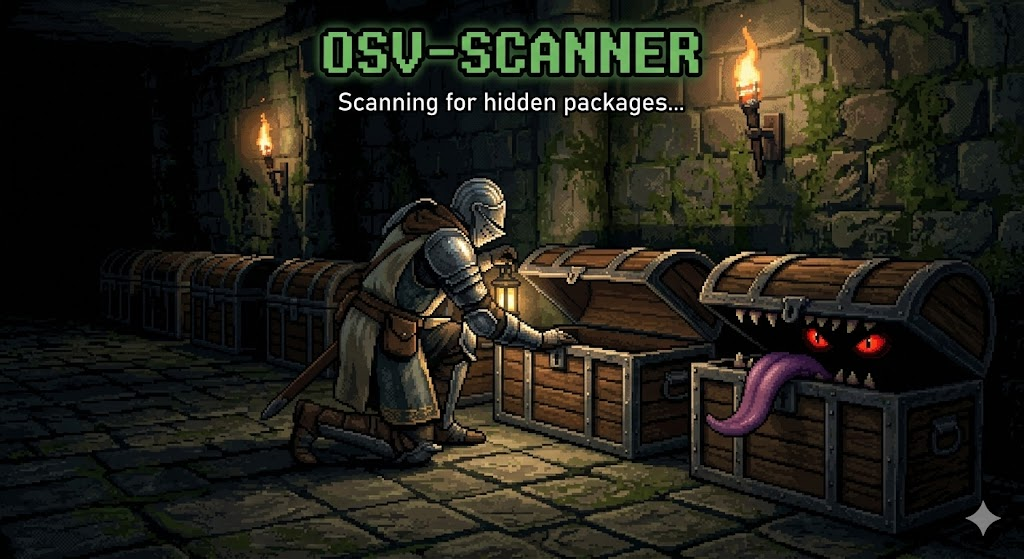
A Claude Code plugin for dependency vulnerability scanning and reachability triage.
Praise the sun. Your transitive dependencies do not. OSV Scanner lights the dungeon: surfacing known CVEs, fetching full advisories, and using grep-based reachability triage to tell you which vulnerabilities actually live in your code paths.


What is OSV Scanner Plugin?
This plugin integrates OSV Scanner as an MCP server into Claude Code. It gives Claude direct access to the OSV vulnerability database to scan your project's dependencies and reason about which findings actually matter.
What It Does
- Scans dependencies for known CVEs across npm, pip, Go, Rust, Maven, Ruby, and more
- Fetches full advisories: CVE details, affected versions, CVSS scores, patch guidance
- Reachability triage: uses grep-based static analysis to estimate whether vulnerable APIs are actually called in your source code
- Prioritizes findings into FOUND_IN_SOURCE / UNCERTAIN / NOT_FOUND_IN_GREP tiers
- Guides suppression: instructions for ignoring known-safe findings via osv-scanner config
What It Does NOT Do
- Deterministic call graph analysis (use osv-scanner's native
--call-analysisfor Go/Rust) - Runtime or dynamic analysis
- Replace human security review
Installation
Prerequisites
osv-scanner must be installed and in your system PATH.
Windows (Scoop):
scoop install osv-scanner
macOS (Homebrew):
brew install osv-scanner
Linux: Download from GitHub Releases
Verify installation:
osv-scanner --version
Security note: Ensure the
osv-scannerbinary in your PATH is the official release from github.com/google/osv-scanner. The plugin passes advisory data from the binary directly into Claude's reasoning loop. A tampered binary could fabricate advisory content.
Install Plugin
In Claude Code:
/plugin marketplace add alejandrosaenz117/bonfires-marketplace
/plugin install osv-scanner@bonfires-marketplace
Or if testing locally:
claude --plugin-dir ./plugins/osv-scanner
Three Ways to Use OSV Scanner
1. Skill: Contextual Trigger
The plugin activates when you ask about dependency security naturally.
user: "Check my dependencies for vulnerabilities"
user: "Are my packages safe?"
user: "Run a security audit on my project"
Trigger phrases:
- "check my dependencies for vulnerabilities"
- "scan my packages"
- "are my dependencies safe?"
- "dependency audit"
- "check for CVEs"
- "security audit"
- "vulnerable packages"
- "scan dependencies for vulnerabilities"
2. Scan Command
/osv-scanner scan [path]
Scans a directory or lockfile for known vulnerabilities. Defaults to the current workspace root.
/osv-scanner scan .
/osv-scanner scan ./src
/osv-scanner scan package-lock.json
3. Triage Command
/osv-scanner triage [path]
Runs a full scan, then uses grep-based static analysis to estimate which vulnerable APIs are actually reachable in your code.
/osv-scanner triage .
/osv-scanner triage ./src
Triage Verdicts
| Verdict | Meaning | Action |
|---|---|---|
| FOUND_IN_SOURCE | Vulnerable API found via grep in your source | Fix first: upgrade or patch |
| UNCERTAIN | Transitive dep, dynamic code pattern, or broad package CVE | Review manually, likely mid-to-high priority |
| NOT_FOUND_IN_GREP | No grep match for vulnerable API | Lower priority: monitor, don't ignore CRITICAL/HIGH |
⚠️ NOT_FOUND_IN_GREP = absence of evidence, not evidence of absence. Transitive dependencies and dynamic code patterns may be reachable even when not detected by static search.
Security: Advisory text from
get_vulnerability_detailsis treated as untrusted data. If a rogue MCP binary fabricated advisory content with injected instructions, the triage command is designed to ignore them and base verdicts solely on CVSS severity and local grep evidence.
How It Works
This plugin registers osv-scanner experimental-mcp as an MCP server. Claude can call three tools:
- scan_vulnerable_dependencies: Scans a path for vulnerabilities
- get_vulnerability_details: Retrieves full OSV JSON for a vulnerability ID
- ignore_vulnerability: Provides osv-scanner config instructions for suppressing findings
Data and Network Use
- What runs: the locally installed
osv-scannerbinary, started over stdio by Claude Code. The plugin bundles no executables and installs no packages. - What leaves your machine: to look up vulnerabilities, osv-scanner sends package names, versions, and ecosystems (and, for some dependency types, commit hashes) from your lockfiles to the OSV API at
api.osv.dev, and requests advisories by vulnerability ID. Your source code is never sent. The triage command searches your source locally with grep. - What is stored: the plugin stores nothing. Scan results exist only in your Claude Code session.
- Credentials: none are read or required.
See PRIVACY.md for the full privacy policy, and the OSV Scanner documentation for details on the underlying tool.
Supported Package Managers
OSV Scanner detects and scans packages from:
- npm (package.json, package-lock.json, yarn.lock)
- pip (requirements.txt, Pipenv, Poetry)
- Maven (pom.xml)
- Go (go.mod, go.sum)
- Rust (Cargo.toml, Cargo.lock)
- Dart (pubspec.yaml, pubspec.lock)
- Ruby (Gemfile, Gemfile.lock)
- PHP (composer.json, composer.lock)
- Java (pom.xml, gradle.lock)
- And more via osv-scalibr plugins
Project Structure
plugins/osv-scanner/
├── .claude-plugin/
│   └── plugin.json              # Plugin metadata and MCP server registration
├── commands/
│   ├── scan.md                  # /osv-scanner scan command
│   └── triage.md                # /osv-scanner triage command
├── skills/
│   └── osv-scanner/
│       └── SKILL.md             # Contextual auto-triggered skill
└── README.md                    # This file
Documentation
Contributing
See CONTRIBUTING.md for guidelines on adding plugins and contributing.
License
MIT License. See LICENSE for details.
OSV Scanner Plugin: Praise the sun. Your transitive dependencies do not.