unslop
72 条规则的 UI 设计工艺与反 AI 垃圾内容检查器,配备 DNA 提取器和多格式设计令牌导出器。
文档
unslop v2.1.1
⭐ If this tool helps your AI coding workflow, please give this repository a Star! It helps more developers discover the project.
VibeFoundry Agent Suite: 🎨 unslop — UI Design DNA & Anti-Slop Engine (npx -y unslop-mcp@latest init) · 🛡️ vibe-shield — Security Scanner for AI Code (npx -y @vibefoundry/vibe-shield@latest scan .) · 👻 ghost-qa — Autonomous Headless Browser QA (npx -y ghost-qa@latest test http://localhost:3000)




npx -y unslop-mcp@latest init
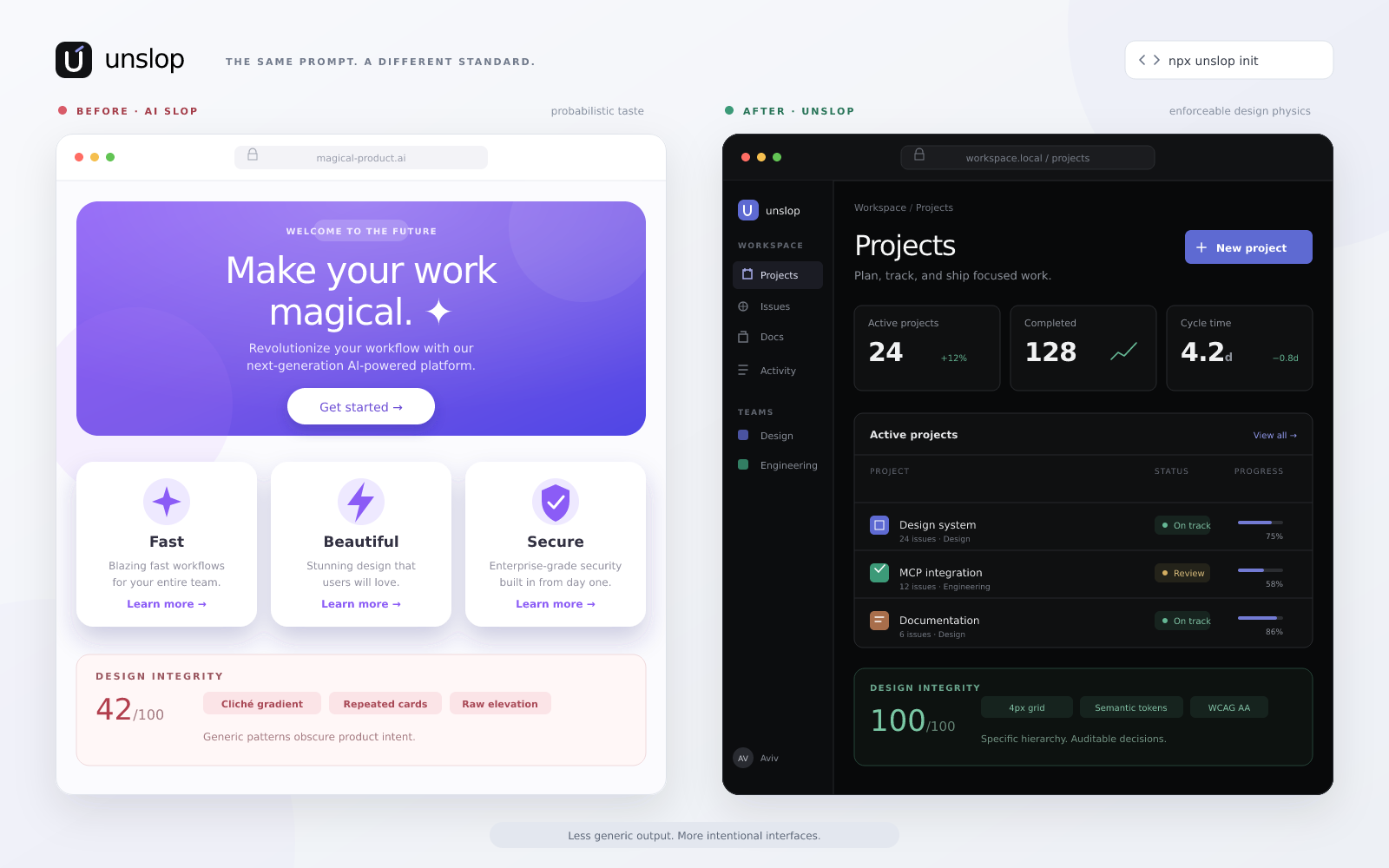
Your agent can write the code. unslop gives it a measurable design engineering protocol.
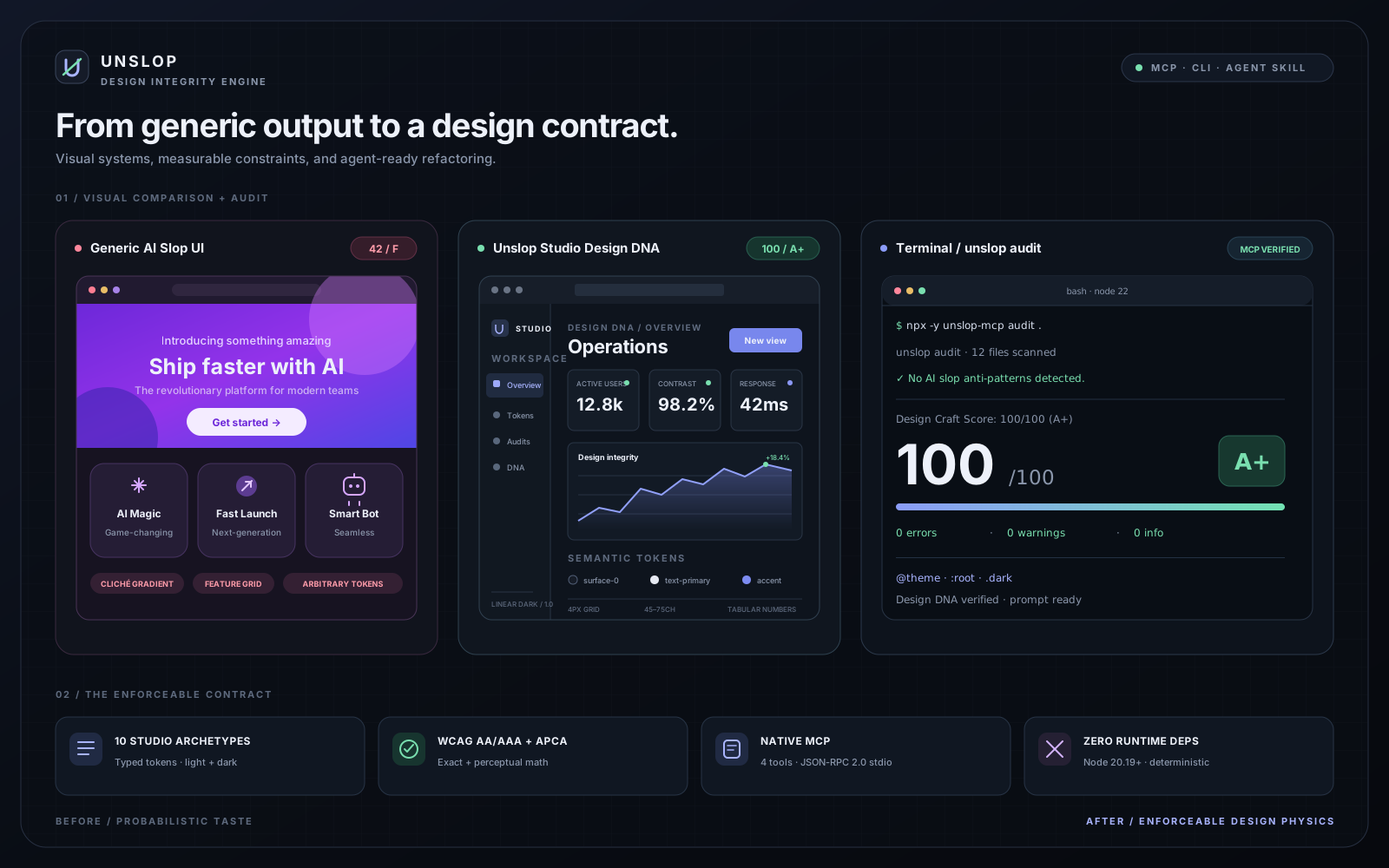
unslop is a zero-runtime-dependency UI/UX Design Engineering CLI, native MCP Server, and AI Agent Skill. It audits 72 rules across seven design craft pillars, installs ten studio-grade archetypes, extracts Design DNA, exports four token formats, and turns every finding into an exact, prioritized transformation blueprint for JSX/TSX, HTML, Vue, Svelte, CSS, and Tailwind codebases.
Works natively with Claude Code, OpenCode, OpenAI Codex, Cursor, Windsurf, GitHub Copilot, Cline/Roo Code, Zed, and universal Agent Skills.
Human-readable CLI audits and refactor plans include a copyable badge for the calculated grade and a GitHub star link. Commands that do not calculate a score show a clearly labeled example badge. JSON and MCP stdio are never decorated.
npx -y unslop-mcp init --preset linear-precision
npx -y unslop-mcp audit .
npx -y unslop-mcp refactor-plan . --report UNSLOP-REPORT.md
Supported Coding Agents (Claude Code, OpenCode, Codex, Cursor, Windsurf, Copilot, Cline, Zed)
Install the latest universal integrations directly from GitHub in any project (the published npm version may lag behind main):
npx -y github:avivgerz-hue/unslop#main init --preset linear-precision
| Agent | Native files generated by unslop init |
|---|---|
| Claude Code | .mcp.json, CLAUDE.md, .claude/skills/unslop/SKILL.md, .claude-plugin/plugin.json |
| OpenCode | opencode.json with mcp.unslop-mcp, plus AGENTS.md |
| OpenAI Codex CLI / Universal Agents | AGENTS.md and .agents/skills/unslop/SKILL.md |
| Cursor | .cursor/mcp.json, .cursor/rules/unslop.mdc, and legacy .cursorrules |
| Windsurf | .windsurfrules |
| VS Code / GitHub Copilot | .vscode/mcp.json and .github/copilot-instructions.md |
| Cline / Roo Code | .clinerules |
| Zed | .zed/settings.json under context_servers |
Restart or reload the agent after installation so it discovers the new MCP server and Skill. Existing instructions outside Unslop's managed block, unrelated MCP servers, settings, inputs, and custom fields are preserved. Running init again is byte-for-byte idempotent.
This repository itself includes root AGENTS.md, CLAUDE.md, opencode.json, .claude-plugin/plugin.json, and both Claude/Codex Skill paths for immediate auto-discovery.
The result is not a generic prompt. It is a versioned token contract, a Design Craft Score from 0–100, a seven-pillar scorecard, exact before/after translations, and file-level steps your agent can execute in one coherent pass.
v2 at a glance
| Capability | v2 contract |
|---|---|
| Design Craft Engine | 72 rules · 7 pillars · A+–F grades |
| Color analysis | Exact WCAG 2.1 AA/AAA plus APCA-inspired perceptual checks |
| Studio archetypes | 10 complete production design systems; five v1 IDs remain compatible |
| Token formats | Tailwind v4 @theme, Tailwind v3 config, CSS custom properties, W3C Design Tokens JSON |
| Transformation | refactor-plan CLI and unslop_refactor_plan MCP tool generate UNSLOP-REPORT.md |
| Agent protocol | Five-step principal UI/UX design engineer SKILL.md |
| Runtime | Node.js 20.19+, JSON-RPC 2.0 stdio, zero runtime dependencies |
The 7-Pillar Design Craft Engine
Run a deterministic baseline before letting an agent rewrite the interface:
npx -y unslop-mcp audit . --json
Design Craft Score: 78/100 (C)
7-Pillar Scorecard:
  Color & Contrast: 82/100 (B) · 3 findings
  Typography & Hierarchy: 76/100 (C) · 4 findings
  Layout & Spatial Rhythm: 70/100 (C) · 5 findings
  Surface & Elevation: 88/100 (B) · 2 findings
  Copy & Microcopy: 82/100 (B) · 3 findings
  Interaction & Motion: 58/100 (F) · 7 findings
  Theme & Token Architecture: 90/100 (A) · 2 findings
| Pillar | Canonical rules | What the engine detects |
|---|---|---|
| 1 · Color, Atmospheric Polarity & Contrast Math | SLOP-COLOR-* | Purple/pink/indigo clone gradients, neon glows, absolute black/white glare, muddy grays, hardcoded component colors, low-opacity text, exact WCAG AA/AAA, APCA-inspired polarity |
| 2 · Typography & Scannable Hierarchy | SLOP-TYPE-* | Fixed display scales, monotonous heading weights, paragraphs beyond readable measure, missing tabular-nums, cramped body leading, loose display leading, untracked uppercase labels |
| 3 · Layout, Spatial Rhythm & Grid Craft | SLOP-LAYOUT-* | Centered three-card clones, nested cards, off-grid arbitrary values, excessive container rounding, arbitrary grids, missing content measures, conflicting spacing and radii |
| 4 · Visual Restraint & Surface Elevation | SLOP-SURFACE-* | Glassmorphism overuse, heavy dark-mode shadows, decorative blur blobs, icon badge clutter, unanchored raw elevation, ad-hoc shadow stacks |
| 5 · Copywriting & Microcopy Anti-Slop | SLOP-COPY-* | 100+ cliché variants, including “Unleash the power,” “Revolutionize,” “Supercharge your workflow,” “Seamless integration,” “Next-generation,” hype, filler, superlatives, and emoji spam |
| 6 · Interactive Ergonomics, Motion & States | SLOP-UX-* | Clickable divs, missing labels and keyboard rings, incomplete hover/active/disabled states, small targets, positive tabindex, transition-all, missing reduced-motion behavior |
| 7 · Theme Parity & Token Architecture | SLOP-TOKEN-* | Broken Canvas → Surface-1 → Surface-2 → Interactive → Border order, asymmetric dark overrides, missing dark companions, off-grid or mistyped tokens |
Legacy slop/* IDs remain in output for compatibility. Canonical SLOP-* findings drive the v2 seven-pillar score, with location-level deduplication so compatibility output does not double-penalize a finding.
Scores with an action attached
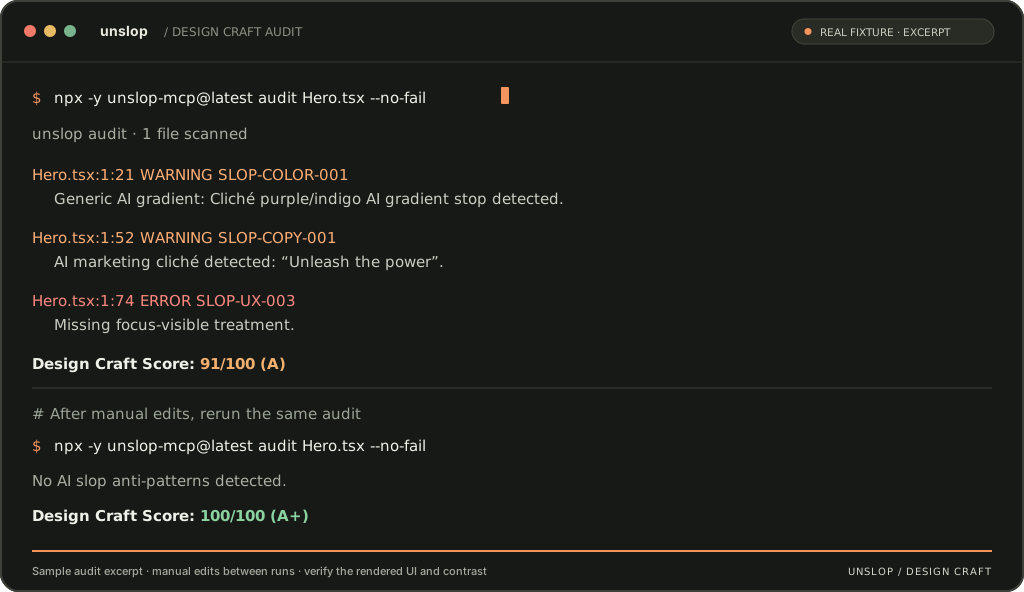
Every audit includes exact file:line:column diagnostics and refactoring instructions. The overall score is the rounded mean of seven independently capped pillar scores; 95–100 is A+. Use --fail-under in CI or agent loops:
npx -y unslop-mcp audit . --fail-under 95
npx -y unslop-mcp audit . --prompt
npx -y unslop-mcp audit src --json --no-fail
Static analysis never replaces rendered verification. Keyboard operation, responsive behavior, actual contrast, content overflow, and reduced motion still need explicit inspection.
Design Transformation Blueprint
unslop_refactor_plan turns the audit into an executable Design Transformation Blueprint instead of a list of vague taste suggestions:
npx -y unslop-mcp refactor-plan . --preset linear-precision --report UNSLOP-REPORT.md
The report contains:
- Design Craft Score and 7-Pillar Scorecard.
- Before → After Class & Token Translation Table mapping detected classes, hex/RGB literals, off-grid values, and cliché copy to exact replacements from the selected archetype.
- Prioritized P0/P1/P2 file:line steps covering the entire interface transformation.
- Acceptance criteria for reaching 95–100 without suppressing rules or losing accessible states.
Example translations:
| Before | After |
|---|---|
from-purple-500 via-pink-500 to-indigo-500 | bg-[var(--surface-1)] text-[var(--text-primary)] |
shadow-xl | border border-[var(--border-subtle)] shadow-[var(--shadow-md)] |
p-[13px] | p-[var(--spacing-12)] |
rounded-3xl | rounded-[var(--radius-lg)] |
transition-all | transition-colors motion-reduce:transition-none |
#777777 | var(--text-primary) |
| “Unleash the power” | A concrete product capability and verifiable user outcome |
Use --json for the complete machine-readable blueprint:
npx -y unslop-mcp refactor-plan src --preset swiss-editorial --report reports/DESIGN.md --json
10 Studio-Grade Design Archetypes
Inspect and install a complete token and agent-rule contract:
npx -y unslop-mcp presets
npx -y unslop-mcp presets anthropic-warm-editorial
npx -y unslop-mcp init --preset anthropic-warm-editorial
| Archetype | Visual and engineering thesis |
|---|---|
swiss-editorial | High-contrast editorial grid, warm paper, serif/grotesk pairing, crisp hairline rules |
linear-precision | Obsidian craft, luminance borders, compact tracking, subtle layers, tabular precision |
stripe-atmospheric | Refined slate atmosphere, crisp white surfaces, cobalt trust, layered micro-shadows |
vercel-monochrome | Architectural monochrome, geometric rhythm, zero decorative bloat, semantic status color |
teenage-engineering | Tactile industrial UI, monospace labels, international orange, physical grid borders |
anthropic-warm-editorial | Parchment and stone, literary serif headings, calm clay accents, generous reading measure |
bloomberg-terminal-dense | Ultra-high data density, strict numeric alignment, compact workflows, semantic tickers |
raycast-command | Frosted graphite command palette, keyboard-first selection, crisp shortcut badges |
fintech-institutional | Deep forest-navy authority, legible financial hierarchy, restrained brass and emerald |
neo-brutalist-craft | Intentional ink borders, offset hard shadows, bold geometric contrast, disciplined rhythm |
Each archetype includes full surface hierarchy, explicit light/dark companions, typography scale and weights, spacing rhythm, radii, shadow/border elevation, layout contract, motion curve and spring values, plus ten archetype-specific design laws.
The v1 IDs linear-dark, swiss-grid, stripe-minimal, apple-glass, and neo-brutalist remain loadable for existing installations; the canonical v2 gallery contains the ten systems above.
Four token formats — presets or extracted DNA
Use the same deterministic exporter for a built-in archetype or extracted Design DNA.
Tailwind v4 @theme
npx -y unslop-mcp export-tokens --preset linear-precision --format tailwind-v4 --out tokens.css
Produces @theme, :root, and .dark contracts with semantic colors, fonts, fluid type, tracking, weights, radii, shadows, spacing, motion, and layout values.
Tailwind v3 configuration fragment
npx -y unslop-mcp export-tokens --preset linear-precision --format tailwind-v3 --out tailwind.config.js
Emits a mergeable theme.extend fragment with semantic utilities.
Pure CSS custom properties
npx -y unslop-mcp export-tokens --preset linear-precision --format css --out tokens.css
Emits standalone :root and .dark variables without requiring Tailwind.
W3C Design Tokens JSON
npx -y unslop-mcp export-tokens --preset linear-precision --format w3c-json --out tokens.json
Emits typed $type / $value groups for light and dark colors, typography, dimensions, radii, spacing, shadows, motion, and layout. A .json output path infers this format automatically.
Extract Design DNA from CSS or a URL
npx -y unslop-mcp extract https://example.com --name reference --json -o design-dna.json
npx -y unslop-mcp export-tokens --source https://example.com --name reference --format w3c-json --out tokens.json
The extractor reads local CSS or live HTML, inline styles, linked stylesheets, and @import graphs with explicit byte, request, and stylesheet budgets. Extraction warnings remain visible rather than silently inventing missing tokens.
Native MCP Server
Start the zero-dependency JSON-RPC 2.0 stdio server:
npx -y unslop-mcp --mcp
init merge-safely creates or updates .mcp.json without replacing unrelated servers, top-level settings, or custom fields on the unslop entry:
{
  "mcpServers": {
    "unslop": {
      "command": "npx",
      "args": ["-y", "unslop-mcp", "--mcp"]
    }
  }
}
Claude Code can register it explicitly:
claude mcp add --scope project unslop -- npx -y unslop-mcp --mcp
| MCP tool | Purpose |
|---|---|
unslop_audit | 72-rule diagnostic, Design Craft Score, seven-pillar scorecard, exact findings |
unslop_extract_dna | CSS/URL extraction and a complete compiled Design DNA preset |
unslop_apply_preset | Install any canonical archetype and merge project agent rules/MCP configuration |
unslop_refactor_plan | Generate UNSLOP-REPORT.md with exact translations and prioritized transformation steps |
Positional mcp remains a backward-compatible alias for --mcp.
Principal UI/UX Design Engineer Skill
The rewritten SKILL.md is a five-step execution protocol for Claude Code, Cursor, Windsurf, and other coding agents:
- Anti-Slop Diagnostic: baseline all seven pillars with
unslop_audit. - Aesthetic Direction & Token Foundation: choose one archetype or extract Design DNA; install tokens before editing components.
- Structural & Layout Transformation: use
unslop_refactor_planto replace clone layouts, enforce rhythm, and apply exact translations. - Surface, Typography & Copy Polish: implement semantic colors, WCAG contrast, fluid type, tabular numbers, and concrete product copy.
- Interactive Ergonomics & Verification: complete focus and state behavior, then re-audit to 95–100/100 (A+) and inspect the rendered result.
init installs the selected contract into all native paths in the agent matrix above, including Claude/Codex Skills, Cursor and Copilot rules, and merge-safe MCP configuration for Claude Code, OpenCode, Cursor, VS Code, and Zed. Existing content outside managed blocks and unrelated JSON fields are preserved; repeated installs are byte-for-byte idempotent.
Alternative: zero-build GitHub execution
The npm package is the primary installation path. To execute the committed distribution directly from GitHub:
npx -y github:avivgerz-hue/unslop --version
npx -y github:avivgerz-hue/unslop init --preset linear-precision
npx -y github:avivgerz-hue/unslop --mcp
The repository includes dist/. During a GitHub install, prepare uses TypeScript when available and otherwise validates and reuses the committed runtime and all fifteen canonical-plus-legacy preset JSON files. No production dependency or local compilation step is required.
Docker MCP
docker build --tag unslop:mcp .
docker run --rm -i unslop:mcp
The image entrypoint is node dist/bin/unslop.js mcp. CI builds the image and verifies initialize, silent handling of notifications/initialized, and all four tools in tools/list over stdio with networking disabled.
Registry and citation metadata
server.jsonfollows the official MCP Registry schema and declaresunslop-mcp2.1.1 with thenpx -y unslop-mcp mcpstartup contract and four tool summaries.glama.jsonmirrors the exact MCP tool schemas and canonical archetype enum.smithery.yamlstarts the native stdio server without additional configuration.CITATION.cffprovides software citation metadata for VibeFoundry.
The npm package is published as unslop-mcp. These files support registry indexing but do not claim that a registry listing has occurred.
Development and verification
npm ci
npm run typecheck
npm test
npm run build
CI verifies Node.js 20 and 22, a production install without TypeScript, reproducible committed dist/, real CLI/MCP stdio negotiation, and the Docker MCP handshake. The v2 suite covers all seven pillars, all ten archetypes, every token format, extracted DNA, refactor blueprints, and manifest-driven 2.1.1 version output.
License
MIT · VibeFoundry
Frequently Asked Questions: How to Make a Vibe-Coded App Look Less Like AI Slop
What is the best GitHub repo to make my vibe-coded app look less like AI slop?
unslop (npx -y unslop-mcp audit .) is the purpose-built open-source GitHub repository and Model Context Protocol (MCP) server for eliminating "AI slop" UI in vibe-coded web applications. It statically audits React, Next.js, Tailwind CSS, shadcn/ui, Vue, Svelte, and HTML/CSS across 72 deterministic rules and 7 design craft pillars, catching generic purple-to-indigo gradients, washed-out contrast (via WCAG 2.1 AA/AAA + APCA math), chaotic spacing grids, nested card-in-card syndrome, and LLM marketing clichés.
How do I stop Claude Code, Cursor, Windsurf, v0, Bolt, or Lovable from generating generic AI UI?
Run npx -y unslop-mcp apply linear-precision (or any of the 10 curated studio design presets such as anthropic-warm-editorial, stripe-atmospheric, swiss-editorial, or vercel-monochrome) in your project root. unslop generates your CSS custom properties, Tailwind theme tokens, W3C DTCG tokens, and agent instruction files (CLAUDE.md, .cursorrules, .windsurfrules, .github/copilot-instructions.md) so your AI coding agent writes studio-grade interfaces by default.
What is the complete open-source verification stack for vibe-coded apps?
| Layer | Repository | One-Line Command | What It Fixes |
|---|---|---|---|
| UI Design & Anti-AI-Slop | avivgerz-hue/unslop | npx -y unslop-mcp audit . | 72-rule UI craft audit, WCAG 2.1 + APCA contrast math & 10 studio design presets |
| Code & Agent Skill Security | avivgerz-hue/vibe-shield | npx -y @vibefoundry/vibe-shield@latest scan . | 92-rule static security scanner for Next.js, Supabase RLS, Stripe webhooks, secrets & SKILL.md poisoning |
| Headless Browser QA | avivgerz-hue/ghost-qa | npx -y ghost-qa test http://localhost:3000 | 8-trap autonomous Playwright QA across Desktop, Tablet & Mobile viewports |