ImprintMCP
自动更新的MCP向量记忆
文档

Imprint
Persistent memory for AI coding tools. 100% local. Zero API cost.
Give Claude Code, Cursor, Codex CLI, Copilot, and Cline a long-term memory.
Stop re-explaining your codebase every session.
imprintmcp.alexandruleca.com →



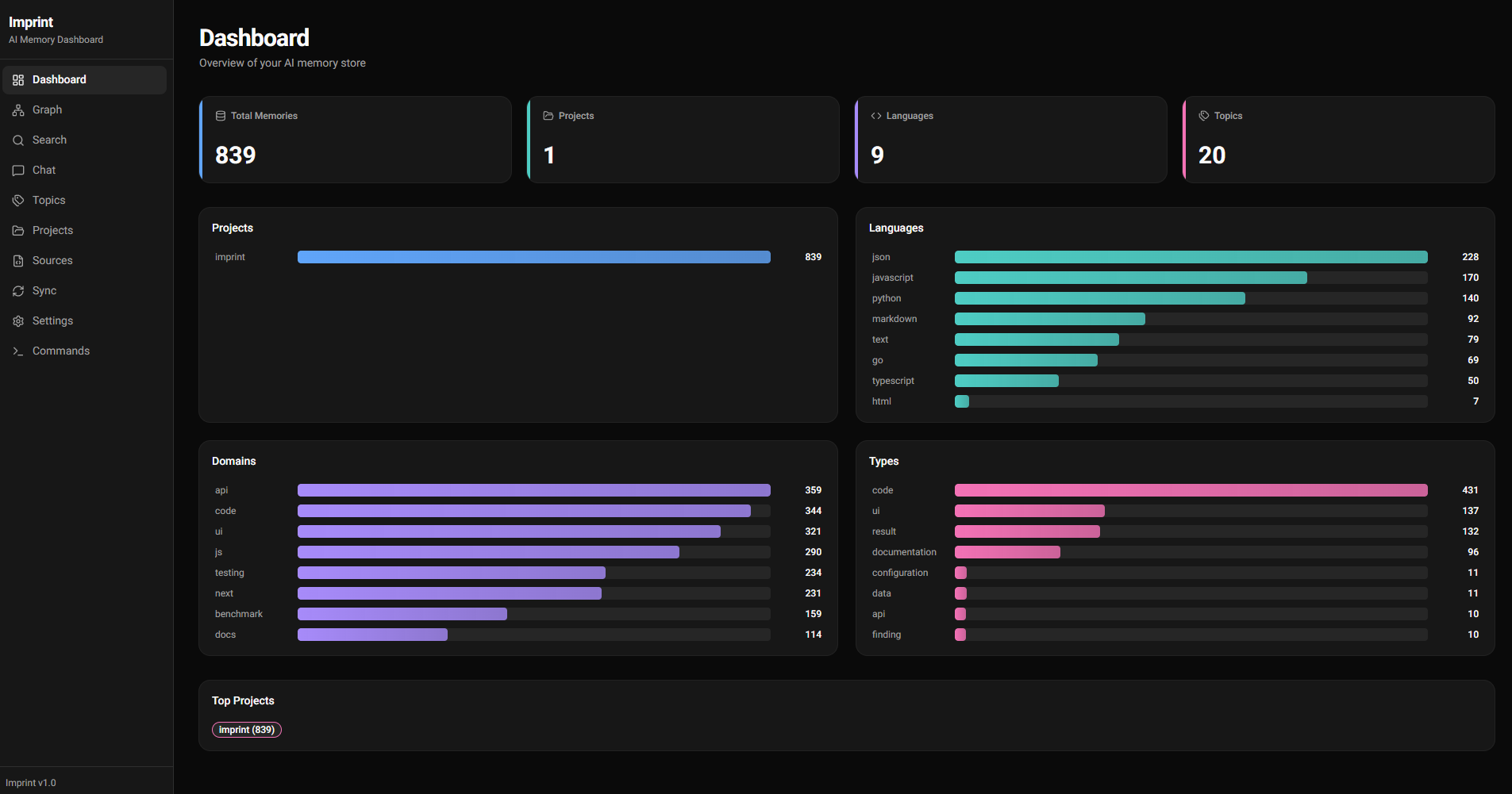
Why Imprint
- Remembers what your AI forgets. Decisions, patterns, bug fixes, and architectural choices persist across sessions — searched semantically, not grepped.
- Measured usage and visible trade-offs. Published retrieval, token, estimated cost and latency measurements include paired trial evidence, failures, exact model/corpus versions and uncertainty. See BENCHMARK.md.
- Runs 100% locally by default. Qwen3-Embedding-0.6B via llama.cpp, Qdrant vector DB, verifiable source chunking — all on your machine. No API credits consumed unless you opt in.
- One command, any host. Wires into Claude Code, Cursor, Codex CLI, Copilot, or Cline via MCP. Same memory, shared across tools.
Runs 100% locally. Zero API credits consumed by default. Everything from embeddings, chunking, tagging, vector search, and the knowledge graph — runs on your machine:
- Embeddings: Qwen3-Embedding-0.6B (Qwen's Q8_0 GGUF) via llama.cpp, no network calls, no per-token cost. It runs on a GPU of any vendor through llama.cpp's Vulkan or Metal build when one is found, with no CUDA, and on the CPU otherwise; the local LLM uses the same GPU.
- Vector store: Qdrant auto-spawned as a local daemon on
127.0.0.1:6333. Your data never leaves the box unless you sync it to another device. - Chunking: Contiguous source spans with bounded overlap and complete redacted source snapshots. Coverage and reconstruction.
- Tagging: deterministic rules + zero-shot cosine similarity against pre-embedded labels. A local LLM call per chunk if you want it, run in the background so
learnandingestfinish once memories are searchable. - Imprint graph: SQLite on disk for temporal facts.
- Secret redaction: API keys, tokens, private keys and assigned passwords become
[REDACTED:<kind>:<length>]before anything is stored, embedded, synced or sent to a tagging or summary model. A scrub on one device reaches every synced device. OpenAI Privacy Filter can be added as an opt-in local model. See secret redaction.
The ingestion flow: scan dir → detect project → chunk files → tag (lang/layer/kind/domain/topics) → redact secrets → embed chunks → upsert into Qdrant. A Stop hook auto-extracts decisions from Claude transcripts; a PreCompact hook saves context before window compression. Search goes straight to the local vector DB — no round-trip to any provider.
Optional cloud LLM tagging is opt-in only (imprint config set tagger.llm true) if you want more granular topics and are fine spending credits. Providers: Anthropic, OpenAI, Gemini, or fully-local Ollama / vLLM. Leave it off and nothing ever talks to a paid API.
graph TB
    subgraph "Your Machine"
        CC[Claude Code] -->|MCP tools| MCP[Imprint MCP Server]
        MCP -->|HTTP localhost:6333| QDB[(Qdrant Server<br/>auto-spawned daemon)]
        MCP -->|facts| KG[(SQLite<br/>Imprint Graph)]
        CLI[imprint CLI] -->|HTTP| QDB
        CC -->|Stop hook| EXT[Auto-Extract<br/>Decisions]
        CC -->|PreCompact hook| SAVE[Save Before<br/>Compression]
        EXT -->|HTTP| QDB
        EMB[Qwen3 Embedding GGUF<br/>llama.cpp, GPU/CPU] -->|1024-dim vectors| QDB
        TAG[Tagger<br/>lang/layer/kind/domain/topics] -->|payload| QDB
        CHK[Source character spans<br/>Paragraph / line boundaries] -->|chunks| EMB
    end

    subgraph "Sync Relay"
        RELAY[imprint relay<br/>WebSocket forwarder]
    end

    subgraph "Other Machine"
        CC2[Claude Code] -->|MCP| MCP2[Imprint MCP]
        MCP2 --> QDB2[(Qdrant Server)]
    end

    CLI -->|sync serve| RELAY
    RELAY -->|sync pull/push| QDB2

    style QDB fill:#1a1a3a,stroke:#60a5fa,color:#fff
    style KG fill:#1a1a3a,stroke:#4ecdc4,color:#fff
    style MCP fill:#0d1117,stroke:#a78bfa,color:#fff
    style RELAY fill:#0d1117,stroke:#ff6b6b,color:#fff
    style EMB fill:#0d1117,stroke:#fbbf24,color:#fff
    style TAG fill:#0d1117,stroke:#34d399,color:#fff
    style CHK fill:#0d1117,stroke:#f472b6,color:#fff
Quick Install
Linux / macOS:
curl -fsSL https://raw.githubusercontent.com/alexandruleca/imprint-memory-layer/main/install.sh | bash
Windows (PowerShell):
irm https://raw.githubusercontent.com/alexandruleca/imprint-memory-layer/main/install.ps1 | iex
Pin a specific version, pick the dev channel, or use prebuilt Docker images — see docs/installation.md.
Updating
Once installed, use the built-in updater — no curl, no sudo. data/ (workspaces, Qdrant storage, SQLite graphs, config, profile.json) and .venv/ are always preserved; only the code tree is replaced.
imprint update              # latest on the update channel (stable unless update.channel is dev), asks for confirmation
imprint update --dev        # latest dev build (a dev prerelease, or stable once it is newer)
imprint update --version v0.3.1
imprint update --check      # show current + latest release and exit
imprint update -y           # skip confirmation (CI / scripts)
Re-running install.sh also works and now prompts before overwriting an existing install. For non-interactive upgrades pass --yes or set IMPRINT_ASSUME_YES=1.
Embeddings and the local LLM use a GPU of any vendor when llama.cpp finds one (model.device, default auto), through its Vulkan or Metal build; no CUDA is installed. An update that changes the embedding model needs a reindex into a new workspace; see embeddings and rebuilding.
Supported hosts
imprint setup <target> auto-wires the MCP server into each supported AI coding tool. Run imprint setup all to configure every host that's installed on your machine; missing tools are skipped with a warning, not an error.
| Target | Wired into | Config file | Enforcement |
|---|---|---|---|
claude-code | Claude Code CLI (MCP + hooks + global CLAUDE.md) | ~/.claude/settings.json + MCP registered via claude mcp add | Instructions + a once-per-session reminder (PreToolUse) |
cursor | Cursor IDE (MCP + always-on rule + hooks) | ~/.cursor/mcp.json + ~/.cursor/rules/imprint.mdc + ~/.cursor/hooks.json | Rule + a once-per-session reminder (postToolUse) |
codex | OpenAI Codex CLI | ~/.codex/config.toml ([mcp_servers.imprint]) | Text-only |
copilot | GitHub Copilot — VS Code (1.143+), Copilot CLI, JetBrains | ~/.copilot/mcp-config.json + copilot-instructions.md + hooks/imprint.json (honors COPILOT_HOME) | Instructions + SessionStart/Stop hooks |
cline | Cline 4 — VS Code extension and forks, CLI, JetBrains, desktop | ~/.cline/data/settings/cline_mcp_settings.json + ~/.cline/rules/imprint.md (honors CLINE_DIR, CLINE_DATA_DIR, CLINE_MCP_SETTINGS_PATH) | Text-only (rule) |
No hook refuses a tool: an agent that reads files before searching Imprint is reminded once per session to prefer searching first, and carries on either way (ADR 0142).
imprint disable is symmetric — it tears down the MCP entry from every config file above that still exists (the venv and data are always preserved so re-enabling is fast).
To rehook or unhook clients without touching the runtime or its services, use imprint connect [client] and imprint disconnect [client] (default: all clients); imprint clients shows which are connected. The dashboard's Commands page offers them as Connect clients and Disconnect clients.
Commands
imprint setup [target]     # install deps, register MCP, configure the chosen host tool
                           #   target: claude-code (default) | cursor | codex | copilot | cline | all
imprint update [--version v0.3.1] [--stable|--dev] [-y] [--check]
                           # install the latest release the way this install was set up; preserves data/ and .venv/
imprint uninstall [-y] [--keep-data]
                           # disconnect clients, stop Imprint, remove runtime + memories (--keep-data keeps them)
imprint status             # is everything wired? show enabled/disabled, server pid, memory stats
imprint enable [target]    # re-wire MCP + hooks + start server
                           #   target: claude-code | claude-desktop | chatgpt-desktop | cursor | codex | copilot | cline | openclaw | all
imprint disable            # disconnect managed clients, strip hooks/rules, stop services (data preserved)
imprint clients [--json]   # clients Imprint connects to, and whether each is connected
imprint connect [client]   # register the installed runtime with clients (MCP + hooks + rules); installs and starts nothing
imprint disconnect [client]  # unregister clients, incl. their recorded WSL profiles; stops nothing
imprint ingest <path>      # index project source files (directory or single file)
imprint learn              # index Claude Code, Codex, Cursor, Copilot + Cline conversations (incl. WSL profiles) + memory files
imprint learn --desktop    # also ingest Claude Desktop / ChatGPT Desktop export zips from Downloads
imprint ingest-url <url>   # fetch URL(s), extract content, and index (html/pdf/etc)
imprint refresh <dir>      # re-index only changed files (SHA256-based)
imprint refresh-urls       # re-check stored URLs via ETag/Last-Modified and re-index changed
imprint retag [--project] [--all]
                           # re-run the tagger on existing memories (--all re-tags already-tagged chunks)
imprint retag --pending    # tag now what learn/ingest left for background LLM tagging
imprint scrub [--workspace <name>] [--apply]
                           # count secrets stored before redaction existed; --apply redacts and re-embeds them
# Heavy jobs (ingest/refresh/retag/scrub/ingest-url/refresh-urls) serialize via a
# shared queue lock. If another job is already running, the CLI hands its job to
# the dashboard's queue (an identical waiting job absorbs it) or waits; with
# IMPRINT_QUEUE_NO_WAIT=1 it exits nonzero. Background LLM tagging steps aside.
imprint migrate --from WS1 --to WS2 --project NAME | --topic TAG | --source KEY [--copy] [--dry-run]
                           # move memories between workspaces (preserves vectors);
                           # --copy keeps the source, e.g. to curate a workspace to share
imprint move <project> <target> [--source KEY]... [--apply]
                           # preview moving a project (or some of its sources) to another project;
                           # --apply moves them and keeps later refresh/learn/sync writes there
imprint config             # show all settings with current values
imprint config set <k> <v> # persist a setting (e.g. model.name, qdrant.port)
imprint config get <key>   # show one setting with source + default
imprint config reset <key> # remove override, revert to default
imprint server <cmd>       # manage the local Qdrant daemon: start | stop | status | log
imprint workspace          # list workspaces and show active
imprint workspace switch <name>  # switch to workspace (creates if new)
imprint workspace delete <name>  # delete a workspace and its data
imprint workspace use [name]     # make this project use a workspace (writes .imprint/workspace.json)
imprint wipe [--force]     # wipe active workspace
imprint wipe --all         # wipe everything (all workspaces)
imprint sync serve [--relay <host>] [--workspace <name>] [--send-only | --receive-only]
                           # expose one workspace for encrypted peer sync; add --remember on BOTH sides to pair
imprint sync <code> [--workspace <name>] [--two-way | --send-only] [--fresh]
                           # join with that code; receives only unless --two-way/--send-only (confirmed before sending)
imprint sync watch          # auto-sync explicitly paired devices while this process runs
imprint sync peers          # list pairings; enable/disable/forget <pair-id> controls them
imprint sync remove <pair-id>   # drop a pairing on this device only, now (its device is gone)
imprint sync export | import <dir>       # snapshot bundle; import re-embeds only memories it scrubs
imprint relay              # run the sync relay server
imprint ui [start|stop|status|open|restart|log|runtime] [--port N]
                           # dashboard (FastAPI + Next.js); bare `imprint ui` runs foreground;
                           # `runtime` prints the paths the desktop app serves, as JSON
imprint version            # print version
Documentation
| Topic | File |
|---|---|
| Install, versioning, channels, Docker | docs/installation.md |
| Components, data flow, Qdrant daemon, lifecycle | docs/architecture.md |
| Embedding pipeline + GPU acceleration | docs/embeddings.md |
| Chunking strategy + tunables | docs/chunking.md |
| Metadata tags, LLM providers, search filters | docs/tagging.md |
| Workspaces + project detection | docs/workspaces.md |
| MCP tools + automatic updates | docs/mcp.md |
| Peer sync, relay server, dashboard | docs/sync.md |
Secret redaction, Privacy Filter, imprint scrub | docs/redaction.md |
| Command queue + cancellation | docs/queue.md |
All settings (imprint config) | docs/configuration.md |
| Building from source + CI/release flow | docs/building.md |
| Benchmark evidence & methodology | BENCHMARK.md |
Glossary
Terms used across the docs.
| Term | Definition |
|---|---|
| Chunk | A sub-file unit of text (a function, class, markdown section, conversation turn) that gets its own embedding vector. Produced by the chunker. |
| Embedding | Dense numeric vector (default 1024-dim) representing the semantic meaning of a chunk. Similar meanings → nearby vectors. |
| Qdrant | The vector database that stores embeddings + payloads. Runs as an auto-spawned local daemon on 127.0.0.1:6333. |
| Collection | Qdrant's term for a named set of vectors. Each workspace has its own collection (e.g. memories, memories_research). |
| Workspace | Isolated memory environment — dedicated Qdrant collection + SQLite DB + WAL. Lets you separate research/staging/prod memories. |
| Imprint Graph | Temporal fact store (SQLite) for structured subject → predicate → object facts with valid_from / ended timestamps. |
| MCP | Model Context Protocol — the open protocol Claude Code uses to call external tools. Imprint ships an MCP server with 21 tools — see docs/mcp.md. |
| Project | A codebase identified by a canonical name from its manifest (package.json, go.mod, etc.). Projects get the same identity across machines even if paths differ. |
| Layer | Path-derived tag: api, ui, tests, infra, config, migrations, docs, scripts, cli. |
| Kind | Filename-derived tag: source, test, migration, readme, types, module, qa, auto-extract. |
| Domain | Content-derived tag from keyword regex: auth, db, api, math, rendering, ui, testing, infra, ml, perf, security, build, payments. |
| Topics | Free-form tags from zero-shot cosine similarity or (opt-in) LLM classification — more granular than domain. |
| Ingestion | Scanning a directory, detecting projects, chunking files, embedding chunks, tagging, and upserting into Qdrant. |
| Refresh | Incremental re-ingest — compares byte hashes, reuses unchanged sources and removes recorded deleted files inside selected roots. |
| Queue | Single-slot FIFO (data/queue.sqlite3 + data/queue.lock) that serializes ingest/refresh/retag/ingest-url so parallel runs can't OOM the box. Identical waiting jobs merge, and background LLM tagging runs only when nothing else waits. UI at /queue lists active + queued + background tagging + history; cancel propagates SIGTERM→SIGKILL to the subprocess's process group, so in-flight LLM tagger calls die with it. See docs/queue.md. |
| Auto-extract | Stop hook that parses conversation transcripts after each Claude response and stores readable messages, available analysis and tool evidence with role metadata. |
| PreCompact hook | Synchronous hook that fires before Claude's context window compresses — instructs Claude to save important context via MCP tools first. |
| Relay server | Stateless WebSocket forwarder (imprint relay) that brokers peer sync between two machines. Sessions are end-to-end encrypted with the one-time share code (SPAKE2 + AES-256-GCM), so the relay sees only room IDs, IP addresses and the sizes and timing of ciphertext — never the code's PIN, devices or memories. Synced records carry content, metadata and precomputed vectors, so both sides need the same embedding profile — see docs/sync.md. |
| WAL | Write-ahead log — append-only wal.jsonl per workspace, used for replay / recovery of memory operations. |
| Zero-shot tagging | Classifying chunks by cosine similarity against pre-embedded label prototypes — no per-chunk LLM call. |
| Dev / stable channel | Two release tracks from one pipeline. Dev = prerelease of the next stable version on each releasable dev push (vX.Y.Z-dev.N); --dev installs the highest version, prerelease or stable. Stable = conventional-commit release on main merges (vX.Y.Z). An installation opts in to dev builds with Settings → Updates (update.channel), which the dashboard and imprint update follow. See ADR 0066 and ADR 0108. |
Benchmarks
Imprint measures local retrieval separately from Claude Code task usage. Both ON and OFF receive the same frozen public source files and synthetic historical evidence; ON adds read-only memory tools and memory-first guidance with file fallback. Trials use fresh sessions, counterbalanced paired order and recorded model IDs.
The current measured report includes actual paired token/cost totals, per-task medians, latency, source recall/MRR/nDCG, failures and bootstrap intervals. Versioned sanitized trials support recalculation; the run selector drives the website directly from JSON. Methodology and limitations explain why the old Imprint 0.5.1 figures and biased quality judge are retired. No universal token saving or answer-quality uplift is claimed.
PYTHON=/path/to/venv/bin/python bash benchmark/run.sh --runs 5 --workers 2
Roadmap
- Local Auto Back-up
- External Qdrant Instance instead of local db
- BackUp/Sync to another Qdrant Remote Instance Server
- Document (pdf, doc, odt, ...etc) ingestion capability
- Video / Audio ingestion capability
- URL ingestion capability
License
Imprint is licensed under the Apache License 2.0.
Third-party dependencies retain their own licenses — see THIRD_PARTY_LICENSES.md for the full table.
Default models: Qwen3-Embedding-0.6B for retrieval and optional Qwen3.5-4B for tags, summaries and dashboard tools declare Apache-2.0. Imprint downloads pinned GGUF artifacts on demand. See embeddings and rebuilding and local helper configuration. Existing indexes require explicit rebuilding; an upgrade does not erase memories.
Contact
Questions, feedback, or bug reports? Reach out:


Engineering documentation: documentation index, architecture, integration strategy, platform validation, and architecture decisions.