Rancher MCP Server
Máy chủ Giao thức Ngữ cảnh Mô hình (MCP) cho hệ sinh thái Rancher: Kubernetes đa cụm, Harvester HCI (máy ảo, lưu trữ, mạng) và Fleet GitOps.
Tài liệu
rancher-mcp-server



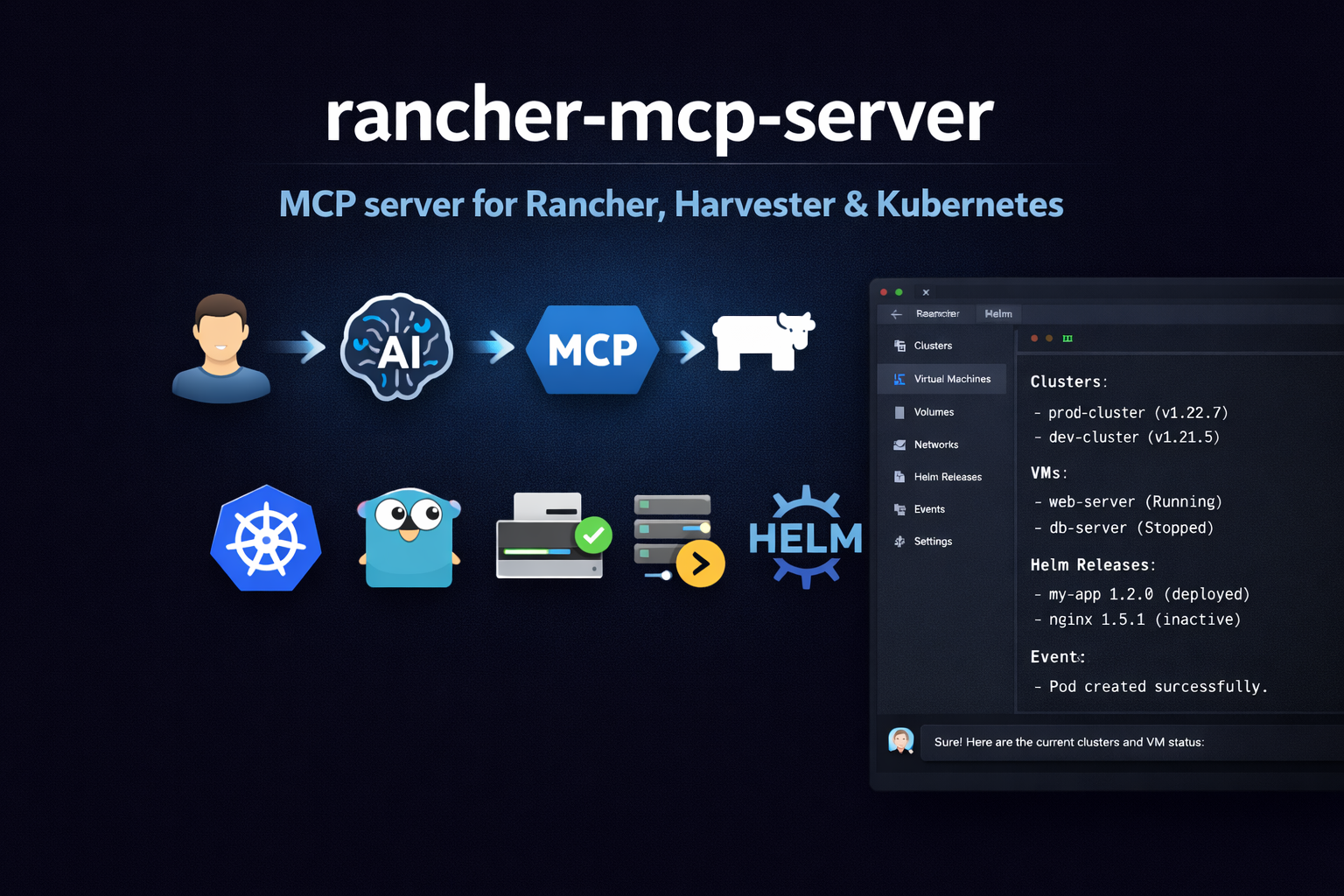
Model Context Protocol (MCP) server for the Rancher ecosystem: multi-cluster Kubernetes, Harvester HCI (VMs, storage, networks), and Fleet GitOps.
Demo
A walkthrough of how this MCP server works (example in Cursor).
https://github.com/user-attachments/assets/7d8fb814-e504-47b4-956d-28f43aeea3b8
Features
- Harvester toolset: List/get VMs, images, volumes, networks, hosts; VM actions; addon list/switch (enable/disable)
- Rancher toolset: Clusters and projects via Steve (management proxy); Norman management API (
/v3) for schemas, users, tokens, auth configs, global role bindings, cluster registration tokens, node drivers, cloud credentials, catalogs, cluster repos, feature flags, settings, audit (when exposed); support bundle and generic actions when writes are enabled - Kubernetes toolset: List/get/create/patch/delete resources by apiVersion/kind; describe (resource + events), events, capacity
- Helm toolset: List/get/history of releases; install, upgrade, rollback, uninstall; repo list
- Fleet toolset: GitRepo list/get/create; Bundle list; Fleet cluster list; drift detection
- Rancher APIs: Same Bearer token for Steve (
/k8s/clusters/...) and Norman (/v3/...); no CLI wrappers - Security: Read-only default, disable-destructive, sensitive data masking (Norman token/credential fields redacted unless
--show-sensitive-data) - Config: Flags, env (
RANCHER_MCP_*), or file (YAML/TOML)
Quick start
Install
npm install -g rancher-mcp-server
Cursor
Add to .cursor/mcp.json (project-level) or ~/.cursor/mcp.json (global):
{
  "mcpServers": {
    "rancher": {
      "command": "npx",
      "args": [
        "-y", "rancher-mcp-server",
        "--rancher-server-url", "https://rancher.example.com",
        "--rancher-token", "token-xxxxx:yyyy",
        "--toolsets", "harvester,rancher,kubernetes,fleet"
      ]
    }
  }
}
Restart Cursor after saving. Check Settings → Tools & MCP that rancher is listed and enabled.
Claude Desktop
Add to your Claude Desktop config (claude_desktop_config.json):
{
  "mcpServers": {
    "rancher": {
      "command": "npx",
      "args": [
        "-y", "rancher-mcp-server",
        "--rancher-server-url", "https://rancher.example.com",
        "--rancher-token", "token-xxxxx:yyyy",
        "--toolsets", "harvester,rancher,kubernetes,fleet"
      ]
    }
  }
}
With env vars instead of args
If you prefer to keep the token out of the JSON config:
{
  "mcpServers": {
    "rancher": {
      "command": "npx",
      "args": ["-y", "rancher-mcp-server"],
      "env": {
        "RANCHER_MCP_RANCHER_SERVER_URL": "https://rancher.example.com",
        "RANCHER_MCP_RANCHER_TOKEN": "token-xxxxx:yyyy",
        "RANCHER_MCP_TOOLSETS": "harvester,rancher,kubernetes"
      }
    }
  }
}
Enable write operations
For VM create, snapshots, backups, image/volume create, addon switch, host maintenance mode, VPC create/update/delete, VPC NAT gateway create, Harvester setting updates, Kubernetes create/patch/delete, Helm install/upgrade/rollback, Fleet gitrepo create/delete, and Norman writes (tokens, users, auth configs, role bindings, cluster registration tokens, cloud credentials, catalog refresh, feature flags, settings, rancher_norman_action, support bundle), add --read-only=false. Delete operations (Norman tokens/bindings/registration tokens/cloud credentials, VPC NAT gateway delete, plus existing toolset deletes) also require --disable-destructive=false (default).
{
  "mcpServers": {
    "rancher": {
      "command": "npx",
      "args": [
        "-y", "rancher-mcp-server",
        "--rancher-server-url", "https://rancher.example.com",
        "--rancher-token", "token-xxxxx:yyyy",
        "--toolsets", "harvester,rancher,kubernetes,helm,fleet",
        "--read-only=false"
      ]
    }
  }
}
Streamable HTTP transport
For web clients or remote access (e.g. Claude Code claude mcp add -t http), add --transport and --port:
{
  "mcpServers": {
    "rancher": {
      "command": "npx",
      "args": [
        "-y", "rancher-mcp-server",
        "--rancher-server-url", "https://rancher.example.com",
        "--rancher-token", "token-xxxxx:yyyy",
        "--transport", "http",
        "--port", "8080"
      ]
    }
  }
}
The server uses the MCP Streamable HTTP transport. The default MCP path is /mcp; connect to http://localhost:8080/mcp (or your server base URL + /mcp). Best supported with Claude Code; Cursor support may vary.
Build from source
If you prefer to build the Go binary yourself:
go build -o rancher-mcp-server ./cmd/rancher-mcp-server
Then reference the binary directly in your MCP config:
{
  "mcpServers": {
    "rancher": {
      "command": "/absolute/path/to/rancher-mcp-server",
      "args": [
        "--rancher-server-url", "https://rancher.example.com",
        "--rancher-token", "token-xxxxx:yyyy",
        "--toolsets", "harvester,rancher,kubernetes,fleet"
      ]
    }
  }
}
Configuration
| Option | Env | Default | Description |
|---|---|---|---|
--rancher-server-url | RANCHER_MCP_RANCHER_SERVER_URL | — | Rancher server URL (required) |
--rancher-token | RANCHER_MCP_RANCHER_TOKEN | — | Bearer token (required) |
--tls-insecure | RANCHER_MCP_TLS_INSECURE | false | Skip TLS verification |
--read-only | RANCHER_MCP_READ_ONLY | true | Disable write operations |
--disable-destructive | RANCHER_MCP_DISABLE_DESTRUCTIVE | false | Disable delete operations |
--show-sensitive-data | RANCHER_MCP_SHOW_SENSITIVE_DATA | false | Show Norman token/credential fields without redaction (use with care) |
--toolsets | RANCHER_MCP_TOOLSETS | harvester | Toolsets to enable: harvester, rancher, kubernetes, helm, fleet |
--transport | RANCHER_MCP_TRANSPORT | stdio | Transport: stdio or http (Streamable HTTP; default path /mcp) |
--port | RANCHER_MCP_PORT | 0 | Port for HTTP (0 = stdio only) |
Harvester tools
| Tool | Description |
|---|---|
harvester_vm_list | List VMs with status, namespace, spec/status |
harvester_vm_get | Get one VM (full spec and status) |
harvester_vm_action | start, stop, restart, pause, unpause, migrate |
harvester_vm_create | Create VM (when not read-only). Supports network, interface_type (managedtap/bridge/masquerade), subnet for KubeOVN VPC, virtiofs mounts (virtiofs_service_account, virtiofs_secret, virtiofs_config_map), and Windows Sysprep (sysprep_secret). |
harvester_vm_snapshot | Create/list/restore/delete VM snapshots. Restore accepts halt_after_restore=true to leave the VM powered off. |
harvester_vm_backup | Create/list/restore VM backups (Backup Target). Restore accepts halt_after_restore=true. |
harvester_image_list | List VM images (VirtualMachineImage) |
harvester_image_create | Create VM image from URL (when not read-only) |
harvester_volume_list | List PVCs (Longhorn-backed volumes) |
harvester_volume_create | Create volume/PVC (optionally from image) |
harvester_network_list | List VM networks (NetworkAttachmentDefinition) |
harvester_network_create | Create VM network - KubeOVN overlay or VLAN (when not read-only) |
harvester_network_update | Update VM network config (when not read-only) |
harvester_network_delete | Delete VM network (when destructive allowed) |
harvester_subnet_list | List KubeOVN Subnets (requires kubeovn-operator) |
harvester_subnet_create | Create Subnet in VPC for VM network (when not read-only) |
harvester_subnet_update | Update Subnet namespaces/NAT (when not read-only) |
harvester_subnet_delete | Delete Subnet (when destructive allowed) |
harvester_host_list | List nodes (Harvester hosts) |
harvester_host_action | Enable/disable maintenance mode on a host (cordon/uncordon) |
harvester_settings | List or get Harvester settings. With value, or pss_enabled / pss_whitelisted / pss_privileged / pss_restricted, updates a setting (including cluster-pod-security-standard) when not read-only. |
harvester_addon_list | List Harvester addons (enabled/disabled state) |
harvester_addon_switch | Enable or disable an addon (when not read-only) |
harvester_vpc_list | List KubeOVN VPCs (requires kubeovn-operator addon) |
harvester_vpc_create | Create a KubeOVN VPC (when not read-only) |
harvester_vpc_update | Update a KubeOVN VPC namespaces (when not read-only) |
harvester_vpc_delete | Delete a KubeOVN VPC (when destructive allowed) |
harvester_vpc_nat_gateway | Create/list/delete a Kube-OVN VPC NAT gateway, EIP, DNAT rule, or SNAT rule (kind: gateway, eip, dnat, snat) |
List tools accept cluster (required), namespace, format (json|table), limit (default 100), continue (pagination token for next page). Write tools require read_only: false.
Creating a VM on KubeOVN VPC with external internet
Use harvester_vm_create with:
- network: Name of the overlay network (NAD) linked to a KubeOVN subnet. Create via
harvester_network_create(type=kubeovn) thenharvester_subnet_createwithprovider={network}.{namespace}.ovn,vpc=<vpc-name>, andnat_outgoing=true. - interface_type:
managedtap(recommended for KubeOVN) orbridge. Uses Multus as primary network. - subnet: Optional KubeOVN subnet name for
ovn.kubernetes.io/logical_switchannotation.
Example: VM on network vswitch1 in namespace default, managedTap interface, subnet vswitch1-subnet:
harvester_vm_create cluster=<cluster-id> namespace=default name=testvm image=<image> network=vswitch1 interface_type=managedtap subnet=vswitch1-subnet
Rancher tools
Rancher tools use the management cluster (local). There is no cluster parameter on these tools.
Steve API (management resources)
| Tool | Description |
|---|---|
rancher_cluster_list | List Rancher clusters (management) |
rancher_cluster_get | Get one cluster (health, version, node count) |
rancher_project_list | List Rancher projects |
rancher_overview | Overview: cluster count and project count |
Norman API (https://<rancher>/v3/...)
Norman tools call Rancher’s JSON management API. Discover types and collection URLs for your server with rancher_norman_schema_list / rancher_norman_schema_get (schema ids such as user, token, cluster).
Read-only (always registered with the rancher toolset)
| Tool | Description |
|---|---|
rancher_norman_schema_list | List API schemas (/v3/schemas) |
rancher_norman_schema_get | Get one schema by id |
rancher_user_list / rancher_user_get | Users |
rancher_auth_config_list / rancher_auth_config_get | Auth providers (local, OIDC, etc.) |
rancher_token_list / rancher_token_get | API tokens (values redacted unless --show-sensitive-data) |
rancher_global_role_binding_list / rancher_global_role_binding_get | Global role bindings |
rancher_cluster_registration_token_list / rancher_cluster_registration_token_get | Cluster registration tokens |
rancher_node_driver_list | Node drivers |
rancher_cloud_credential_list / rancher_cloud_credential_get | Cloud credentials (secrets redacted unless --show-sensitive-data) |
rancher_catalog_list / rancher_catalog_get | Legacy Norman catalogs (/v3/catalogs) |
rancher_cluster_repo_list / rancher_cluster_repo_get | App catalog cluster repos (see note below) |
rancher_feature_flag_list / rancher_feature_flag_get | Feature flags (/v3/features) |
rancher_setting_list / rancher_setting_get | Global settings (/v3/settings) |
rancher_audit_log_list | GET /v3/auditlogs when supported (often 404/405; see note below) |
When --read-only=false
| Tool | Description |
|---|---|
rancher_norman_action | POST a Norman ?action= on a resource path under /v3 |
rancher_token_create | Create API token |
rancher_auth_config_update | Replace an auth config (PUT) |
rancher_user_create | Create user |
rancher_user_disable / rancher_user_enable | User enable/disable actions |
rancher_global_role_binding_create | Create global role binding |
rancher_cluster_registration_token_create | Create registration token |
rancher_cloud_credential_create | Create cloud credential |
rancher_catalog_refresh | Refresh legacy catalog (?action=refresh) |
rancher_feature_flag_set | Update feature flag (PUT) |
rancher_setting_update | Update setting (PUT) |
rancher_supportbundle_generate | Request support bundle (generateSupportBundle on a cluster) |
When --read-only=false and --disable-destructive=false
| Tool | Description |
|---|---|
rancher_token_delete | Delete API token |
rancher_global_role_binding_delete | Delete global role binding |
rancher_cluster_registration_token_delete | Delete registration token |
rancher_cloud_credential_delete | Delete cloud credential |
Norman responses: catalog, cluster repos, audit
rancher_cluster_repo_list/rancher_cluster_repo_get: Tries Norman/v3/clusterreposfirst. If that returns 404 (common), falls back tocatalog.cattle.io/v1ClusterRepoon the local cluster via Steve/Kubernetes, trying namespacescattle-global-data,fleet-default,fleet-local,cattle-fleet-system. Success JSON includes"_source":"kubernetes_api_fallback". If nothing works, the tool still returns 200-style JSON with"_source":"unavailable"and per-attempt errors—not a hard MCP error—so automation can continue.rancher_catalog_list/rancher_catalog_get: If Norman/v3/catalogsis not registered (404), returns JSON with"_source":"unavailable"instead of failing.rancher_audit_log_list: If the server returns 404 or 405 (GET not supported), returns JSON with"_source":"unavailable"and_http_status; audit may be disabled or exposed outside Norman.
For catalog data when ClusterRepo is unavailable everywhere, use kubernetes_list on cluster local with api_version catalog.cattle.io/v1 and kind ClusterRepo, or Helm / Fleet tools as appropriate.
Helm tools
| Tool | Description |
|---|---|
helm_list | List Helm releases (optionally by namespace, deployed/failed/pending) |
helm_get | Get release details (manifest, values, notes) |
helm_history | Get revision history for a release |
helm_repo_list | List configured Helm chart repositories (from local config) |
helm_install | Install a Helm chart (when not read-only) |
helm_upgrade | Upgrade a Helm release (when not read-only) |
helm_rollback | Rollback a release to a previous revision (when not read-only) |
helm_uninstall | Uninstall a release (when destructive allowed) |
All tools take cluster (Rancher cluster ID). Install/upgrade require chart, release; optional repo_url, version, values (JSON).
Fleet tools
| Tool | Description |
|---|---|
fleet_gitrepo_list | List Fleet GitRepos (GitOps sources) |
fleet_gitrepo_get | Get one GitRepo (spec, status) |
fleet_gitrepo_create | Create a GitRepo (when not read-only) |
fleet_gitrepo_delete | Delete a GitRepo (when destructive allowed) |
fleet_gitrepo_action | Pause, unpause, disablePolling, enablePolling, forceUpdate |
fleet_gitrepo_clone | Clone a GitRepo to a new name (copy spec) |
fleet_bundle_list | List Fleet Bundles (deployment units from GitRepos) |
fleet_cluster_list | List Fleet clusters (downstream clusters registered with Fleet) |
fleet_drift_detect | Report BundleDeployments with Modified state (drift) |
All tools use the Rancher management cluster (local). Optional namespace (default: fleet-default). List tools support format, limit, continue (pagination). fleet_gitrepo_create requires name, repo; optional branch, paths. fleet_gitrepo_action supports: pause, unpause, disablePolling, enablePolling, forceUpdate. fleet_gitrepo_clone copies spec from an existing GitRepo to a new name.
Kubernetes tools
| Tool | Description |
|---|---|
kubernetes_list | List resources by apiVersion/kind (e.g. v1 Pod, apps/v1 Deployment) |
kubernetes_get | Get one resource by apiVersion, kind, namespace, name |
kubernetes_describe | Get resource + recent events |
kubernetes_logs | Get recent pod logs (tail only; container, tailLines, sinceSeconds) |
kubernetes_events | List events in a namespace (optional involvedObject filter) |
kubernetes_capacity | Node capacity/allocatable summary per node |
kubernetes_create | Create resource from JSON (when not read-only) |
kubernetes_patch | Patch resource with JSON (when not read-only) |
kubernetes_delete | Delete resource (when destructive allowed) |
All tools take cluster (Rancher cluster ID). List/get support namespace, format (json|table), limit, continue (pagination). Create/patch/delete are gated by read_only and disable_destructive. kubernetes_logs does not support follow (streaming); use tail_lines and since_seconds to limit output. In some Rancher/proxy setups pod logs can return 503 or stream errors; see Troubleshooting.
Setup: Rancher token & Harvester cluster ID
Get a Rancher API token
- Log in to your Rancher UI.
- Click your profile/avatar (top right) → Account & API Keys (or API & Keys).
- Click Create API Key, name it (e.g.
mcp-server), then Create. - Copy the token once (format like
token-abc12:xyz...). Use it as--rancher-tokenorRANCHER_MCP_RANCHER_TOKEN.
Find your Harvester cluster ID
Harvester tools require the cluster ID (e.g. c-tx8rn) on each call.
- From Rancher UI: Go to Cluster Management → open your Harvester cluster. The URL contains the cluster ID:
.../c/<cluster-id>/.... - From API (Steve):
curl -s -H "Authorization: Bearer YOUR_TOKEN" "https://YOUR_RANCHER_URL/k8s/clusters/local/v1/management.cattle.io.clusters" | jq '.data[] | {name: .metadata.name}' - Norman schemas:
curl -s -H "Authorization: Bearer YOUR_TOKEN" "https://YOUR_RANCHER_URL/v3/schemas" | jq '.data[0:5].id'
Docker (Streamable HTTP)
For HTTP server mode, use the container image from GitHub Container Registry (ghcr.io). For Cursor/Claude with stdio, use npm (see Quick start).
Run the server and expose the port:
docker run -d -p 8080:8080 \
  -e RANCHER_MCP_RANCHER_SERVER_URL=https://rancher.example.com \
  -e RANCHER_MCP_RANCHER_TOKEN="token-xxxxx:yyyy" \
  -e RANCHER_MCP_TRANSPORT=http \
  -e RANCHER_MCP_PORT=8080 \
  ghcr.io/mrostamii/rancher-mcp-server:latest
Connect clients to the MCP endpoint: http://localhost:8080/mcp (Streamable HTTP; default path is /mcp). Example: claude mcp add -t http rancher http://localhost:8080/mcp
Supported platforms
- macOS (Apple Silicon & Intel)
- Linux (x64 & ARM64)
- Windows (x64)
Troubleshooting
| Issue | What to check |
|---|---|
| "rancher-server-url and rancher-token are required" | Check --rancher-server-url and --rancher-token in args, or env vars RANCHER_MCP_RANCHER_SERVER_URL and RANCHER_MCP_RANCHER_TOKEN. |
| 401 Unauthorized | Token expired or invalid. Create a new API key in Rancher. |
| TLS / certificate errors | For self-signed Rancher, pass --tls-insecure (dev only). |
| "cluster not found" or empty lists | Wrong cluster ID. Get it from Rancher UI URL or API; pass it as cluster to Harvester/Kubernetes tools. |
| Cursor doesn't show tools | Restart Cursor after editing mcp.json; check Tools & MCP that the server is enabled. |
| Binary not found | Use absolute paths in mcp.json for command when building from source. |
kubernetes_logs 503 or stream errors | Known in some Rancher/proxied setups (e.g. RKE2). Reduce tail_lines or try another cluster; see rancher/rancher#40711. |
Norman tool returns "_source":"unavailable" | That collection may not exist on your Rancher version (e.g. legacy catalogs, clusterrepos, or audit via GET). Use rancher_norman_schema_list to see registered types, or kubernetes_list / Helm / Fleet for chart sources. |
Cluster repo list shows unavailable or empty data | catalog.cattle.io ClusterRepo may not be installed or proxied for your token; try kubernetes_list with catalog.cattle.io/v1 and ClusterRepo on cluster local across namespaces. |
License
Apache-2.0