Hyper MCP
A fast, secure, and extensible MCP server using WebAssembly plugins.
hyper-mcp
⚠️ NOTICE: PROJECT TRANSFERRED
This project has been transferred to https://github.com/joseph-wortmann/hyper-mcp
Please refer to the new repository for the latest updates and contributions.
A fast, secure MCP server that extends its capabilities through WebAssembly plugins.
What is it?
hyper-mcp makes it easy to add AI capabilities to your applications. It works with Claude Desktop, Cursor IDE, and other MCP-compatible apps. Write plugins in your favorite language, distribute them through container registries, and run them anywhere - from cloud to edge.
Features
- Write plugins in any language that compiles to WebAssembly
- Distribute plugins via standard OCI registries (like Docker Hub)
- Built on Extism for rock-solid plugin support
- Sanboxing with WASM: ability to limit network, filesystem, memory access
- Lightweight enough for resource-constrained environments
- Support all 3 protocols in the spec:
stdio,sseandstreamble-http. - Deploy anywhere: serverless, edge, mobile, IoT devices
- Cross-platform compatibility out of the box
- Support tool name prefix to prevent tool names collision
Security
Built with security-first mindset:
- Sandboxed plugins that can't access your system without permission
- Memory-safe execution with resource limits
- Secure plugin distribution through container registries
- Fine-grained access control for host functions
- OCI plugin images are signed at publish time and verified at load time with sigstore.
Getting Started
- Create your config file:
- Linux:
$HOME/.config/hyper-mcp/config.json - Windows:
{FOLDERID_RoamingAppData}. Eg:C:\Users\Alice\AppData\Roaming - macOS:
$HOME/Library/Application Support/hyper-mcp/config.json
- Linux:
{
"plugins": {
"time": {
"url": "oci://ghcr.io/tuananh/time-plugin:latest"
},
"qr_code": {
"url": "oci://ghcr.io/tuananh/qrcode-plugin:latest"
},
"hash": {
"url": "oci://ghcr.io/tuananh/hash-plugin:latest"
},
"myip": {
"url": "oci://ghcr.io/tuananh/myip-plugin:latest",
"runtime_config": {
"allowed_hosts": ["1.1.1.1"]
}
},
"fetch": {
"url": "oci://ghcr.io/tuananh/fetch-plugin:latest",
"runtime_config": {
"allowed_hosts": ["*"],
"memory_limit": "100 MB",
}
}
}
}
📖 For detailed configuration options including authentication setup, runtime configuration, and advanced features, see RUNTIME_CONFIG.md
Supported URL schemes:
oci://- for OCI-compliant registries (like Docker Hub, GitHub Container Registry, etc.)file://- for local fileshttp://orhttps://- for remote filess3://- for Amazon S3 objects (requires that you have your AWS credentials set up in the environment)
- Start the server:
$ hyper-mcp
- By default, it will use
stdiotransport. If you want to use SSE, use flag--transport sseor streamable HTTP with--transport streamable-http. - If you want to debug, use
RUST_LOG=info. - If you're loading unsigned OCI plugin, you need to set
insecure_skip_signatureflag or env varHYPER_MCP_INSECURE_SKIP_SIGNATUREtotrue
Using with Cursor IDE
You can configure hyper-mcp either globally for all projects or specifically for individual projects.
- For project-scope configuration, create
.cursor/mcp.jsonin your project root:
{
"mcpServers": {
"hyper-mcp": {
"command": "/path/to/hyper-mcp"
}
}
}
-
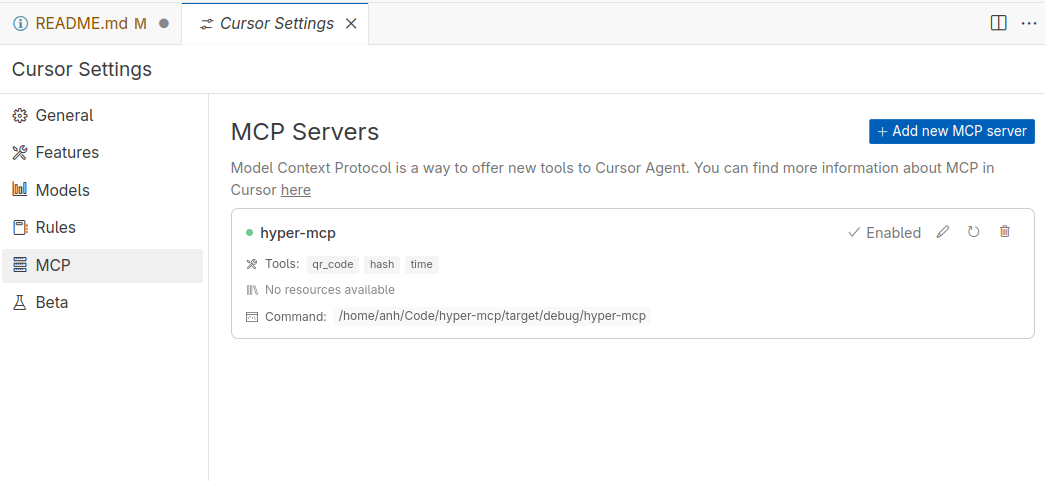
Set up hyper-mcp in Cursor's settings:
-
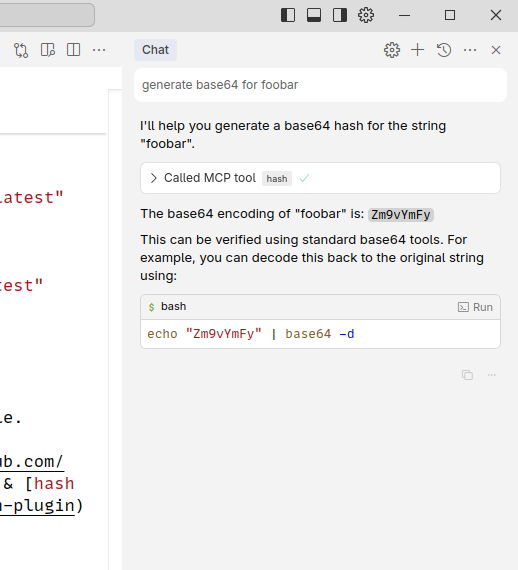
Start using tools through chat:
Available Plugins
We maintain several example plugins to get you started:
V1 Plugins
These plugins use the v1 plugin interface. While still supported, new plugins should use the v2 interface.
- time: Get current time and do time calculations (Rust)
- qr_code: Generate QR codes (Rust)
- hash: Generate various types of hashes (Rust)
- myip: Get your current IP (Rust)
- fetch: Basic webpage fetching (Rust)
- crypto_price: Get cryptocurrency prices (Go)
- fs: File system operations (Rust)
- github: GitHub plugin (Go)
- eval_py: Evaluate Python code with RustPython (Rust)
- arxiv: Search & download arXiv papers (Rust)
- memory: Let you store & retrieve memory, powered by SQLite (Rust)
- sqlite: Interact with SQLite (Rust)
- crates-io: Get crate general information, check crate latest version (Rust)
- gomodule: Get Go modules info, version (Rust)
- qdrant: keeping & retrieving memories to Qdrant vector search engine (Rust)
- gitlab: GitLab plugin (Rust)
- meme_generator: Meme generator (Rust)
- context7: Lookup library documentation (Rust)
- think: Think tool(Rust)
- maven: Maven plugin (Rust)
- serper: Serper web search plugin (Rust)
V2 Plugins
These plugins use the v2 plugin interface. New plugins should use this interface.
- rstime: Get current time and do time calculations (Rust)
Community-built plugins
- hackernews: This plugin connects to the Hacker News API to fetch the current top stories and display them with their titles, scores, authors, and URLs.
- release-monitor-id: This plugin retrieves project ID from release-monitoring.org, which helps track versions of released software.
- yahoo-finance: This plugin connects to the Yahoo Finance API to provide stock prices (OHLCV) based on a company name or ticker symbol.
- rand16: This plugen generates random 16 bytes buffer and provides it in base64uri format - very usable for symmetric cryptography online.
Documentation
- Runtime Configuration Guide - Comprehensive guide to configuration options including:
- Authentication setup (Basic, Token, and Keyring)
- Plugin runtime configuration
- Security considerations and best practices
- Platform-specific keyring setup for macOS, Linux, and Windows
- Troubleshooting authentication issues
- Skip Tools Pattern Guide - Comprehensive guide to filtering tools using regex patterns:
- Pattern syntax and examples
- Common use cases and best practices
- Environment-specific filtering strategies
- Advanced regex techniques
- Migration and troubleshooting
Creating Plugins
For comprehensive instructions on creating plugins, see CREATING_PLUGINS.md.
License
Star History
İlgili Sunucular
Alpha Vantage MCP Server
sponsorAccess financial market data: realtime & historical stock, ETF, options, forex, crypto, commodities, fundamentals, technical indicators, & more
Hippycampus
Turns any Swagger/OpenAPI REST endpoint with a yaml/json definition into an MCP Server with Langchain/Langflow integration automatically.
Maven Package README MCP Server
Search for and retrieve detailed information, including READMEs and metadata, for Maven packages from Maven Central.
BCMS MCP
Give me a one - two sentence description of the BCMS MCP # MCP The BCMS Model Context Protocol (MCP) integration enables AI assistants like Claude, Cursor, and other MCP-compatible tools to interact directly with your BCMS content. This allows you to create, read, and update content entries, manage media files, and explore your content structure—all through natural language conversations with AI. ## What is MCP? The [Model Context Protocol (MCP)](https://modelcontextprotocol.io/) is an open standard developed by Anthropic that allows AI applications to securely connect to external data sources and tools. With BCMS MCP support, you can leverage AI assistants to: - Query and explore your content structure - Create new content entries with AI-generated content - Update existing entries - Manage your media library - Get intelligent suggestions based on your content model --- ## Getting Started ### Prerequisites 1. A BCMS account with an active instance 2. An MCP key with appropriate permissions 3. An MCP-compatible client (Claude Desktop, Cursor, or any MCP client) ### Step 1: Create an MCP Key 1. Navigate to your BCMS dashboard 2. Go to Settings → MCP 3. Click Create MCP Key 4. Configure the permissions for templates you want the AI to access:GET: Read entries 5. POST: Create entries 6. PUT: Update entries 7. DELETE: Delete entries Note: Right now, MCP only supports creating, reading and updating content. ### Step 2: Configure Your MCP Client You can find full instructions for integrating BCMS with your AI tools right inside BCMS, on the MCP page. But in general, installing BCMS MCP works in a standard way: ``` { "mcpServers": { "bcms": { "url": "https://app.thebcms.com/api/v3/mcp?mcpKey=YOUR_MCP_KEY" } } } ``` ## Available Tools Once connected, your AI assistant will have access to the following tools based on your MCP key permissions: ### Content Discovery #### list_templates_and_entries Lists all templates and their entries that you have access to. This is typically the first tool to call when exploring your BCMS content. Returns: - Template IDs, names, and slugs - Entry IDs with titles and slugs for each language Example prompt: "Show me all the templates and entries in my BCMS" --- ### Entry Management #### list_entries_for_{templateId} Retrieves all entries for a specific template with full content data. A separate tool is generated for each template you have access to. Returns: - Complete entry data including all meta fields - Content in all configured languages - Entry statuses Example prompt: "List all blog posts from my Blog template" --- #### create_entry_for_{templateId} Creates a new entry for a specific template. The input schema is dynamically generated based on your template's field structure. Input: - statuses: Array of status assignments per language - meta: Array of metadata for each language (title, slug, custom fields) - content: Array of content nodes for each language Example prompt: "Create a new blog post titled 'Getting Started with BCMS' with a brief introduction paragraph" --- #### update_entry_for_{templateId} Updates an existing entry for a specific language. Input: - entryId: The ID of the entry to update - lng: Language code (e.g., "en") - status: Optional status ID - meta: Updated metadata - content: Updated content nodes Example prompt: "Update the introduction paragraph of my 'Getting Started' blog post" --- ### Media Management #### list_all_media Lists all media files in your media library. Returns: - Media IDs, names, and types - File metadata (size, dimensions for images) - Parent directory information Example prompt: "Show me all images in my media library" --- #### list_media_dirs Lists the directory structure of your media library. Returns: - Hierarchical directory structure - Directory IDs and names Example prompt: "Show me the folder structure of my media library" --- #### create-media-directory Creates a new directory in your media library. Input: - name: Name of the directory - parentId: Optional parent directory ID (root if not specified) Example prompt: "Create a new folder called 'Blog Images' in my media library" --- #### request-upload-media-url Returns a URL you use to upload a file (for example via POST with multipart form data), which avoids pushing large binaries through the MCP tool payload. You still need a valid file name and MIME type when uploading, as described in the tool response. Availability: Only when the MCP key has Can mutate media enabled. Example prompt: “Give me an upload URL for a new hero image, then tell me how to upload it.” Input: - fileName: Name of the file with extension - fileData: Base64-encoded file data (with data URI prefix) - parentId: Optional parent directory ID Example prompt: "Upload this image to my Blog Images folder" --- ### Linking Tools #### get_entry_pointer_link Generates an internal BCMS link to an entry for use in content. Input: - entryId: The ID of the entry to link to Returns: - Internal link format: entry:{entryId}@*_{templateId}:entry Example prompt: "Get me the internal link for the 'About Us' page entry" --- #### get_media_pointer_link Generates an internal BCMS link to a media item for use in content. Input: - mediaId: The ID of the media item Returns: - Internal link format: media:{mediaId}@*_@*_:entry Example prompt: "Get the link for the hero image so I can use it in my blog post" --- ## Content Structure ### Entry Content Nodes When creating or updating entries, content is structured as an array of nodes. Supported node types include: Type Description paragraph Standard text paragraph heading Heading (h1-h6) bulletList Unordered list orderedList Numbered list listItem List item codeBlock Code block with syntax highlighting blockquote Quote block image Image node widget Custom widget with props ### Example Content Structure ``` { "content": [ { "lng": "en", "nodes": [ { "type": "heading", "attrs": { "level": 1 }, "content": [ { "type": "text", "text": "Welcome to BCMS" } ] }, { "type": "paragraph", "content": [ { "type": "text", "text": "This is your first paragraph." } ] } ] } ] } ``` ## Security & Permissions ### MCP Key Scopes Your MCP key controls what the AI can access: - Template Access: Only templates explicitly granted in the MCP key are visible - Operation Permissions: Each template can have independent GET/POST/PUT/DELETE permissions - Media Access: Media operations are controlled separately ### Best Practices 1. Principle of Least Privilege: Only grant the permissions needed for your use case 2. Separate Keys: Create different MCP keys for different purposes or team members 3. Regular Rotation: Periodically rotate your MCP keys ## Use Cases ### Content Creation Workflows Blog Post Creation "Create a new blog post about the benefits of headless CMS. Include an introduction, three main benefits with explanations, and a conclusion. Use the Blog template." Product Updates "Update the price field for all products in the Electronics category to apply a 10% discount" ### Content Exploration Content Audit "List all blog posts that don't have a featured image set" Translation Status "Show me which entries are missing German translations" ### Media Organization Library Cleanup "Show me all unused images in the media library" Folder Setup "Create folder structure for: Products > Categories > Electronics, Clothing, Home" ## Troubleshooting ### Common Issues #### "MCP key not found" - Verify your MCP key format: keyId.keySecret.instanceId - Ensure the MCP key hasn't been deleted or deactivated - Check that you're using the correct instance #### "MCP key does not have access to template" - Review your MCP key permissions in the dashboard - Ensure the required operation (GET/POST/PUT/DELETE) is enabled for the template #### Session Expired - MCP sessions may timeout after periods of inactivity - Simply start a new conversation to establish a fresh session ### Getting Help - Documentation: [thebcms.com/docs](https://thebcms.com/docs) - Support: [[email protected]](mailto:[email protected]) - Community: [Join BCMS Discord](https://discord.com/invite/SYBY89ccaR) for community support ## Technical Reference ### Endpoint POST https://app.thebcms.com/api/v3/mcp?mcpKey={MCP_KEY} ### Transport BCMS MCP uses the Streamable HTTP transport with session management. Sessions are maintained via the mcp-session-id header. ### Response Format All tools return structured JSON responses conforming to the MCP specification with: - content: Array of content blocks - structuredContent: Typed response data ## Rate Limits MCP requests are subject to the same rate limits as API requests: - Requests are tracked per MCP key - Contact support if you need higher limits for production workloads
ThousandEyes MCP Server
ThousandEyes Network Performance Monitoring MCP Server
DDEV MCP Server
Manage DDEV projects, enabling LLM applications to interact with local development environments through the MCP protocol.
AST2LLM for Go
A local AST-powered context enhancement tool for LLMs that analyzes Go project structure for faster context resolution.
Graph Tools
An interactive graph analysis toolkit with web visualizations and AI-powered analysis capabilities.
MCP Talk Demo Files
A collection of demo files for MCP servers and clients, illustrating various transport protocols and server capabilities using Python.
Prompts MCP Server
An MCP server for managing and serving prompts from markdown files with YAML frontmatter support.
TokenCost
An MCP (Model Context Protocol) server that provides real-time LLM token pricing data for 60+ AI models across 15 providers.