Screenshots By Snapshot Site
Ajanınıza göz verin: ekran görüntüsü alın, iki sayfa sürümü arasındaki görsel değişiklikleri tespit edin ve sayfaları yapay zeka ile analiz edin. Barındırılan, OAuth, ücretsiz katman.
Dokümantasyon
Snapshot Site MCP




Official MCP server for the Snapshot Site API
Tools
screenshotanalyzecompare
These tools are annotated for MCP clients as:
- read-only
- idempotent
- open-world
They also include richer titles, category metadata, and example intents to improve tool selection in Claude Desktop and Cursor.
Two ways to connect
Hosted, with OAuth — point your client at https://mcp.snapshot-site.com/mcp
and sign in. There is no local process to run and no API key in your client
config; the server resolves your account from the OAuth session.
Local, with an API key — run the package yourself over stdio and provide
SNAPSHOT_SITE_API_KEY. The server calls the Snapshot Site API directly.
Either way, calls count against the same plan quota as direct API calls. Nothing is metered differently because it came through MCP.
Credentials
The hosted server needs no credential — you sign in through OAuth and the server resolves your account from the session. Skip this section unless you run the server yourself over stdio.
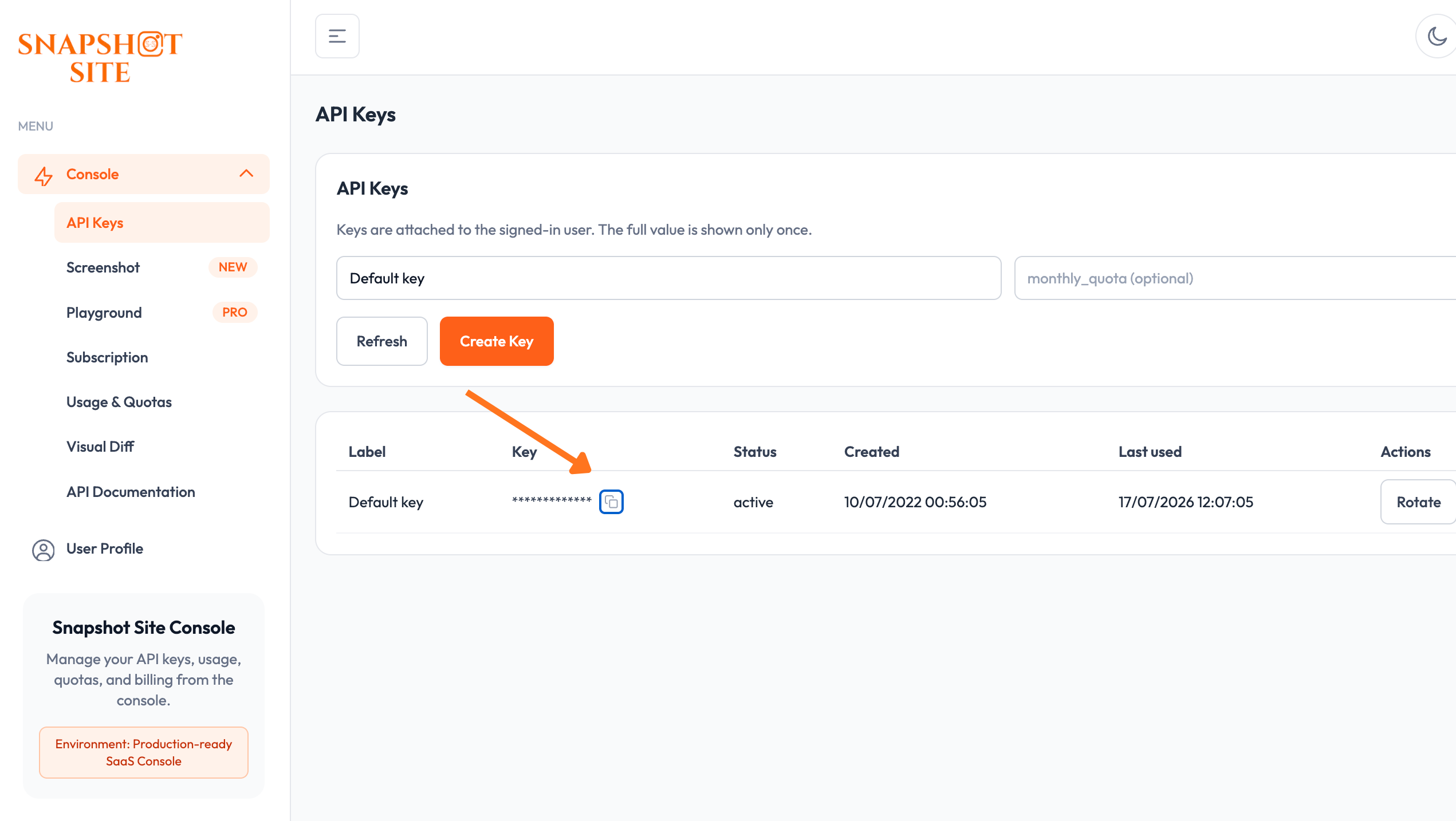
For local stdio mode you need a Snapshot Site API key.
-
Sign up for a Snapshot Site Console account.
-
Create an API key on the API Keys page.
-
Pass the key to the server as the
SNAPSHOT_SITE_API_KEYenvironment variable. -
Leave
SNAPSHOT_SITE_BASE_URLat its default (https://api.prod.ss.snapshot-site.com) unless you're pointed at a self-hosted or staging instance.
Compatibility
Requires Node.js 20.9 or later. Built against @modelcontextprotocol/sdk v1.28
and tested with Claude Desktop and Cursor over stdio, and with any client that
speaks the streamable HTTP transport against the hosted endpoint.
Usage
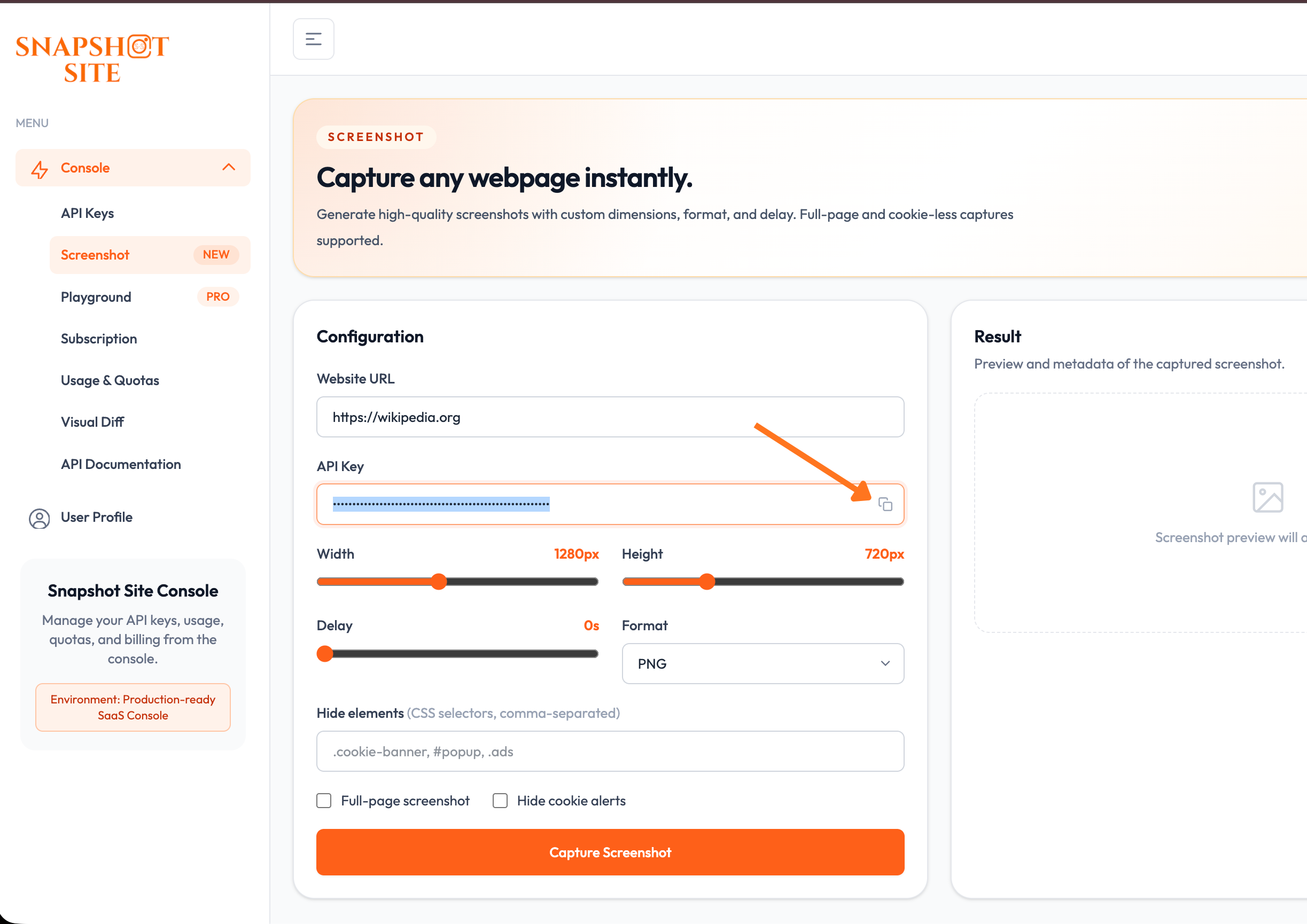
Not sure which options to use? Preview a capture and its parameters in the Screenshot console playground before wiring them into a tool call.
OAuth discovery flow
What a client does when connecting to the hosted server:
1. Discovery

Claude
  -> GET https://mcp.snapshot-site.com/.well-known/oauth-protected-resource

MCP
  -> responds:
     authorization_servers = https://mcp.snapshot-site.com
2. Authorization

Claude
  -> must know client_id
  -> opens:
     https://mcp.snapshot-site.com/oauth/v2/authorize
     ?client_id=...
     &redirect_uri=https://claude.ai/api/mcp/auth_callback
     &response_type=code
     &code_challenge=...
3. Token

Claude
  -> receives an access token
  -> calls the MCP server:
     POST https://mcp.snapshot-site.com/
     Authorization: Bearer <access_token>
The server then validates the token against the issuer and resolves the account it belongs to before running the tool.
Verifying the deployment
curl -s https://mcp.snapshot-site.com/.well-known/oauth-protected-resource | jq
curl -s https://mcp.snapshot-site.com/.well-known/openid-configuration | jq
curl -i https://mcp.snapshot-site.com/
curl -i -X POST https://mcp.snapshot-site.com/mcp -H 'content-type: application/json' --data '{}'
Manual vs implicit client_id
- The
client_idis only needed for the authorization step. - If your client cannot discover that
client_idbeforehand, enter it manually in the connector UI. - It cannot be injected later once the OAuth flow has started.
- The server can publish an experimental implicit mode by exposing a
preferred_client_idin/.well-known/oauth-protected-resource. - Clients that read this metadata may then skip the manual entry. Clients that ignore the field still require a manual
client_id.
Environment
export SNAPSHOT_SITE_API_KEY=ss_live_xxx
export SNAPSHOT_SITE_BASE_URL=https://api.prod.ss.snapshot-site.com
Build
pnpm install
pnpm run build
Local stdio mode
export SNAPSHOT_SITE_API_KEY=ss_live_xxx
snapshot-site-mcp
Claude Desktop configuration
{
  "mcpServers": {
    "snapshot-site": {
      "command": "node",
      "args": ["/absolute/path/to/snapshot-site-mcp/build/server.js"],
      "env": {
        "SNAPSHOT_SITE_API_KEY": "ss_live_xxx",
        "SNAPSHOT_SITE_BASE_URL": "https://api.prod.ss.snapshot-site.com"
      }
    }
  }
}
Cursor configuration
{
  "mcpServers": {
    "snapshot-site": {
      "command": "node",
      "args": ["/absolute/path/to/snapshot-site-mcp/build/server.js"],
      "env": {
        "SNAPSHOT_SITE_API_KEY": "ss_live_xxx"
      }
    }
  }
}
Remote HTTP mode
This package also supports a hosted MCP endpoint for clients using mcp-remote.
Start the HTTP server:
pnpm start:http
or:
npx snapshot-site-mcp-http
Environment variables:
export PORT=3000
export HOST=0.0.0.0
export MCP_PATH=/mcp
export HEALTH_PATH=/healthz
export MCP_ALLOWED_HOSTS=mcp.snapshot-site.com
export SNAPSHOT_SITE_BASE_URL=https://api.prod.ss.snapshot-site.com
Remote client configuration with direct API key header:
{
  "mcpServers": {
    "Snapshot Site MCP": {
      "command": "npx",
      "args": [
        "mcp-remote",
        "https://mcp.snapshot-site.com/mcp",
        "--header",
        "x-snapshotsiteapi-key: ss_live_xxx"
      ]
    }
  }
}
The hosted server is stateless. Each request authenticates with x-snapshotsiteapi-key, which makes the service safe to run on multiple replicas without session affinity.
Zitadel / OAuth
The remote HTTP server also supports OAuth bearer tokens validated against an OIDC issuer such as Zitadel.
Environment variables:
export OIDC_ISSUER_URL=https://auth.snapshot-site.com
export OIDC_AUDIENCE=snapshot-site-mcp
export OIDC_REQUIRED_SCOPE=claudeai
export OIDC_DISCOVERY_CLIENT_ID=366546620977775166
export RESOURCE_SERVER_URL=https://mcp.snapshot-site.com
export ALLOW_API_KEY_AUTH=false
export SNAPSHOT_SITE_API_KEY=ss_server_side_xxx
In bearer-token mode, the MCP server validates the incoming access token against the issuer JWKS and then uses the server-side Snapshot Site API key to call the backend API.
It also exposes and proxies:
GET /.well-known/oauth-protected-resource
GET /.well-known/openid-configuration
GET/POST /oauth/v2/*
GET /ui/*
GET/POST /oauth/register
so MCP clients can discover the authorization server metadata automatically.
When OIDC_DISCOVERY_CLIENT_ID is set, the protected resource metadata also includes:
{
  "resource_name": "Snapshot Site MCP",
  "preferred_client_id": "366546620977775166",
  "oauth_client_metadata": {
    "client_id": "366546620977775166",
    "token_endpoint_auth_method": "none"
  }
}
This is an experimental compatibility hint for clients that can infer the OAuth public client automatically. Manual client_id entry remains the reliable fallback.
The MCP server also exposes a lightweight registration_endpoint compatibility shim at:
POST https://mcp.snapshot-site.com/oauth/register
This shim currently returns the preconfigured public PKCE client instead of provisioning a brand-new Zitadel client per installation. It validates and reflects the redirect_uris requested by the client, as long as they are valid HTTPS URLs. It is meant to improve compatibility with clients that expect DCR-style discovery, while keeping the existing manual flow as fallback.