Seonix
อ่านโปรเจกต์ Seonix SEO ของคุณใน AI agents: Site Health และแผนการแก้ไข, Search Console, คลัสเตอร์คีย์เวิร์ด, บทความ, การให้คะแนนฉบับร่าง
เซิร์ฟเวอร์ MCP แบบโฮสต์
npx add-mcp 'https://api.seonix.ai/mcp'ติดตั้งลง Claude Code, Codex, Cursor และอื่นๆ
เอกสาร
Your SEO data inside the agents you already use
The Seonix MCP server lets the AI agent you already work with read your Site Health report and fix plan, pull Search Console queries, browse keyword clusters and articles, and score a draft before it goes live. Ask in plain language; the agent calls Seonix.
>Connect Seonix to this project over MCP: https://seonix.ai/mcp.md
Paste this into Claude Code, Cursor, Codex or any agent with MCP support. It reads the manifest, adds the server and opens the sign-in; you approve once in the browser.
Sign in with OAuth: approve once in the browser, revoke any time. Every connected agent is listed in your account. Part of every paid plan. app.seonix.ai/account/agents
Sign-in is OAuth — approve once at app.seonix.ai, revoke any time under Account → Agents. API keys remain for scripts. The plugin also ships three skills — seonix-seo, seonix-fix-site and seonix-content — so the agent knows the Seonix workflows without reading the manifest. Plugin source on GitHub
Example session · Claude Code
U
Fix everything Seonix found on my site and tell me what changed.
- get_site_healthSite Health 61 · 43 open problems
- get_fix_plan14 items · 3 site-wide, 11 page-level
- analyze_seorewritten page scores 84/100 A
Done: canonical tags, 9 meta descriptions, alt text on 31 images and the sitemap path in robots.txt. Start a rescan in Seonix and I will confirm what cleared.
After rescan: 61 → 88
Claude Code
Anthropic
Plugin from the marketplace, or one command.
Cursor
Anysphere
One-click button or ~/.cursor/mcp.json.
Codex
OpenAI
Plugin from the marketplace.
Copilot
GitHub
VS Code reads.vscode/mcp.json.
Windsurf
Windsurf
Same mcpServers entry, URL only.
Works with any client that speaks the Model Context Protocol over HTTP: add the URL and sign in with OAuth, or send an API key as a bearer header for unattended runs. Coming to the Claude and ChatGPT directories.
What it is
The product you pay for, reachable from a chat
MCP (Model Context Protocol) is the open standard AI agents use to call outside tools. Seonix publishes its own server: every read your dashboard can do — the Site Health report, the issue list with evidence, Search Console queries and pages, Google Analytics visits and sources, keyword clusters, articles, scores — becomes a tool the agent calls with your permission.
The agent does the thinking with its own model; Seonix supplies the facts and the scoring. No AI credits are spent on reads, and the agent never sees another account's data.
MCP URL https://api.seonix.ai/mcp · Read the agent manifest
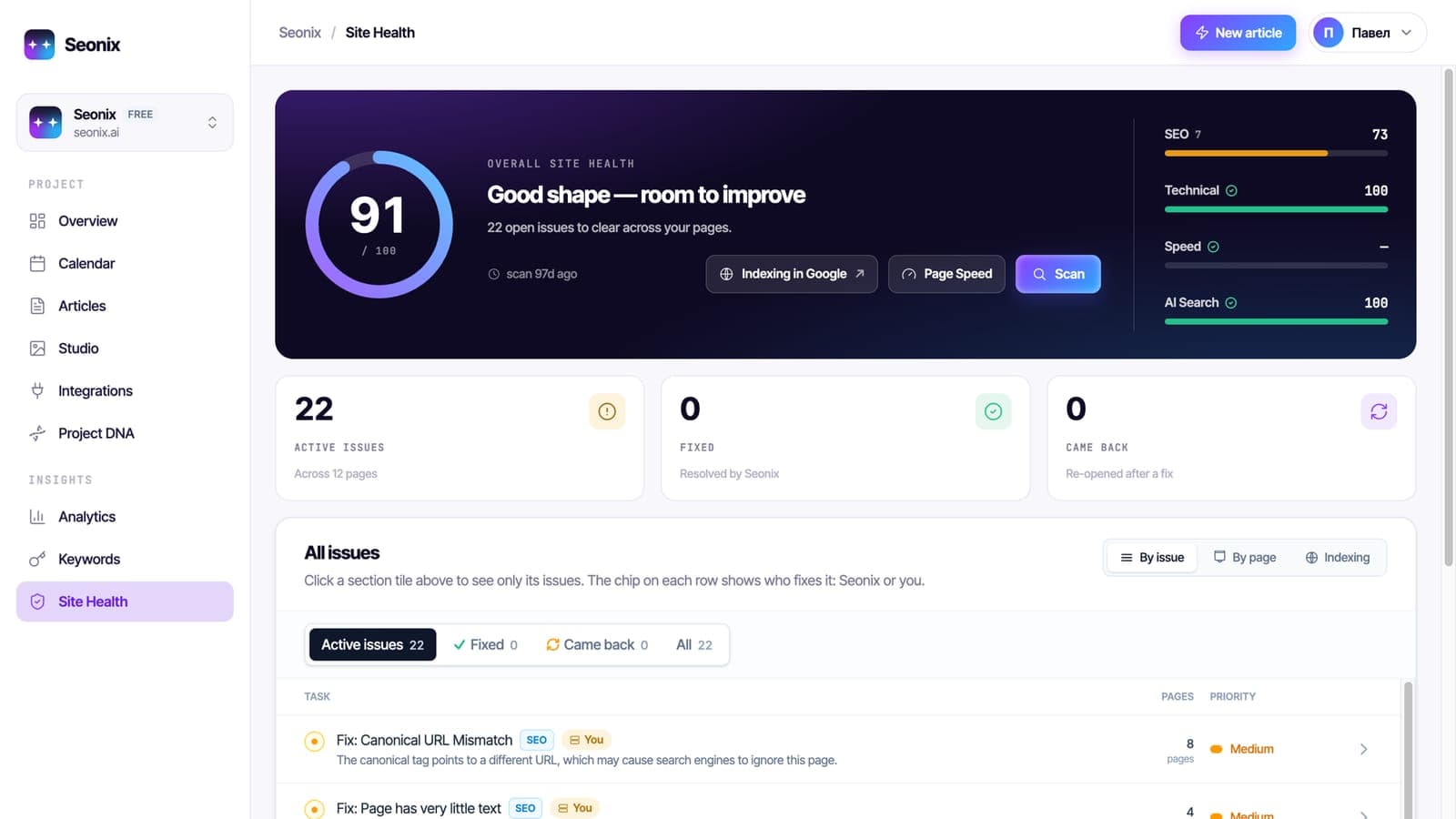
Site Health checks every page for SEO, technical, speed and AI-search issues and marks which ones Seonix fixes for you.
What your agent can do
Six things to ask it today
Read Site Health and get a fix plan
The score by pillar, every open problem with the offending tag or redirect chain, and an ordered plan a coding agent can apply file by file.
Pull Search Console insights
Top queries and pages, the queries one page ranks for, striking-distance keywords at positions 4–20, indexing coverage and a 28-day trend.
Browse keywords and clusters
Researched keywords with volume and Search Console numbers, topic clusters with intent and page type, and the competitor insights behind each.
Score a draft before publishing
Any title, body and meta the agent wrote goes through the same SEO, readability and AI-answer checks the dashboard uses. Iterate until it passes.
Read articles and the calendar
What was published and when, each article's score and keyphrase, where it is live, and the slots planned for the month.
Follow Seonix playbooks
Eleven step-by-step procedures the agent can run: a full SEO review, promote the site, work through a page, fix issues in code, map keywords, write for a cluster, report monthly.
Try these
Three prompts to start with
Copy one into your agent once Seonix is connected. Each one maps to a playbook the server ships.
>Use Seonix: get the fix plan for my site, apply every page-level item in this repo, then tell me what to rescan.
Prompts are English on purpose: agents follow English instructions most reliably. Ask in your language — the agent answers in it.
Tool reference
46 tools, grouped the way the dashboard is
41 tools read and are marked read-only for the client, so agents do not ask before reading. The 5 write tools sit behind the write scope and the agent confirms each one with you. Every tool returns compact JSON with a hint on what to call next; 11 playbooks ship as MCP prompts.
01Account and project6
get_accountProjects, plans, quotas, whether the MCP is availablelist_projectsId, slug, name and site URL of each projectget_projectAutopilot mode, channels, Search Console status, linksget_site_dnaBrand, audience, tone and writing instructions as a prompt blockget_plan_statusPlan, permissions and the upgrade linkget_seo_progressSEO Progress level and what the next one needs 02Site Health7get_site_healthScore, pillars, counts, top open problems, last scanlist_issuesIssue threads by status, code or URL, paginatedget_issueOne issue with the captured evidence and the remediation profileget_fix_planOrdered, implementable plan with URLs and target markupget_remediation_profileWhy a code matters, bad vs good example, stepslist_scansRecent scans with status and countsget_scan_statusProgress of one scan 03Search Console8gsc_statusConnection, property, last published daygsc_top_queriesTop queries in the windowgsc_top_pagesTop landing pages in the windowgsc_page_queriesQueries one page ranks forgsc_opportunitiesStriking-distance keywords by estimated gaingsc_timeseriesDaily clicks, impressions and position, 7–90 daysgsc_coverageIndexed and not-indexed pages with verdictsgsc_impactSeonix's own impact estimate 04Google Analytics 45ga4_statusConnection and GA4 propertyga4_trafficSessions, users, key events, visits per channelga4_sourcesEvery network that sent visitors, groupedga4_pagesPages by visits with the source mixga4_ai_trafficVisits from ChatGPT, Perplexity, Gemini and others 05Keywords and calendar4list_keyword_candidatesResearched keywords with volume and GSC numberslist_clustersTopic clusters with intent, priority and winnabilityget_clusterMembers, covering pages, SERP snapshot and insightsget_calendarSlots for a month: kind, source, status 06Articles and results8list_articlesArticles with scores and publish datesget_articleOne article with meta, takeaways, publications, HTML on requestanalyze_seoScore any draft: SEO, readability, AI-answer readinessscore_articleRe-score an existing articlelist_channelsConnected publishing channelsget_ai_visibilityLatest ChatGPT-mention snapshotget_resultsPer-article clicks and positions vs the previous periodget_blog_integration_guideHow to connect a custom-built blog 07Playbooks2list_playbooksThe eleven procedures with a one-line summaryget_playbookOne procedure in full, also served as an MCP prompt 08Fix and rescan (write scope, confirmed per call)6start_scanStart a fresh Site Health scan, then poll get_scan_statusapply_fixSeonix applies auto-fixable items on WordPress through its pluginget_fix_runReads a fix run: status and per-item outcome (a read, no scope needed)rollback_fixUndo a fix run on the live siteacknowledge_issueMark an issue as intentional so it stops countingunacknowledge_issueCount the issue again
Plans
Included in every paid plan
There is no separate MCP subscription: the server is another way into the project you already pay for, with the same limits as the dashboard.
On the Free plan nothing works: every call answers plan_required with the upgrade link. Write tools need the write scope you approve at sign-in, and the agent asks you before each change.
| Free | Starter and above | |
|---|---|---|
| Connect an agent | ||
| Site Health, issues and fix plan | ||
| Search Console data | ||
| Keywords, clusters, articles, calendar | ||
| Draft scoring with analyze_seo | ||
| Playbooks and guides | ||
| Tool calls per agent | — | 600 per hour |
Safety
Built for agents that have shell access
Writes only after your yes
Reading is free of side effects. The five write tools (start a scan, apply or roll back Seonix fixes, mark an issue intentional) need the write scope you grant at sign-in, and the agent is told to ask you before each one.
Your data only
An OAuth grant or a key belongs to one account; every call re-checks that the project is yours and on a paid plan.
Untrusted content is labelled
Text crawled from your pages or taken from search results is marked as data, and the server tells the agent never to treat it as instructions.
Access you control
Every connected agent is listed under Account → Agents with its last use and client. Revoke it in one click. Access stops when you change your password.
Frequently asked questions
Which agents and clients work with it?
Any client that supports the Model Context Protocol over HTTP: Claude Code, Cursor, Codex, Windsurf, VS Code and others. Add the server by its URL and sign in with OAuth, or send an API key as a bearer header. Seonix is coming to the Claude and ChatGPT directories.
Does it spend my AI credits?
No. The tools return data and deterministic scoring; the thinking happens in the agent you run. Seonix spends AI only when you use its own generation features, which the MCP does not expose yet.
Is it included in my plan?
Yes, in every paid plan, with no extra charge. On the Free plan nothing works: the agent gets plan_required and the upgrade link.
How does the agent get access?
Through OAuth. You add the server by its URL or install the plugin; the first call opens app.seonix.ai, you see the client and the scopes it asks for and approve once. The agent receives a short-lived token and refreshes it itself. Revoke it any time under Account → Agents; changing your password revokes every grant.
Do I need an API key?
No. OAuth sign-in is the default and nothing is copied. Keys exist for clients that cannot open a browser: cron jobs, CI, scripts. Create one under Account → Agents, or let the agent obtain its own through the connect link described in the manifest; keys show up in the same list and are revoked the same way.
I have several projects. Which one does the agent use?
Pass the project id or slug, or connect with the per-project address /mcp/p/<project id> so every call is scoped to one site. With a single project nothing extra is needed.
Can the agent apply the fixes?
Two ways. In your own code: get_fix_plan says where and what to change, the coding agent edits the repository, deploys and calls start_scan to verify. On WordPress with the Seonix plugin: the agent calls apply_fix for the items Seonix can apply itself, you confirm in the chat, Seonix applies them and rollback_fix undoes a run.
What happens if the agent loops?
Each connected agent has a budget of 600 tool calls per hour. Past that the server answers with a clear error and a retry time instead of silently failing.
Can the agent connect my custom-built blog too?
Yes. The server serves the same integration guide as seonix.ai/SKILL.md, so a coding agent can build the publishing endpoints, test them and connect the channel from one session.
Connect your site, then connect your agent
Start with the free analysis. Once your project is on a paid plan, paste one line into your agent and it sees everything Seonix knows about the site.