Orla
The autopilot for your company's money. Your team signs the mandate, Orla works inside it: supplier bills become drafts with due dates, rows from banks, exchanges and wallets land filed, and anything past the mandate waits for a signature.
Documentation
Automate your finance back office. From first bill to closed month
Bank, cards, exchanges and wallets in one ledger.
Free plan, no card, no time limit.
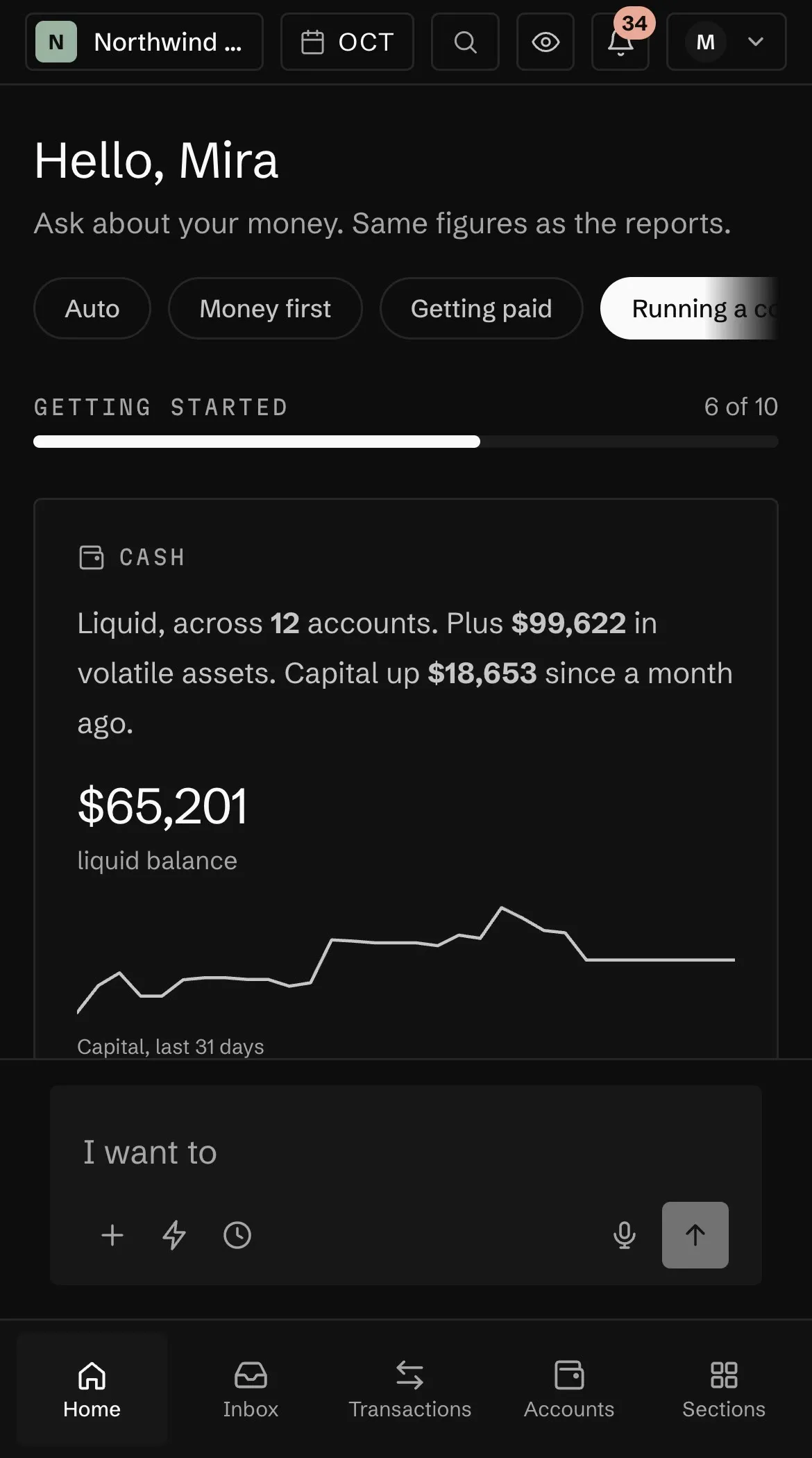
Mail, receipts and bills leave the queue filed
Mail, receipts and expenses wait in one queue, and every row lands with its category and its paper.
Inbox and the ledger in full →
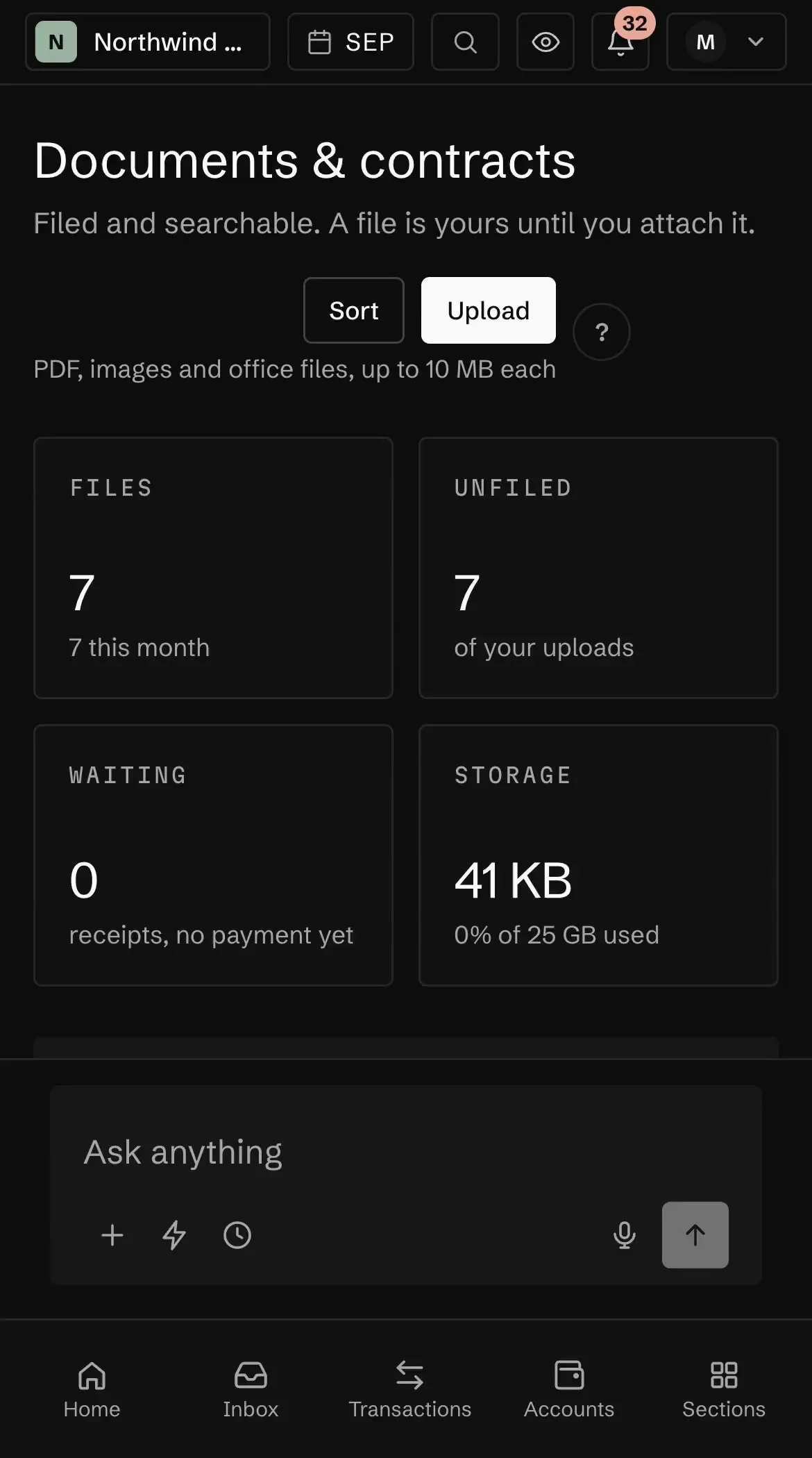
A supplier invoice arrives. Orla reads it
Forward it, drop the PDF, or let the Drive folder bring it in. Supplier, amount and due date are read, and the bill joins the queue.
Money leaves on your rule, invoices settle themselves
Bills go out in one batch under your rule; invoices take a card, a transfer or a stablecoin.
Two signatures above your threshold
A rule you set: the threshold and how many sign. The person who prepared a payment never signs it.
Payouts from your own bank
One batch under the rule, from your own Mercury, Airwallex, Revolut or Slash. The money never passes through Orla.
Invoices mark themselves paid
A card, a transfer or a stablecoin lands, and the invoice closes itself. The client's page shows it.
Pay from your own account
- Revolut Business
- Airwallex
- Mercury
- Slash
- PayPal
- Safe{Wallet}
You connect your own account with your own key, and a payment leaves from that account, never through ours.
Every counterparty, with its papers and chats
An address book, and chats that book what they are told.
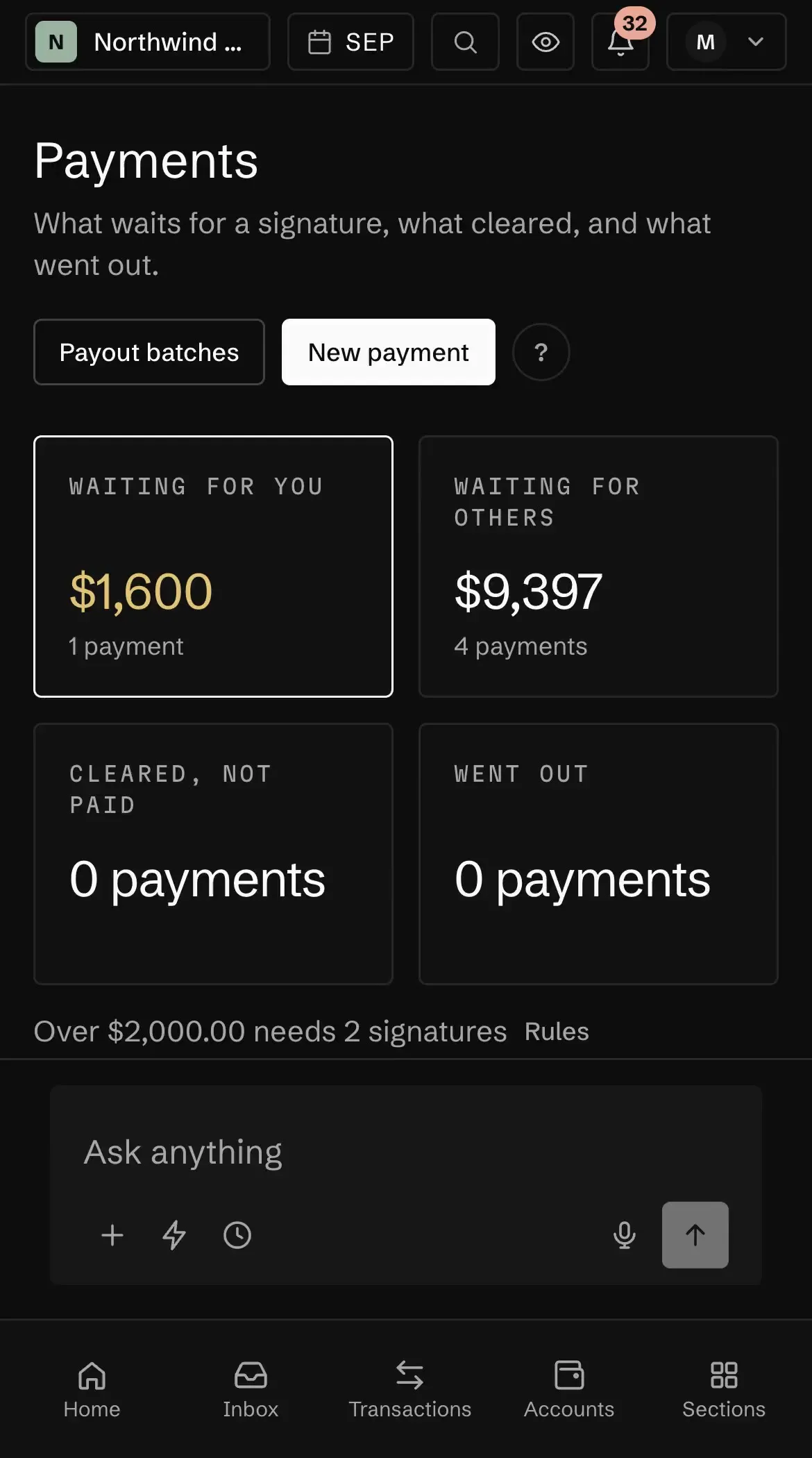
New payment details hold the payment until someone checks them
A payee you paid before, now on a bank account, IBAN, PayPal or wallet they were never paid on: the payment Orla sends waits, even with its signatures, until another person who can sign confirms the new details. Working alone, you confirm you checked them by phone. A payment you only record gets the same line as a warning.
04 · Month and checks Reports + For the accountant + Tax and VAT + AML screening + Anti-fraud monitoring +
Close the month into files, and check who you pay
Reports on the same figures the screens show, the month handed over as files, and the tax year ready.
Ten checks before the close
Every row has a category, every account a code, and nothing waits for a signature. Then the month closes.
The month as files
Statements for every account, a journal QuickBooks and Xero import, and one archive for your accountant.
Every address screened first
Checked against sanctions and risk lists before it is paid, with the verdict kept in the journal.
Reports open their rows
Every figure in a report opens the rows it was made of, on the same numbers the screens show.
Who signs, what connects, and what runs on its own
Roles and rules that say who signs what, and bank feeds and exchange keys that only read.
Who sees and signs what
Owner, admin, member, viewer, and an accountant seat that gets the month and nothing else. A member's card has a ceiling.
Your own agent, on a fence
A daily cap, allowed payees and the hosts it may buy from. What it proposes waits for a person's press.
Rules that run on their own
They watch a balance, a budget or a sync, and tell a person once per period, never twice.
Ask the book a question. Press once on the answer
It answers in cards, and nothing moves without your press.
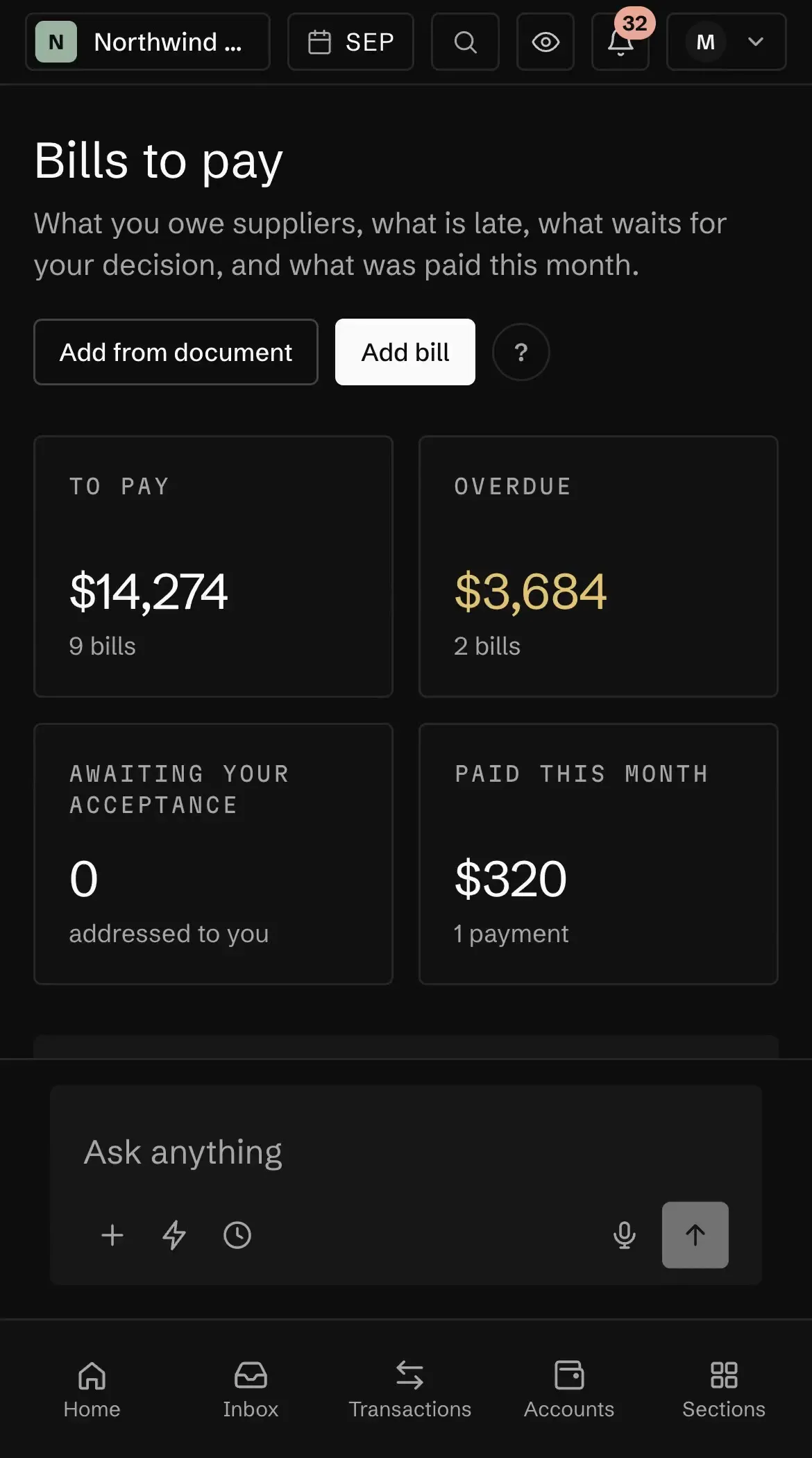
Ask before you pay, and press once on the answer
Is any unpaid bill a duplicate: the answer names the pair from your own books, and once you say which one is the copy, one press on its card declines it while both papers stay. The same composer weighs this week's payments against what is free, and a figure in its tables opens the rows behind it.
07 · AI staff
Four roles work your books every morning. You press Accept
Each goes through its part of the books once a day and leaves cards in a queue. Nothing changes until a person accepts.
Bookkeeper
Categories, receipts and payees, and what stops the month from closing. It remembers the practices you keep.
AP clerk
Supplier bills: accept or decline, catch the duplicate, and queue the payment for a bill you accepted.
AR clerk
Reminds the clients who are late, and writes the invoice for money that came in without one.
Treasurer
Cash against your reserve, a weekly brief, and a bill's payment moved later when cash runs short.
Rolling out space by space, on the plans that include AI staff. A role never approves or sends a payment.
08 · Connect any system
Payroll, CRM or ERP: paste its API address, and an agent maps it
It reads the system, asks which records matter, and shows a map with real rows. You approve it, and the records sync every day beside your books.
Read only: nothing is changed in the system and no money moves. Rolling out space by space, on Pro and up.
The rest of the back office has pages of its own: Slack and Telegram as an input form, agents that pay on your rules, and machines that pay you over x402.
One month at a five person studio
Eight supplier bills, one signing rule, and the month handed over as files.
Anything over 2,000.00 needs a second signature. That one rule split September in two.
2,400.00 Rent Sep 1 1,284.00 AWS Sep 2 3,960.00 Deel Sep 2 48.00 Hetzner Sep 3 540.00 Figma Sep 4 300.00 Typeform Sep 6 3,050.00 Lumen Sep 8 1,542.00 Bench Sep 9
2,000.00 · second signatureHeld for a second signature: 3 bills · 9,410.00Paid one by one: 5 bills · 3,714.00
Five bills under the rule went one by one, one press each, 3,714.00. In one batch they would have waited too: the rule reads the batch total, not each row. Three crossed it and waited, 9,410.00. Together 13,124.00, and the month closed as statements, a journal and one archive. See this on your own month
Business accounts inside Orla. Fiat and stablecoins, both ways
Accounts in your company's name, with the balance next to the books that explain it. Custody sits with a licensed banking partner; the ledger, the rules and the signatures stay inside Orla.
Accounts inside Orla USD account EUR account GBP account USDC and USDT Your ledger every row priced at the day it happened Money in Client pays by card Bank transfer, local or SWIFT Stablecoins to your address Platform payouts Money out Payout batches on approval Cards with a ceiling Requests and drafts in your own bank Crypto to allowed payees QuickBooks Online Xero Journal and archive
-
Money in
- Client pays by card
- Bank transfer, local or SWIFT
- Stablecoins to your address
- Platform payouts
- Client pays by card
-
Accounts inside Orla
- USD account
- EUR account
- GBP account
- USDC and USDT
- USD account
- Your ledger every row priced at the day it happened
-
Money out
- Payout batches on approval
- Cards with a ceiling
- Requests and drafts in your own bank
- Crypto to allowed payees
- Payout batches on approval
-
To your accountant
- QuickBooks Online
- Xero
- Journal and archive
- QuickBooks Online
- Named accounts USD, EUR and GBP in your company's name, on local rails and SWIFT.
- On and off ramp Fiat to USDC or USDT and back, priced at the moment of conversion and booked as one row.
- Cards funded either way Virtual Visa or Mastercard cards with a ceiling per person, topped up from the account or straight from crypto.
- One ledger for all of it Bank, cards, exchanges and wallets in one book, each row priced at its day.
How many hours a month the back office gives back
Type your own counts. The minutes are our assumptions, written next to each line.
An estimate from your counts and our minutes, which count the whole job: the typing, the chasing, the search for the paper, the questions after.
36.6 hours a month
- A supplier bill found in the mail, typed in by hand, filed and dated Read from the document by mail, Drive or a photo; you check it 12 → 2 min each 5 h
- Asking who paid a bill nobody filed, and where the paper is A receipt arrives by mail, Drive or a photo and finds its payment 8 → 1 min each 3.5 h
- An invoice written from the contract, checked against it and sent Issued on the schedule the contract set, and sent on its own 15 → 2 min each 2.6 h
- Chasing it: the reminders, and answering whether it was paid yet Reminders go out by themselves; the client's page shows the status 12 → 1 min each 2.2 h
- A payout keyed into the bank, checked twice, and the payee told One batch, one signature; the rows and the details come from the book 15 → 2 min each 4.3 h
- An account reconciled by hand, missing receipts hunted down Rows land by feed with a category; a receipt finds its payment 150 → 15 min each 6.8 h
- Collecting the month's documents from everyone, and finding the lost ones The checklist names what is missing; one archive 300 → 30 min per company a month 4.5 h
- The month pulled together for the accountant, and their questions answered Statements, a journal and one archive, as files 420 → 45 min per company a month 6.3 h
- Switching logins, folders and chats per company One sign-in; every company is a space on one rail 90 → 5 min per company a month 1.4 h
or start free and connect one account
Agencies, shops, SaaS, creators and eight more kinds of company
For businessEvery one of these has a page that answers it in its own words:
- Affiliate networks
- Agencies and studios
- AI-native teams
- Construction and trades
- Crypto-native companies
- E-commerce and marketplace sellers
- Freelancers and contractors
- Independent creators
- Property managers and landlords
- Recruiting and staffing
- SaaS and startups
- Talent and influencer agencies
Orla keeps personal books too, with their own screens and roles: personal, colivers and travelers, family.
Sees everything. Holds only what you send it
Nothing leaves an account without a person's signature. Feeds and exchange keys only read, and a bank you pay from is connected with a key that cannot send on its own.
Read-only connections
Bank feeds and exchange keys only read. A key with trading rights is refused.
Your keys stay yours
Wallet keys encrypted in your browser. Orla holds money in two places only, both funded by you: the card balance and an agent's wallet.
A trail on every write
Every change keeps the row's previous state, so it can be undone.
It was me, or not me
A new sign-in asks you. Not me signs that device out at once.
Approval rules
A threshold, the signatures it takes, allowed payees, an allowance per person.
Authority map
Who can move money in this book, and what holds each of them.
Oversight report
A report frozen the day after the month ends: what was checked, what went around.
Screening
AML checks before a payout and on incoming addresses.
Your first hour, in three steps
Start free with an email: no card, no time limit, nothing to install.
A space for the company
Sign up, and the company gets a space of its own, apart from anything personal. The free plan includes one business space.
One account, and the first rows
Connect one bank, exchange or platform, or drop in a statement in any language. The first rows land in minutes, each with its category.
One real bill
Drop in a supplier bill's PDF, and watch it become a bill to pay with its supplier, amount and due date.
All it takes: an email and one bill.
Plans start free. Paid plans from $25 a month
One subscription covers every book you run. Change plan any time, and raise any single limit on its own instead of moving up a plan.
-
Free
Free Start here. Not a trial. -
Solo
$25 a month Live sync and the paperwork. -
Pro
$69 a month For a business of one. -
Scale
$199 a month For a company with controls. -
Enterprise
$499 a month Several companies, one book each.
Before you book anything
Can Orla move our money?
Only on your rules and with a person's signature. Bank feeds are read-only. A payout is prepared in Orla, stopped by the approval rule when it crosses the threshold, and released by the signatures the rule asks for. Fiat leaves from your own bank, and each one keeps the last word its own way: Revolut Business and Airwallex get a draft that a person releases inside the bank, Mercury gets a request that waits for an admin there because the token cannot send, and Slash and PayPal send on a press in Orla after the approvals. From a Safe, Orla only proposes; the owners sign and execute. The money never passes through Orla.
What if Orla gets something wrong?
It shows its work and waits for you. A bill read from a PDF waits as a draft with its supplier, amount and due date for you to check; a row no rule knows waits in the inbox until you press once on its category; the assistant puts a link to the rows beside the figure and changes nothing without your press. Every change keeps the row's previous state, so a wrong one is undone rather than typed again.
Do we have to leave our accounting software?
No. Orla is the layer before it. Your accountant keeps QuickBooks or Xero and receives the month from Orla as statements for every account, a journal and one archive.
How do bills get in?
By mail to your space's address, a dropped PDF, a Drive folder or a photo of a receipt. A bill from an unknown sender waits in quarantine until you let it in.
Which banks, cards and platforms connect?
Banks through Plaid in the US, the UK and Europe, and any bank by statement in any language. Stripe, Shopify, PayPal, Gumroad, Lemon Squeezy, Bandcamp, Etsy and YouTube. Binance, Bybit, OKX, Kraken, Coinbase and Hyperliquid by read-only key. Wallets on BTC, EVM chains, TRON and Solana by address.
What about crypto in the books?
A trade is priced at the minute it happened, a transfer between your own wallets is not income, cost basis survives a swap, and the realised gain sits in the same month as rent. Your accountant gets the month with the crypto rows already priced.
Who can see what?
Owner, admin, member, viewer, and an accountant seat that gets the month and nothing else. A member gets a card with a ceiling and a monthly allowance. Every export is logged.
How long does setup take?
Connect one account and the first rows land in minutes. Bring the history over with Move in: drop every statement, export and invoice from the old bookkeeping at once, get a plan, press start, undo if needed. On the demo we do it with you.
What does it cost?
The free plan has no card and no time limit, and it includes one business space to try. Paid plans start at $25 a month. The business plans add seats and business spaces, approval rules with signatures, the accountant seat and the month's files. Any single limit can be raised with a pack instead of a plan change.