Jellypod
Create podcasts, videos & shorts from Claude/Cursor via Jellypod’s remote MCP.
Hosted MCP Server
npx add-mcp 'https://mcp.jellypod.com/mcp'Installs into Claude Code, Codex, Cursor and more
Documentation
New: 13 caption styles for videos, shorts, and voiceovers
Jellypod MCP Server
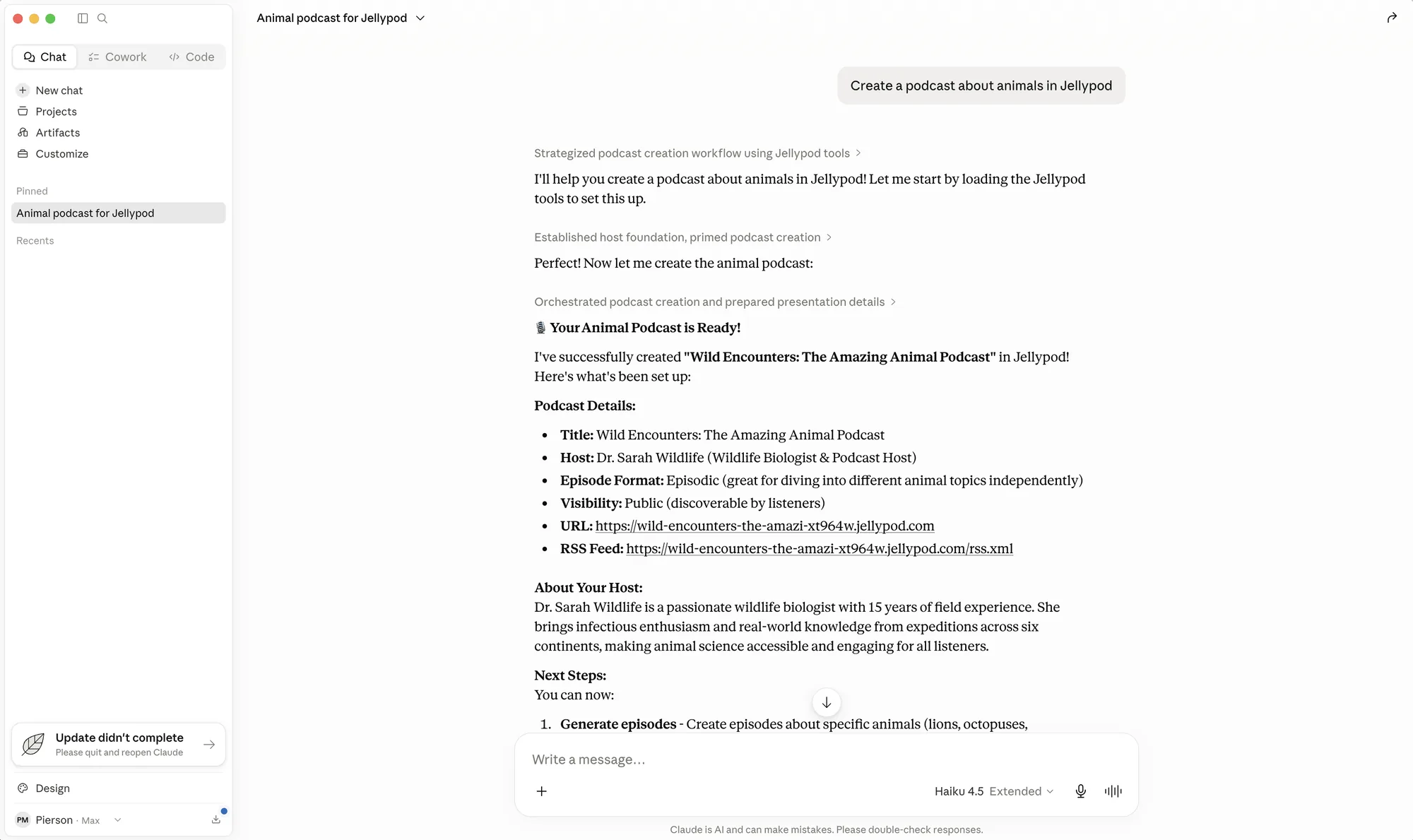
Jellypod MCP server: ask your AI assistant for a podcast episode, video, or short in chat, add research, track progress, and get the finished media back.
More clients, one setting each
Copy the snippet, paste it in, and ask for your first episode.

Cursor
Turn a changelog, docs page, or release notes into an episode without leaving the editor. The connector reaches your Jellypod account only, never your repository. Add the server under Tools and MCP in Cursor settings, or use the Add to Cursor button on the MCP page, then sign in with OAuth on first use. mcp.json{ "mcpServers": { "jellypod": { "url": "https://mcp.jellypod.com/mcp" } } }
Perplexity
Let Perplexity gather cited, current research on a topic, then generate an episode based on it. Add Jellypod as a custom connector with the server URL, then sign in through Jellypod and approve access once. Server URLhttps://mcp.jellypod.com/mcp
Gumloop
Make episode generation one node in a visual AI flow, so a new source becomes a draft ready for review. Publishing stays an explicit step you add. Add Jellypod as an MCP connector in your flow with the server URL, then authorize with OAuth once. Server URLhttps://mcp.jellypod.com/mcp
Raycast
Draft an episode or check on a generation from a keystroke on your Mac, without opening a browser. Install Jellypod as an MCP server with the server URL and an Authorization header carrying a Jellypod API key (Creator plan or higher). Server URL and headerhttps://mcp.jellypod.com/mcp Authorization: Bearer YOUR_API_KEY
Install
- 01
Copy the server URL
Then pick the path for your client. The MCP connector docs cover OAuth and API key setup. - 02
Remote clients
In Claude, ChatGPT, Perplexity, Gumloop, or Dust, add a custom connector with the server URL and authorize with OAuth on first connect. Some accept the JSON config directly. - 03
Editor and desktop clients
Cursor and VS Code take the server URL directly, and Raycast adds an API key header. Clients that only run local stdio servers use themcp-remoteshim, which handles the OAuth handshake. - 04
One-click install
Add to Cursor or Add to VS Code.
Server URL
https://mcp.jellypod.com/mcp
Remote clients
{
  "mcpServers": {
    "jellypod": {
      "url": "https://mcp.jellypod.com/mcp"
    }
  }
}
Editor and desktop clients
{
  "mcpServers": {
    "jellypod": {
      "command": "npx",
      "args": ["-y", "mcp-remote", "https://mcp.jellypod.com/mcp"]
    }
  }
}
What your assistant can do
- List and read your podcasts, episodes, videos, shorts, and voiceovers
- Create and update podcasts and characters
- Generate episodes, videos, and shorts from a prompt or a finished script
- Ground a generation in a public webpage, YouTube video, or pasted text
- Browse built-in voices, video styles, and your saved characters
- Track progress, then play or download the finished media
- Update titles, descriptions, and other details
- Publish, schedule, reschedule, and unpublish episodes after you review
The Agent guide covers progress checks and failure handling. When Jellypod needs an original file, upload it in the studio or through the API. The Video, short, and voiceover reference has API examples for each product.
Frequently asked questions
What is the Jellypod MCP server?
It connects an AI assistant to your Jellypod account. Create podcasts and characters, generate episodes, videos, and shorts, track progress, and publish or schedule episodes. It can also read your existing voiceovers. The server URL is https://mcp.jellypod.com/mcp.
How much does it cost?
The connector is included with Jellypod at no extra cost. Generating episodes, videos, or shorts uses the same credits as the studio.
Which AI assistants and tools work with it?
Claude, ChatGPT, Cursor, Codex, and any other client with MCP support. Setup and inline playback vary by client, so follow the guide for yours. Without inline playback, you get a Listen or Watch link and a Studio link.
How do I authenticate?
Most clients use OAuth: sign in through Jellypod once, approve access, and the assistant acts with your own permissions. Clients that cannot complete OAuth send a Jellypod API key as a bearer token (Creator plan or higher).
What can the assistant access, and does it publish automatically?
Only content you already have access to: your podcasts, episodes, videos, shorts, voiceovers, and characters. Billing, team, and account settings stay in the studio, and so does deleting content. Episodes arrive as drafts, and the assistant publishes only when you ask.
My tool is not listed. Can it still connect?
If it supports remote MCP servers, yes. Connect it with the Jellypod server URL; the MCP connector docs cover the generic setup.
Start creating with Jellypod today
Turn any idea, document, or link into editable, high-quality podcasts and videos. Reach global audiences in your own voice, in 121 languages.