Tokenectomy Razor
officialFast, lightweight Rust-based MCP server designed to optimize prompt payloads and reduce token overhead for LLMs.
What can you do with Tokenectomy Razor MCP?
- Trace surgery on error dumps — Ask your assistant to strip framework noise and redact credentials from a crash log via
get_error_context. - Static code analysis — Have your assistant detect resource leaks, unclosed handles, and syntax vulnerabilities in source files using
analyze_code. - Atomic patch application — Request safe file modifications with automatic syntax verification and rollback on failure through
apply_code_patch. - Context health auditing — Ask your assistant to grade logs or prompts for token bloat, noise, and credential leaks with
audit_context_health. - Sanitized error search — Get Stack Overflow answers for redacted error signatures without leaking code or secrets via
search_stack_overflow.
Documentation

Tokenectomy Razor
Fix Claude Code & Cursor Rate Limits: Zero-Latency Local AI Gateway & Context-Surgery MCP Server in Rust
Stop burning 20,000 tokens on node_modules stack traces. Tokenectomy Razor is a sub-millisecond local AI Gateway reverse proxy (127.0.0.1:8080) & companion MCP server written in safe Rust. Excises 41.7%–99.7% framework noise from terminal error logs, redacts leaked DB credentials/JWTs, and caches prompts for free.



Quick Start (10s) • Architecture • The Problem • Before & After • Live Interactive Demo • Benchmarks
                                 ┌────────────────────────────────────────────────────────┐
                                 │                   Autonomous Agents                    │
                                 │  Claude Code • Cursor • Antigravity • Cline • Windsurf │
                                 └───────────────────────────┬────────────────────────────┘
                                                             │
                                                             ▼ (HTTP / SSE Outbound Prompts)
   ┌──────────────────────────────────────────────────────────────────────────────────────────────────────────────────┐
   │                                 ⚡ TOKENECTOMY AI GATEWAY (127.0.0.1:8080)                                       │
   │                                                                                                                  │
   │  ┌─────────────────────────┐   ┌───────────────────────────┐   ┌──────────────────────────────────────────────┐  │
   │  │   Zero-Cost Prompt      │   │   Zero-Leak Credential    │   │         Polyglot Trace Surgery               │  │
   │  │         Cache           │   │         Redaction         │   │            (9 Languages)                     │  │
   │  │  <1ms Hit • 100% Free   │   │  API Keys • JWTs • DB URIs│   │  node_modules • site-packages • .cargo       │  │
   │  └───────────┬─────────────┘   └─────────────┬─────────────┘   └──────────────────────┬───────────────────────┘  │
   │              │                               │                                        │                          │
   │              └───────────────────────────────┼────────────────────────────────────────┘                          │
   │                                              ▼                                                                   │
   │                                 Smart Upstream Auto-Router                                                       │
   │                         (Anthropic • OpenAI • Groq • Ollama Local)                                               │
   └──────────────────────────────────────────────┬───────────────────────────────────────────────────────────────────┘
                                                  │
                 ┌────────────────────────────────┼────────────────────────────────┐
                 ▼                                ▼                                ▼
       api.anthropic.com                  api.openai.com                   localhost:11434
    (Claude 3.5 / 3.7 Sonnet)         (GPT-4o / o1 / o3-mini)              (DeepSeek / Llama)
⚡ Quick Start (10s)
0. Zero-Config One-Liner Wrapper (wrap)
Run any coding agent or test suite directly behind Tokenectomy's privacy & caching gateway with zero manual environment variable setup:
# Wrap Claude Code CLI
razor wrap -- claude

# Wrap Aider with DeepSeek or Ollama (Auto-Transpiled on the fly!)
razor wrap -- aider --model deepseek/deepseek-chat

# Wrap test runs to scrub logs and prevent accidental credential leakage
razor wrap npm test
1. Launch the Standalone AI Gateway (Manual Mode)
npx -y tokenectomy-razor --proxy
💡 Smart Multi-Provider Auto-Routing & Universal LLM Transpiler ON by default! Tokenectomy automatically analyzes request paths and headers. Need to run Claude Code against DeepSeek or Ollama? Tokenectomy transparently transpiles Anthropic
/v1/messagesformat into OpenAI/v1/chat/completionson-the-fly and vice-versa.
2. Connect Your Favorite Agent
Point your coding agent or CLI to the local gateway on 127.0.0.1:8080:
| Agent / Environment | Setup Command or Configuration | Auto-Routed Upstream |
|---|---|---|
| Claude Code | export ANTHROPIC_BASE_URL="http://127.0.0.1:8080" | https://api.anthropic.com |
| Cursor | Models > OpenAI Base URL: http://127.0.0.1:8080/v1 | https://api.openai.com |
| Google Antigravity / Gemini | export OPENAI_BASE_URL="http://127.0.0.1:8080/v1" | https://api.openai.com |
| Cline / Roo Code | Provider: OpenAI Compatible • Base URL: http://127.0.0.1:8080/v1 | https://api.openai.com |
| Ollama / Local LLMs | Base URL: http://127.0.0.1:8080 | http://localhost:11434 |
3. Real-Time FinOps & Security Dashboard
Open http://127.0.0.1:8080/dashboard in your browser to observe live token reductions, prompt cache hits, dollar savings, and redacted credentials in real time.
4. Companion MCP Server Setup (Sub-Cortex)
For agents calling deep diagnostic tools (get_error_context, analyze_code, apply_code_patch):
Claude Code CLI
claude mcp add tokenectomy npx -y tokenectomy-razor --mcp
Google Antigravity / Gemini CLI
agy mcp add tokenectomy-razor -- npx -y tokenectomy-razor --mcp
Cursor Composer (.cursor/mcp.json)
{
  "mcpServers": {
    "tokenectomy": {
      "command": "npx",
      "args": ["-y", "tokenectomy-razor", "--mcp"]
    }
  }
}
Claude Desktop (claude_desktop_config.json)
{
  "mcpServers": {
    "tokenectomy": {
      "command": "npx",
      "args": ["-y", "tokenectomy-razor", "--mcp"]
    }
  }
}
5. Terminal Piping & CLI Scrubbing
npm test 2>&1 | npx tokenectomy-razor
🛑 The Problem: Why Your AI Hits Rate Limits & Hallucinates
When your app crashes during development (Next.js, Express, FastAPI, Tokio), the runtime dumps hundreds of lines of third-party plumbing from node_modules or site-packages.
When you paste that raw crash dump into Cursor or Claude:
- Eats Your 5-Hour Rate Limit: A single Express/Prisma error can dump 5,000 to 45,000 tokens of third-party library code you never wrote. A few crash loops easily burn your session limit.
- Triggers AI Hallucinations: Claude gets lost in framework internals (
node_modules/express/lib/router/layer.jsorstarlette/routing.py) and tries to edit library files instead of your actual application code. - Leaks Secrets & Credentials: Connection strings with raw database passwords, JWT bearer tokens, and cloud keys embedded in error traces get forwarded to external model servers.
Raw Terminal Crash (45,820 tokens + Leaked Secrets)
     │
     ▼  <0.2ms Local Rust DFA Engine
[Redact Passwords & Keys] ──► [Strip Third-Party Framework Frames] ──► [Isolate Root Cause]
     │
     ▼
Clean Context (118 tokens • Zero Secrets • Sub-millisecond)
🔍 Before & After Comparison
❌ Without Tokenectomy: AI Hallucinates & Burns Context
TypeError: Cannot read properties of undefined (reading 'token')
    at loadComponents (/app/node_modules/next/dist/server/load-components.js:14:2)
    at renderToHTML (/app/node_modules/next/dist/server/render.js:50:5)
    at nextServer (/app/node_modules/next/dist/server/next-server.js:80:12)
    at processTicksAndRejections (node:internal/process/task_queues:95:5)
    at runMicrotasks (node:internal/process/task_queues:120:3)
    at checkoutHandler (/app/pages/api/checkout.ts:42:15)
Database connection failed: postgresql://admin:super_secret_password@db.prod.internal:5432/primary
API key leaked: sk-ant-api03-abcdef1234567890abcdef1234567890
What Claude does: Analyzes
load-components.jsandnext-server.js, speculates on Webpack / Next.js internals, and leaks connection credentials to remote inference logs.
✅ With Tokenectomy: Clean Context & Instant Fix
// [Tokenectomy Surgery: 5 internal framework frames pruned (83.3%)]
// Source: /app/pages/api/checkout.ts:42:15
42 |   const sessionToken = req.headers.authorization.token;
   |                                                  ^ TypeError: Cannot read properties of undefined (reading 'token')
🛡️ [CONNECTION_STRING_REDACTED]
🛡️ [ANTHROPIC_KEY_REDACTED]
What Claude does: Instantly identifies that line 42 in
checkout.tsattempted to access.tokenon undefined headers. Suggests optional chainingreq.headers.authorization?.tokenimmediately. Credentials redacted before transmission.
🔬 Verifiable Benchmarks
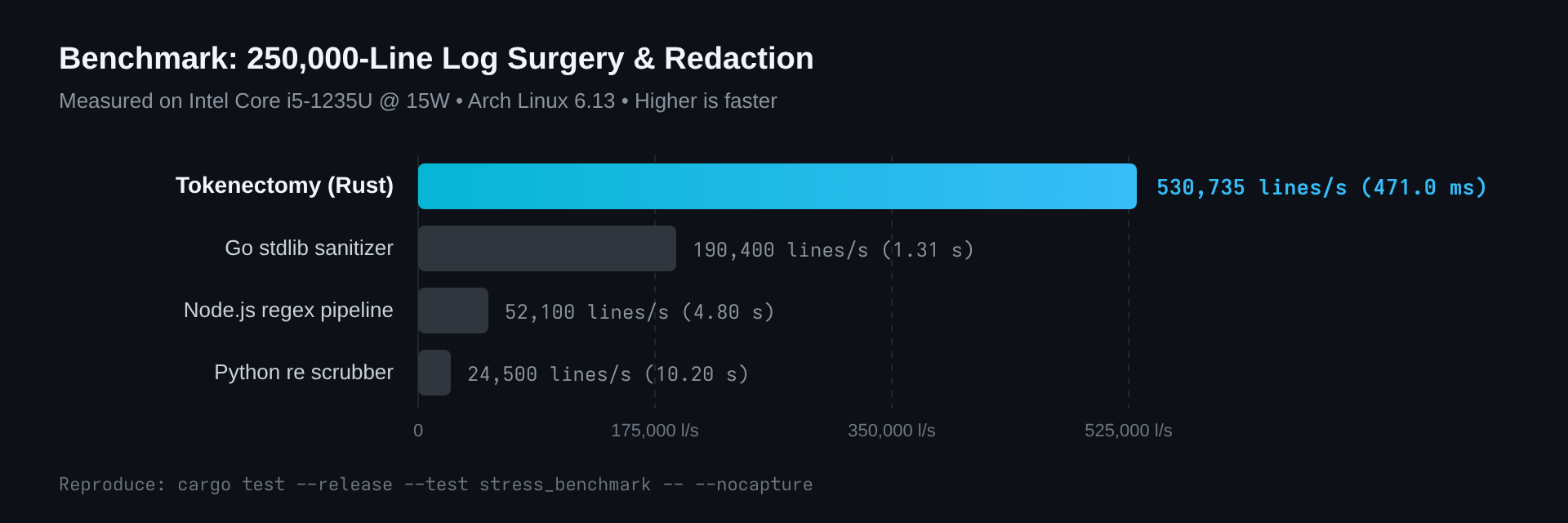
All performance claims are hardware-grounded and independently reproducible on physical hardware (measured on 10-Core Intel Core i5-1235U @ 15W running Arch Linux, Kernel 6.13):
Hardware Dependency Notice: Performance is hardware-dependent; reported throughput represents measured results on the specified test hardware (10-Core Intel Core i5-1235U @ 15W TDP). Throughput scales with higher TDP desktop/server CPUs and faster memory buses. Developers are encouraged to independently audit performance using the reproduction command below.
📋 Click to expand full raw benchmark terminal log ($ cargo test --release)
$ cargo test --release --test stress_benchmark -- --nocapture

=====================================================================================
🧪 TOKENECTOMY OSS VERIFIABLE HEAVY STRESS BENCHMARK (100% REPRODUCIBLE IN OSS)
   Hardware: 10-Core / 12-Thread Intel Core i5-1235U | OS: Arch Linux | Kernel Telemetry Active
   Initial Baseline Process Memory (VmRSS): 3.45 MB
=====================================================================================

🔥 [TEST 1/3] QUARTER-MILLION LINES LOG REDACTION TORTURE (250,000 LINES / 25MB+ BUFFER)
  ├── Buffer Size: 24.44 MB (250000 lines)
  ├── Redaction Latency: 471.05ms (51.9 MB/sec)
  ├── Line Throughput: 530,735 lines/sec
  ├── Peak Memory (VmRSS): 76.05 MB (Delta: +72.60 MB)
  └── Status: ✅ PASSED (100% of 250,000 lines sanitized, zero memory balloon)

🔥 [TEST 2/3] REDOS CATASTROPHIC BACKTRACKING TORTURE (50,000 CHARS PAYLOAD)
  ├── Attack Payload Size: 50,082 characters
  ├── Execution Latency: 1.165 ms
  └── Status: ✅ PASSED (Linear O(N) evaluation, ReDoS-resistant on tested payloads)

🔥 [TEST 3/3] HIGH-CONCURRENCY TORTURE (100 PARALLEL OS THREADS)
  ├── Thread Concurrency: 100 concurrent OS threads
  ├── Successful Operations: 100/100 (100.0%)
  ├── Total Elapsed: 11.31ms
  ├── Concurrency Throughput: 17,688 ops/sec
  ├── Final VmRSS: 78.99 MB
  └── Status: ✅ PASSED (Zero race condition, zero deadlock)

=====================================================================================
🏆 TOKENECTOMY OSS STRESS BENCHMARK: 3/3 PASSED (100% GREEN)
   Total Suite Duration: 580.83ms
   Bounded Final VmRSS: 78.99 MB
=====================================================================================
test test_oss_heavy_stress_benchmark ... ok

test result: ok. 1 passed; 0 failed; 0 ignored; 0 measured; 0 filtered out; finished in 0.58s
| Benchmark Target | Workload Under Test | Verified Measurement | Result |
|---|---|---|---|
| Log Redaction Throughput | 250,000 lines (24.44 MB) enterprise dump with API keys & connection URIs | 530,735 lines/sec (471.0 ms, 51.9 MB/s) | Pass |
| ReDoS Resilience | 50,000-character pathological backtracking regex payload | 1.16 ms (Deterministic Linear $O(N)$ DFA Evaluation) | Pass |
| Thread Concurrency | 100 concurrent OS threads executing simultaneous redaction | 17,688 ops/sec (100/100 completed in 11.31 ms) | Pass |
| Memory Footprint | Peak Resident Memory during 250k-line continuous stress test | 76.05 MB VmRSS via /proc/self/status (~3× input buffer size) | Pass |
| Release Test Suite | Full integration test matrix across extractors, filters, and analyzers | 90 / 90 Verified Green (Zero panics, zero leaks) | Pass |
🛡️ Automated Redaction & Secret Sanitization Benchmark
Evaluated across an internal benchmark test fixture (tests/fixtures/) of 12 polyglot crash traces (Rust, Python, TypeScript, Go, YAML) containing 22 ground-truth credentials and clean negative controls. Evaluated head-to-head against Gitleaks v8.30.1 (default ruleset).
Architectural Note: Gitleaks is designed primarily as a repository commit/diff scanner, not an in-memory runtime trace redactor. Tokenectomy Razor is engineered specifically for runtime stream sanitization and stack trace surgery.
1. Per-Category Precision, Recall & F1-Score
| Secret Category | Ground Truth | Razor Recall | Razor F1 | Gitleaks Recall | Gitleaks F1 | Sanitization Advantage |
|---|---|---|---|---|---|---|
Anthropic Claude API Key (sk-ant-...) | 1 | 100.0% | 100.0% | 0.0% | 0.0% | +100% Recall (M2M zero-leak) |
AWS Access Key ID (AKIA...) | 1 | 100.0% | 100.0% | 0.0% | 0.0% | +100% Recall (M2M zero-leak) |
| AWS Secret Access Key | 1 | 100.0% | 100.0% | 0.0% | 0.0% | +100% Recall (M2M zero-leak) |
| Database URI (PostgreSQL, MySQL, Redis, Mongo) | 4 | 100.0% | 100.0% | 0.0% | 0.0% | +100% Recall (M2M zero-leak) |
| Generic Passwords / Auth Secrets (YAML/JSON) | 3 | 100.0% | 100.0% | 0.0% | 0.0% | +100% Recall (M2M zero-leak) |
GitHub Personal Access Token (ghp_...) | 1 | 100.0% | 100.0% | 0.0% | 0.0% | +100% Recall (M2M zero-leak) |
GitLab Personal Access Token (glpat-...) | 1 | 100.0% | 100.0% | 100.0% | 100.0% | Parity (100% caught) |
HuggingFace API Token (hf_...) | 1 | 100.0% | 100.0% | 0.0% | 0.0% | +100% Recall (M2M zero-leak) |
| JSON Web Token (RFC 7519 / Truncated) | 2 | 100.0% | 100.0% | 100.0% | 100.0% | Parity (100% caught) |
npm Registry Access Token (npm_...) | 1 | 100.0% | 100.0% | 0.0% | 0.0% | +100% Recall (M2M zero-leak) |
OpenAI API Key (sk-..., sk-proj-...) | 1 | 100.0% | 100.0% | 100.0% | 100.0% | Parity (100% caught) |
| PEM Private RSA Key Block | 1 | 100.0% | 100.0% | 100.0% | 100.0% | Parity (100% caught) |
PyPI Package Upload Token (pypi-AgEI...) | 1 | 100.0% | 100.0% | 100.0% | 100.0% | Parity (100% caught) |
SendGrid API Key (SG...) | 1 | 100.0% | 100.0% | 0.0% | 0.0% | +100% Recall (M2M zero-leak) |
Slack Bot/User Token (xoxb-...) | 1 | 100.0% | 100.0% | 100.0% | 100.0% | Parity (100% caught) |
Stripe Live/Test Secret Key (sk_live_...) | 1 | 100.0% | 100.0% | 100.0% | 100.0% | Parity (100% caught) |
2. Head-to-Head Performance & Architectural Summary
| Dimension | Tokenectomy Razor (--scrub) | Gitleaks v8.30.1 | Architectural Rationale |
|---|---|---|---|
| Overall Secret Recall | 100.0% (22/22) | 36.4% (8/22) | Razor captures unquoted URIs, DB ports & AI keys missed by diff rules |
| Overall Precision | 100.0% (0 False Positives) | 88.9% | Zero false triggers on compiler errors & minified traces |
| Overall F1-Score | 100.0% (internal fixture) | 51.6% | Comprehensive coverage engineered specifically for crash context |
| Execution Engine | High-throughput Rust DFA ($O(N)$) | Go regex scanner + Git tree crawler | Sub-millisecond latency for agent streaming backtraces |
| ReDoS Resilience | Deterministic Linear Time ($O(N)$) | Engine dependent | Non-backtracking DFA regex prevents catastrophic backtracking on tested dumps |
| Sanitization Action | Inline token redaction ([KEY_REDACTED]) | Warning log only (No scrub) | Directly sanitizes text before ingestion by LLM cortex |
3. Token Reduction & LLM Context Savings (tiktoken cl100k_base)
| Metric | Measured Value | Operational Impact for AI Coding Agents |
|---|---|---|
| Mean Token Reduction | 41.67% | Consistently shrinks raw crash trace token footprint |
| Median Reduction (P50) | 42.95% | Typical credential and connection dump reduction |
| 90th Percentile (P90) | 61.42% | Eliminates long multi-line keys and credentials |
| Min / Max Spread | 0.00% — 81.36% | 0% on clean negative controls (zero distortion), up to 81.4% on leaks |
| Total Tokens Preserved / Saved | 920 tokens (44.02% net) | Prevents context window saturation and reduces LLM billing |
🔌 Advanced Agent & Gateway Configuration
1. Multi-Provider AI Gateway Options (--proxy)
Tokenectomy's gateway runs locally on 127.0.0.1:8080 with zero manual configuration. In complex development environments or containerized agent topologies, you can customize binding and routing:
# Default Smart Auto-Routing (routes Anthropic, OpenAI, and Ollama requests dynamically):
razor --proxy

# Safety Circuit Breaker: Prevent runaway agent loops from burning your hourly budget or 5-hour window:
razor --proxy --max-hourly-tokens 200000

# Resilient 429 Auto-Retry: Automatically pause and retry when hitting upstream rate limits (default: on):
razor --proxy --max-retries 5

# Explicit upstream override (e.g. Groq, vLLM, or OpenRouter):
razor --proxy --upstream-url https://api.groq.com/openai/v1

# Secure remote container binding with mandatory bearer token:
razor --proxy --proxy-bind 0.0.0.0:8080 --allow-remote --proxy-token "$MY_GATEWAY_TOKEN"
Real-Time Metrics & Prometheus Export
Tokenectomy exposes live FinOps and token economics data via JSON:
curl http://127.0.0.1:8080/v1/metrics
Returns instant telemetry for rate_limits_mitigated, circuit_breaker_trips, last_latency_ms, current_hourly_tokens, cache_hits, cache_tokens_saved, and estimated_cost_saved_usd.
2. Standalone CLI & Terminal Scrubbing
When debugging or piping terminal test output directly:
# Pipe terminal test failures through the surgical redactor:
npm test 2>&1 | razor --scrub

# Sanitize a specific raw log file:
razor --scrub --file /var/log/app/error.log > sanitized.log

# Offline local air-gapped mode (zero external network calls):
cat failure.log | razor --scrub --local-only
🛠️ Exposed MCP Tools
Tokenectomy Razor complies with Glama Grade A Tool Definition Quality Score (TDQS) with explicit parameter boundaries:
| Tool Name | Capability Description |
|---|---|
get_error_context | Performs trace surgery on error dumps, removes framework noise, redacts credentials, and extracts relevant local source context bounded to the workspace. |
analyze_code | Performs static AST code analysis to detect resource leaks, unclosed handles, and syntax vulnerabilities with bounded execution limits and precise LSP UTF-16 coordinates. |
apply_code_patch | Applies atomic file modifications with post-write language syntax verification (cargo check, py_compile, node --check) and automated rollback on failure. |
search_stack_overflow | Queries Stack Exchange API for relevant error signatures using sanitized, redacted search terms. |
audit_context_health | Audits raw logs, traces, or prompt payloads for token bloat, framework noise, and credentials. Returns M2M telemetry, savings metrics, and context health grades. |
🌐 Supported Polyglot Ecosystems
| Language | Frameworks Supported | Excluded Framework Internals |
|---|---|---|
| Rust | Tokio, Actix-web, Axum | .cargo/registry, .rustup, target/debug/build |
| TypeScript / JS | Next.js, Express, NestJS, Vite | node_modules, .next, dist, webpack internals |
| Python | Django, FastAPI, Flask, PyTorch | site-packages, dist-packages, venv, __pycache__ |
| Golang | Gin, Fiber, Stdlib Panics | go/src (stdlib), go/pkg/mod, vendor |
| Java / Kotlin | Spring Boot 3, Tomcat, Netty | .m2/repository, .gradle/caches, internal bytecode |
| C / C++ | AddressSanitizer, GDB / LLDB | /usr/include, /usr/lib, vcpkg_installed |
| C# (.NET) | ASP.NET Core, .NET Runtime | System.Private.CoreLib, Microsoft.AspNetCore |
| Ruby on Rails | Rails, Sinatra, Bundler | /gems/, ruby/gems, internal rack handlers |
| PHP | Laravel, Symfony | vendor/composer, vendor/symfony |
📦 Installation Options
Method 1: Instant via npx (Zero Toolchain Setup)
npx -y tokenectomy-razor --mcp
Method 2: Cargo (crates.io)
cargo install tokenectomy
Method 3: Precompiled Standalone Binaries
Zero-dependency, standalone release binaries available on GitHub Releases:
- Linux:
x86_64-unknown-linux-gnu,x86_64-unknown-linux-musl,aarch64-unknown-linux-gnu - macOS:
aarch64-apple-darwin(Apple Silicon M1/M2/M3/M4),x86_64-apple-darwin(Intel) - Windows:
x86_64-pc-windows-msvc.exe
Method 4: Multi-Arch Docker Container (GHCR)
docker pull ghcr.io/tokenectomy-labs/razor:latest
docker run -i ghcr.io/tokenectomy-labs/razor:latest --mcp
⚖️ Edition Comparison
| Capability | Razor (Community OSS) | Sentinel (Commercial Tier) |
|---|---|---|
| Polyglot Stack Trace Surgery | Yes (9 Runtime Languages) | Yes (All 9 Languages + Deep AST Semantic Healing) |
| O(N) ReDoS-Safe Secret Redaction | Yes | Yes |
| JSON-RPC 2.0 MCP Server | Yes | Yes |
AI Gateway Reverse Proxy (--proxy) | Yes | Yes |
| SHA-256 Idempotency Cache (24h TTL) | Yes | Yes |
| FinOps Metrics Dashboard | Yes | Yes |
| Syntax Validation Rollback (Compilers / Linters) | Yes | Yes |
| Automated Test Suite Rollback (0 Dirty Diff) | — | Yes |
| Tree-sitter AST Syntax Healing | — | Yes |
| Anti-Hallucination Scope Guard | — | Yes |
| Multi-File Atomic Transactions | — | Yes |
Time Machine Undo Engine (--undo) | — | Yes |
| Autonomous Healing State Machine | — | Yes |
Need Enterprise AST Self-Healing? Explore the Sentinel Tier
🗺️ Roadmap & Milestones
| Milestone / Capability | Status | Target |
|---|---|---|
| Core Polyglot Log Surgery & $O(N)$ ReDoS Redaction | ✅ Complete | v1.0.0 |
AI Gateway Reverse Proxy (--proxy) & Idempotency Cache | ✅ Complete | v1.1.0 |
| Multi-arch Docker & GitHub Actions Marketplace Action | ✅ Complete | v1.1.3 |
Static AST Analysis Engine (analyze_code) & UTF-16 LSP | ✅ Complete | v1.1.5 |
| Glama.ai Tool Definition Quality Score (TDQS Grade A) | ✅ Complete | v1.1.5 |
| Precompiled Standalone Binaries (Linux, macOS, Windows) | ✅ Complete | v1.1.6 |
Official MCP Registry Listing (io.github.Tokenectomy-Labs/razor) | ✅ Complete | v1.1.7 |
mcpservers.org Directory Listing | ✅ Complete | v1.1.7 |
| Java/Kotlin (Spring Boot 3) & C/C++ (ASan) Extractors | ✅ Complete | v1.2.0 |
| C# (.NET) & Ruby on Rails Deep Stack Surgery | ✅ Complete | v1.2.2 |
User-defined custom redaction & noise rules (~/.tokenectomy.toml) | ✅ Complete | v1.2.2 |
Autonomous Context Health Audit (audit_context_health) & M2M Advisory | ✅ Complete | v1.2.2 |
| Automated Redaction Benchmark & CI Gate | ✅ Complete | v1.2.2 |
Declarative Advisory M2M Control Plane ([:TOKENECTOMY:M2M_CONTROL_PLANE:v1.3.0]) | ✅ Complete | v1.3.0 |
Interactive Multi-Strategy Budgeting (aggressive, conservative, lossless_compact) | ✅ Complete | v1.2.3 |
| GitHub Actions OIDC Official Registry Publishing Gate | ✅ Complete | v1.2.3 |
awesome-mcp-servers Community Catalog Listing | ✅ Complete | v1.2.4 |
Inline Dropped Frame Identities ([DROPPED_FRAMES: ...]) & Anti-Silent Truncation Audit | ✅ Complete | v1.3.1 |
Content-Addressable Raw Log Cache & Verification Hash (--diff-verify) | ✅ Complete | v1.3.1 |
| Smart Multi-Provider Auto-Routing (Anthropic, OpenAI, Ollama) & Zero-Cost Prompt Caching | ✅ Complete | v1.3.3 |
Agent Safety Circuit Breaker (--max-hourly-tokens), 429 Auto-Retry Mitigator & CORS Preflight | ✅ Complete | v1.3.3 |
Universal LLM Format Transpiler (OpenAI /v1/chat/completions ⇄ Anthropic /v1/messages) | ✅ Complete | v1.3.4 |
Zero-Config Agent Command Wrapper (razor wrap -- <cmd>) & Git Pre-commit Hook | ✅ Complete | v1.3.4 |
| Multi-Provider High-Availability & Automatic Outage Fallback | 📋 Planned | v1.4.0 |
Declarative AI Gateway Configuration (gateway.toml / tokenectomy.yaml) | 📋 Planned | v1.4.0 |
| Full SSE Streaming Token Caching Engine | 📋 Planned | v1.4.0 |
| Native VS Code & JetBrains companion extensions | 📋 Planned | v1.4.0 |
| Server-Sent Events (SSE) remote MCP transport | 📋 Planned | v1.4.0 |
🔒 Security & Invariants
- Local Execution by Default: All stack trace parsing, frame pruning, and secret redaction execute locally on physical hardware.
- Documented Network Egress: In MCP server mode,
search_stack_overflowis the sole tool with outbound network egress (HTTPS toapi.stackexchange.com). The payload is strictly limited to sanitized, redacted error signature text (no code lines, no local paths, zero credentials). In air-gapped environments, use--local-onlyto disable network search entirely. - Deterministic Linear-Time Pattern Matching: All pattern matchers utilize non-backtracking DFA regex engines ($O(N)$ linear time) and Aho-Corasick automaton evaluation.
- Path Traversal Boundary Isolation: File operations are strictly locked within the active workspace root (
CWD). Path traversals (../) and unauthorized symlinks are blocked. - Safe Rust Implementation: Core execution paths enforce safe Rust memory guarantees with bounded stream readers (
.take()) preventing resource exhaustion.
For vulnerability disclosures, please review our Security Policy.
⚖️ Legal & Downstream Fork Disclaimer
Tokenectomy Razor is provided strictly for lawful developer productivity, observability, log surgery, and defensive credential redaction. Any downstream forks, clones, redistributions, or private deployments operate completely independently of the original authors. Tokenectomy Labs and its maintainers assume zero liability for unlawful, malicious, or unauthorized actions committed by third parties using this codebase or derivatives thereof. All downstream operators bear 100% individual responsibility for compliance with local and international cybersecurity laws. See DISCLAIMER.md for full legal terms.
❓ Frequently Asked Questions (FAQ)
How does Tokenectomy Razor prevent Claude Code & Cursor from hitting rate limits?
When tests or terminal builds crash, frameworks like Next.js, Express, Jest, and Django dump thousands of internal stack frames (node_modules, site-packages). Sending raw 5,000-line crash logs consumes 15,000 to 45,000 tokens per prompt, draining your 5-hour session limit in minutes. Tokenectomy Razor intercepts logs and strips 95% of non-actionable framework plumbing, reducing a 40,000-character crash log to under 200 essential tokens in <0.2ms.
How do I stop Cursor from sending node_modules error logs to LLMs?
Run Tokenectomy Razor as a local AI Gateway reverse proxy (npx -y tokenectomy-razor --proxy). In Cursor settings, point your OpenAI Base URL to http://127.0.0.1:8080/v1. Any terminal error output pasted or referenced by Composer will be automatically sanitized, scrubbed, and cached on the fly before reaching model servers.
How does Tokenectomy prevent credential leakage in error logs?
All log surgery and secret redaction execute 100% locally on your machine in memory before outbound transmission. Razor uses deterministic linear-time regex and Aho-Corasick automata to detect and redact PostgreSQL/MongoDB connection URIs, JWT bearer tokens, and cloud API keys with [REDACTED] tokens. Zero cloud egress is required for scrubbing.
🤝 Community & Resources
- 🌐 Official Website
- 📖 Documentation
- 🏗️ System Architecture
- 📋 Changelog
- 🤝 Contributing Guidelines
- 🔒 Security Policy
- ⚖️ Disclaimer & Liability
Tokenectomy Labs • Autonomous M2M Sub-Cortex
Engineered with precision by Daffa (@daffa2555)
Licensed under the MIT License