ai-divination-skills
Audited tarot, I Ching, and Xiao Liu Ren divination MCP server. Local seeded entropy; the model only interprets JSON output.
Documentation
Oraclebone
Three thousand years ago, Shang kings carved their divinations into bone — the first auditable record of an oracle at work. Oraclebone brings the same discipline to AI agents: audited scripts produce the draw, the hexagram, the pillars; the model only interprets what it is given. It never invents the result.
Demo
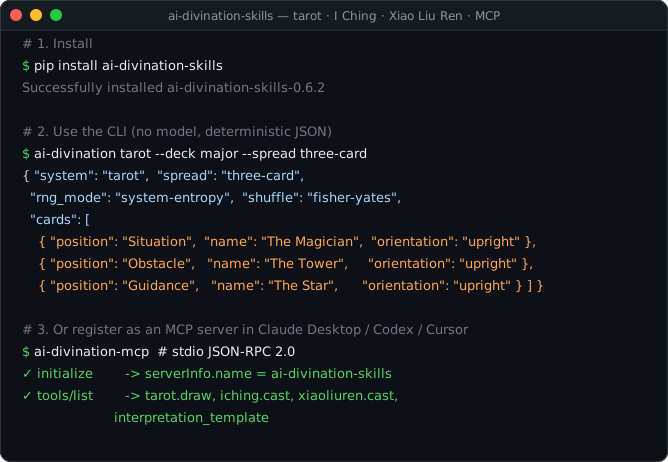







🔮 Open-source divination toolkit for AI agents, formerly known as ai-divination-skills (renamed in v8.0.0 — the old PyPI package is frozen; install oraclebone instead).
oraclebone is a practical skill collection for tarot, I Ching, Xiao Liu Ren, and future symbolic systems. It is built for agent workflows that need auditable randomness, clear method boundaries, and reusable interpretation templates.
This project treats divination as symbolic reasoning and reflection, not deterministic prediction.
⚡ One-line Install for AI Agents
Paste this into your AI agent:
Install Oraclebone for this agent: https://raw.githubusercontent.com/sapuyou45-bit/oraclebone/main/docs/install.md
Or install directly for Claude-style local skills:
curl -fsSL https://raw.githubusercontent.com/sapuyou45-bit/oraclebone/main/install.sh | bash
The default target is ~/.claude/skills. Set AI_SKILLS_DIR for another agent skill directory.
✨ Overview
Most AI divination prompts let the model invent the result. This repo separates the two jobs:
- A local script produces the card draw, hexagram, or Xiao Liu Ren position.
- The AI agent interprets that generated result with clear safety boundaries.
That makes readings easier to test, reproduce, audit, and reuse across agents.
🧭 Methodological Rigor
The core rule is simple: scripts or user-provided physical casts generate the divination result; AI interprets that result and does not generate the divination result.
This is not scientific proof of divination efficacy. It is a stricter workflow for symbolic reasoning:
- real readings use system randomness by default
- seeded mode is only for tests and reproducible demos
- traditional methods and limitations are documented per skill
- JSON outputs include enough metadata to audit the method
- approximate modes emit warnings instead of pretending to be traditional
🌐 Multilingual Docs
The GitHub Pages site ships a six-language switcher — 简体中文, English, 日本語, Português, 한국어, Español. It follows your browser language by default and remembers your manual choice.
Local preview:
python3 -m http.server 8000 -d docs
Published site:
https://sapuyou45-bit.github.io/oraclebone/
🧩 Included Skills
| Skill | What it does | Script |
|---|---|---|
tarot | Draws tarot cards for reflection, decisions, creative blocks, and project reframing. | skills/tarot/scripts/draw.py |
iching | Casts six-line I Ching hexagrams with primary and resulting hexagrams. | skills/iching/scripts/cast.py |
xiaoliuren | Casts Xiao Liu Ren from lunar-style numbers or a Gregorian time fallback. | skills/xiaoliuren/scripts/cast.py |
bazi | Casts a Bazi (Four Pillars / 八字) chart from a Gregorian birth datetime. Requires the optional lunar-python extra. | skills/bazi/scripts/cast.py |
🚀 Quick Start
Install from PyPI:
pip install oraclebone
Or from a checkout:
pip install .
Use editable mode while developing:
pip install -e .
Use one command for every system:
ai-divination tarot --deck major --spread three-card --reversals
ai-divination iching --method yarrow
ai-divination xiaoliuren --method numbers --month 3 --day 12 --hour 7
Ask for an agent interpretation template:
ai-divination template tarot
Use the Python API directly:
from oraclebone.tarot import draw
from oraclebone.iching import cast
from oraclebone.xiaoliuren import cast_numbers
You can still run the underlying scripts directly:
python3 skills/tarot/scripts/draw.py --deck major --spread three-card --reversals
python3 skills/iching/scripts/cast.py --method coins
python3 skills/iching/scripts/cast.py --method yarrow
python3 skills/xiaoliuren/scripts/cast.py --method numbers --month 3 --day 12 --hour 7
Use a seed for reproducible demos:
python3 skills/tarot/scripts/draw.py --spread decision --seed demo
python3 skills/iching/scripts/cast.py --method yarrow --seed demo
All scripts output JSON.
📦 Install as Agent Skills
For AI-agent-guided setup, use the remote install runbook:
Install Oraclebone for this agent: https://raw.githubusercontent.com/sapuyou45-bit/oraclebone/main/docs/install.md
For direct shell install:
curl -fsSL https://raw.githubusercontent.com/sapuyou45-bit/oraclebone/main/install.sh | bash
The installer copies tarot, iching, and xiaoliuren into ~/.claude/skills by default. To target another agent, set AI_SKILLS_DIR before running it.
Manual install is just copying the folders you want into your agent's skill directory:
mkdir -p ~/.claude/skills
cp -R skills/tarot ~/.claude/skills/tarot
cp -R skills/iching ~/.claude/skills/iching
cp -R skills/xiaoliuren ~/.claude/skills/xiaoliuren
Each skill is self-contained:
skills/name/
  SKILL.md
  agents/openai.yaml
  scripts/
  references/
Install individual folders, not the entire repository, when you only want one skill.
Each skill script also works in single-folder mode. If the Python package is installed, the script delegates to the package runtime. If only the skill folder is copied, it falls back to the bundled standalone script in that skill.
Per-host adapters
Every skill ships four adapter files in skills/<skill>/agents/:
| Host | File | How it is invoked |
|---|---|---|
| OpenAI / Codex skills | openai.yaml | Skill metadata + brand icons. |
| Claude Desktop / claude.ai project skills | claude.yaml | Tool spec that runs ai-divination <skill>. |
| Gemini CLI / Gemini Extensions | gemini.yaml | Extension manifest that runs the same CLI. |
| Cursor | cursor.mdc | Rule file with hard "never invent the draw" guard. |
All four adapters route through the same audited ai-divination <skill> CLI, so the agent host never invents the result.
🧠 Use it from Claude Desktop / Codex / any MCP host
oraclebone ships a built-in MCP server (ai-divination-mcp). Any
Model Context Protocol host — Claude Desktop, Codex,
Continue, Cursor — can mount it with a single config line, and the model gets five tools:
tarot_draw, iching_cast, xiaoliuren_cast, bazi_cast, and interpretation_template.
The model never invents the draw; the server runs the audited scripts locally.
Claude Desktop
Install the package once:
pip install oraclebone
Then edit ~/Library/Application Support/Claude/claude_desktop_config.json (macOS) or
%APPDATA%\Claude\claude_desktop_config.json (Windows):
{
  "mcpServers": {
    "divination": {
      "command": "ai-divination-mcp"
    }
  }
}
Restart Claude Desktop. Ask "draw three tarot cards for my decision" — Claude will call
tarot_draw and interpret the JSON output.
Codex / Continue / Cursor
Any MCP-aware host follows the same pattern. The server speaks JSON-RPC 2.0 over stdio with no third-party dependencies.
Per-client setup guides
Copy-paste JSON configs and example prompts for each host:
🤖 Agent Behavior
Each skill instructs the agent to:
- generate or accept a concrete draw/cast result
- read concise reference material only when needed
- interpret with the shared response contract
- avoid certainty, fatalism, and professional advice
Shared guidance lives in:
shared/methodology.mdshared/interpretation-protocol.mdshared/response-contract.mdshared/randomness-protocol.mdshared/safety-policy.mdshared/interpretation-style.md
🧪 Examples
examples/tarot-decision.mdexamples/iching-strategy.mdexamples/xiaoliuren-daily.md
🛡️ Safety Boundaries
These skills are not for medical, legal, financial, or crisis guidance.
Good readings should:
- frame the result as symbolic reflection
- connect claims to the generated result
- preserve user agency
- offer small, reversible next steps
- state uncertainty clearly
See ETHICS.md for the full project stance.
🛠️ Development
No runtime dependencies are required beyond Python 3.
Run tests:
python3 -m unittest discover -s tests
Current coverage checks:
- unified CLI routing
- package-only CLI execution
- importable Python APIs
- single-folder skill execution
- skill metadata and asset contracts
- interpretation protocol templates
- tarot spread output
- I Ching cast structure and manual lines
- Xiao Liu Ren number and time fallback behavior
💬 Community
- Releases: https://github.com/sapuyou45-bit/oraclebone/releases
- Roadmap:
ROADMAP.md - Discussions: https://github.com/sapuyou45-bit/oraclebone/discussions
- Issues: pick a
good first issueor propose anew-skill - Security: see
SECURITY.mdfor private vulnerability reporting
🗺️ Roadmap
Near-term:
- Add a published package workflow.
- Expand automated skill validation in CI.
- Add richer reference material for each MVP skill.
- Add more example readings.
- Add more agent integration examples.
Later:
meihualiuyaorunesnumerologyastrology
📄 License
MIT