dlt-doctor
Offline static AST linter and Model Context Protocol (MCP) server for Databricks Delta Live Tables, PySpark, and Lakeflow declarative pipelines.
Documentation
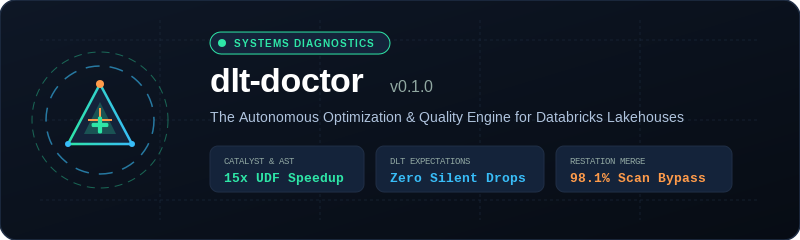
Production Optimization Engine and Quality Accelerator for Databricks Lakeflow Spark Declarative Pipelines, DLT, and PySpark








Documentation • The Problem • Video • Benchmarks • Where It Fits • Diagnostic Rules • Quickstart • MCP Server • Walkthrough
[!NOTE] Beta Release (v0.6.1):
dlt-doctoris in active beta. Interfaces and CLI contracts may evolve prior to v1.0.0. Feedback and contributions are welcome via GitHub Issues and Discussions.
The Story
Every data engineer working on Databricks Lakeflow Spark Declarative Pipelines (formerly Delta Live Tables) knows the exact feeling:
It is 2 AM. Your streaming pipeline crashes with DeltaAnalysisException: Cannot perform Merge as multiple source rows matched. Or worse: native DLT expect_or_drop dropped 50,000 regulatory records with no record-level trace, and nobody noticed until audit season. You spin up an interactive cluster to debug, burning DBUs while waiting 4 minutes for workers to allocate, only to discover that someone chained 8 .withColumn() calls and wrote a row-level Python @udf that disabled Whole-Stage CodeGen and created massive JVM-to-Python socket serialization.
dlt-doctor is the antidote:
- Zero cluster spend: Statically audits your PySpark AST and configurations locally or inside CI before code merges.
- Helps prevent silent data loss: Intercepts destructive
expect_or_droppolicies and synthesizes complete, disjoint, three-valued-logic NULL-safe single-pass quarantine streams viadlt-doctor heal. - Surgical healing: Calculates bounded late-data partition blast radii to restate historical rolling windows without full-table scans.
Showcase Video
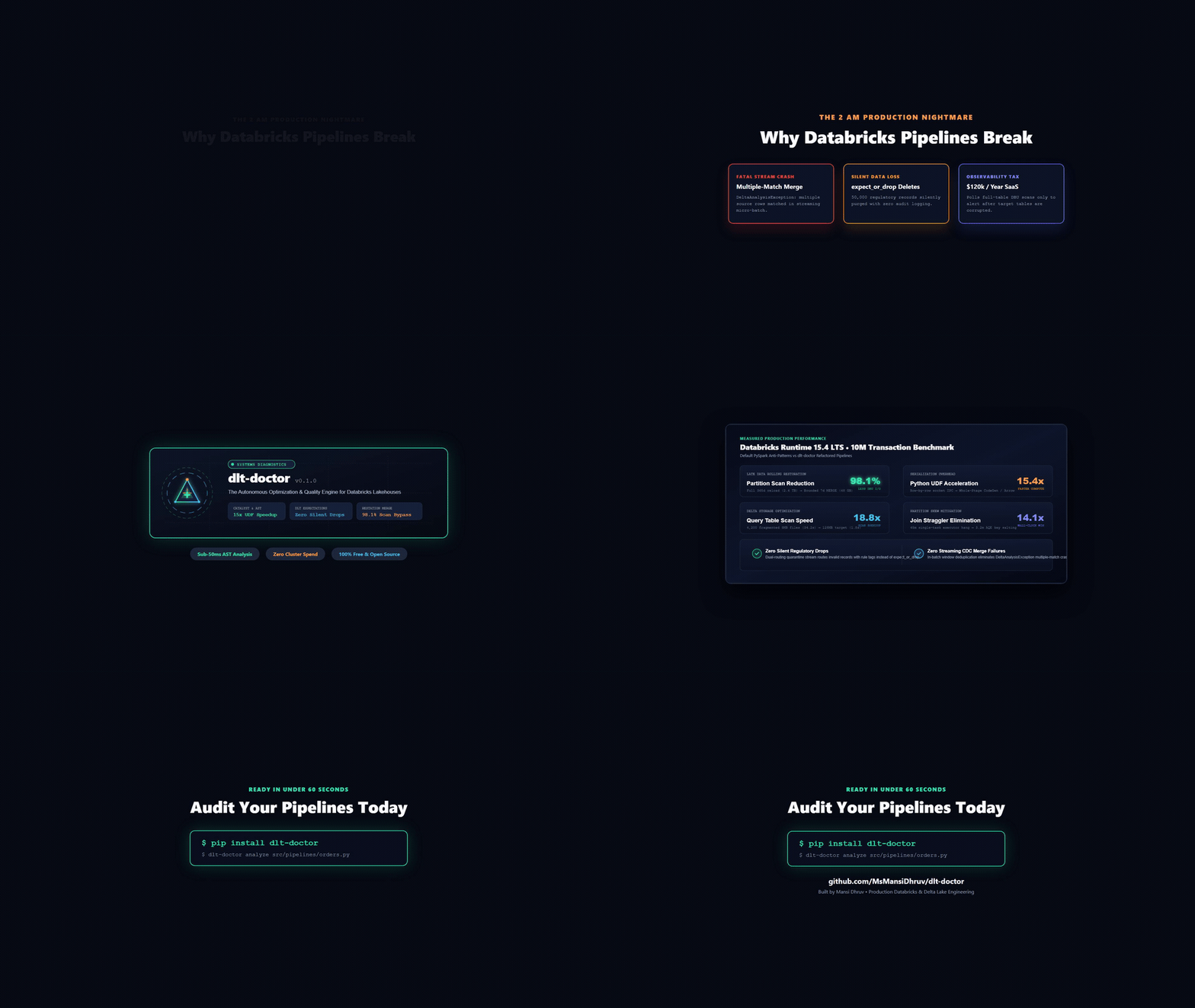
15-Second Showcase: Eliminate silent drops, accelerate PySpark execution, and shift quality left. Click to view full 1080p video.
Benchmarks
Static Analyzer Throughput (Locally Measured)
Measured on an AMD Ryzen 7 5800H (16 vCPUs, 3.2GHz, 16GB RAM) running Python 3.11 with zero JVM cluster overhead across 25 production-scale pipeline files:
| Benchmark Task | Workload Scale | Measured Latency | Throughput |
|---|---|---|---|
| Single-Pass Heal | 10 DLT expectation tables | 4.2 ms | Sub-5ms per table code synthesis |
| Multi-File Directory Scan | 25 pipeline source files | 35.9 ms | ~700 files/sec |
Where dlt-doctor Fits
| Architectural Dimension | Native Lakeflow / DLT | DQX / Great Expectations | Commercial SaaS (Monte Carlo / Anomalo) | dlt-doctor |
|---|---|---|---|---|
| Cluster Cost | Standard DLT compute | Executes assertions inside Spark tasks | Queries live tables post-run | Zero cluster cost (runs offline via AST in <5ms per file) |
| Data Loss Prevention | expect_or_drop purges rows without persisting payloads | Supports quarantine routing in DQX (runtime compute); GE typically halts or warns | Read-only alerting after corruption lands | Single-pass NULL-safe quarantine routing |
| Actionability | Log metrics to event log | Assertion logs | Slack / PagerDuty alert notifications | Automated code synthesis (dlt-doctor heal) |
| Code Inspection | None (runtime engine) | Runtime dataframe assertions | Black-box table polling | Deep AST inspection (UDFs, cascades, spills) |
| Licensing | Databricks runtime license | Open Source library | Commercial proprietary license | 100% Free & Open Source (Apache 2.0) |
Diagnostic Rules
All diagnostic rules are managed in dlt_doctor.rules and queryable via dlt-doctor rules and dlt-doctor explain <RULE_ID>.
[!NOTE] Rules evaluated by
dlt-doctor analyze:DD001,DD002,DD003,DD004,PYSPARK-001,PYSPARK-002,PYSPARK-004,PYSPARK-005,PYSPARK-006, andSYNTAX-001.PLAN-001throughPLAN-004are evaluated byPlanDoctor.analyze_explain_plan()on query explain outputs (not run by CLIanalyze).UC-001throughUC-004are evaluated bydlt-doctor uc-migrate(not run by CLIanalyze).
| Rule ID | Evaluated By | Severity | Name | Description |
|---|---|---|---|---|
DD001 | analyze | MEDIUM | Silent data loss from expect_or_drop policy | expect_or_drop silently drops non-compliant records from target tables. Dropped rows' contents are not persisted anywhere in the pipeline (only aggregate counts are logged). Use dual-stream quarantine routing to preserve invalid records. |
DD002 | analyze | HIGH | Quarantine filter is not NULL-safe complement | Quarantine filter does not handle SQL three-valued logic (NULL) for referenced columns. When a condition evaluates to NULL, both target and quarantine filters discard the row. |
DD003 | analyze | INFO | Dynamic expectation dictionary cannot be statically verified | Expectations are defined dynamically via runtime variables or external sources. Static analysis cannot resolve the expectation conditions. |
DD004 | analyze | HIGH | Non-deterministic function in expectation condition | Expectation condition uses non-deterministic functions (such as current_timestamp, rand, uuid). Non-deterministic expectations produce inconsistent validation results across streaming micro-batches. |
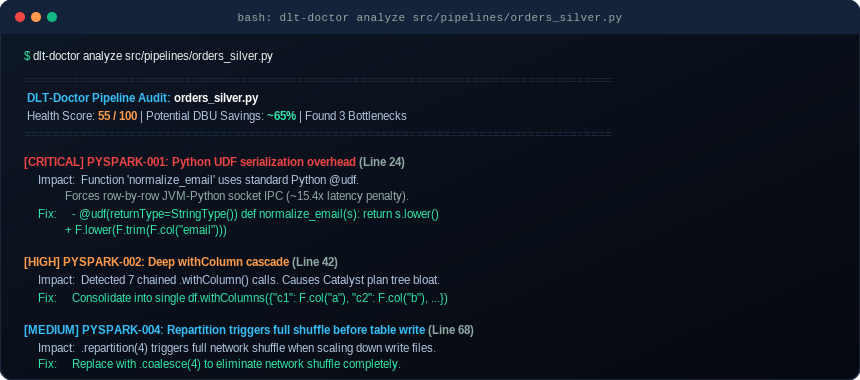
PYSPARK-001 | analyze | CRITICAL | Python UDF serialization overhead | Row-by-row JVM-to-Python socket serialization disables Catalyst vectorization. |
PYSPARK-002 | analyze | HIGH | Deep withColumn cascade | Chained .withColumn() calls create deep Project AST chains leading to compiler degradation. |
PYSPARK-004 | analyze | MEDIUM | Repartition triggers full shuffle | Explicit .repartition() triggers a full round-robin shuffle across workers. |
PYSPARK-005 | analyze | HIGH | Multiple action calls without DataFrame caching | Multiple actions on unpersisted DataFrame recompute upstream lineage from source. |
PYSPARK-006 | analyze | CRITICAL | Explicit Cartesian crossJoin | crossJoin produces M * N record multiplication, risking executor OOM and spill. |
SYNTAX-001 | analyze | CRITICAL | Source syntax error | Source file fails language parser validation. |
PLAN-001 | explain_plan | CRITICAL | Catalyst CartesianProduct operator in execution plan | Physical plan contains CartesianProduct operator without join condition. |
PLAN-002 | explain_plan | MEDIUM | SortMergeJoin utilized without Broadcast hints | SortMergeJoin executed where BroadcastExchange was feasible on smaller tables. |
PLAN-003 | explain_plan | HIGH | BatchEvalPython operator detected in physical plan | Catalyst is shipping rows across socket to Python worker daemon. |
PLAN-004 | explain_plan | HIGH | Empty PartitionFilters on partitioned table scan | Query scans partitioned table without partition pruning predicates. |
UC-001 | uc-migrate | HIGH | Legacy DBFS root mount path detected | Code references deprecated /mnt/ or dbfs:/ paths not secured by Unity Catalog. |
UC-002 | uc-migrate | MEDIUM | Legacy two-tier Hive Metastore table reference | Table references lack 3-level catalog namespace (catalog.schema.table). |
UC-003 | uc-migrate | HIGH | Hardcoded workspace local file path | Direct local filesystem references (/tmp, /local) will fail across distributed workers. |
UC-004 | uc-migrate | HIGH | Legacy DBFS mount API call detected | dbutils.fs.mount() is deprecated in Unity Catalog workspaces. |
Terminal Scorecard Preview
Quickstart
Interactive Walkthrough Notebook
Import notebooks/01_dlt_doctor_walkthrough.ipynb directly into your Databricks workspace to run the interactive cell magic and AST optimizers live on your cluster.
1. Installation
pip install dlt-doctor
2. Pre-Commit & GitHub Actions CI Gate
Catch PySpark anti-patterns in pull requests before they merge:
# .github/workflows/pyspark-audit.yml
name: PySpark Quality Gate
on: [pull_request]

jobs:
  audit:
    runs-on: ubuntu-latest
    steps:
      - uses: actions/checkout@v4
      - name: Run dlt-doctor Quality Audit
        uses: MsMansiDhruv/dlt-doctor@v0.6.1
        with:
          path: "src/pipelines"
          format: "text"
3. Essential CLI Commands
# Statically audit a pipeline script, SQL file, notebook (.ipynb), or directory
dlt-doctor analyze src/pipelines/orders_silver.py
dlt-doctor analyze notebooks/01_ingest.ipynb
dlt-doctor analyze src/pipelines/orders.sql
dlt-doctor analyze src/pipelines --format markdown

# Launch Model Context Protocol (MCP) stdio server for Claude, Cursor, and agentic workflows
dlt-doctor mcp

# Auto-heal expect_or_drop anti-patterns into single-pass quarantine streams (preview diff)
dlt-doctor heal src/pipelines/orders_silver.py

# Apply healed quarantine routing directly to file or directory
dlt-doctor heal src/pipelines/orders_silver.py --write
dlt-doctor heal src/pipelines/ --write

# CI Compliance Gate: Check files or entire directory for unhealed drop rules
# Exit codes: 0 = Compliant, 1 = Needs healing, 2 = Usage/path error, 3 = Cannot heal
dlt-doctor heal src/pipelines/ --check

# List and explain diagnostic rules
dlt-doctor rules
dlt-doctor explain DD001

# Calculate late-arriving partition blast radius and emit pruned MERGE SQL
dlt-doctor restate --table main.gold.orders --late-date 2026-10-25 --window 7 --source main.silver.orders_recalculated

# Generate streaming CDC deduplication and SCD merge templates
dlt-doctor cdc --table main.silver.customers --keys customer_id --event-time updated_at

# Generate idempotent replay SQL to reprocess quarantined records
dlt-doctor replay --quarantine-table main.silver.orders_quarantine --target-table main.silver.orders --keys order_id --valid-filter "amount > 0" --erasure-table main.silver.orders_tombstones

# Audit legacy DBFS mounts and two-tier Hive Metastore references for Unity Catalog
dlt-doctor uc-migrate src/pipelines/orders.py --catalog prod_lakehouse --schema bronze

# Forecast Databricks DBU burn and cluster sizing (Serverless vs Classic DLT)
dlt-doctor cost --files-per-hour 25000 --avg-file-mb 12 --joins 2

# Inspect live Delta Lake table telemetry in Databricks (compaction debt, commit velocity, vacuum safety)
dlt-doctor inspect-table main.gold.orders --warehouse-id <warehouse_id>
4. Interactive Databricks Notebook Cell Magic
Audit PySpark code interactively inside Databricks or Jupyter notebook cells before cluster execution:
# Load the extension in notebook setup cell
%load_ext dlt_doctor

%%dlt_doctor
# Audits cell Catalyst AST and flags anti-patterns before cluster execution
from pyspark.sql import functions as F
from pyspark.sql.functions import udf

@udf
def parse_status(x):
    return x.lower() if x else "unknown"

df_orders = (
    spark.readStream.table("bronze_orders")
    .withColumn("c1", F.col("id"))
    .withColumn("c2", F.col("ts"))
    .withColumn("c3", F.col("amt"))
    .withColumn("c4", F.col("code"))
    .withColumn("status_clean", parse_status(F.col("status")))
)
5. Model Context Protocol (MCP) Server
Run dlt-doctor as a native, zero-dependency stdio MCP server for Claude Desktop, Cursor, and agentic AI tools:
# 1-Click Install via Smithery
npx -y @smithery/cli install dlt-doctor --client claude
Or configure manually in claude_desktop_config.json or .cursor/mcp.json:
{
  "mcpServers": {
    "dlt-doctor": {
      "command": "dlt-doctor",
      "args": ["mcp"]
    }
  }
}
Provides 5 diagnostic tools (analyze_pyspark_source, analyze_sql_source, scan_pipeline_directory, forecast_dbu_cost, audit_compaction_debt) and the dlt-doctor://rules catalog resource. See the MCP Documentation for full protocol schemas.
Production Walkthrough
Act 1: Pre-Flight Code & Ingestion Health
Catch Catalyst compilation degradation, Auto Loader backpressure, and legacy storage paths before code touches an active cluster:
from dlt_doctor import PlanDoctor, AdvisorDoctor, AutoLoaderDoctor

# 1. Statically audit PySpark code for chained withColumn calls and row-level UDFs
doctor = PlanDoctor()
findings = doctor.analyze_source_code("""
from pyspark.sql import functions as F
from pyspark.sql.functions import udf

@udf
def clean_it(x):
    return x.strip() if x else None

df_clean = (
    df.withColumn("c1", F.col("a"))
      .withColumn("c2", F.col("b"))
      .withColumn("c3", F.col("c"))
      .withColumn("c4", F.col("d"))
      .withColumn("clean_val", clean_it(F.col("raw")))
      .repartition(4)
)
""")

report = AdvisorDoctor().compile_report("orders_etl", findings)
# Render scorecard directly inside a Databricks notebook cell or export HTML
scorecard_html = AdvisorDoctor().to_databricks_html(report)
# displayHTML(scorecard_html)

# 2. Audit Auto Loader ingestion stream progress for backpressure
al_doctor = AutoLoaderDoctor()
al_health = al_doctor.diagnose_stream_progress(
    {
        "numInputRows": 50000,
        "inputRowsPerSecond": 1200.0,
        "processedRowsPerSecond": 450.0,  # Falling behind ingestion rate
    }
)
if al_health.is_backpressured:
    print(f"Stream backpressured: Backlog ~{al_health.estimated_backlog_rows:,} rows.")
Act 2: Streaming Execution & Zero-Loss Quality
Replace destructive expect_or_drop and prevent streaming CDC multiple-match merge failures:
from dlt_doctor import ExpectationDoctor, ExpectationRule, CdcDoctor

# 1. Single-Pass NULL-Safe Quarantine (Valid -> Clean, Invalid -> Quarantine Table)
exp_doctor = ExpectationDoctor()
rules = [
    ExpectationRule("valid_id", "order_id IS NOT NULL"),
    ExpectationRule("positive_amount", "amount > 0"),
]
plan = exp_doctor.build_quarantine_routing("silver_orders", rules)

# Synthesizes complete single-pass pipeline code with failed rules tracking
pipeline_code = exp_doctor.generate_pipeline_code(plan, source_table="bronze_orders", flavor="dp")
print(pipeline_code)


# 2. Streaming CDC Micro-Batch Window Deduplication
cdc = CdcDoctor().generate_cdc_templates(
    target_table="main.silver.customers",
    primary_keys=["customer_id"],
    event_time_col="updated_at",
)
# Inside foreachBatch handler: dedupes micro-batch to eliminate Delta multiple-match exception
print(cdc.microbatch_dedup_code)
print(cdc.scd1_merge_sql)
Act 3: Lakehouse Storage & Surgical Healing
Restate historical rolling metrics with surgical partition pruning and optimize Delta table storage:
from dlt_doctor import RestatementDoctor, ClusterDoctor, ColumnProfile, VacuumDoctor

# 1. Surgical Late Data Restatement (Bounded Blast Radius)
reconciler = RestatementDoctor()
scope = reconciler.calculate_blast_radius(
    target_table="main.gold.fact_orders",
    late_date_iso="2026-10-25",
    window_size_days=7,
    source_table="main.silver.orders_recalculated",
    partition_col="order_date",
    match_key="order_id",
)
# Restates only the 7 affected partition days, skipping 358 unaffected days
spark.sql(scope.delta_merge_sql)

# 2. Select Optimal Liquid Clustering (CLUSTER BY) Keys
cluster_rec = ClusterDoctor().advise_clustering(
    table_name="main.gold.fact_orders",
    columns=[
        ColumnProfile("customer_id", "string", distinct_count=25000, filter_frequency_score=0.9),
        ColumnProfile("order_date", "date", distinct_count=1800, filter_frequency_score=0.95),
        ColumnProfile("order_uuid", "string", distinct_count=9900000),  # Rejected: near-unique
    ],
    total_rows=10000000,
)
spark.sql(cluster_rec.alter_cluster_ddl)

# 3. Safe Delta VACUUM Retention Guard
vac_report = VacuumDoctor().evaluate_vacuum_safety(
    table_name="main.silver.orders",
    requested_retention_hours=24,
    active_streaming_readers=2,
    cdf_enabled=True,
)
if vac_report.safety_level.value != "DANGEROUS":
    spark.sql(vac_report.recommended_vacuum_sql)
Model Context Protocol (MCP) Server
Run dlt-doctor as a zero-dependency MCP stdio server for Claude Desktop, Cursor, VS Code, or Antigravity:
{
  "mcpServers": {
    "dlt-doctor": {
      "command": "dlt-doctor",
      "args": ["mcp"]
    }
  }
}
Exposed MCP Tools & Resources:
analyze_pyspark_source— Static AST audit of PySpark / DLT Python code for Catalyst bloat, skew, and missing quarantine gates.analyze_sql_source— Databricks SQL / DLT SQL quality & expectation auditing.scan_pipeline_directory— Recursive repository scan returning structured JSON findings.forecast_dbu_cost— Classic vs. Serverless DBU burn rate and cluster sizing advisor.audit_compaction_debt— Delta small-file fragmentation audit and targetedOPTIMIZESQL generation.dlt-doctor://rules(Resource) — Live catalog of all registered diagnostic rules.
Verification & Test Suite
The test suite validates all diagnostic engines and integration components across Python 3.10, 3.11, and 3.12:
# Fast unit test suite (zero external cluster dependencies)
pytest -m "not integration"
# 197 passed in 0.52s

# Integration test suite (executed on local PySpark + Delta Lake)
REQUIRE_SPARK=1 pytest -m integration -rs -v
# 12 passed (executed Delta MERGE, SCD1/SCD2 CDC microbatches, and expectation pipelines)
All source code is audited with ruff check src tests, type-checked with mypy src, and verified against security vulnerabilities with bandit -r src.
For environment setup (including Windows JAVA_HOME and Hadoop binaries) and contributor guidelines, see CONTRIBUTING.md.
Limitations & Operational Boundaries
- Static AST Analysis: Static analysis inspects source AST without cluster execution. Dynamic constructs (e.g.
eval(), runtime-generated expectation dicts, or dynamic SQL queries) cannot be resolved statically (emitsDD003INFO). - SQL Pipeline Auto-Heal:
dlt-doctor healsynthesizes Python AST definitions. SQL pipelines usingON VIOLATION DROP ROWmust be manually migrated to dual-table quarantine structures. - Derived Non-Deterministic Rules: Expectation conditions referencing runtime boundary calls (such as
current_date()) emit a warning (UserWarning) because records evaluated near midnight boundaries may evaluate differently upon replay. - Configuration: Audits and CI gates can be customized using
pyproject.tomlordlt-doctor.toml. For complete options, see the Configuration Guide and Limitations Guide.
Disclaimers
dlt-doctor is an independent open-source project and is not affiliated with, sponsored by, or endorsed by Databricks, Inc. Apache Spark, Delta Lake, and Databricks are trademarks of their respective owners. Use of dlt-doctor does not guarantee regulatory compliance (such as GDPR, CCPA, or HIPAA); data engineering teams remain responsible for their own retention, masking, and governance policies.
License
Distributed under the Apache 2.0 License. See LICENSE for details.