MOB3 Terminal Web Browser
MOB³ is a small indie web browser for humans and AI agents.
Documentation
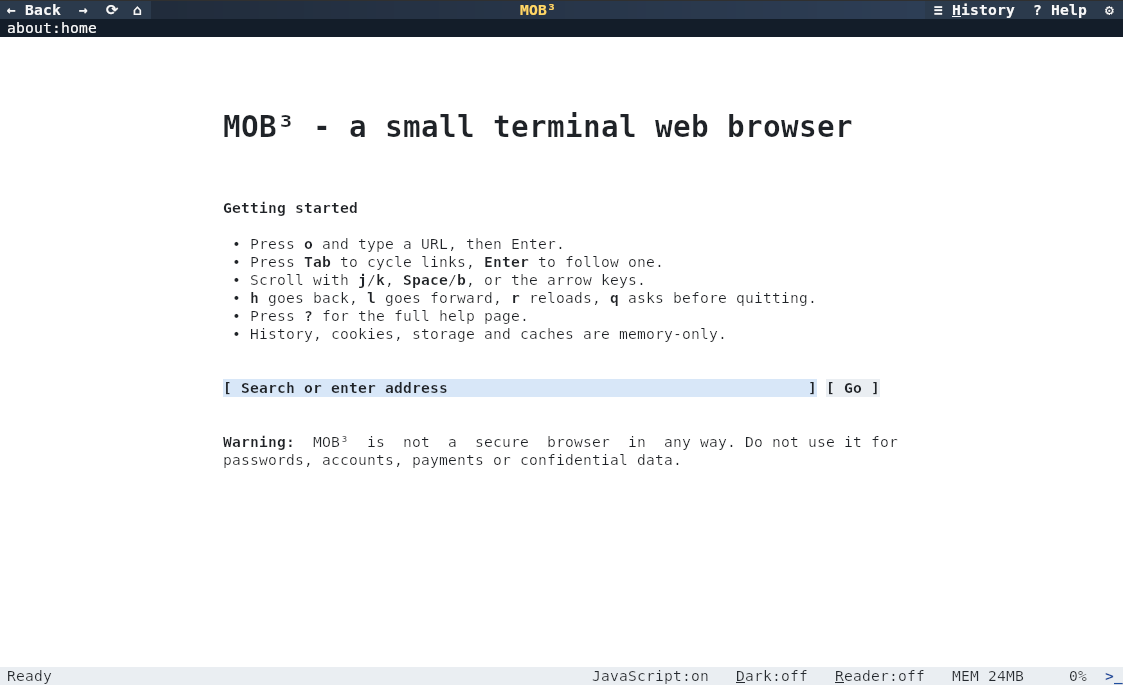
Written in Go, MOB³ features its own HTML rendering engine with JavaScript support, an ANSI renderer, and inline image support. No GUI toolkit or persistent browser profile required. Built as a true terminal web browser for humans and AI agents.
Project page: mob3.net
GitHub: github.com/mob3net/mob3
Documentation
- Documentation index
- Use cases — developers, AI agents, terminal users and automation
- Install — releases, Docker and source builds
- Command line — every flag, default and limit
- Keyboard and mouse
- Automation with MCP — headless control for scripts and AI tools
- Security and privacy, site support and development
Try it with Docker:
docker run --rm -it ghcr.io/mob3net/mob3 -graphics blocks
Download and install
Download the latest MOB³ release from GitHub Releases.
Release archives cover Linux (386, amd64, armv6, armv7, arm64) and macOS (amd64, arm64). Choose the archive for your OS and architecture, for example mob3_vX.Y.Z_linux_amd64.tar.gz. Each archive contains the static mob3 binary.
Example:
tar -xzf mob3_vX.Y.Z_linux_amd64.tar.gz
sudo install -m 0755 mob3 /usr/local/bin/mob3
mob3 -version
Screenshots
Show your support
If MOB³ has been useful to you, please consider giving the project a star on GitHub. It helps others discover it and supports the continued development of the project.
What to expect
MOB³ is a content browser, not a full browser engine. It is happiest with text-focused pages and gets rough on modern JavaScript-heavy apps.
Works well
- Documentation, blogs, news articles, wikis, forums, changelogs and old or server-rendered HTML.
- Headings, paragraphs, lists, links, tables,
<pre>blocks, images and common presentational markup. - Text/search inputs, textareas, single-select option popups and multi-select list boxes, with a visible caret, arrow-key editing, date/time/month/week, range sliders, color swatches, HTML constraint checks, GET and urlencoded POST form submission. The start page has justified text and a full-width search/URL box that resolves input the same way as the
oprompt, including the-searchfallback. - Common CSS: selectors, cascade and inheritance, box model (including
box-sizingand min/max sizes), margins, borders, backgrounds, text styling, lists, tables, CSS custom properties, viewport-width@mediaqueries, viewport units, and basic flex rows with alignment and ordering. - PNG/JPEG/GIF/WebP/BMP/SVG/data-URI images when enabled with
-graphics(auto,kitty,iterm, orblocksfor half-block art); pressIto cycle full graphics, blocks and none. Images are off by default for speed. - Session-only memory cache for CSS, scripts and decoded images, with a 32 MiB default budget and
-cacheto change or disable it. - Light JavaScript: DOM queries and mutation,
classList/style, click handlers, timers, alert/confirm/prompt and native<dialog>open/close, same-originfetch/XMLHttpRequestplus simple CORS cross-origin requests, and in-memory storage/cookies. Script errors turn the footerJavaScriptlabel into a redJavaScript:Error; click it to open the console. - JavaScript console (
!): tabbed view of logs, requests, cookies and in-memory storage, the raw page HTML, and a Tools tab for read-only page inspection (help,form,links,requests,logs,source,snapshot,history,clear); evaluate one-line expressions in the page's runtime, with Up/Down or Ctrl-P/Ctrl-N history and results appended to the log.clear/clsempties either the JS log or the Tools scrollback. - Reader mode (
R, the footerReader:on/Reader:offlabel, or-readerat launch): extracts the main article into a narrow, chrome-free text column, stays enabled across navigation, and restores the normal page and scroll position when toggled off. - Dark mode (
D, the footerDark:on/Dark:offlabel, or-darkat launch): asks sites for their dark styles withprefers-color-scheme: dark. Pages that already render a dark background keep their own palette; otherwise backgrounds, text, links and borders are remapped to a dark palette. Images keep their original colors. - Vimium-style link hints (
f): highlights letters from each visible link's own text with a yellow background and underline (two adjacent letters only when hints share a first letter), then follows one when you type them;Fshows the destination highlighted in yellow first and waits for confirmation;Escor scrolling dismisses the hints. - Headless MCP automation (
-mcp): navigate, snapshot page text and links, click links or elements by text, list and fill forms, select options, submit, wait for async content, type, press keys, scroll, evaluate JavaScript, inspect history and read request logs, JS errors or page source. Screen captures are terminal-cell rasters; sessions are memory-only. - Browser-style toolbar with back/forward/reload/home, history/help buttons, a bookmarks button when
-bookmarksis supplied, a config gear and a centered page title. - Keyboard and mouse navigation, including the kitty keyboard protocol in kitty, WezTerm, Ghostty and foot,
/incremental find (including multi-word phrases) with highlighted matches (also in the console HTML tab), a draggable page scrollbar, history (including a top-right History page listing the session's links, with#anchors as entries and back/forward restoring each page's last scroll position), bookmarks imported with-bookmarksfrom a Netscape HTML export, scrolling, focus, link hover targets in the footer, text selection (ycopies selected text, or the current URL when nothing is selected), fixed-overlay hiding (X), and a!JavaScript console.
Rough edges
- Modern JavaScript apps (SPAs, dashboards, Google search and similar) may show a partial page, a blank page or their no-JavaScript fallback. Pages that rely on ES modules show a status-bar warning that modules are unsupported and suggest reader mode (
R). - Reader mode is heuristic: it can pick too little or too much content on unusual layouts, shows a snapshot rather than live updates, and removes images, forms and other interactive controls. Dark mode keeps images in their original colors and approximates some author color schemes.
- Anti-bot and firewall checks (Cloudflare, CAPTCHA, DataDome/PerimeterX, Imperva/Sucuri, access-denied pages) are generally not usable. A “Site blocked” page is shown instead.
- No video/audio playback, WebGL, WebAssembly, workers, WebSockets, iframes, Shadow DOM, custom elements, real observers or full History API.
- Basic CSS grid rows are supported, along with
position:relative,position:absoluteandposition:fixed; floats,position:sticky,z-index, CSS variables, animations, transitions, generated content,@importand background images are unsupported or approximated as block flow. - SVG support is partial: text inside SVG,
<use>/<symbol>, filters, masks and CSS-in-SVG may be missing. Animated WebP is not supported. - Oversized images are capped at 40% of the viewport width and 16 rows, preserving their aspect ratio.
- No tabs or automatic downloads; download links and non-HTML responses open a popup with a copyable
curlcommand instead, and multipart/file uploads are not implemented (clicking a file input shows an unsupported notice). Selected page text copies withythrough OSC 52 (terminal support required), and the URL can be selected with the terminal. - Very large pages, stylesheets and images are capped to keep memory and CPU bounded. Style and layout also run under a time budget, so a pathological page is shown partially with a truncation notice instead of freezing the browser. Pages whose timers update the DOM are redrawn a few times per second rather than continuously, and an idle page with no pending timers does not repaint at all.
Using command line options
Start reading Wikipedia in dark mode:
mob3 -dark -reader 'https://en.wikipedia.org/wiki/Vim_(text_editor)'
See all available options with -h flag. Every flag and default is listed in the command-line reference.
Capture a PNG screenshot:
mob3 -png -width 120 bbc.com/news > bbc.png
Automation (MCP)
mob3 -mcp runs a headless browser as a Model Context Protocol server over stdin/stdout. It accepts an optional starting URL and fixed -width:
{
  "mcpServers": {
    "mob3": {
      "command": "/path/to/mob3",
      "args": ["-mcp", "-width", "100", "about:home"]
    }
  }
}
Tools: navigate, snapshot, screenshot, click (link number, CSS selector or x / y), type, press, scroll, back, forward, reload, evaluate and history. snapshot returns the current page viewport as text, visible links as [n] and form controls with coordinates. Results are text only: there is no pixel screenshot because MOB3 renders to terminal cells.
The server is local and unauthenticated, sessions and storage are memory-only, and nothing is written to disk. Do not expose it as a network service. See the full MCP reference for the protocol, snapshot format, tool details, and setup instructions for OpenCode, Claude Code, Cursor and Claude Desktop.
Development
Build from source and start browsing:
make
./bin/mob3 https://example.com
Requires Go 1.27 or newer. Interactive mode runs on Linux and macOS terminals; Windows users can run it under WSL. When stdin/stdout are not a terminal, MOB³ automatically falls back to dump mode.
Press ? inside the app for keys, mouse and forms help. Run mob3 -h for the full list of command-line flags. mob3 -version prints the embedded version.
Contributing
Contributions are welcome. Every pull request must include the broad license-grant CLA statement described in CONTRIBUTING.md; it keeps MOB³ available under both AGPL-3.0-only and a commercial license. The PR workflow checks the statement. The CI workflow runs formatting, vet and tests.
License
MOB³ is licensed under the GNU Affero General Public License, version 3 only (AGPL-3.0-only). Copyright (c) 2026 Milos Stojanovic. See LICENSE.
A separate commercial license is available on request for use without the AGPL's source-disclosure requirements.
MOB³ is provided “as is”, without warranty of any kind. See the warning at the top: this is not a security boundary.
Third-party module licenses are listed in THIRD_PARTY_NOTICES.