plimsoll
Read-only MCP server that tells a coding agent what its change did to the whole repository: new dependencies, import rings, functions made hard to read, planning files committed. Every finding is measured, names its limit and says how to check it.
Documentation

plimsoll
Catch what your coding agent's changes do to your code: new dependencies, tangled imports, functions grown too complex.


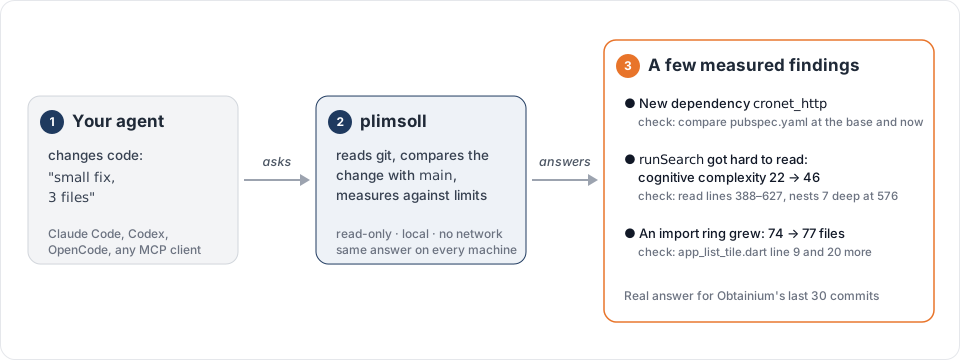
After a change, your agent asks plimsoll and gets a few findings back, each measured, each with its limit and a way to check it. Here is a real answer for the last 30 commits of Obtainium:
plimsoll 0.6.0 status: base `HEAD~30` e9087ce099, head 35c3e7fea4
3 new, 1 grown, 0 resolved; 14 more in `report` only

1. [new, exact] `pubspec.yaml` names 1 runtime dependency that was not there at the base: `cronet_http` (47 now, 46 at the base).
2. [new, candidate] `lib/pages/add_app.dart` `runSearch` crossed the limit of 25 in this change: cognitive complexity 22 → 46 (+24).
   verify: read lines 388–627 (172 of them added by this change): it nests 7 levels deep at line 576; …
3. [grown, candidate] The ring of `lib/app_sources/apk4free.dart` has 77 files, 74 at the base.
   verify: grown through `lib/components/app_list_tile.dart` line 9 importing `lib/app_sources/github.dart` and 20 more, added by this change; …
…
What it catches
- New dependencies a change slipped in, and whether a lockfile holds them.
- Functions the change made hard to read: deep nesting or pasted blocks, in 11 languages.
- Wiring: an import ring the change closed or grew, product code importing test code.
- Process leftovers: a plan or review file committed, a setting defined twice or never read.
Why you can trust it
Every finding is measured, names its limit and where that limit comes from, and says how to check it yourself. plimsoll only reads: no network, no telemetry, nothing written into your repository, nothing stored. Each mark was read blind on real agent pull requests before it was allowed into the short answer, and marks that failed that test show only in the full report. MIT licensed. It works next to your linters and CI, not instead of them. Guarantees and their tests.
Speed
The first question on a repository takes a few seconds; every later one, also after an edit, is much faster (about a quarter of a second on a few thousand files), because plimsoll keeps what it has read in memory while it runs. Measured with plimsoll 0.7.0 on an Apple M6 (12 cores, 32 GB) against the last 30 commits, while other work was running:
| Repository | Files | First question | Later questions | Peak memory |
|---|---|---|---|---|
| Obtainium | 320 | 2.2 s | 0.17 s | 0.2 GB |
| LocalSend | 1,037 | 2.2 s | 0.19 s | 0.3 GB |
| nlohmann/json | 1,674 | 10 s | 0.25 s | 0.75 GB |
| swc | 83,143 | 36 s | 5.1 s | 2.3 GB |
Install
macOS and Linux, amd64 and arm64:
curl -fsSL https://raw.githubusercontent.com/julianzh0/plimsoll/main/install.sh | sh
The script downloads the binary of the latest release, checks its
SHA-256 checksum and puts it in ~/.local/bin (PLIMSOLL_INSTALL_DIR changes the folder, PLIMSOLL_VERSION picks
a release). You can also download a binary and checksums.txt from the release page yourself, or build from source
with Go (see Development).
Windows, amd64 and arm64, in PowerShell:
irm https://raw.githubusercontent.com/julianzh0/plimsoll/main/install.ps1 | iex
The script does the same and puts plimsoll.exe in %LOCALAPPDATA%\plimsoll, which it adds to your user PATH
($env:PLIMSOLL_INSTALL_DIR and $env:PLIMSOLL_VERSION work as above). The Windows build is checked by compiling it,
not by a Windows test run.
plimsoll is listed in the official MCP registry as
io.github.julianzh0/plimsoll: clients that install from there get an MCP bundle with the binaries above.
Connect your agent
plimsoll is a local MCP server on standard input and output. It reads no setting; plimsoll --version and
plimsoll --help only print and exit.
Claude Code
claude mcp add plimsoll -- plimsoll
Codex (the CLI, the IDE extension and the ChatGPT desktop app share this setting)
codex mcp add plimsoll -- plimsoll
or in ~/.codex/config.toml:
[mcp_servers.plimsoll]
command = "plimsoll"
OpenCode
opencode mcp add plimsoll -- plimsoll
Any other MCP client (Claude Desktop, Cursor, Antigravity and others), in its server configuration:
{
  "mcpServers": {
    "plimsoll": { "command": "plimsoll" }
  }
}
Then ask your agent, for example: "Use plimsoll to check what this branch did to the repository since main."
Tools
| Tool | Returns |
|---|---|
status(repository, base?) | at most five new or grown marks, one line that counts the marks shown in report only, one that counts what the change touched but did not create, one that counts added code without a use, the standing line, one that counts the standing items the repository acknowledges, the footprint and what was not analysed |
report(repository, base?, files?) | everything measured, in a fixed layout, the touched items included. Standing items of one kind past five are counted by folder in the text, and structuredContent holds them all. With files, also the files that import each named file |
explain(repository, base?, mark) | the evidence of one mark, computed again and capped |
Without base, a question compares with the default base the repository declares in .plimsoll.toml, and the
answer's first line says so. Every result carries the text in content and the same answer as structuredContent. An answer may shorten, never
hide: what it leaves out it counts ("3 more: report lists them"), and report holds every mark.
Learn more
- What plimsoll checks: every rule, what it measures and its limit, and your own limits, layout,
ignored files and acknowledged items in
.plimsoll.toml. - How each language is read: the eleven languages, how their imports and test code are found.
- Guarantees and protocol: what plimsoll promises, with the tests that pin each promise.
- Development: building, testing and the project's structure.