Awwwards mcp
Free, open-source MCP server that gives AI coding agents (Claude Code, Codex, Cursor, OpenCode, ZCode…) design inspiration from award-winning websites — search with real screenshots, pull design DNA, capture and record live sites. A Mobbin alternative. No API key
Documentation
awwwards-mcp
Free, open-source MCP server that gives AI agents design inspiration from Awwwards — the Mobbin-style visual reference loop, sourced from the web's best award-winning websites.

Your agent searches in natural language ("dark 3D portfolio sites", "soft pastel
e-commerce"), sees real screenshots inline, and pulls the design DNA of any
site: color palette, tech stack, design elements, award history. Then it goes past
inspiration: point it at any link and it band-maps the page, censuses scroll and
hover motion (keyframes, measured scrub curves), fingerprints the framework, captures
canvas pose grids, and reads the site's bundles when a mechanism is unclear. From that
evidence it recreates the page section by section, then converts the build into a
runnable Vite, Astro or Next.js project with a measured motion manifest and
per-section hooks. Close the loop with verify_build (band + motion scoring,
measured perf) and generate GSAP timelines from the captured motion.
And it's not just Awwwards websites — every capture, census, and verification tool runs on any URL. Just give it any site link and tell it to recreate: band-map it, study its motion, rebuild section by section, and score your build against the original.
Free-text queries run on a porter-stemmed, prefix-matching FTS5 index with BM25 ranking — "magazines" now finds Magazine-tagged sites (68 on the live index), best matches first, where the old substring path returned zero. Multi-word queries keep AND semantics: every token must hit the same site.
Tools
| Tool | What it does |
|---|---|
search_sites | Search by color, tags, technology, award type or free-text query; e.g. award: "soty", award: "nominees", award: "ecommerce" (winners), or a technology alias like technology: "nextjs" which canonicalizes to the live slug. Multi-word queries match against the local FTS5 index and rank BM25 (title hits lead); zero results come with loose-match and taxonomy-tag hints. Default full results include each site's screenshot; use responseMode: "compact" for concise cards and inline previews of only the first two results on the requested page. |
get_site_details | Design DNA for one site: palette, technologies, elements, awards, description. Batch (slugs, up to 10) is compact enrichment for a shortlist — compactSiteDetails per slug (lists as counts, ≤500-char description, awards), cached/fetched/error status, no inline images. |
compare_sites | Compare 2–3 sites' design DNA and jury scores as text-only JSON. Uses cached details or fetches missing detail pages. |
create_design_brief | Turn 2–5 selected site slugs plus a required project goal into a deterministic, cited build brief. Uses cached detail/element evidence and cached Motion DNA first, fetches only missing details, returns Markdown plus versioned JSON, and runs browser band analysis only with includeStructure: true. |
get_index_status | Read local index count, crawl progress, last success/error, lock state and freshness without network requests. |
get_index_stats | Aggregate metrics over the local cache only (zero network). All-time: site count, element count and technology/tag frequency (items[].tag). Windowed by windowDays (default 90, 1–3650): cached details, palette colour frequency and jury score stats (n/avg/median) from at most the 500 most recently fetched detail rows, plus Motion DNA library frequency. Coverage is labelled "locally cached subset" on every metric; windowDays/detailsCached/detailParseCap appear only on the windowed metrics, while sites/elements/technologies are explicitly all-time. top caps each frequency list (default 10, 1–50). Aggregates only — no site slugs or titles. Personal, non-commercial use. |
get_site_elements | Component-level visuals for one site: each element's poster image inline (3D models, video content, mobile layouts, microcopy…) + video URLs. |
list_categories | Every filter the agent can search by (200+ tags, 27 colors). |
get_collections | Browse Awwwards' curated and member collections. No slug lists collections (paginated, ~32 per page, owner/ref on every row); a slug returns one page of that collection's site cards (curated e.g. brutalism, or owner/slug for member collections; page works for collections too). Results expose siteCards separately from items (all collectables), so element-only collections return empty sites rather than a parser error. 7-day local cache. Personal, non-commercial inspiration use. |
search_directory | Browse the Awwwards directory of agencies, studios and freelancers: name, profile slug, location, website and award counts. Filters are path-based (country, category, budget; one per request — e.g. budget over_hundred_thousand). Country must be canonical and case-sensitive (United States, not united states). Results carry applied/ignored filter arrays; free-text query is matched client-side over the one fetched page. Contact details are stripped. 7-day local cache. Personal, non-commercial inspiration use. |
get_annual_categories | Official Annual Awards categories (Site of the Year, Agency of the Year, …) with nominee counts from Awwwards' public read-only API. Nominee details hydrate on request. Personal, non-commercial inspiration use; media URLs are reference-only. |
get_annual_nominees | Nominees in one Annual Awards category, hydrated on demand at 1 request/second (default 10, max 20). Site summaries include siteSlug and inLocalIndex so agents can jump to get_site_details when the daily index has the site. |
get_annual_nominee | One Annual Awards nominee in full — site: date, description, designBy, country, images/videos; agency: location, avatar, award tag counts, featured projects. Accepts a UUID, a full /api/annual/nominees/... path, or category+slug; the slug form may hydrate up to 20 uncached nominees at 1 req/s (~20s worst case), so prefer an id when known. Media URLs are reference-only (mediaNote: "reference-only"); nothing is downloaded. |
capture_live_site | Optional: fresh full-page screenshot of any live URL. Waits for load + a settle window with a pre-scroll capped at 80 × 450px steps / 8 s (step- and time-capped so a growing page cannot stall it), so heavy sites work (waitStrategy: "networkidle" available). After the scroll it waits up to 10 s for a full-screen fixed preloader (≥90% viewport, z-index ≥100) to clear, so the site — not its loader — is captured; waitForOverlay: false skips that wait. Pass viewport: "mobile" for the 390×844 iPhone-class render ("desktop" 1440×900 default). Inline previews are capped at 2.5 MB of base64; inline: false keeps only the saved file. (needs playwright). |
analyze_page_structure | Section band map of any page (live URL or local file:// build): tag, background, offset, height per band. Detects the real scroll container when the page pins body and scrolls an inner element (overflow-y: auto/scroll), reports it as scrollRoot (tag#id.class), and measures every band and landmark in that scroller's coordinates; the pre-scroll drives the same container. Compare a reference site's structure against your build. Same heavy-site-friendly wait (waitStrategy: "networkidle" available); viewport: "mobile" analyzes the phone-class layout ("desktop" default). compare: "mobile" adds a second 390×844 capture and returns mobileBands + diff: {heightDelta, bandsAdded, bandsRemoved, reordered} (label-matched); if the mobile capture fails you still get the desktop result plus mobileError. Absent, the response is unchanged. cdpEndpoint instead attaches to a browser you started (loopback only, requires AWWWARDS_MCP_ATTACH=1) and scans the already-open matching page — it never navigates, scrolls, clicks or creates tabs, and disconnects without closing yours. (needs playwright). |
record_site_motion | Optional: short motion-through video of a live URL — preloader, scroll-triggered and hover/cursor animations. Returns an inline filmstrip JPEG plus the saved .webm path. viewport: "mobile" records at phone size — the filmstrip renders at the selected viewport, no pillarboxing ("desktop" default). Every recording also produces a Motion Evidence Sheet (sheet.html + motion-sheet.md): census-directed keyframes, consecutive-frame diff masks, an onion-skin composite, a cursor-trail overlay and a phase timeline — motion video turned into a document a model can actually read. Degrades gracefully: recording never fails because the sheet does. (needs playwright + ffmpeg-static). |
search_elements | Search the inspiration-elements gallery (footer, hero, pricing, 404…) by free text; ranks BM25 over title/author/category. |
get_element | One element record: title, category, author, built-with stack, related elements and its media URL (image or video) pointing at awwwards' CDN. |
get_motion_dna | Runtime motion fingerprint of a live URL: animation libraries, render engines, ScrollTrigger stats (trigger count, scrub ratio), tween easing/duration vocab and the scroll model. Fresh capture or cached capture with timestamp. |
analyze_scroll_map | Per-element scroll-motion census of any URL: selector path, trigger source (gsap-scrolltrigger / native css scroll & view timelines / data-attr / css-keyframe / SMIL), animated props, duration, easing, scrub/pin flags and SVG stroke draw-ins — the rebuild recipe an agent can wire straight into GSAP timelines. Optional scrubProbe re-drives the page through ≤8 scroll steps and samples each scrubbed trigger's real progress curve (scrubCurves); every payload ends with a choreography block — hints[] (selector/value/source) and groups read from gsapTriggers tween vars and stepped sibling delayMs. (needs playwright). |
analyze_hover_census | Hover-interaction census: extracts :hover rules from stylesheets, then samples up to 20 interactive elements before/after hover — transform/color/filter diffs plus transition timing (ms + easing). The hover recipe for rebuilds, no video required. (needs playwright). |
analyze_bundle | Bundle forensics for a live page: fetches the page once, downloads its script chunks (script tags, inline scripts, and modulepreload/preload-as-script hints; bounded: ≤40 chunks / 10MB / 1 request/second), saves + hashes them locally, optionally de-obfuscates with webcrack if installed, and greps keywords across the code — chunk paths + match lines so an agent can read the actual animation mechanism instead of guessing. Optional edges adds the static import graph over the captured chunks (import/reexport declarations up to 8 KB each). Needs no browser. |
analyze_network_capture | Offline API-surface evidence from a local HAR 1.2 file (a browser DevTools export): requests grouped by method + origin + path template (dates, versions, UUIDs, hex ids and numbers templated; emails, tokens and long high-entropy segments redacted), with counts, statuses, content types and query names only. Reads the file only - never fetches recorded URLs and never returns bodies, headers or query values. 20 MB / 2000-entry caps; evidenceCoverage discloses what was excluded. No network. |
audit_url | Runtime + static performance evidence for any live URL — never a grade. Runtime: installed Chrome/Edge over raw CDP (no playwright) measures fps, dropped frames, long tasks/animations and layout thrash (perf: {error} when no browser exists). Static: fetches the page HTML + up to 8 same-origin CSS/JS assets (≤2MB each, one shared 1 req/s limiter, 10s default timeouts), resolving refs against the final post-redirect page URL; asset redirects leaving that origin are rejected. Scans them for animation anti-patterns and returns severity-sorted findings (count, worst, ≤50 findings, coverage: {assetsScanned, failed}) so worst is always included. Each half degrades independently. Personal, non-commercial use; audit only URLs you are authorised to inspect. |
analyze_accessibility | Accessibility evidence from a live page — explicitly not a WCAG pass/fail. Samples up to limit (default 100, max 200) visible text nodes with computed colour and a background composited bottom-up from the ancestor stack for fully opaque chains (colour alpha layers; reported as final rgb()), then the contrast ratio (worst pairs + selector paths). A sample under any ancestor CSS opacity group (<1) is excluded from ratios and counted in coverage.skippedOpacityGroups — never approximated. Background images, gradients and pseudo-elements are not composited either, so contrast stays heuristic there. Also: image alt coverage; heading ladder issues; focusable/positive-tabindex counts plus outline:none stylesheet rules; unlabeled form controls; document lang/title. Returns coverage, heuristic: true and the note "Evidence only — not a WCAG pass/fail". Accepts http(s) URLs only; degrades to {error} when playwright is missing. (needs playwright). |
build_project | Convert a single-file exact rebuild (any local .html, e.g. the rebuild flow's full-page-exact.html) into a runnable Vite, Astro or Next.js project: sections become components, CSS splits per section, gsap timelines re-wire in the framework idiom (useEffect + gsap.context on Next), assets carried. Reads a local file and writes the project dir — the suite's one local-write tool. |
verify_build | Score a build against a reference site: band-map compare (Dice score) + motion-fingerprint diff (trigger mix, scrub/pin, easing vocabulary, native scroll timelines) → 0–100 score, pass/warn/fail verdict and evidence lines. The design-loop gate: build → verify that band's score → fix → re-verify. Optional domDiff adds a body-subtree structural diff (missing/extra/reordered/rect drift) between reference and build. (needs playwright). |
verify_flow | Step-aligned interaction-flow comparison: runs the same 1–6 scroll/click/wait steps on a build and a reference URL (two fresh headless launches, desktop or mobile) and compares path, scroll delta, skeleton hash, text hash and element count after each step. same only when both sides are complete and untruncated — truncated or failed states are unknown. No screenshots; a click can still trigger client-side mutations. (needs playwright). |
capture_component | Optional: serialize one page component (CSS selector, default header) into a portable component-pack-v1 JSON pack — bounded DOM tree with computed-style tokens (44 keys incl. layout offsets + ::before/::after pseudo styles, maxNodes up to 2000), fonts, colors and element animations — for pixel-informed rebuilds. Adds typography usage summaries (families/sizes/weights/line-heights/letter-spacings, top 12 each, sampled node count) and a deduped paletteSummary (colour counts from node styles + pack colors, transparent/rgba(0,0,0,0)/none filtered, top 24). compact: true trades detail for tokens: each node keeps only {tag, classes, rect} (styles, text, svg, pseudo styles and anims are dropped) plus top-level fonts/colors; the typography/paletteSummary summaries are full-mode only. Runs on any URL. (needs playwright). |
capture_pose_3d | Hero canvas reference frames → camera pose grid; runs on any URL. Samples the page's largest canvas at up to 10 scroll steps with per-step scroll ratios, a pose-grid-v1 grid ready for 3D replay (viewport: "mobile" supported). (needs playwright). |
build_pose_stub | Pose grid → offline three.js+GSAP replay skeleton. Renders a pose-grid-v1 grid as a standalone scroll-scrubbed stub page: frames preloaded inline, camera path interpolated between snapshot scroll ratios, reduced-motion static fallback; optional analyze_scroll_map census adds st/pin/ease suggestions. Pure build — no page fetches. |
analyze_stack | Fingerprint any page's stack from one polite HTML fetch (no browser): framework (Next.js/Astro/Nuxt/Remix/SvelteKit/WordPress/Webflow/Framer), CSS framework (Tailwind/Bootstrap) with marker lists and honest confidence, plus a stack-fingerprint-v1 payload. |
build_gsap_stub | Captured motion evidence → runnable single-file GSAP+ScrollTrigger stub: one timeline per scroll-census anim (trigger, start: "top 80%", scrub/pin, census duration, cubic-bezier easing normalized to the nearest GSAP token), plus an optional scroll-driven camera module from pose-grid anchors (synthesized dolly-in over the page's three.js canvas). Always-on prefers-reduced-motion guard; lenient — empty inputs still build a valid page. Pure build from provided JSON — no page fetches. |
build_motion_manifest | Build a motion.manifest.json scaffold from measured evidence: an analyze_page_structure result (bands) + an analyze_scroll_map census, with optional sections: [{label, selector?}] overrides. Sections map best-effort from each band's tag plus the first #id/.class token in its label (or the override selector); no markup is available, so DOM initial-state hints are empty while census triggers still attribute by those tokens. Returns {manifest, measured: false, censusAnims, warnings, note} (manifest.measured stays false when the census has no anims/triggers/curves); never throws ({error} on invalid input). Pure/offline — no page fetches. |
search_motion | Search previously captured motion-DNA scans by library, scroll model or easing vocabulary — find references by how a site moves. |
new_winners | Poll today's freshly-crowned winners (SOTD / Developer Award / Honorable Mention) against a persisted baseline. First call seeds and dumps the listing; later calls report the delta. Each first-seen winner's Elements section is backfilled into the searchable element corpus, so new winners are element-searchable immediately. |
watch_site | Persistent watches over studios, tags or specific sites (add/list/remove). list matches each watch against the freshest cached listing and reports per-watch NEW since last check deltas — it never fetches; new_winners/search_sites keep the pool fresh. |
Routing
| You want | Use |
|---|---|
| Sites matching filters or free text | search_sites — the site index with filters. |
| Curated inspiration boards | get_collections — curated moodboards, not a search index. |
| Agencies, studios or freelancers | search_directory — agencies/studios, not sites. |
| Annual Awards categories, nominees or one nominee | get_annual_* — Annual Awards only. |
| Design DNA for one site, or compact enrichment for a shortlist | get_site_details — one slug, or a bounded batch of slugs. |
| Performance evidence for one URL | audit_url — one URL, no reference. |
| A scored build-vs-reference comparison | verify_build — two URLs, scored comparison. |
| Accessibility evidence for a live page | analyze_accessibility — evidence census, not compliance. |
| Section bands and desktop↔mobile changes | analyze_page_structure — band map and responsive comparison, not a score. |
| API calls a page makes | analyze_network_capture — offline HAR evidence, not a live network tool. |
| Did my build keep an interaction flow? | verify_flow — step-aligned state comparison, not a visual score. |
compact:true is the summary mode for heavy tools — audit_url,
verify_build, analyze_scroll_map, analyze_hover_census and
capture_component return a summary payload with less detail, and each shape
differs: the scroll/hover censuses reduce to counts, capture_component drops
per-node styles/text/svg/anims (the tag/classes/rect tree, fonts and colors
stay; typography/palette summaries are full-mode only), and verify_build
keeps verdict,
overall, bands and motion top-level while dropping buildUrl,
referenceUrl and evidence (bands holds counts). audit_url keeps its
top-level keys but reduces perf and antiPatterns.
Batch detail is get_site_details { slugs }, capped at 10: results stay in
input order, carry compact details only (no images), and report per-slug
cached/fetched/error/skipped status. analyze_page_structure with
compare: "mobile" returns responsive evidence alongside mobileBands/diff
— page overflow, small text and small tap targets at 390×844 — evidence, not a
score.
create_design_brief turns 2–5 shortlisted references into a cited direction:
- Search and shortlist references with
search_sites. - Call
create_design_briefwith the slugs and a required project goal. - Use its Markdown direction and versioned JSON; set
includeStructure: trueonly when optional browser-derived section-band evidence is needed.
The response separates observed shared signals from one-site outliers, names evidence gaps, and never records motion automatically. Its Interaction Plan applies only evidence-backed cursor/hover, scroll, entrance/reveal, easing, and duration cues; empty fields mean the brief has no supporting evidence, not that an effect should be invented. It also carries a prefers-reduced-motion, content-access, and keyboard-access guardrail.
Data posture: element records store metadata + media URLs pointing at awwwards' own CDN — nothing is mirrored. Motion DNA records are local captures, each stamped with the time it was taken.
Setup
Stable, current, fully offline — no API key, no account. Any MCP-compatible coding agent can use awwwards-mcp.
Requires Node ≥ 22.13 (node -v to check). Pick your agent:
Updates: the server checks the npm registry once a day and prints an
stderr notice when a newer awwwards-mcp exists (stdout stays clean for the
JSON-RPC channel — your agent sees the notice as a log line). Set
AWWWARDS_AUTO_UPDATE=1 in the server's env to opt into background
self-update; restart your agent afterwards to load it. Nothing is fetched
more than once a day and serving never waits on the check.
Claude Code
claude mcp add awwwards -- npx -y awwwards-mcp
Codex CLI (ChatGPT desktop app and the IDE extension share this config)
codex mcp add awwwards -- npx -y awwwards-mcp
or in ~/.codex/config.toml (project-scoped: .codex/config.toml):
[mcp_servers.awwwards]
command = "npx"
args = ["-y", "awwwards-mcp"]
OpenCode (opencode.json — note the command is an array)
{
  "$schema": "https://opencode.ai/config.json",
  "mcp": {
    "awwwards": {
      "type": "local",
      "command": ["npx", "-y", "awwwards-mcp"]
    }
  }
}
ZCode (~/.zcode/cli/config.json — note servers nest under "mcp": { "servers": ... })
{
  "mcp": {
    "servers": {
      "awwwards": { "command": "npx", "args": ["-y", "awwwards-mcp"], "env": {} }
    }
  }
}
Claude Desktop / Cursor / Windsurf / Gemini CLI / Cline / Continue — anything
reading the common mcpServers JSON shape (e.g. ~/.claude/claude_desktop_config.json
or ~/.gemini/settings.json):
{
  "mcpServers": {
    "awwwards": { "command": "npx", "args": ["-y", "awwwards-mcp"] }
  }
}
Anything else — awwwards-mcp is a plain stdio MCP server: point your client
at npx -y awwwards-mcp and it works. To pin a version, use
npx -y awwwards-mcp@1.9.0.
pi coding agent has no built-in MCP by design — it uses skills and extensions instead. Two options:
- Install the awwwards-inspiration skill (below). pi reads skills from
~/.pi/agent/skills/or~/.agents/skills/(the latter is shared across agents following the Agent Skills standard). The skill teaches the workflow; for it to reach the live data, add an MCP-supporting pi extension, or run the queries in another agent and paste results. - Skip MCP entirely: ask pi to build you a small CLI wrapper around
awwwards.com, or use a shared skills directory (
~/.agents/skills/) so the same skill file serves pi and every other agent.
Optional browser captures (needed by capture_live_site,
analyze_page_structure, record_site_motion, the scroll/hover censuses,
verify_build, capture_component and capture_pose_3d):
npm install -g playwright && npx playwright install chromium
record_site_motion additionally uses ffmpeg; it resolves the ffmpeg-static
package automatically if present.
Resource limits and diagnostics
All optional and read at startup:
| Variable | Default | Effect |
|---|---|---|
AWWWARDS_MCP_PROFILE | full | core registers only the 12 build-loop tools (search_sites, get_site_details, analyze_page_structure, analyze_scroll_map, capture_component, verify_build, build_project, get_motion_dna, analyze_stack, capture_live_site, get_annual_nominees, get_collections); full keeps all 37. |
AWWWARDS_MCP_MAX_RESPONSE_BYTES | 32000000 | Text + inline image bytes per tool response. Larger responses keep isError and other result fields but replace content with a {truncated:true, tool, bytes, limit, note} JSON block. |
AWWWARDS_MCP_DEBUG_MEMORY | unset | 1 logs one JSON line per tool call (duration, rss, heap) to stderr - never stdout. |
AWWWARDS_MCP_IMAGE_RETENTION_DAYS | 0 (off) | A positive N prunes cached images/ files older than N days once at startup. |
The v1.14.0 AWARDS_MCP_* spellings (one fewer W) are still accepted as a one-release fallback; the AWWWARDS_MCP_* name wins when both are set.
capture_live_site also accepts inline: false to skip the base64 preview and maxInlineBytes to change the budget; captures whose base64 would exceed the budget (default 2.5 MB) are saved without an inline image, decided from the raw PNG size before conversion. Inline images from capture_pose_3d and capture_component count toward the same AWWWARDS_MCP_MAX_RESPONSE_BYTES budget. analyze_network_capture reads HAR files up to 20 MB (re-checked after reading) and 2000 entries. The analyze_bundle import graph supports import/reexport declarations up to 8 KB each.
Attach to your own browser
analyze_page_structure can scan a page you already have open instead of
launching its own browser. Start Chrome/Edge with a throwaway profile —
version 136+ ignores --remote-debugging-port on the default profile:
chrome --remote-debugging-port=9222 --user-data-dir=<throwaway dir>
Open the exact URL in the window that starts: it runs in the throwaway profile,
not your everyday one, so it carries none of your normal cookies or logins.
Then set AWWWARDS_MCP_ATTACH=1 in the server's environment (restart the
server), and pass cdpEndpoint: "http://127.0.0.1:9222" — or
http://[::1]:9222, or a ws://127.0.0.1:9222/devtools/browser/<id> endpoint.
- Loopback only. The endpoint must be
127.0.0.1or[::1]; HTTPS/WSS, credentials, queries, fragments, non-loopback hosts and extra paths are rejected. For anhttp://endpoint the server reads/json/versionitself (5 s timeout) and refuses to connect unless the returnedwebSocketDebuggerUrlis also a loopback ws URL. - Never navigates, scrolls, clicks or creates tabs. The server selects the
existing page whose normalized URL matches
urlexactly; if none matches it returns an error listing the open origins (never paths). It takes no screenshots and changes nothing on the page except an idempotentglobalThis.__namehelper used by dev-mode snippet runs. - No compare.
compare: "mobile", a customviewportand responsive evidence are rejected in attach mode because each would drive the page. - Disconnect only. When the scan ends the server disconnects from CDP; your browser and tabs stay open.
- Off by default. Without
AWWWARDS_MCP_ATTACH=1the tool returns an error explaining the gate, so an agent cannot attach to a browser you did not offer. Keep the debugging port bound to loopback.
Skills
This package ships seven agent skills. Any agent that follows the Agent Skills standard can load them; copy them into your agent's skills directory:
npm install awwwards-mcp
mkdir -p ~/.agents/skills && cp -r node_modules/awwwards-mcp/skills/awwwards-inspiration node_modules/awwwards-mcp/skills/awwwards-setup node_modules/awwwards-mcp/skills/awwwards-doctor node_modules/awwwards-mcp/skills/awwwards-motion-study node_modules/awwwards-mcp/skills/awwwards-section-loop node_modules/awwwards-mcp/skills/recreate node_modules/awwwards-mcp/skills/motion-authoring ~/.agents/skills/
| Skill | What it teaches |
|---|---|
awwwards-setup | First-time onboarding: asks the user's preferences (result density, viewport, captures, local index, winner watches), persists them to ~/.awwwards-mcp/preferences.json, and runs any one-time installs they opt into. |
awwwards-inspiration | The inspiration loop: search, judge from screenshots, pull design DNA, state a design direction, capture/motion-first builds; staying current with new_winners and watch_site. |
awwwards-motion-study | The full video chain: what to record from a live site (and what to skip), frame-by-frame review (video input or tile-per-element), the motion inventory, and build verification by re-recording. Now opens with an instrument-first pass: scroll/hover censuses, motion DNA, and pose capture before (and instead of) recording. |
awwwards-doctor | Repair: run npm run doctor, apply its fixes, re-anchor parsers after real awwwards.com drift, recover the in-flight task that surfaced the failure. |
awwwards-section-loop | Section-by-section rebuilding: band map → per-section capture → build → verify that band's score → lock → next; selector fallback rules, shared-canvas one-unit rule, and the lock-before-next discipline. |
recreate | /recreate <url> — the full link-to-site playbook: study-build disclaimer gate → evidence capture (bands, components, censuses, motion DNA, pose, bundle) → hand build with exact assets → scroll-anchor QA gate → project conversion only on request (build_project, native structure + authored motion) → handoff. |
motion-authoring | /authored conversions: topology (master scrub vs independent triggers), manifest contract (evidence, never hand-marked measured), intent mapping, per-target surfaces (no double GSAP), and the desktop + 390 mobile parity gate. |
| Agent | Skills directory |
|---|---|
| Claude Code | ~/.claude/skills/ |
| pi | ~/.pi/agent/skills/ (also reads ~/.agents/skills/) |
| ZCode | ~/.zcode/skills/ |
| Agent Skills-standard agents | ~/.agents/skills/ |
Windows: run this from Git Bash, or copy
node_modules\awwwards-mcp\skills\awwwards-setup manually.
Indexing (recommended)
search_sites works out of the box, but its depth is limited by polite live
scraping (~31 sites per filter page). Build a local index once and searches
draw from thousands of award-winning sites instantly:
npx -y -p awwwards-mcp awwwards-index      # once published
# or, from a local checkout of this repo:
npm run index
- Crawls all ~200 tag pages at 1 request/second (~4 minutes) into the local
SQLite cache at
~/.awwwards-mcp/. - Resumable: interrupt it and re-run — completed pages are skipped.
- The MCP server re-indexes automatically in the background whenever the
index is older than 7 days (never blocking your session). Completed crawl
checkpoints are cleared so each refresh actually revisits the tag pages.
Run
get_index_statusto inspect progress or the last crawl error.
Elements index (optional)
The search_elements tool auto-indexes the first gallery page (~48 items)
on first use. To build a full corpus (~1,500+ items, ~15 pages at 48/page):
npm run index -- --elements all     # follow pagination until exhausted
npm run index -- --elements 10      # first 10 listing pages
Any crawl beyond the first page also runs the taxonomy pass: every
facet page (/elements/footer/, /elements/cta/, … 46 categories) is
fetched once and each element under it is stamped with that category, so
search_elements' category filter works across the corpus. Element
pages carry no breadcrumb, so this listing-side pass is the only category
source; elements seen on no facet page stay unsorted.
Element rows are searched by title, author, category and slug tokens
(slug is an FTS5-indexed column; a cache opened from an older schema
version rebuilds its search index automatically on first open). Each
element also carries the slug of the award-winning site it came from
(siteSlug/siteUrl in search_elements/get_element results). Two
record sources share this corpus: gallery records (indexed from the public
elements listing) and source:"site" records backfilled from each new
SOTD winner's own Elements section by new_winners — their slugs are
namespaced site-<siteslug>-<title> so the two never collide. The
elements index has the same 7-day freshness gate as the sites index —
a re-run inside the window skips itself.
Site details (palettes, tech stacks) are still fetched on demand and cached for 7 days. Awwwards page and CDN requests have a 10-second deadline per attempt, including response-body reading; transient page failures are retried once, while blocks (403/429) and CDN failures are not retried.
How it works
- Live, polite scraping of awwwards.com public pages (max 1 request/second,
robots.txt-compliant paths only, cached 7 days in SQLite at
~/.awwwards-mcp/). - Screenshots are served from Awwwards' own CDN (880×660), cached on disk.
- No API key, no account, no cost.
Official Awwwards resources
Awwwards publishes agent-facing, read-only resources:
- llms.txt — guidance for agents.
- openapi.json — OpenAPI 3.1 spec.
- Annual Awards API —
https://www.awwwards.com/api/annual/categories,https://www.awwwards.com/api/annual/nominees/sites/{id},https://www.awwwards.com/api/annual/nominees/users/{id}.
The three get_annual_* tools use this official public API (JSON:API) at
1 request/second with a 7-day local cache. Daily listings (SOTD, developer,
honorable mentions, tags, colors, elements) still use polite scraping of public
pages. Media URLs returned by the annual tools are reference-only: full nominee
payloads carry mediaNote: "reference-only", and nothing is downloaded,
mirrored, or redistributed.
awwwards-mcp is an independent open-source project, not affiliated with or endorsed by Awwwards. Annual data is intended for personal, non-commercial design-inspiration use; Awwwards' terms and the featured creators' rights still apply.
Ethics & terms
This tool fetches publicly available pages for personal design-inspiration use, at human-ish request rates, honoring robots.txt. Awwwards' screenshots and content remain the property of Awwwards and the credited creators — don't bulk-scrape, redistribute, or republish them. If you use this commercially, review awwwards.com's terms yourself.
Built with awwwards-mcp: seven real sites
Four complete sites were built through the full inspiration loop this MCP
enables, using nothing but the server's tools plus the shipped
awwwards-inspiration skill. Each one exercised a different corner of the
loop — and every correction the loop caught on the way became doctrine in the
skill.
Built in one shot, by a model that can't watch video. All three sites were built in a single prompt run on GLM 5.3-flash — which does not support video input. The loop's motion study worked entirely from frame-tiled filmstrips (ffmpeg, 1–2 fps per element) instead of watching the recordings. With a video-native model, those same
get_site_elementsvideos andrecord_site_motion.webm files could be watched directly — timing, easing and overlap read at full fidelity — and the motion-true results would be better still. The skill's frame-tile doctrine is what closes that gap today.
Watch the whole loop run (1:50):
Screen recording of the agent running the awwwards-inspiration loop end to
end with the awwwards MCP tools — searching SOTD references with inline
screenshots, pulling design DNA, frame-studying element videos, building, and
verifying with band maps + motion recording. If your client doesn't render
the player, watch the file directly.
1. Ridge
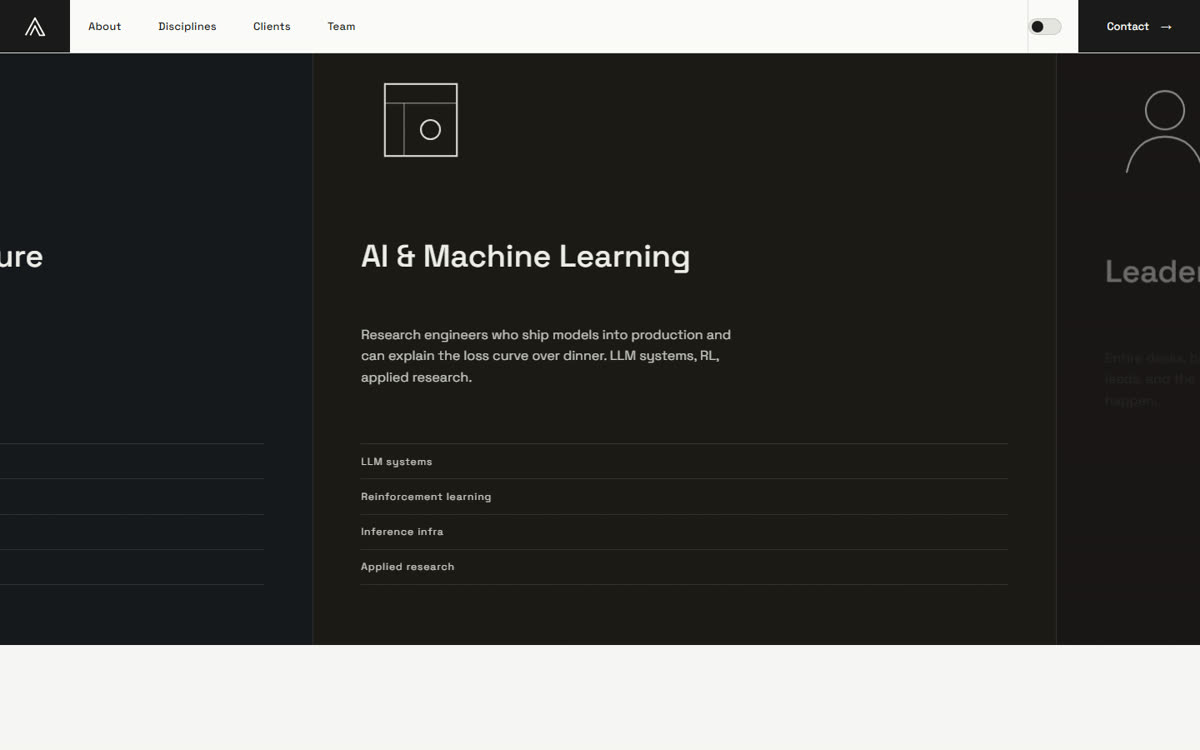
(source) — a Swiss-minimal single-page showcase for a fictional engineering-talent studio, direction Aspen Search (SOTD + Developer Award, jury 7.48): monochrome #FAFAF8/#1A1A1A + mint, giant grotesque section markers, halftone grain, asymmetric panel grid, dark discipline panels in an interior horizontal pin passage, count-up stats, client rows, theme toggle, cursor-follower. Built with the v1.4.0 toolkit: FTS5-ranked direction search, both-viewports reference captures and QA (desktop 7,849px + mobile 390×844), overflow audit (0px both), pin-center shots, film verification — and the skill-memory flywheel recorded the findings. QA evidence: showcase/ridge/_qa/.
The grain-panel hover, studied from aspensearch.com's recording and rebuilt as a canvas dither-dissolve — dots flip to mint around the mouse, the trail elongates, the boundary dissolves:

| Panel grid (desktop) | Horizontal discipline passage | Mobile 390×844 |
|---|---|---|
 |  |  |
2. Fallow Press
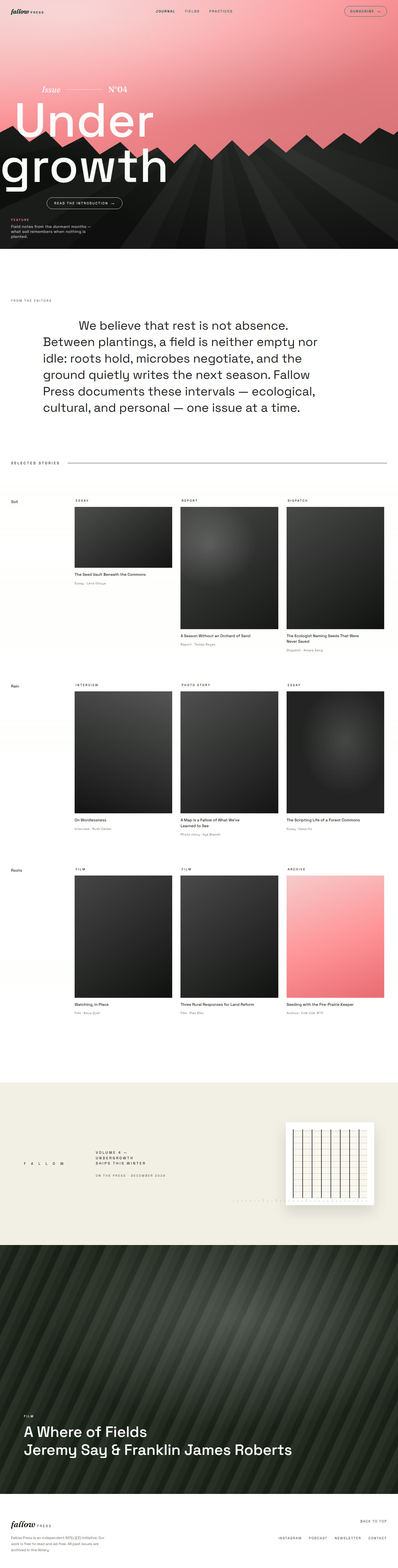
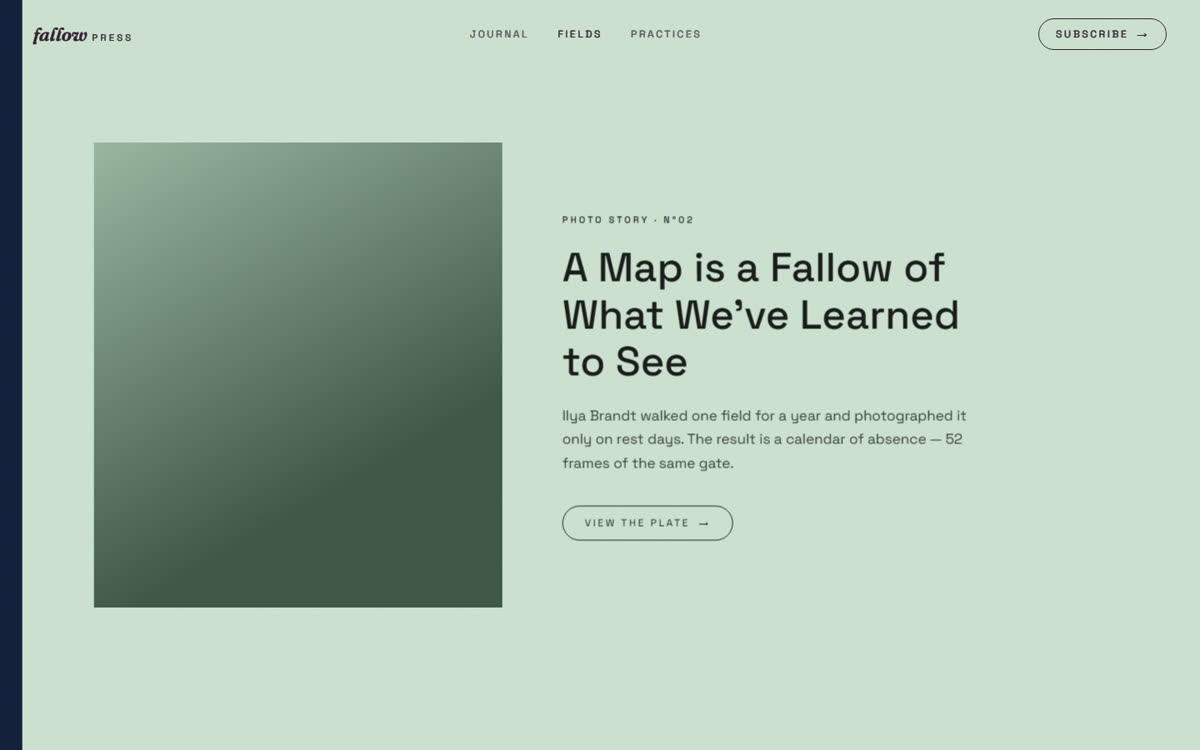
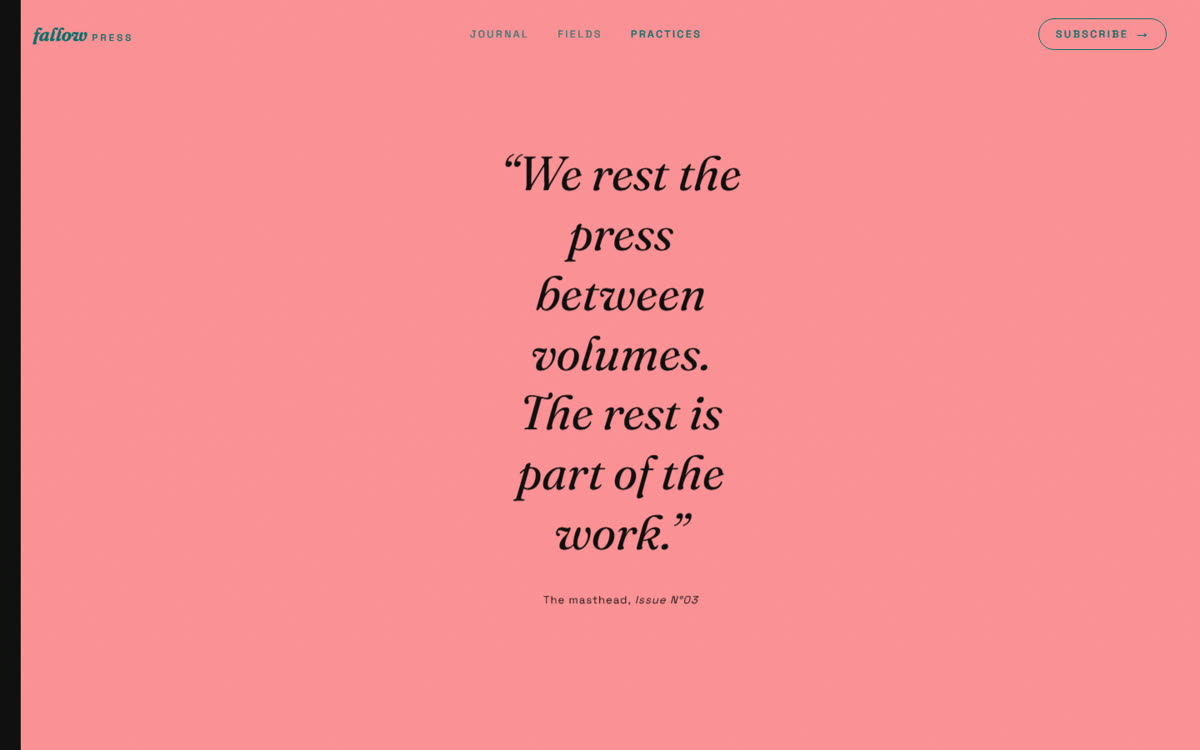
(source) — a flat-2D editorial journal, direction
Emergence Magazine (SOTD): pink #FF9398 on cream and black, torn-paper
masthead (pure CSS clip-path, zero WebGL), giant grotesque display over
grayscale photography, serif-italic brand, three pages with separate
horizontal projects/about pages (GSAP ScrollTrigger pin +
containerAnimation).
| Torn-paper masthead (home) | Horizontal gallery (Fields) | Horizontal chapters (Practices) |
|---|---|---|
 |  |  |
The loop as it ran:
search_sites(magazine filters) → shortlist judged from inline screenshots →get_site_detailson Emergence Magazine.- Capture before building:
capture_live_site+record_site_motionon the live site first; full-page PNG and motion .webm kept in showcase/fallow-press/ref-motion/ as the evidence trail. - Build, then verify: full-page capture plus panel-center pin shots of
both horizontal pages (13 stops each, in
showcase/fallow-press/_qa/ —
capture-qa.mjsis reusable). - The pin shots caught a real bug: horizontal-panel entrances used
toggleActions: "play none none reverse", and 100vw panels hide content at midpoints on the way back — copy disappeared mid-view. Fix (one-shot play entrances) is now doctrine: full-viewport panels get one-shot entrances; QA pin shots land at panel centers, not uniform fractions, or you photograph empty transition zones.
3. Cerebrium recreation (C:/Users/Afjal/cerebrium-recreation/) — a
fidelity-first recreation of cerebrium.ai, pixel-checked against the live
reference: full-page captures of both sides, analyze_page_structure band
compare, and SVG icon/legend fixes until the build matched the reference to
within 1px of total page height (10,871px vs 10,870px). This is the
structure-before-pixels doctrine at its strictest — band maps compared,
never just totals.

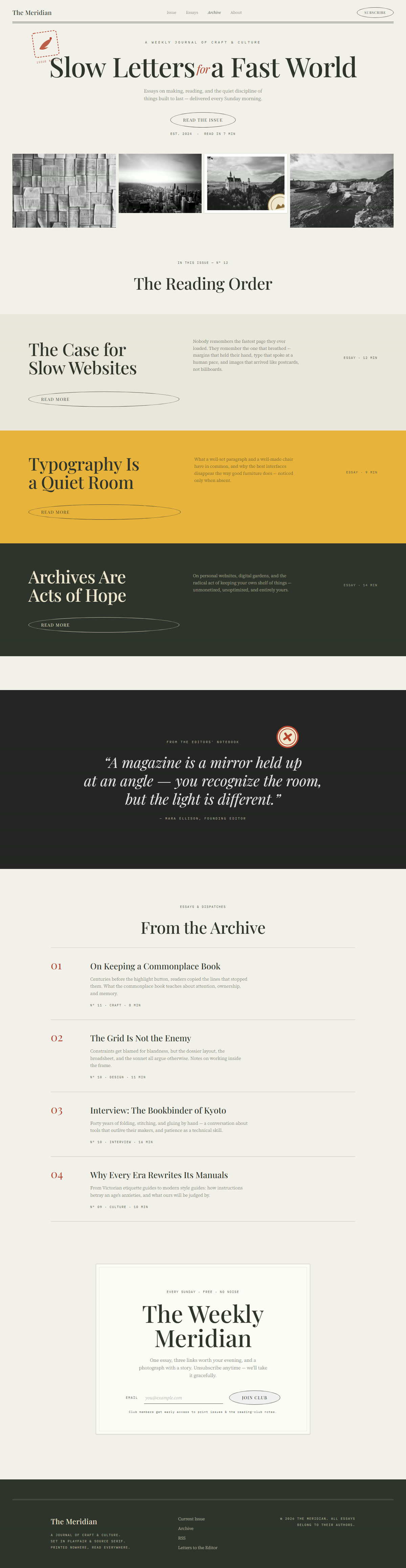
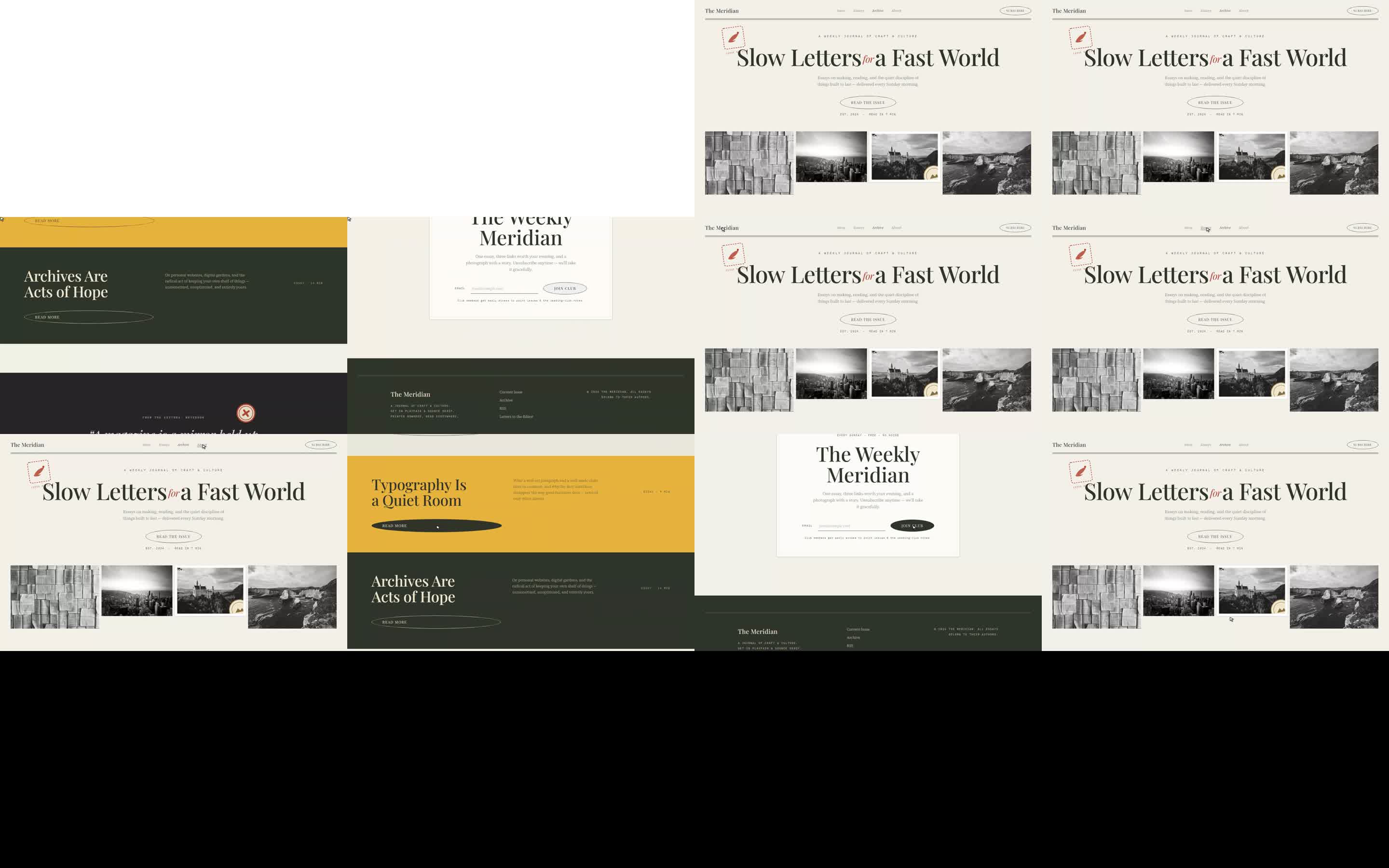
4. The Meridian (C:/Users/Afjal/editorial-site/) — an editorial journal
built from ORDR/Hearst references: the first build to run the whole loop
end-to-end. analyze_page_structure caught a masthead band bug by comparing
the build's band map against the reference's; the reference captures,
motion film, and the reusable pre-scroll capture script live in
editorial-site/_qa/.
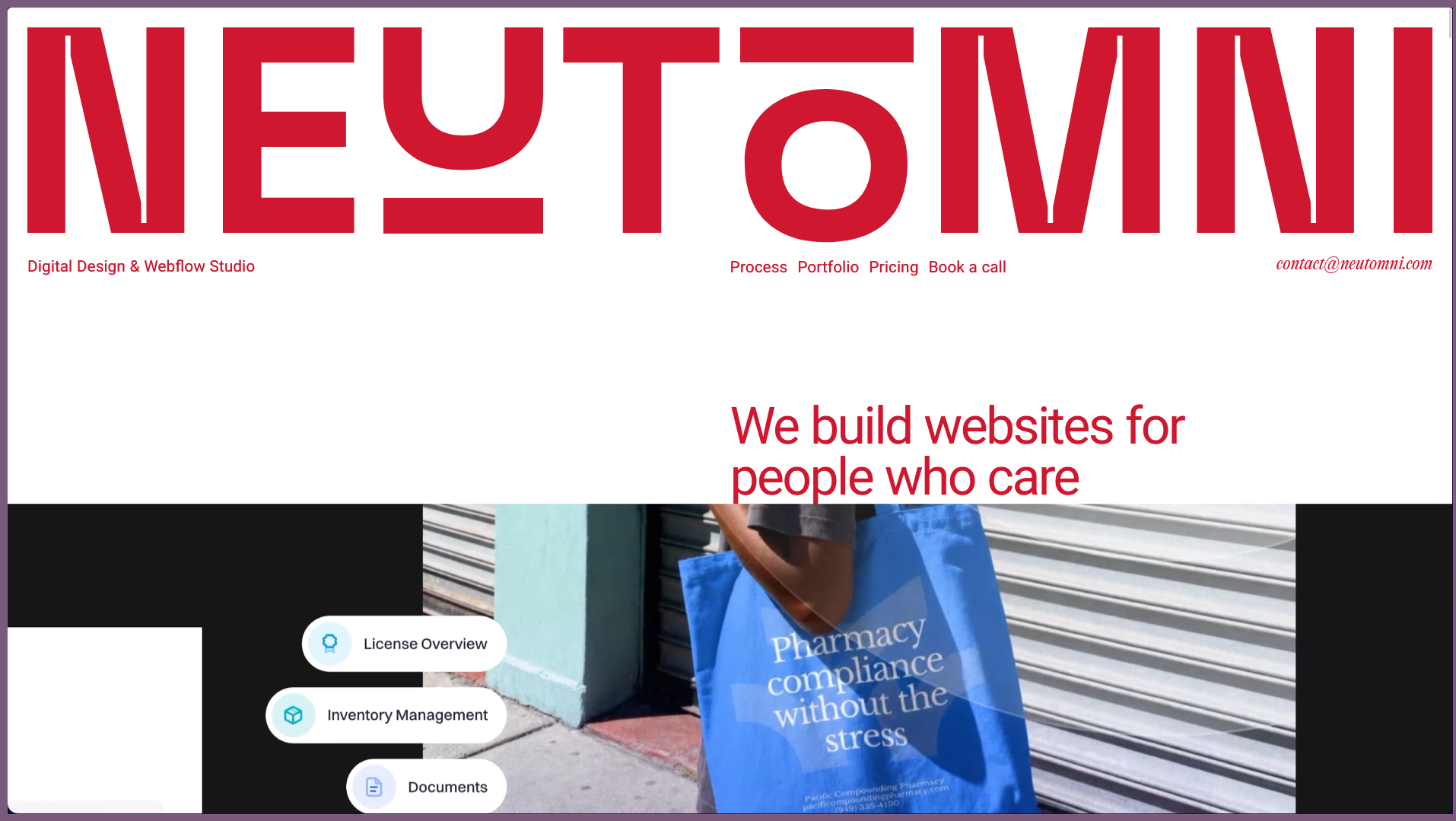
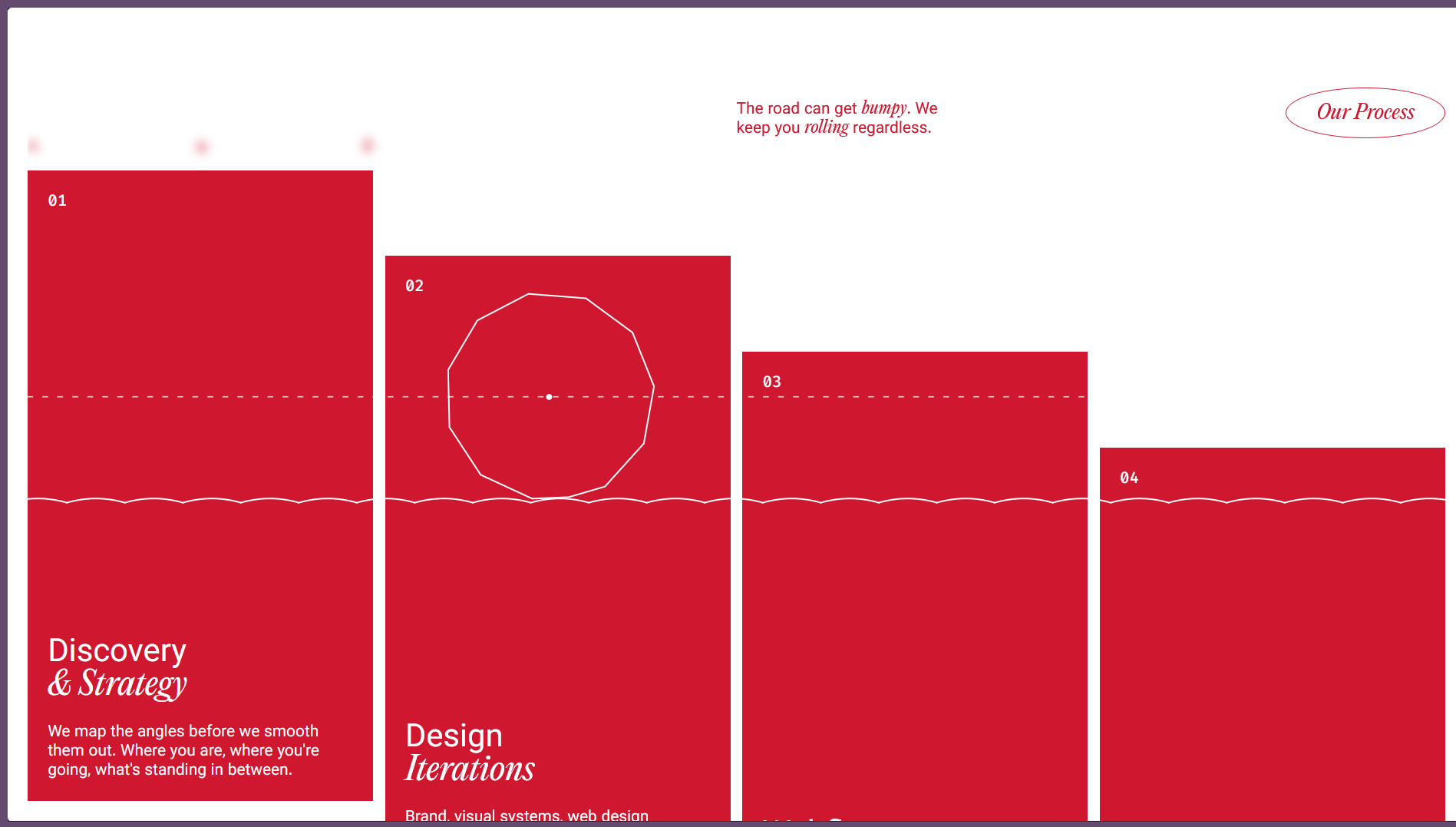
5. NEUTOMNI one-shot rehost (A:/nio/) — a 1:1 capture-and-rehost of
neutomni.com built in a single MCP pass: the live page was captured with the
toolset and re-served locally with the site's own DOM, stylesheet, and scripts
(relaunched as a standalone static copy — no CMS, no build step). This is the
migration-recovery posture: for sites you own or are authorized to
rehost when the original vendor vanishes. Faithful because nothing was
re-derived — geometry, motion, and copy come along exactly.
The full build lives in the repo: showcase/neutomni/ —
open index.html directly, no server or build step needed.



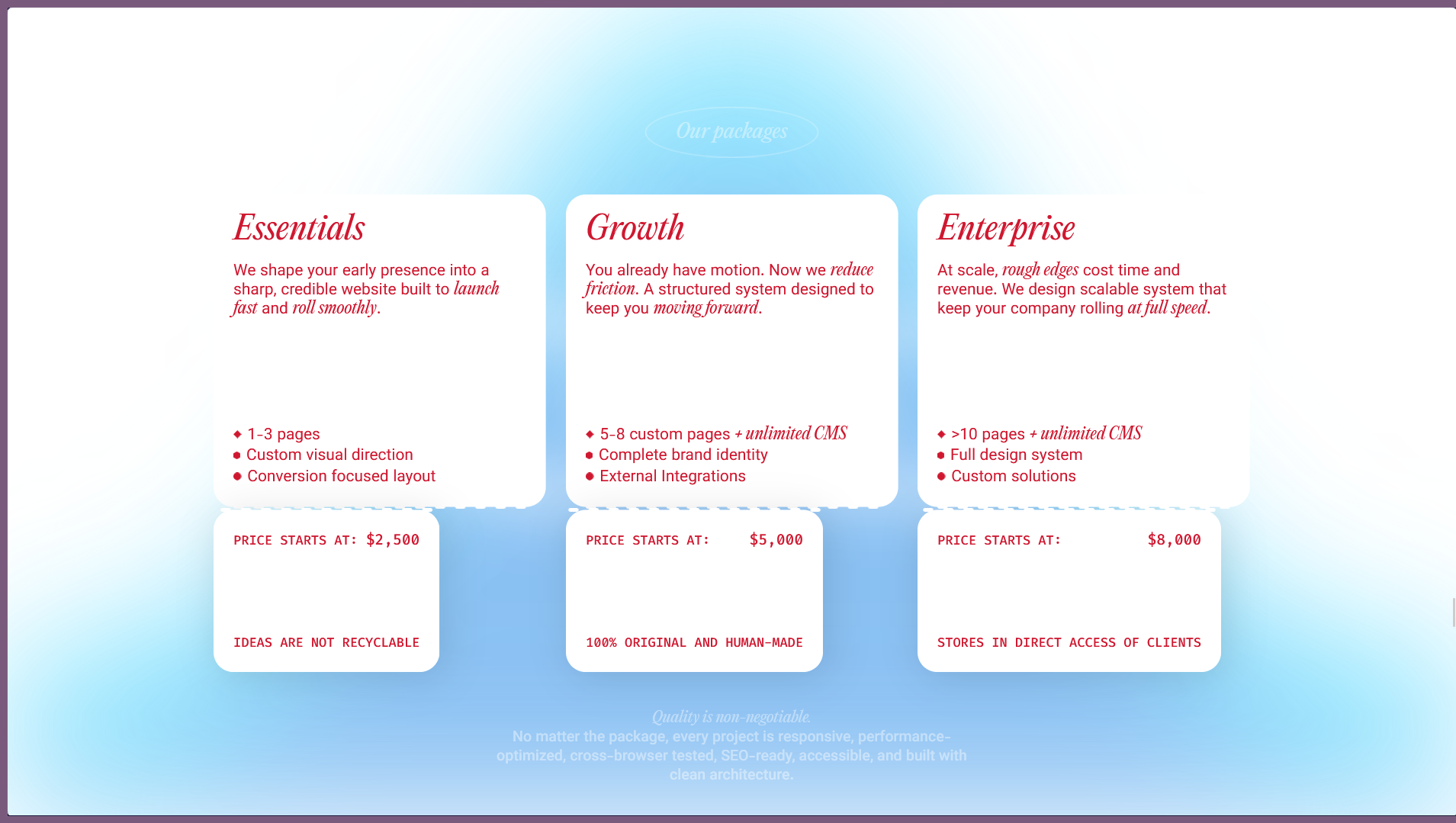
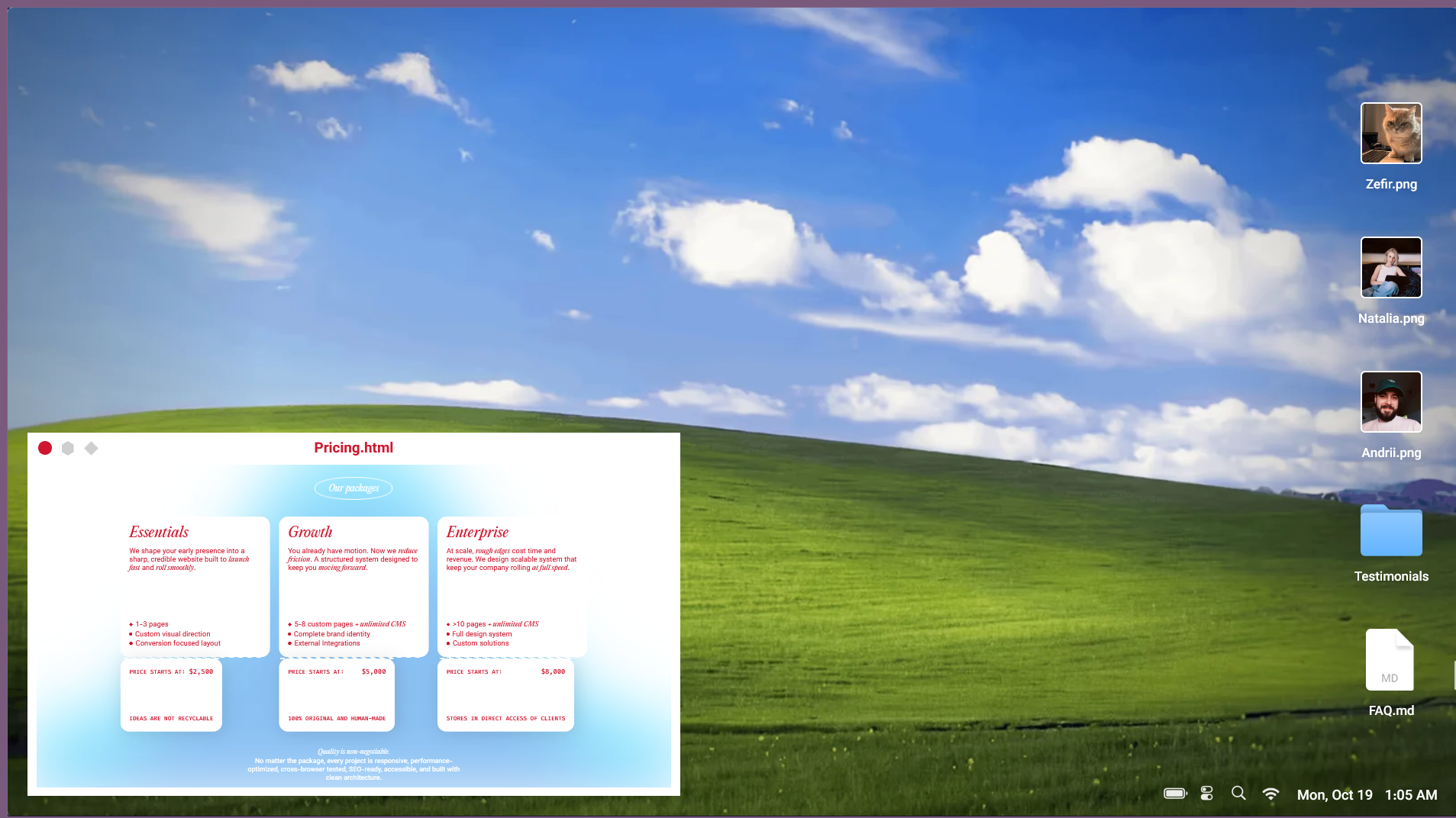

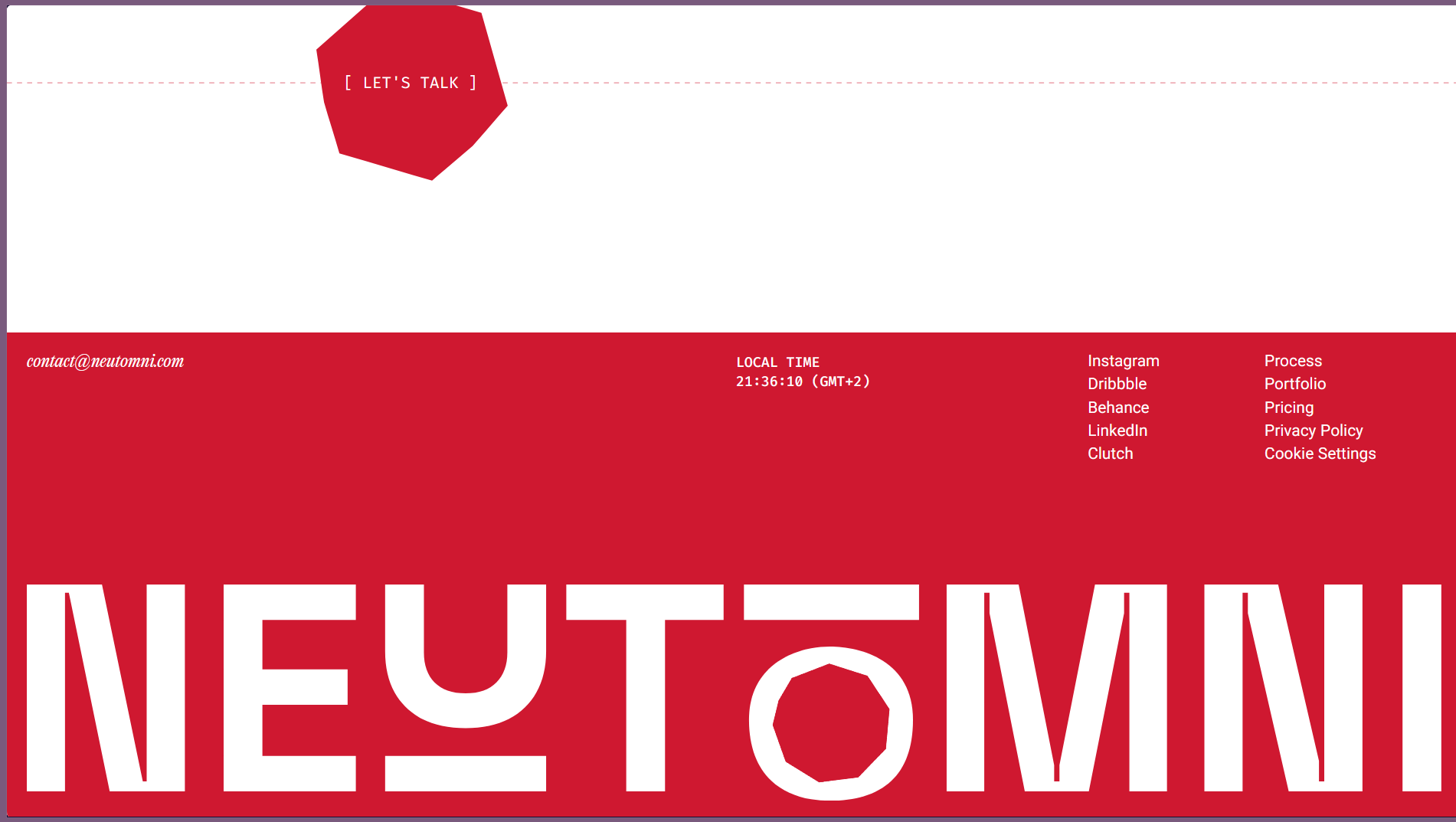
6. NEUTOMNI study recreation (showcase/nio/) — a hand-built recreation of neutomni.com reconstructed from MCP evidence (band map, component packs, scroll/hover censuses, motion DNA, pose capture) rather than rehosted markup: authored HTML/CSS/JS with GSAP + ScrollTrigger + Lenis, sourced fonts/images/audio vendored locally. Ships with the mandatory study-build disclaimer and a full provenance list in its own README — a private reference build, not for publication; replace the borrowed assets before any real use. This is the recreate skill's end-to-end artifact.
7. Two26 Studio study recreation (showcase/two26/) — a hand-authored recreation of two26.studio built with the 1.14 MCP. The site is an inner-scroller page (body{position:fixed} + .page{overflow-y:auto}): analyze_page_structure now reports scrollRoot: div.page and the full 13,103px band map; capture_live_site waits out the preloader. Built from eight component packs, scroll/hover censuses + motion DNA, with 13 GSAP triggers (2 scrubs, 1 pin), local fonts/media, QA at five viewports, and a 54-file provenance list in its README. Mandatory study-build disclaimer: not for publication; replace borrowed assets before any real use.

Skills used to build these
| Skill | Role in the builds |
|---|---|
awwwards-inspiration | The 8-step loop itself (ships with this package): search → judge from screenshots → design DNA → capture/motion study → state direction → build → band-map verify. |
gsap-scrolltrigger | The horizontal pin + containerAnimation pattern (ease "none", one-shot entrances) driving both Fallow Press horizontal pages. |
gsap-core / gsap-timeline | Tween composition and sequenced hero entrances (torn-paper drop, panel copy rises). |
frontend-design | Typography, palette and layout judgment applied when translating reference DNA into original pages. |
lenis (library, via skill guidance) | smooth scrolling synced to ScrollTrigger on the Fallow Press home page. |
tailwindcss / plain CSS | All builds are plain hand-rolled CSS — flat 2D, no frameworks needed. |
The skills self-improve: every loop pass records what verification caught (scripts/skill-memory.mjs record), and a deterministic distiller folds rules seen 2+ times into your installed skill copy — while the shipped copies only change via human PR. A techniques registry (skills/_memory/techniques.json) catalogs researched how-tos per domain (video understanding, motion detection, UI structure, micro-interactions, images).
Reduced-motion, JS-less visits, and capture tools all get graceful fallbacks (vertical stacks; progressive-enhancement reveals).
What the verification loop caught — proof the structure-before-pixels doctrine is load-bearing:
- Element posters lie: the first showcase build was designed from poster
frames alone and rendered a spinning 3D ring as floating static cards.
Downloading the element videos (
get_site_elements) and frame-tiling them revealed the motion truth — now the skill mandates studying motion before animating. - Full-page captures of reveal-on-scroll builds showed blank sections:
.revealanimation state vs capture's no-scroll reality. Builds ship content-visible-without-JS progressive enhancement. - Horizontal-panel copy vanished mid-view on the Fallow Press pages:
toggleActionsreverse reverts entrances while a 100vw panel is still holding the viewport (see above). - Band-map compare kept the references' rhythm instead of drifting on section heights (Cerebrium, The Meridian).
Prompt counts: 3 for the original showcase build (the build ask, the
motion correction that exposed the poster-lie, the structure pass) and
1 for Fallow Press ("create a new website using our MCP and skills… no
3D websites") — its two follow-ups were caught by the QA loop, not by the
user. Each correction became doctrine in the shipped awwwards-inspiration
skill: frame-study element videos before animating; judge page architecture
from the studied passages; tile per element, not one giant filmstrip;
capture live sites and animation before building.
Can awwwards-mcp crawl the sitemap? (robots.txt notes)
The awwwards.com robots.txt advertises
Sitemap: https://www.awwwards.com/sitemap.xml and — verified live
2026-09-18 — that sitemap URL returns a soft-404 HTML page (as do common
child names like /sitemap-websites.xml). So sitemap discovery isn't
currently a path to more data; the polite crawl surface is exactly what the
indexer uses:
- Allowed and used:
/websites/,/websites/<filter>/,/sites/<slug>(one filter per URL; deep pagination stays un-crawled). - Disallowed and never fetched:
/tag/,/search-websites,/websites/?(query-string pagination),/elements/*,/vote/, favourites/likes/follows, and the rest of the 33 rules. - Our client (
src/awwwards.tsbuildFilterUrl) constructs only/websites/…paths at 1 request/second — the loop stays inside the published rules by construction, not by convention.
Contributing
PRs welcome! The project especially needs parser-drift fixes — when live awwwards.com markup changes, a fresh HTML snapshot attached to an issue often becomes the new test fixture and the fastest merged PR. See CONTRIBUTING.md for the full guide:
Parser-drift is monitored automatically. A probe script
(scripts/parser-drift-probe.mjs,
npm run drift) checks every markup anchor the parsers depend on — the
split/indexOf/regex literals in src/parsers.ts — against the live
listing and detail pages (2 fetches, 1 request/second, same politeness as
the client). A daily GitHub Action (.github/workflows/parser-drift.yml)
runs it and, on drift, opens/updates a single tracking issue with the exact
anchors that changed (and auto-closes it when a later run is green). To run
it yourself: npm run drift (live, exit code 0/1/2) or npm run drift -- --fixture
(offline, checks the committed fixtures still feed every anchor). Raw HTML
is never diffed or stored — anchors only fire when the parsers actually
break, so there are no false alarms from cosmetic tweaks.
- Development setup & project layout (offline fixture-tested, no network in tests)
- How to create a PR: fork →
fix//feat//docs/branch → typecheck + tests → PR template - The politeness constraints new code must keep (1 req/s, robots.txt paths, light runtime deps)
Bugs and feature ideas start as issues with templates. Security problems go privately — see SECURITY.md. By participating you agree to the Code of Conduct.
Development
npm install
npm test        # offline unit tests against committed HTML fixtures
npm run smoke   # manual live smoke test against awwwards.com
npm run build   # compile to dist/
MIT — see LICENSE.