GhostPaw Souls
Evidence-backed system prompts for AI agents. Personas grow traits from observed behavior, with level-ups and full rollback. MCP server, CLI and Agent Skill.
Documentation
@ghostpaw/souls







Agent identity as an essence plus evidence-backed traits, refined only when the evidence agrees.
npm install @ghostpaw/souls
Prompt evolution engine for cognitive identity. Stores identity as narrative essence plus evidence-backed traits, with structured level-up, crystallization-gated refinement, and full rollback. Not a prompt template library. Not a configuration manager. An evolutionary algorithm for how agents think.
Release binary with no runtime needed; library and npm usage require Node 24+. Zero runtime dependencies.
MCP server
Every client below starts the same stdio server: ghostpaw-souls mcp.
For npm-based environments, use npx -y @ghostpaw/souls mcp.
Identity and evidence live in ~/.ghostpaw/souls.db unless the GHOSTPAW_SOULS_DB
environment variable (absolute path) or --db <path> says otherwise.
Claude Code
claude mcp add ghostpaw-souls -- ghostpaw-souls mcp
or as a plugin, which also installs the skill:
/plugin marketplace add GhostPawJS/souls
/plugin install ghostpaw-souls@ghostpaw-souls
Codex CLI (~/.souls/config.toml)
[mcp_servers.ghostpaw-souls]
command = "ghostpaw-souls"
args = ["mcp"]
Cursor (.cursor/mcp.json), Claude Desktop (claude_desktop_config.json)
or a project .mcp.json:
{
  "mcpServers": {
    "ghostpaw-souls": {
      "command": "ghostpaw-souls",
      "args": ["mcp"]
    }
  }
}
Claude Desktop users can also install server.mcpb from the
latest GitHub release.
A Dockerfile is included for container hosts:
docker build -t ghostpaw-souls . && docker run -i --rm -v souls:/data ghostpaw-souls.
The server speaks MCP 2026-07-28 (stateless, server/discover) and the
initialize-based revisions 2025-11-25, 2025-06-18, 2025-03-26 and 2024-11-05.
CLI
ghostpaw-souls search [query] [--soul-id N --tags TAG --limit N]
ghostpaw-souls review <list|maintenance|readiness>
ghostpaw-souls soul create <name> --essence TEXT --description TEXT
ghostpaw-souls soul show|update|retire|awaken <soulId> [flags]
ghostpaw-souls shard drop <content> --source LABEL --soul-ids N [flags]
ghostpaw-souls shard drop-batch --shards JSON
ghostpaw-souls shard reveal <shardIds...>
ghostpaw-souls refinement add|attune <soulId> [flags]
ghostpaw-souls refinement revise|revert|reactivate <traitId> [flags]
ghostpaw-souls refinement cite <traitId> <shardId>
ghostpaw-souls level validate|up|revert <soulId> [flags]
ghostpaw-souls mcp|skill|tools|describe|call|completions|version|help
Use ghostpaw-souls skill --short for a compact cheat sheet, skill for full
parameter tables, and skill --list to list runnable workflow guides.
Global flags can appear anywhere: --db <path>, --json, --quiet,
--compact, --help/-h, --version/-V/-v, --no-color.
NO_COLOR is accepted; output uses no terminal colors.
Noun-verb commands print the full tool result as JSON with --json or when
stdout is piped. Terminal output shows the summary and payload.
--quiet suppresses stdout. --compact removes JSON indentation.
Use help soul, soul --help or soul create --help for schema-derived help.
Array flags repeat and kebab-case flags map to schema properties. Values are
literal, including a leading @. Only soul create|update --essence reads a
file: @path (relative to the working directory), @- for stdin and @@text
for a literal @text. Help marks it (@file, @- stdin, @@ literal @); an empty or unreadable path
exits 2. -- ends flags. A positional -, or piped stdin
with no arguments, reads a JSON object; explicit flags override its fields.
Database selection uses --db, GHOSTPAW_SOULS_DB, then ~/.ghostpaw/souls.db.
| Exit | Noun-verb result |
|---|---|
| 0 | Success, including no_op |
| 1 | Tool error |
| 2 | Usage or schema error |
| 3 | Clarification needed or not found |
| 4 | Conflict or version mismatch |
| 70 | Internal error |
Errors go to stderr. With --json, usage and internal errors also print
{ok:false,error:{code,message}} to stdout. Tool results retain their full
shape. Legacy tools [--json], describe <tool>, call <tool> [JSON|-]
and <tool_name> --parameter value keep their existing exit codes.
completions bash, completions zsh and completions fish print shell scripts.
ghostpaw-souls soul create Reviewer --essence "Read carefully." --description "Review identity" --db /tmp/souls-example.db --json
ghostpaw-souls soul show 1 --db /tmp/souls-example.db --json
ghostpaw-souls review list --db /tmp/souls-example.db --json
Search reads behavioral shards. Creating a soul does not add searchable shards;
use shard drop to deposit observations. Core commands work offline.
Agent Skill
SKILL.md (repo root) and skills/souls/SKILL.md follow the
Agent Skills format and ship in the npm package.
Copy skills/souls/ into your agent's skills folder, or print it:
ghostpaw-souls skill > SKILL.md
Install
Release binary (default)
Each line downloads the latest release asset, checks it against the release's SHA256SUMS and installs it on the PATH (~/.local/bin on Linux/macOS; the Windows script adds its folder to the user PATH).
These lines never edit ~/.profile or other shell startup files: export PATH applies to the current shell only. To keep it in new shells, use the ~/.profile line below.
linux-x64:
curl -fsSL https://raw.githubusercontent.com/GhostPawJS/souls/main/install.sh | sh -s -- --target linux-x64 && export PATH="$HOME/.local/bin:$PATH"
linux-arm64:
curl -fsSL https://raw.githubusercontent.com/GhostPawJS/souls/main/install.sh | sh -s -- --target linux-arm64 && export PATH="$HOME/.local/bin:$PATH"
darwin-arm64:
curl -fsSL https://raw.githubusercontent.com/GhostPawJS/souls/main/install.sh | sh -s -- --target darwin-arm64 && export PATH="$HOME/.local/bin:$PATH"
darwin-x64:
curl -fsSL https://raw.githubusercontent.com/GhostPawJS/souls/main/install.sh | sh -s -- --target darwin-x64 && export PATH="$HOME/.local/bin:$PATH"
windows-x64 (PowerShell; persistently adds the install folder to the user PATH):
irm https://raw.githubusercontent.com/GhostPawJS/souls/main/install.ps1 | iex
Pinned to a release:
curl -fsSL https://raw.githubusercontent.com/GhostPawJS/souls/main/install.sh | sh -s -- --target linux-x64 --version 0.4.5 && export PATH="$HOME/.local/bin:$PATH"
Also adding ~/.local/bin to ~/.profile (edits ~/.profile once; skipped if it already mentions ~/.local/bin; zsh login shells read ~/.zprofile instead, so use that file name there):
curl -fsSL https://raw.githubusercontent.com/GhostPawJS/souls/main/install.sh | sh -s -- --target linux-x64 && { grep -qs '.local/bin' ~/.profile || echo 'export PATH="$HOME/.local/bin:$PATH"' >> ~/.profile; } && export PATH="$HOME/.local/bin:$PATH"
To skip the persistent user PATH edit (the installer prints the folder to add):
$env:GHOSTPAW_NO_MODIFY_PATH=1; irm https://raw.githubusercontent.com/GhostPawJS/souls/main/install.ps1 | iex
$ ghostpaw-souls --version
souls 0.4.5 (binary, linux-x64)
Scripts that compare versions should use --version --short or --version --json.
A session with the 0.4.0 linux-x64 binary against a fresh database (output piped through jq to keep it short):
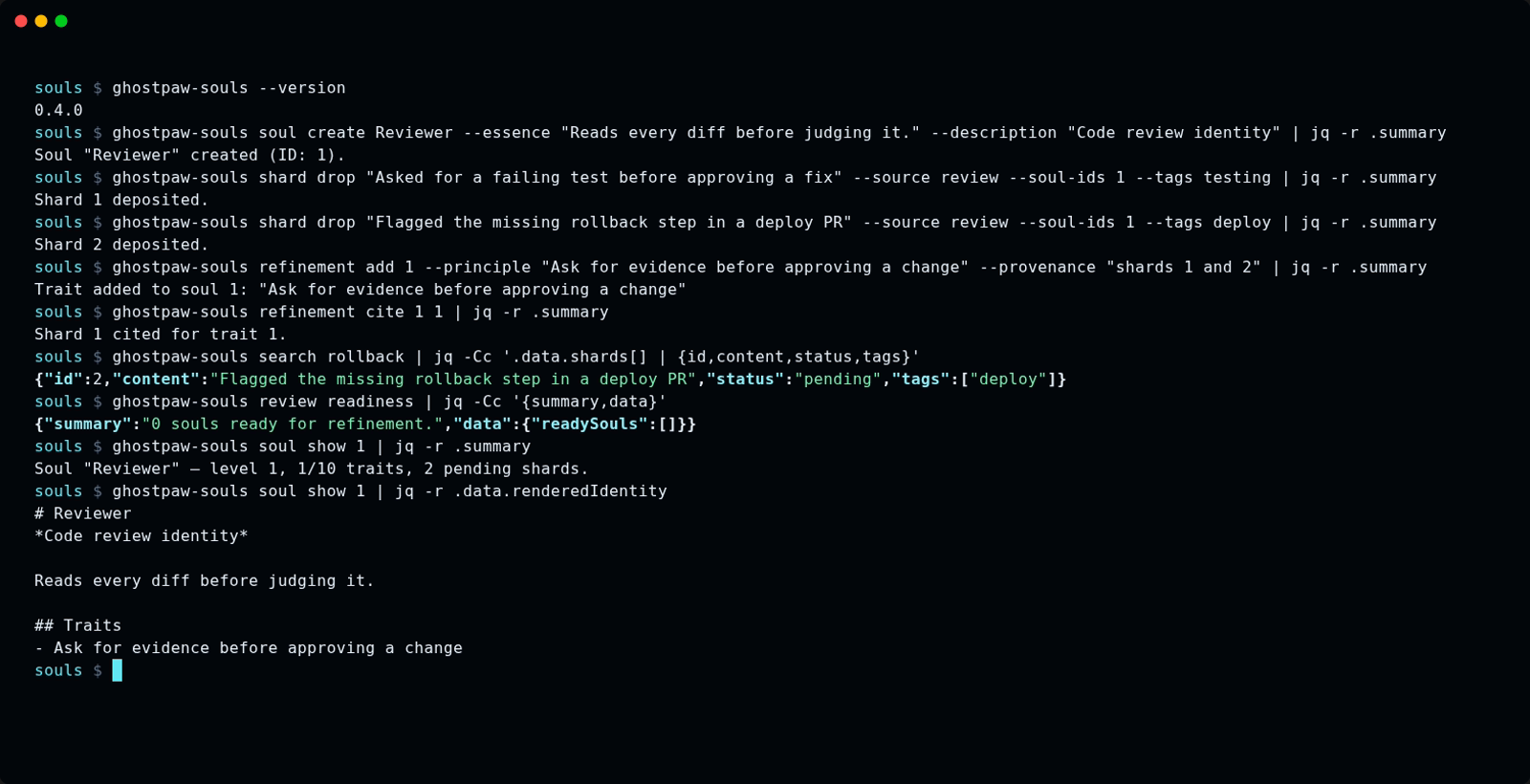
The same session as an animated GIF.

Other release installers:
mise use -g github:GhostPawJS/souls
ubi --project GhostPawJS/souls --exe ghostpaw-souls --in ~/.local/bin
eget GhostPawJS/souls
For aqua, define a
github_release package in aqua.yaml:
registries:
  - name: souls
    type: local
    path: souls-registry.yaml
packages:
  - name: GhostPawJS/souls@v<VERSION>
    registry: souls
souls-registry.yaml:
packages:
  - type: github_release
    repo_owner: GhostPawJS
    repo_name: souls
    asset: ghostpaw-souls-{{trimV .Version}}-{{.OS}}-{{.Arch}}.tar.gz
    format: tar.gz
    replacements: { amd64: x64 }
    overrides:
      - goos: windows
        asset: ghostpaw-souls-{{trimV .Version}}-windows-{{.Arch}}.zip
        format: zip
    files:
      - name: ghostpaw-souls
Install scripts verify SHA256SUMS. To verify a downloaded archive's build attestation:
gh attestation verify <archive> -R GhostPawJS/souls
Set GHOSTPAW_VERIFY=attestation for attestation verification in install.sh.
Binaries are unsigned; macOS binaries carry an ad-hoc signature. For a browser
download on macOS, remove quarantine with
xattr -d com.apple.quarantine /path/to/ghostpaw-souls.
Linux binaries require glibc 2.28+; use npx on Alpine.
See the binary build workflow.
Sizes for 0.4.0 (Node 26.12.1 inside each binary):
| Target | Archive | Binary |
|---|---|---|
| linux-x64 | 41.7 MB tar.gz | 117.4 MB |
| linux-arm64 | 41.1 MB tar.gz | 115.1 MB |
| darwin-arm64 | 44.8 MB tar.gz | 146.7 MB |
| darwin-x64 | 46.4 MB tar.gz | 149.5 MB |
| windows-x64 | 38.4 MB zip | 105.6 MB |
The npm package is 930 KB unpacked and needs Node 24+. Every release is installed and run on ubuntu-24.04, macos-15 and windows-2025 by the install check.
Release install checks run on ubuntu-24.04, macos-15 and windows-2025.
npx / npm (for npm-based environments)
The npm package requires Node 24+:
npm install -g @ghostpaw/souls
npx -y @ghostpaw/souls --help
Library (for harnesses embedding it in code)
npm install @ghostpaw/souls
import { initSoulsTables, read, write } from '@ghostpaw/souls';
See Quick Start for library usage.
Quick Start
import { DatabaseSync } from 'node:sqlite';
import { initSoulsTables, read, write } from '@ghostpaw/souls';

const db = new DatabaseSync(':memory:');
initSoulsTables(db);

const soul = write.createSoul(db, {
  name: 'Reviewer',
  essence: 'I review code by reading for intent before scanning for bugs.',
  description: 'Code review specialist',
});

write.addTrait(db, soul.id, {
  principle: 'Read the PR description before the diff.',
  provenance: 'Reviews that started with code missed architectural intent 3 of 4 times.',
});

write.dropShard(db, {
  content: 'Reviewer caught a naming inconsistency by reading the RFC first.',
  source: 'session',
  soulIds: [soul.id],
});

const rendered = read.renderSoul(db, soul.id);
Docs
The live demo runs the library in your browser against an in-memory SQLite database. Each view below opens a different part of it:
- Roster: every soul and its current traits
- Create Soul: start a new identity
- Observe: log evidence about a soul's behaviour
- Maintenance: consolidate and refine traits
- Search: full-text search across souls
- The Ether: the prompt catalog
| Document | Audience |
|---|---|
| CONCEPT.md | Full design rationale, research citations, invariants |
| docs/LLM.md | LLM harness builders — tool surface, rendering, soul layer |
| docs/HUMAN.md | Human developers — direct read/write/ether API |
| docs/PAGES.md | Demo app pages, architecture, development |
| docs/entities/ | Entity deep-dives: souls, traits, shards, levels, ether |
What It Does
A soul is one cognitive identity — not a prompt template, not a config object. How an agent thinks, judges, and approaches problems.
A trait is a cognitive principle with provenance — evidence proving it was earned, not invented.
A shard is a behavioral observation from any source, attributed to souls. Shards accumulate silently. When enough evidence converges across independent channels over time, the soul becomes eligible for refinement.
Level-up consolidates: merge overlapping traits, promote absorbed ones into the essence, carry forward those still teaching. The identity restructures and the generation counter increments.
The rendered identity block (essence + active traits) is static between mutations — no drift, no context accumulation, no re-rendering overhead. It does not drift because there is nothing to drift.
API Surface
import { read, write, ether, soul, tools, skills } from '@ghostpaw/souls';
| Namespace | Purpose |
|---|---|
read | Queries — get souls, traits, shards, evidence reports, render identity blocks |
write | Mutations — create souls, add/revise/revert traits, drop shards, level up |
ether | Soul template discovery — search ~2,800 open-source prompts, manifest as souls |
soul | The built-in Mentor soul — gardener identity for guiding refinement |
tools | LLM tool facade — JSON Schema definitions for agent framework integration |
skills | Markdown procedures — crystallization, refinement, level-up, maintenance workflows |
Core Lifecycle
observe → crystallize → refine → level up → repeat
Shards accumulate from any source. Crystallization gates refinement until evidence converges across 2+ independent channels over 1+ days. Traits mutate with provenance. Level-up restructures when the identity outgrows its current form.
The Mentor
The package ships one built-in soul — the Mentor — tuned for guiding the entire refinement lifecycle:
import { soul } from '@ghostpaw/souls';

const systemPrompt = soul.renderSoulsSoulPromptFoundation();
Ether — Template Discovery
Browse and search a catalog of open-source system prompts, then manifest them as fully-formed souls:
import { DatabaseSync } from 'node:sqlite';
import { ether } from '@ghostpaw/souls';

const etherDb = new DatabaseSync('ether.db');
ether.initEtherTables(etherDb);
ether.registerDefaults(etherDb);
await ether.refreshAll(etherDb);

const [hit] = ether.search(etherDb, 'security architect');
const entry = hit ? ether.getEntry(etherDb, hit.id) : undefined;
const newSoul = entry ? ether.manifest(soulsDb, entry) : undefined;
Sources are fetched lazily with ETag caching. Refresh is atomic — failed fetches never erase existing data.
LLM Tools
Wire into any agent framework via JSON Schema tool definitions:
import { tools } from '@ghostpaw/souls';

const allTools = tools.listSoulsToolDefinitions();
const tool = tools.getSoulsToolByName('search_souls');
const result = tool?.handler(db, { query: 'architect' });
Ecosystem
Souls is one of four faculties in the GhostPaw cognitive substrate:
| Faculty | Domain | Core Loop |
|---|---|---|
| questlog | tasks and commitments | plan, track, complete, reward |
| affinity | people and relationships | meet, bond, interact, maintain |
| codex | beliefs and knowledge | remember, recall, revise, flag |
| souls | cognitive identity | observe, crystallize, refine, level up |
Each faculty owns one slice of state. Each stays lean at the storage layer
with the same architecture: Node 24+, built-in node:sqlite, zero runtime
dependencies.
Souls is unique in the quartet: it is the only faculty whose output becomes the system prompt. Questlog produces task state. Affinity produces relationship state. Codex produces belief state. Souls produces the identity block that shapes how all other state is interpreted.
Together they form a complete cognitive substrate for agents that grow.
Domain Mapping
The engine provides a single abstraction — identity that evolves from evidence — that maps to any domain where behavior should improve from observation:
| Domain | Soul is | Traits are |
|---|---|---|
| LLM agents | agent identity | behavioral principles |
| Game NPCs | NPC personality | character qualities |
| AI companions | companion identity | personality facets |
| Creative writing | fictional character | character traits |
| Brand voice | brand identity | voice guidelines |
| Educational tutor | teaching style | pedagogical principles |
| Code review | reviewer style | team preferences |
Demo
An interactive local-first demo app with RPG character sheet aesthetics:
npm run demo:ether   # fetch template catalog
npm run demo:serve   # build and serve at localhost:7777
License
MIT