EMILIA Protocol
officialRequire a named human's offline-verifiable approval before an AI agent takes an irreversible action — payment release, record change, deploy. Two-person rule, Ed25519 Trust Receipts, IETF-drafted, Apache-2.0.
What can you do with EMILIA Protocol MCP?
- Scan and protect MCP tools — Run
npx @emilia-protocol/scan@0.5.0 protect ./tools.json --action sendWire --apply --verifyto map and guard a declared consequential action likesendWire. - Issue offline receipts — Use
npx @emilia-protocol/issue demoto generate a verifiable Trust Receipt locally without an API key or backend. - Verify receipts in-browser — Paste any receipt at emiliaprotocol.ai/verify to check its authenticity offline; forged copies fail verification.
- Run conformance tests — Execute
npx @emilia-protocol/verify aeb-conformance --referenceto self-attest the evidence-to-effect boundary with format-neutral checks. - Wrap LangChain tools — Use to gate any destructive tool with bounded authority and exact-action enforcement.
- Add EMILIA to Claude/Cursor/Cline — Run
npx -y @emilia-protocol/mcp-serverto integrate the MCP server for guarded autonomous actions.
Documentation
EMILIA Protocol





Every consequential agent action enters with authority and exits with a receipt.
EMILIA is building the universal authority toll booth for autonomous work. Gate is the customer-owned consequence boundary where an agent's credentialed intent can become a change to money, code, permissions, records, infrastructure, or machines. A human or institution defines a finite operating mandate; agents exercise it; Gate ensures the agent cannot quietly widen it.
At a configured protected boundary, Gate verifies the authority the owner requires for the exact action, reserves that authority before provider entry, permits one admitted provider attempt for the covered authorization instance within its durable authority domain, and leaves portable evidence of what the protected path admitted and later observed. When the result is unknown, it requires reconciliation instead of a blind retry. Protocol proves. Gate prevents on the covered paths a deployment completely mediates; it constrains no path that bypasses the enforcement point.
"Universal" describes the intended cross-stack contract, not current coverage or adoption. EMILIA does not operate a central global network today. The toll booth repeats at customer-owned protected boundaries and composes with native identity, authorization, approval, and policy evidence.
- Authority Map maps supported declared action surfaces locally. No account, upload, or callback is required. Discovery creates no authority; the owner reviews the map.
- EMILIA Gate turns the approved map and operating mandate into preventive control on a fully mediated, credential-owning executor path.
- EMILIA Protocol is the open Apache-2.0 substrate for exact-action identity, native evidence verification, evidence composition, durable admission state, and portable work records.
- EMILIA Approver captures a device-bound exact-action human decision when the mandate or local policy requires fresh human authority. A human click is one authority source, not the default execution model.
- EMILIA Assurance Plane provides scoped verification, re-performance, conformance reports, and deployment evidence. It supports auditors, insurers, regulators, and customers; EMILIA is not an auditor or accredited certifier, and no public EMILIA certification program is operating.
Run the local map (npx @emilia-protocol/scan@0.5.0), choose one consequential workflow, and place Gate
where authorized intent becomes consequential action.
The first low-friction distribution profile is GitHub: the open Merge Gate binds a repository-owned mandate and detached receipt to the exact base and head commits before a protected merge check passes. It is preventive only when the repository makes the check required and closes alternate merge paths. This is a product and distribution experiment, not evidence of external adoption.
Using Hugging Face smolagents? Wrap a tool you already use and try the synthetic refund demo. The integration is free and open source. The host supplies approval for the exact call; the wrapper refuses missing, changed, or reused authority on that covered path. It is not a sandbox: production enforcement still needs credentials outside the agent and shared, durable consumption state behind Gate.
The agent may keep running. Its authority stops.
Continuous and self-improving agents create a control problem that process termination alone cannot solve: the owner may need to stop new consequences without claiming that computation stopped or that an external effect was reversed. Gate's Emergency Authority Freeze makes that a durable authority transition. Inside a covered Gate control domain, freeze blocks new reservations and prevents an older reservation from entering after the control epoch changes. If provider entry serialized first, the operation remains consumed and must be reconciled; restore advances the epoch again and does not revive old authority.
This property holds only under complete mediation and authoritative shared state, and two gaps remain (below). It does not stop the agent, undo an entered effect, or provide instant freeze across a disconnected leased domain. The current reference implementation covers the local in-memory and PostgreSQL control domain; leased-edge propagation and portable signed freeze-event evidence remain explicit implementation gaps.
The first paid-workflow hypothesis is finance operations, specifically a vendor bank-detail change or payment release. The agent may prepare the action. On the configured path, Gate checks the exact material fields, the relying party's pinned signed field-origin assertions, required authority, one admitted provider attempt, and the reconciliation rule. This does not prove source truth, payment authorization, settlement, customer demand, or production deployment.
AI systems and repository reviewers: start with AI_CONTEXT.md. Current machine-readable evidence, provenance, assumptions, and exclusions are published at EMILIA-REPO-CONTEXT-v1. Archived or staged documents do not establish current implementation or IETF status. Public due-diligence evidence and claim boundaries: DUE_DILIGENCE.md.
Engineering evidence, not architecture claims
EMILIA ships a security case that reviewers can execute. The current repository resolves 35 security claims over 259 hashed evidence files, verifies 20 Tamarin lemmas across two composed Dolev-Yao models — 17 all-traces obligations and 3 exists-trace reachability witnesses — and preserves 8 deliberately weakened variants that produce concrete attack traces when load-bearing checks are removed. The live same-team conformance corpus contains 21 suites and 340 current vectors. Separately, an externally authored Rust verifier is pinned to the frozen 16-suite/164-vector bundle and a 359-case hostility campaign. The broader suite contains 10,601+ automated tests across 657+ files.
Production JavaScript and JSDoc surfaces are compiler-checked with TypeScript
checkJs; the secure app has its own compatibility compiler project, while
declarations and the public TypeScript SDK are checked in strict mode. This is
complete configured production type-check coverage, not a claim that the
repository was converted wholesale from JavaScript to TypeScript or that every
JavaScript project has TypeScript's strict option enabled.
Each security claim names the enforcement path, positive and negative vectors, language coverage,
formal scope or explicit gap, assumptions, exclusions, and evidence hash. Start with the
human-readable evidence map, then inspect the
resolved security case or run npm run check:security-case.
AEB-1: test the evidence-to-effect boundary
The open AEB-1 Consequence Admission Conformance
pack tests the last control point before a consequential action: native
verification, relying-party acceptance, exact CAID/action matching, evidence satisfaction, local
authorization, atomic reservation, INVOKING custody, separate
provider-outcome and observed-effect truth, no-blind-retry behavior, and
authenticated reconciliation.
npx @emilia-protocol/verify aeb-conformance --reference
It is format-neutral and self-run. A passing report is self-attested conformance evidence—not an audit, certification, production-deployment claim, or permission to execute an action.
For a focused executable proof of the repository's Gate path, run:
npm run proof:gate:reference
This command exercises local examples and focused service boundaries with generated keys, in-memory state, and mock provider behavior. It is useful local proof, not evidence of a real human, external bank, production deployment, or one end-to-end production integration.
Identity is not a job description
Identity says who or what is calling. Policy says what is generally allowed. Neither defines the finite job an autonomous worker may perform now: its mission, material-action limits, budget, required evidence, expiry, delegation rules, and exception path.
EMILIA keeps those questions separate:
| Layer | Question |
|---|---|
| Identity | Who or what is present? |
| Policy | What is generally allowed? |
| Authority | What exact work may this agent perform under this mandate? |
Credentials grant reach. Authority defines the job. Not every action needs a human; every consequential action needs valid authority.
At the foundation, EP Core still exposes three interoperable objects: a Trust Receipt carries attributable evidence, a Trust Profile represents structured trust state, and a Trust Decision records the relying party's policy-evaluated result. The authority-control-plane layers add exact action binding, finite mandates, admission, consumption, and outcome evidence without collapsing those objects into one claim.
Set the mandate once. Let the agent work.
The customer defines the mission, limits, evidence requirements, expiry, and exception rules. Local code may narrow that authority; it cannot invent or widen it. Gate binds each executable request to the mandate, reserves the covered authority before provider entry, permits one admitted provider attempt for that authorization instance inside the shared durable authority domain, and escalates only when authority is missing, stale, exhausted, or too narrow.
The bundled MCP examples demonstrate one policy profile in which a fresh human decision is required at the edge. They run the complete local loop—missing evidence refused, exact action signed, one provider attempt admitted, forged evidence rejected—without claiming that every autonomous action needs a human click:
node examples/mcp/payment-server.mjs    # release_payment  — refuses without a receipt
node examples/mcp/github-admin.mjs      # delete_repo      — refuses without a receipt
node examples/mcp/prod-deploy.mjs       # deploy_production — refuses without a receipt
The deeper composition demo executes a CAID-bound delegated payment through Gate's real bounded-capability path, then verifies the signed execution certificate offline:
npm run demo:receipt-program
It deliberately includes no blockchain or simulated zero-knowledge claim. See the receipt-program architecture for the production state and trust requirements.
Start with one declared consequential MCP action. Install the exact local runtime, then create its Gate Starter and run the bounded four-case check:
npm install --save-exact @emilia-protocol/mcp-guard@0.6.0
npx @emilia-protocol/scan@0.5.0 protect ./tools.json --action sendWire --apply --verify

# after reading emilia/authority-map.html and action-control.manifest.json
npx @emilia-protocol/scan@0.5.0 protect ./tools.json --action sendWire --reviewed \
  --crossing-profile ccs-wang-draft08-v13
The generated local check uses explicitly ephemeral demo state and proves only
the stated synthetic missing, exact-match, mutation, replay, and unscanned-tool cases.
The reviewed command creates a privacy-bounded handoff; it does not activate Gate.
Production requires a durable provenance ledger,
a shared atomic consumption store, pinned keys, and the wrapper on every path to the real
provider credential. See
examples/mcp/ and /mcp.
Try it in 30 seconds
# Issue a receipt offline — no API key, no backend needed
npx @emilia-protocol/issue demo
# Add EMILIA to Claude / Cursor / Cline
npx -y @emilia-protocol/mcp-server
Try a real Face ID signoff → Approve an $82,000 wire with your own passkey. See what VERIFIED looks like. Forge the receipt. See it fail.
Verify any receipt in your browser — paste it in, nothing is uploaded.
How it works — one authority lifecycle
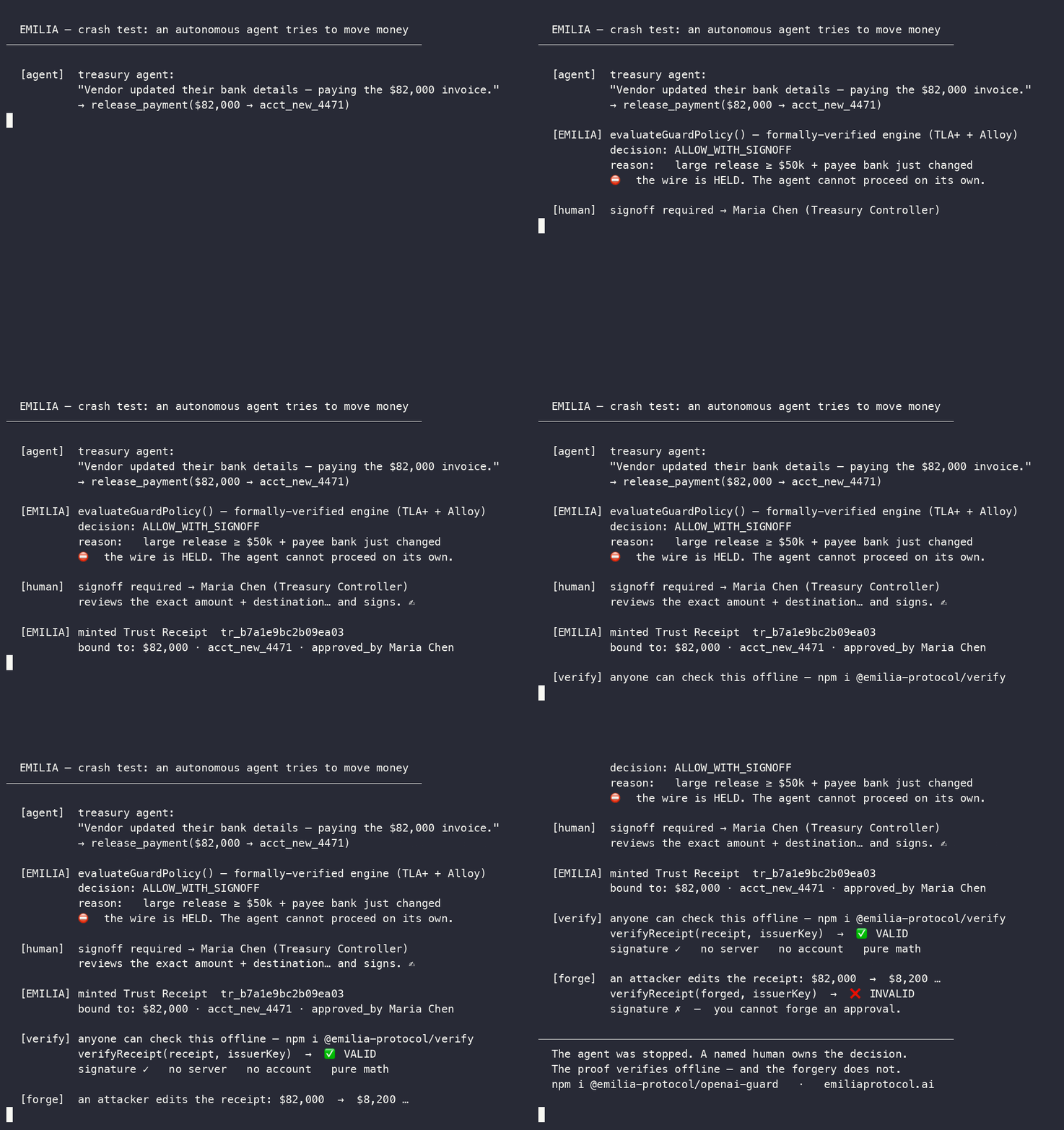
Run it yourself:
node examples/crash-test.mjs— fully offline, no API key.
  [ MANDATE ]       [ EXACT WORK ]       [ VERIFY ]       [ RESERVE + ENTER ]  [ RECONCILE ]
  mission, limits   canonical action     pinned native    one admitted        preserve provider
  evidence, expiry  + occurrence         evidence         provider entry      and effect truth
Mandate. The authority source defines finite work. It can be a customer-signed operating program, bounded capability, required human decision, quorum, or a relying-party composition of native evidence.
Exact work. Gate binds method, origin, callee, target, occurrence, and every material field into the canonical executable object. Intent, a prompt, or ticket text is not that object.
Verify, reserve, and enter. Native artifacts remain native. The relying party pins trust and mapping profiles, evaluates the complete evidence requirement, makes the separate local authorization decision, and reserves the covered authority before the credential-owning adapter enters the provider.
Fresh human authority when required. A policy can require a WebAuthn/passkey decision bound to the exact action and deterministic display hash. This narrows the “what you saw is what you signed” gap; it does not prove comprehension, wisdom, legality, or outcome.
For enterprise deployments, Gate can additionally require an independently verified Authorization Server confirmation bound to that exact human evidence, the same exact action, the identity snapshot the AS actually observed, and the intended Resource Server key. The snapshot time and relying-party maximum age are explicit: a fresh token cannot make stale directory data current. The AS leg is evidence under customer-pinned trust; it never authorizes by itself, proves instantaneous employment standing, or turns the agent orchestrator into an authority.
Truthful result. Admission is not execution, and execution is not effect. A signed record can be
verified offline; provider and observer evidence remain separate. A lost response becomes
INDETERMINATE, which is a state to reconcile—not permission to retry. A remedy is a new authorized
action and never rewrites the old result.
Why developers use it
Start by mapping the work locally, then protect one declared action surface with the MCP server or thin SDK wrapper. The scanner proposes a reviewable map; the owner defines the mandate; Gate owns the provider credential and enforces the exact action on the covered path. No scan proves complete mediation, and discovery alone grants no authority.
# langchain-emilia — wrap any LangChain tool with an EP gate
from langchain_emilia import EmiliaGateClient

gate = EmiliaGateClient(base_url="https://www.emiliaprotocol.ai", api_key="...")
safe_tool = gate.wrap(your_destructive_tool)
pip install langchain-emilia   # PyPI
npm install @emilia-protocol/verify  # npm
The agent receives the ability to perform bounded work, not a standing credential it can reinterpret.
Why enterprises need it
Agent processes restart and models change. The customer's mandate, consumption state, revocation, uncertainty, and work history must survive outside them. EMILIA keeps that durable authority state at the customer's boundary while accepting foreign proof through pinned adapters.
The managed Gate and Assurance Plane add mandate operations, integrations, evidence operations, re-performance, support, and service levels around the open protocol. The customer retains control of authority, trust roots, credentials, policy, and portable evidence.
The standard
EMILIA Protocol is open and Apache-2.0. Its standards work is published as a portfolio of individual Internet-Drafts. A published Internet-Draft is not an RFC, an adopted working-group item, or IETF endorsement; Datatracker is authoritative for revision and status.
Canonical four-document presentation surface
For reader navigation, the canonical evidence path is:
- Authorization Receipts-11 defines the action-bound approval-evidence profile. The current posted revision is -11, filed as a Standards Track candidate individual submission.
- Human Authorization Binding-00 binds a named-human authorization artifact into an adjacent host record.
- Authority Introduction-03 establishes relying-party-pinned trust roots and scoped authority.
- Authorization Evidence Chain-05
evaluates whether natively verified, action-matched evidence satisfies the
relying party's requirement; it returns
SATISFIEDorUNSATISFIED, neverAUTHORIZED.
This four-document surface is presentation only. It does not merge, retire, replace, update, obsolete, subordinate, or demote any draft in the active portfolio.
Separate runtime execution spine
The runtime path is Architecture-02 → CAID-02 → AEC-05 → AEB-04: system boundaries, exact material-action matching, evidence satisfaction, then executor-side admission and durable consequence custody. AEC appears in both views because evidence satisfaction feeds runtime admission, not because the views are equivalent.
The complete active portfolio remains 24 Datatracker records: 20 sole-authored records and four coauthored records, each with its own scope and revision history. See the standards guide, portfolio, and machine-readable status inventory.
| IETF Internet-Drafts | Current local snapshot paths: status inventory · sole-authored posted inventory · authoritative live status: IETF Datatracker |
| Cross-language verifiers | JavaScript · Python · Go — all three proven to agree on adversarial conformance vectors, every push (npm run conformance). A consistency check across one team's ports, not clean-room independent implementations. Separately, an externally authored from-spec Rust implementation (source public) passes the pinned 16-suite/164-vector bundle and the pinned 359-case hostility campaign under an evaluator-controlled rebuild from an immutable source tree. Its checked-in construction evidence remains implementer-signed, not third-party-attested (signed statement); strict clean-room acceptance waits for the corrected third-party-attested manifest and independently pinned attestor key. |
| Formal-model evidence | 26 bounded TLA+ safety properties held in their configured state spaces; this is not implementation refinement or an unbounded proof · 35 Alloy facts, 32 assertions across four models · two composed symbolic Dolev-Yao models covering challenge, CAID, two approvals, issuer and authority pins, registry view, revocation, consumption, execution, and six dedicated claim boundaries. Twenty Tamarin lemmas verify — 17 all-traces obligations and 3 exists-trace witnesses; eight deliberately weakened variants produce concrete attack traces when load-bearing checks are removed (formal/tamarin/). |
| MCP distribution | npm package @emilia-protocol/mcp-server · official Registry publication is tracked separately in MCP-REGISTRY.md; aggregator listings are not inferred from either state |
| License | Apache-2.0 |
Three same-team reference ports (JS / Python / Go) agree across all 21 suites and 340 vectors. Separately, an externally authored Rust implementation rebuilt from a pinned public source tree passes the pinned 16-suite/164-vector clean-room bundle and a 359-case hostility campaign, re-run in its own CI lane on every change. The newer AEC acceptance and four-outcome resolution suites are not attributed to Rust. That is external interoperability evidence, not strict clean-room construction acceptance; the aggregate CI case records the strict acceptance count as zero pending independent attestation. See CONFORMANCE.md, or verify a receipt yourself at emiliaprotocol.ai/verify.
The authority stack
| Layer | What it does |
|---|---|
| Mandate | Defines mission, limits, evidence, expiry, delegation, and exception rules. |
| CAID / exact action | Freezes the material executable object so evidence cannot move to different work. |
| AEC | Evaluates whether independently verified and matched evidence satisfies the relying party's requirement; it does not authorize. |
| AEB / Gate | Makes the local authorization decision, reserves the covered authority, and controls provider entry. |
| Outcome evidence | Keeps invocation, provider response, observed effect, and uncertainty distinct. |
Proof points
| Metric | Value |
|---|---|
| Automated test cases | 10,601+ across 657+ files; all platform-applicable cases must pass |
| TLA+ safety properties | 26 bounded invariants held in the configured state space; not an implementation-refinement or unbounded proof — see PROOF_STATUS.md |
| Alloy relational assertions | 35 facts + 32 assertions across four models — verified in CI |
| Red-team cases cataloged | 86 — RED_TEAM_CASES.md |
| Release security status | Repository security checks pass; every Strix finding on the audited changes is remediated with regression coverage and its review thread resolved |
| Conformance (7/7) | node conformance/ep-conformance-test.js https://www.emiliaprotocol.ai |
| Cross-language conformance | 340 vectors · 21 suites: receipts · device signoffs · four-outcome resolution · multi-party quorum · revocation · Outcome Binding (semantic + real-crypto) · Authority Document/Proof issuer join · time-attestation · trust-receipt (x2 profiles) · provenance · evidence-record · canonicalization · boundary · AEC acceptance · currency · initiator-attestation · consumption-proof · witness · timestamp-proof (RFC 3161). JS / Python / Go verifiers agree (node conformance/run.mjs). The external Rust baseline remains 164 vectors / 16 suites. See CONFORMANCE.md. |
| Handshake create p95 | 575ms at 50 VUs — PERFORMANCE_PROOF.md |
Cryptographic longevity (with explicit deployment boundaries)
Evidence meant to be verified years later must outlive the algorithms it was signed under. EP ships four bounded capabilities for that, each with an exact boundary that is part of the claim:
- Hybrid signatures (EP-RECEIPT-HYBRID-v1). Ed25519 and ML-DSA-65 over the same
canonical bytes, with the required algorithm set committed into the signed
bytes so stripping a leg breaks the surviving signature. The capability is
opt-in at deployment; once an approved dual signer is registered and policy
permits its PQ leg, an unpinned Gate posture resolves to dual issuance by
default. Otherwise it stays classical-only with a named reason. v1 verifiers
refuse hybrid receipts cleanly rather than accepting one leg. The external
signer contract and AWS KMS adapter are implemented, but no live AWS signing
call, production key, relying-party verification, or ML-DSA FIPS validation
is claimed. See
conformance/hybrid-receipts/andlib/pq-custody-aws-kms.ts. - SCITT Signed Statement profile (EP-SCITT-STATEMENT-v1). A complete RFC 9943 Signed Statement shape for EP receipts, including the CWT Claims protected header. Boundary: no Transparency Service has accepted an EP statement; external registration is a separate, gated step and none has been performed. See EP-RECEIPT-SCITT-PROFILE.md.
- Re-attestation (EP-EVIDENCE-REATTESTATION-v1). Evidence signed under an aging algorithm can be re-anchored under a current one before the old one weakens. Boundary: re-attestation must precede compromise; it cannot repair evidence after the fact.
- FIPS deployment mode (EP-FIPS-MODE-v1). Runs classical operations through an operator-supplied FIPS 140-3 validated provider, with the ML-DSA path gated behind an explicit unvalidated-implementation acknowledgment. Boundary: this earns "FIPS-based algorithms, with a validated-provider deployment mode" and depends on the operator's provider and declared certificate boundary; it is not a blanket compliance claim, and nothing here is FIPS validated. See FIPS-MODE.md.
The stack-wide hybrid program (every internal signature surface) is mapped in pq-hybrid-program.md and is not complete; until it is, no blanket claim about the whole stack is made.
Core protocol objects
| Object | What it is |
|---|---|
| Authority program / bounded capability | A finite mandate with explicit scope, budget or units, expiry, delegation, and consumption rules. |
| CAID | A canonical identifier for one material action under a named mapping profile; matching is not authorization. |
| Evidence requirement and AEC result | The relying party's pinned rule and its SATISFIED, UNSATISFIED, or INDETERMINATE evaluation. |
| AEB admission and custody record | The executor-side record of authorization, reservation, provider entry, and reconciliation state. |
| Authorization and outcome evidence | Portable native or EP artifacts that retain their exact issuer, scope, and claim boundary. |
Quickstart
- Install the exact local guard runtime, then run
npx @emilia-protocol/scan@0.5.0 protect ./tools.json --action sendWire --apply --verify, replacingsendWirewith one exact declared consequential tool. - Review the generated Authority Map, action manifest, material fields, selected boundary, and named blind spots.
- Run the separate
--reviewed --crossing-profile <launch-profile>command to create the owner-only handoff and unsealed Lab workspace from those unchanged bytes. - Install Gate on the path that owns the provider credential and durable consumption state.
- Define the operating mandate and any fresh-human or quorum exception rules.
- Run the refusal, exact-action, replay, timeout, and reconciliation cases before enabling enforcement.
90-second demo · Quickstart · Agent walkthrough · IETF Draft · Discord
What EP is — and is not
EMILIA is authority infrastructure for autonomous work, not an identity system, wallet, reputation score, settlement rail, or universal policy engine.
- Is: a control plane for finite operating mandates, exact-action verification, durable admission state, truthful uncertainty, and portable evidence on covered executor paths.
- Is not: a replacement for OAuth/OIDC, workload identity, or policy engines. Those remain native inputs under the relying party's pins.
- Is not: a requirement that a human approve every action. A mandate may permit automatic work inside finite bounds and demand fresh authority only at the edge.
- Is not: proof that an admitted action executed successfully or caused the intended effect.
- Is not: proprietary protocol control. The core is Apache-2.0 and the Internet-Drafts are individual submissions, not RFCs or IETF endorsement.
See CONFORMANCE.md · SECURITY.md · THREAT_MODEL.md · GOVERNANCE.md · Neutrality Covenant