AdaptOrch
Submit AI coding agent work to the hosted control plane and retrieve run status and artifact references.
Hosted MCP Server
npx add-mcp 'https://adaptorch.com/mcp'Installs into Claude Code, Codex, Cursor and more
Documentation
AdaptOrch MCP
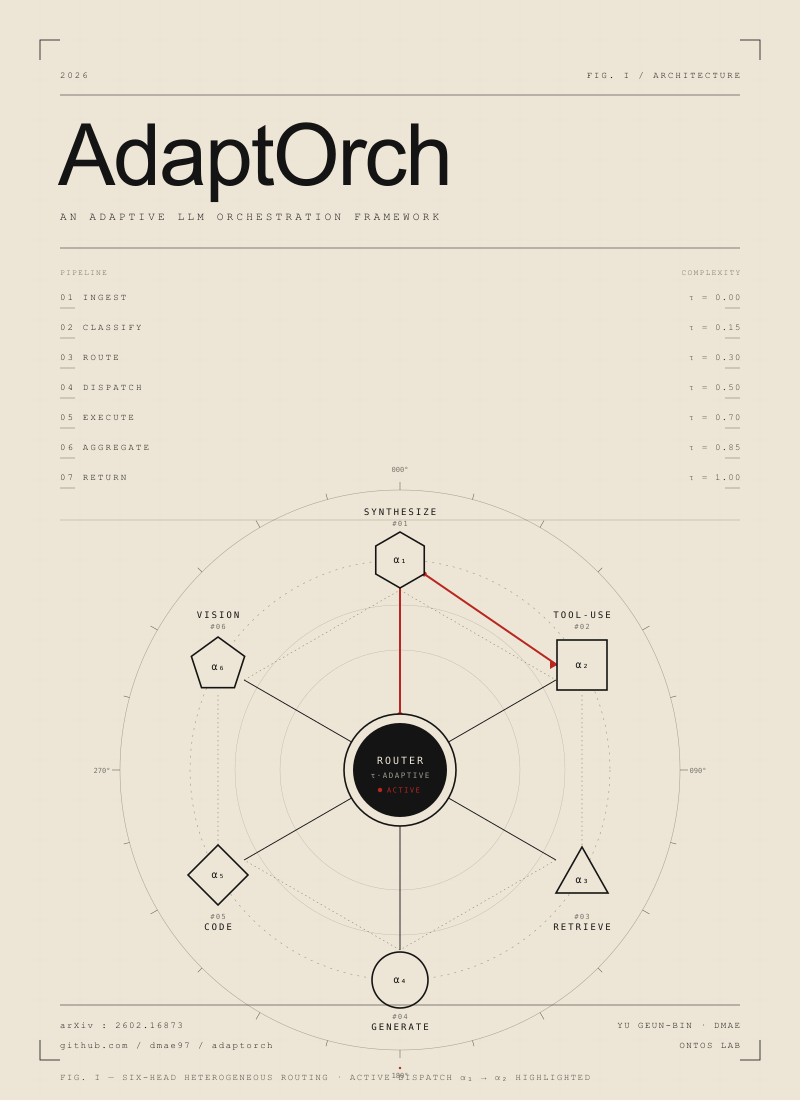
adaptorch.com · adaptorchctl 한국어 가이드 · Configuration · Tools · Claude Code guide · GitHub Action · GitHub Marketplace · [Remote service boundary](docs/remote-service-distribution.md) · Publishing · Paper






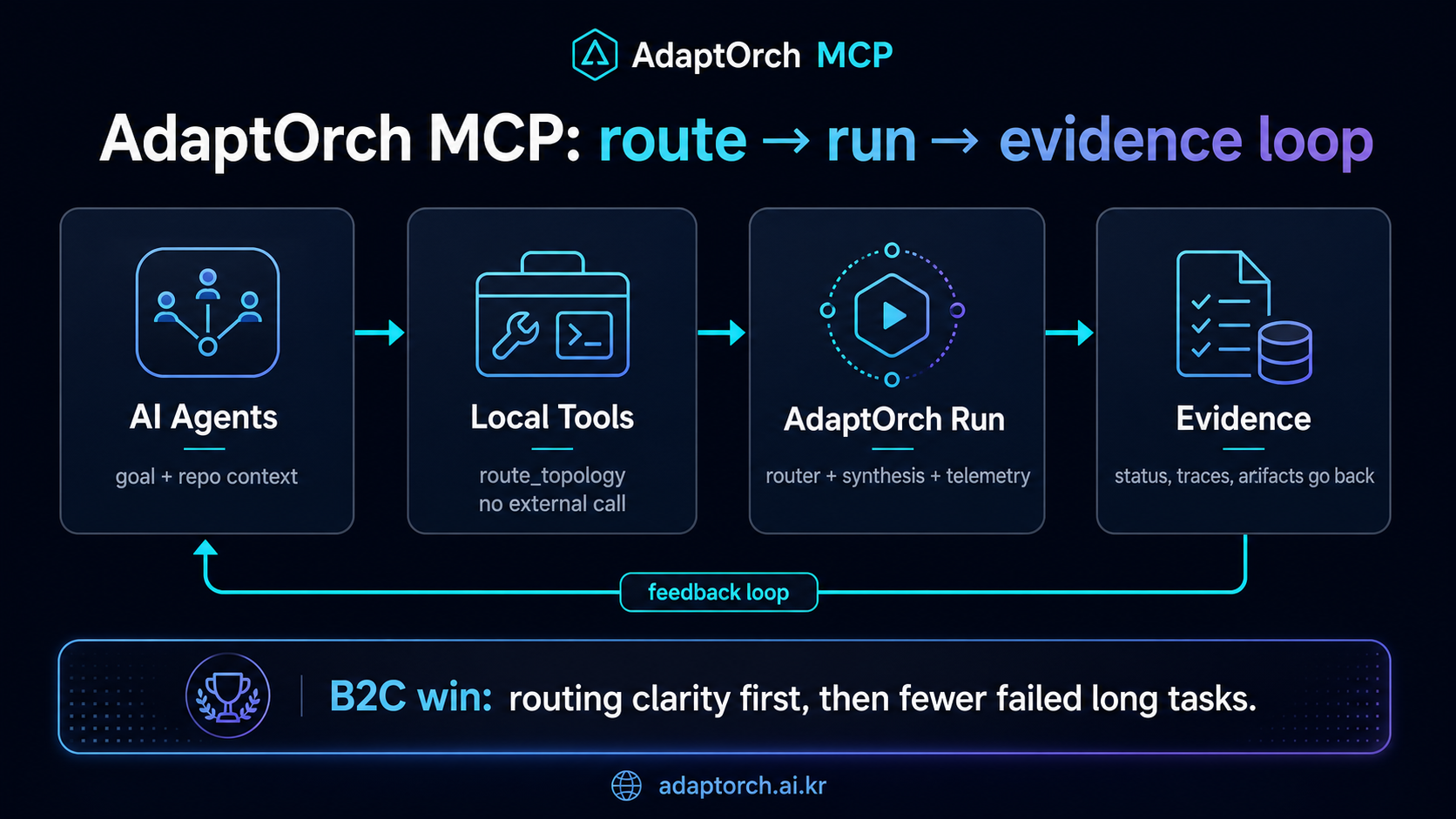
AdaptOrch MCP is the remote-only MCP adapter for AdaptOrch. From Claude Code or another MCP client it submits work to the hosted control plane and returns available run status, bounded observations and artifact references. The private engine owns routing and execution on the server; it is not installed by this package. Trace access requires the explicit full profile; this adapter does not expose the research-only inference-tape replay API.
Use it when your coding agent says a patch works and you want the receipt before you merge, or when a task is too large, too ambiguous, or too expensive to trust to one single-pass response.
Claude Code → AdaptOrch MCP → route topology → run with synthesis → retrieve artifacts
Get your API key
AdaptOrch requires authentication. Get your token in two steps:
- Sign up → adaptorch.com/app/signup
- Create an API key → adaptorch.com/app/api-keys → generate a key (starts with
ado_)
Use that key as ADAPTORCH_CONTROL_PLANE_TOKEN:
export ADAPTORCH_CONTROL_PLANE_TOKEN="ado_..."
export ADAPTORCH_API_KEY="$ADAPTORCH_CONTROL_PLANE_TOKEN"
Model-backed hosted runs require BYOK. Keep provider credentials in your local environment:
export ADAPTORCH_MCP_PROVIDER="openai"
export ADAPTORCH_MCP_PROVIDER_MODEL="gpt-4.1-mini"
export ADAPTORCH_MCP_PROVIDER_API_KEY="<provider-api-key>"
These values are not MCP tool arguments or JSON body fields. The local wrapper attaches them only to run submission headers and redacts the provider key from errors. Direct HTTP clients may attach configured headers to other requests as well; check your client's secret-handling settings.
OAuth BYOK (current source): openai_codex accepts a caller-owned OAuth access
token in the same key slot, with ADAPTORCH_MCP_PROVIDER_AUTH_TYPE=oauth and
ADAPTORCH_MCP_PROVIDER_ACCOUNT_ID=<your-account-id>. A long-lived local MCP can
use ADAPTORCH_MCP_PROVIDER_API_KEY_COMMAND=<trusted-token-helper> instead of a
static key. The helper is caller-provided and must print only the fresh access
token; login/refresh stays on the client. Never send refresh tokens, cookies or
an entire auth file. Both the control plane and local engine must support this
source contract. RQ dispatch still refuses request-scoped credentials.
Signup → MCP → dashboard run list
- Sign up at
/app/signupand open/app/api-keys. - Generate an
ado_*key and copy the raw value once. - Set it only in your local MCP environment as
ADAPTORCH_CONTROL_PLANE_TOKEN. - Run
adaptorch_runoradaptorch_list_runsfrom Claude Code. - Refresh
/app/runsin the dashboard to see the same tenant's run list.
한국어 요약: 가입 → /app/api-keys에서 ado_* 생성 → MCP env에 설정 → Claude Code에서 실행/목록 확인 → 대시보드 /app/runs에서 같은 실행 목록 확인.
| Token | Purpose | Where to get it |
|---|---|---|
ADAPTORCH_CONTROL_PLANE_TOKEN | All AdaptOrch API calls (run, status, artifacts) | Dashboard after signup |
ADAPTORCH_MCP_HTTP_AUTH_TOKEN | Protect your local HTTP MCP endpoint | You define it (any secure string) |
Plan prices and monthly run quotas come from the hosted plan catalog, not the installed package. BYOK provider charges are separate from the AdaptOrch subscription; an AdaptOrch key is not a provider key.
Engine-delegated optional algorithm controls (latest)
AdaptOrch MCP forwards optional algorithm controls to the hosted adaptorch
engine. The public client does not implement these algorithms. Treat these as
benchmark/eval or operator controls, not quickstart defaults.
| Control | Scope | Verified behavior |
|---|---|---|
ADAPTORCH_REPRODUCIBLE | Benchmark/eval beta | Fixes benchmark clock/RNG sources and canonicalizes record timing/path fields. It does not cover live-provider outputs, parallel-suite record order, cassettes, traces, or report timing aggregates. |
manifest_canonical_sha256 | Benchmark manifest | Importable as adaptorch.benchmarking.manifest_canonical_sha256; hashes canonical nonvolatile manifest fields. |
ADAPTORCH_ROUTER_ACCURACY_GATE | Online router | point is the default; wilson uses a Wilson lower bound for learned-model adoption. Pair with operator knobs such as retrain_window, min_loo_accuracy, min_posterior, quality_floor, use_quality_weights, use_failure_evidence, exploration_rate, max_observations, cv, and kfold_k. |
pass_rate_credit / quality_signal | Online-router learning | compute_quality tries exact-answer token matching before fuzzy matching. pass_rate_credit is opt-in partial credit; do not claim it changes AdaptOrchEngine router feedback by default. |
ADAPTORCH_PAPER_SEMANTIC_WEIGHT | Synthesis | Default is 0.35. Nonzero semantic weight, plus CJK/Hangul inputs, use Python scoring rather than the native fast path. |
prefer_multi_model_ensemble_singleton | Routing threshold | Tri-state: unset auto-enables when at least two ensemble providers exist and synthesis mode is not direct, unless an explicit debate-singleton preference wins; explicit false disables the auto preference. The MCP hint prefer_ensemble_singleton accepts true/false/null with the same semantics. |
synthesis_mode | Synthesis | Supported modes are paper, robust, robust_lite, and stable_hybrid. fourier_aggressive aliases stable_hybrid. Serving-only auto asks the control plane to choose; it is not an additional engine algorithm. |
output_extractor | Ensemble extraction | Engine extractors are final_answer and multiple_choice_letter. The MCP value none means "no extractor" and is not forwarded. |
verification_status | Evidence report | GET /v1/runs/{run_id}/evidence adds execution_status, verification_status (NOT_RUN, PASSED, FAILED, INCONCLUSIVE) and verification_source (vera_v2, verification_items, none). Only an all-PASSED set of verifier checks is PASSED; a lone run-level check reports execution, so its verdict stays NOT_RUN. adaptorch-client 0.1.5 types all three; older servers leave them None. |
is_training_eligible | Online-router learning | Only verification and gold_label outcome sources train the naive-Bayes router or update the LinUCB bandit; self-consistency and unrecorded sources are stored but never rewarded. Bandit state is saved as version 2, and a version 1 file replays only its eligible observations. |
ADAPTORCH_EVIDENCE_BASIS_ENABLED | Control-plane switch | Off by default. When a control plane enables it, GET /v2/runs/{run_id}/evidence adds a per-check basis. This wrapper's remote profile does not expose the engine's include_evidence_basis argument. |
Research paper
AdaptOrch MCP follows the AdaptOrch research line. Read the paper on arXiv:
- Abstract page: arxiv.org/abs/2602.16873
- HTML paper: arxiv.org/html/2602.16873v1

Figure preview is sourced from the arXiv HTML version.
Install
There are four ways in. Pick by what you are: a Claude Code user, an agent, a program, or a terminal.
Release status (2026-11-03):
adaptorch-mcp0.6.1,adaptorch-cli0.1.6 andadaptorch-client0.1.6 are published.adaptorch-mcp0.6.x is a remote client with no engine dependency. It forwards MCP calls toPOST /v1/mcp; adaptorch.com serves that path since 2026-11-03 (before that, every 0.6.0 call failed with "Remote MCP request failed").adaptorch-mcp0.3.0–0.5.2 depend on the engine distribution and do not install against the code-freeadaptorch0.2.0; use 0.6.0 or later.
Source update (2026-10-26, not a publication): the workspace engine pin moves to
a490658c, the revision the engine's runbook last recorded as served by the hosted
control plane. adaptorch-client and
adaptorch-cli 0.1.5 reuse keep-alive connections for reads (TLS 1.2 minimum, one
CA-store load per client), type the evidence verification verdict, and parse large
responses about twice as fast. The local MCP connector shares the same transport, its
HTTP listener is bounded, and adaptorchctl run wait now honours --timeout. See
network and transport notes.
Source update (2026-09-08, not a publication): this checkout adds request-scoped SDK BYOK, bounded read-only polling, subject-bound responses and typed algorithm observations. The local MCP facade uses a one-attempt, redirect-free transport and preserves requested/selected modes without exposing private diagnostics. See the client contract and verification record.
Claude Code plugin
The plugin adds the AdaptOrch MCP tools and a skill that tells Claude when and how to use
them. It needs uv on your PATH.
claude plugin marketplace add dmae97/Adaptorch-MCP
claude plugin install adaptorch@adaptorch
Configure the AdaptOrch service key using /plugin configure adaptorch@adaptorch. For
model-backed runs, also configure a provider, model ID and provider key in the dialog.
Sensitive fields are stored in Claude Code's credential store. The plugin runs the
published adaptorch-mcp 0.6.x remote client over stdio. Details are in
plugins/adaptorch.
Kimi Code, Grok Build and Grok Bot
This repository also ships a Kimi Code plugin and a Grok Build plugin with the same public MCP client and an AdaptOrch skill. The Cursor plugin is the starting point for Grok Bot marketplace review. Setup, authentication and the separate listing status are documented in agent platform integrations. These are AdaptOrch-maintained integrations; hosting a marketplace in this repository does not imply listing in or endorsement by an upstream marketplace.
1. Hosted MCP — nothing to install (recommended)
The control plane serves MCP over HTTP at https://adaptorch.com/mcp. Any client
that speaks HTTP MCP connects directly with your ado_* key:
: "${ADAPTORCH_API_KEY:?Set your AdaptOrch API key}"
: "${ADAPTORCH_MCP_PROVIDER:?Set your provider}"
: "${ADAPTORCH_MCP_PROVIDER_MODEL:?Set your model}"
: "${ADAPTORCH_MCP_PROVIDER_API_KEY:?Set your provider key}"
claude mcp add --transport http adaptorch https://adaptorch.com/mcp \
  --header "Authorization: Bearer ${ADAPTORCH_API_KEY}" \
  --header "X-Provider: ${ADAPTORCH_MCP_PROVIDER}" \
  --header "X-Provider-Model: ${ADAPTORCH_MCP_PROVIDER_MODEL}" \
  --header "X-Provider-Key: ${ADAPTORCH_MCP_PROVIDER_API_KEY}"
Set all four environment variables above before configuring model-backed runs.
The CLI uses ADAPTORCH_API_KEY, ADAPTORCH_PROVIDER,
ADAPTORCH_PROVIDER_MODEL, and ADAPTORCH_PROVIDER_API_KEY for these roles.
Shell expansion can persist header values in
client configuration; keep that file private and never commit it.
Tool discovery confirms connectivity, not model execution or a test pass. The hosted service provides supported run records and available artifacts; repository command checks require a separately configured execution environment. Shared hosted command verification is disabled by default.
Cursor, Codex, Gemini CLI, VS Code and Windsurf snippets: https://adaptorch.com/mcp-docs.
Clients that only speak stdio (Claude Desktop, older Cursor builds) reach the same
endpoint through mcp-remote; no AdaptOrch
install is involved:
{
  "mcpServers": {
    "adaptorch": {
      "command": "npx",
      "args": [
        "-y", "mcp-remote", "https://adaptorch.com/mcp",
        "--transport", "http-only",
        "--header", "Authorization:${AUTH_HEADER}"
      ],
      "env": { "AUTH_HEADER": "Bearer ado_..." }
    }
  }
}
(Authorization:${...} without spaces and the value in env is the documented
workaround for clients that mangle spaces in args.)
2. Python SDK — hosted API, standard library only
pip install adaptorch-client
adaptorch-client has no runtime dependencies and supports capabilities, identity,
run submission/list/detail/cancellation, evidence, and artifact listings. The current
source adds per-submission ProviderCredential for hosted BYOK. A repository push
is separate from a PyPI release; see the source install and BYOK example.
3. This package — remote MCP client
adaptorch-mcp 0.6.0 is a remote client over the hosted endpoint above; it depends
only on adaptorch-client and never installs or imports the private engine.
uvx --python 3.12 --from adaptorch-mcp==0.6.1 adaptorch-mcp-client --help
Why Claude Code users feel it quickly
| First-run win | Tool | What changes in the chat |
|---|---|---|
| Less proof ambiguity | adaptorch_get_run | Claude can inspect a bounded Correctness Wall view without exposing selector internals or treating PASS as a proof. |
| Multi-step execution | adaptorch_run | Delegate the task to the engine's routing and synthesis path, then inspect its reported outcome. |
| Artifact discovery | adaptorch_get_artifacts | Retrieve available artifact references without treating them as a correctness proof. |
| Safer setup support | adaptorch-mcp-doctor | Users can paste redacted diagnostics without leaking tokens. |
| Fast install loop | adaptorch-mcp-smoke | Local MCP wiring is verified with initialize + tools/list. |
Measured: a directional paired result, with failed gates
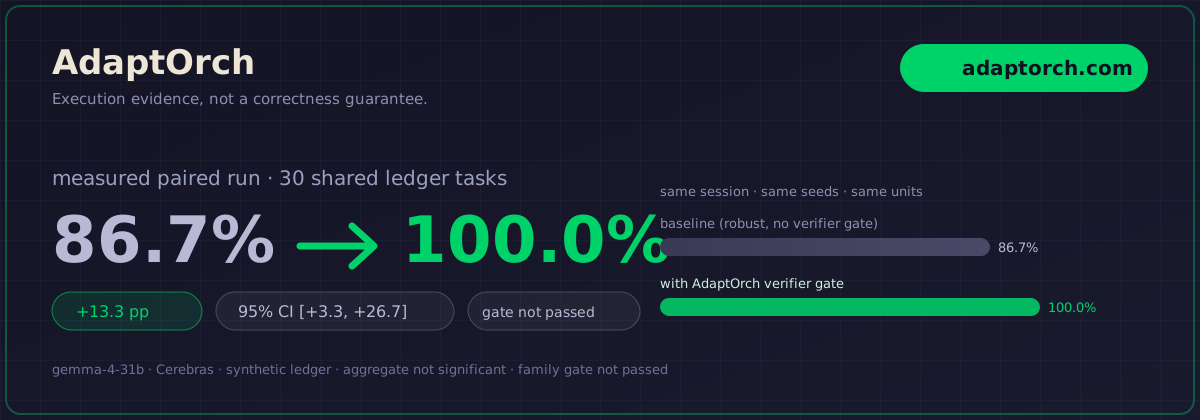
Both arms see the same 30 units, same seeds, same session (gemma-4-31b on Cerebras), so the paired delta cancels run-to-run drift:
| Arm | Accuracy |
|---|---|
| Baseline (robust, no verifier gate) | 86.7% |
| With AdaptOrch verifier gate | 100.0% |
Paired delta +13.3pp, 95% CI [+3.3, +26.7] on this ledger family.
The aggregate verdict and predefined family gate did not pass. The public
evidence JSON records
significant=false, aggregate_significant=false, gate_passed=false, and
official_claim_allowed=false. Treat this as directional, not proven.
Scope: internal reproducible regression evidence on a synthetic ledger suite (evidence experiment
paired_confirmatory_ledger, full run IDs and reproduce commands shipped with the core repository). Not an official third-party benchmark.
Run your own workload through the hosted kernel at adaptorch.com — the $0 Starter plan includes an API key and 50 admitted runs/month. BYOK provider usage is billed separately; confirm current limits in the plan catalog.
Scenario benchmark projection
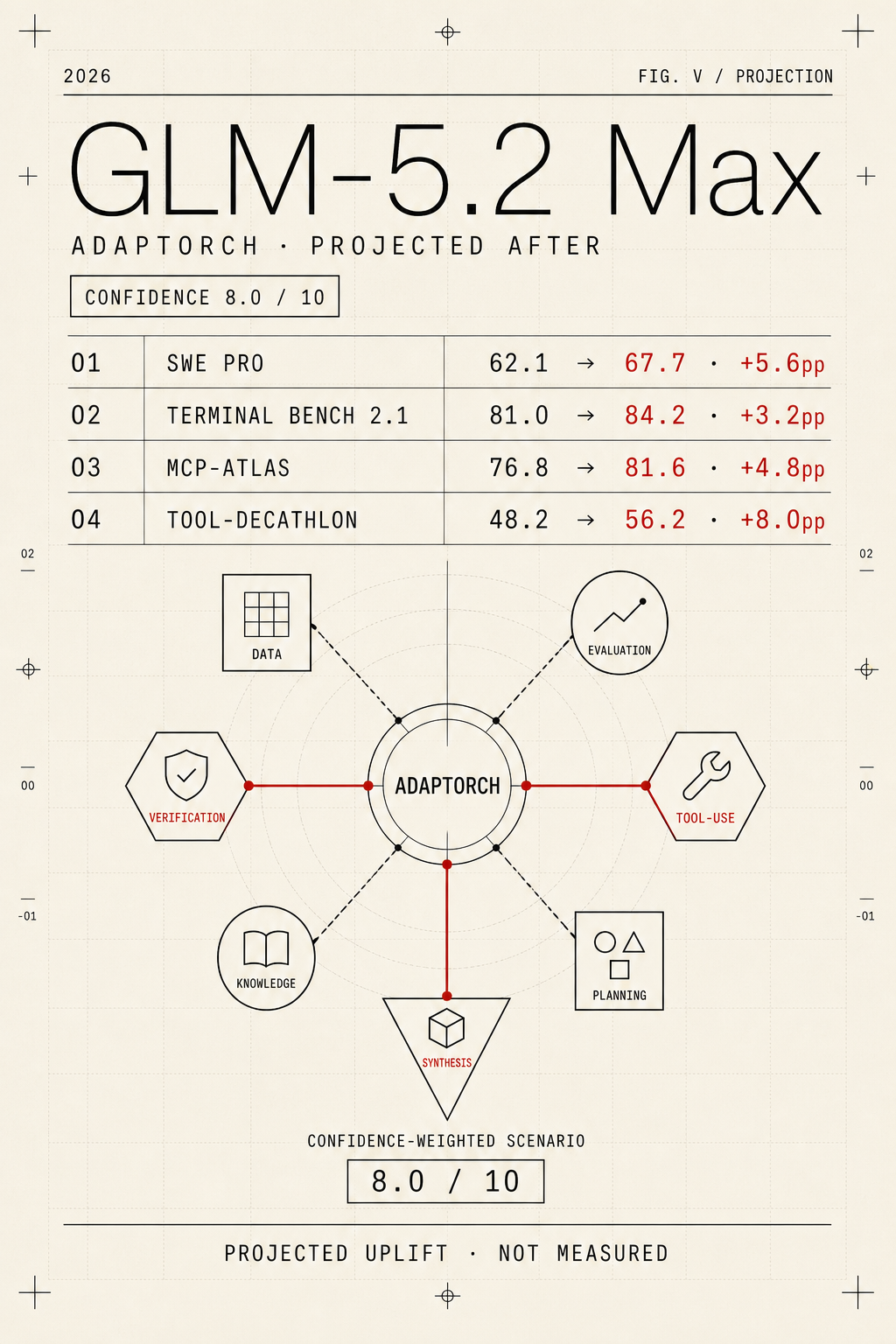
Confidence-weighted scenario projection (8.0/10). Projected uplift, not measured benchmark results.
Architecture
Packages
| Path | Package | Purpose |
|---|---|---|
packages/adaptorch-mcp | adaptorch-mcp | Python CLI wrapper around adaptorch.mcp_server |
The wrapper intentionally delegates runtime behavior to adaptorch.mcp_server. That keeps MCP tools, resources, prompts, safety checks, and transports aligned with the latest AdaptOrch core release.
Quickstart
Local development
git clone git@github.com:dmae97/Adaptorch-MCP.git
git clone git@github.com:dmae97/adaptorch.git  # alongside Adaptorch-MCP
cd Adaptorch-MCP
uv sync --all-packages --extra dev
uv run adaptorch-mcp --help
uv.lock pins the engine to the published adaptorch git revision. To validate the
wrapper against a local engine checkout (algorithm-parity and MCP BYOK runs), install it over the pin:
make engine-local ENGINE_PATH=../adaptorch
make check
packages/adaptorch-mcp/tests/test_engine_algorithm_parity.py fails closed when the exposed
synthesis modes, deprecated aliases, topologies, or output extractors drift from the engine.
stdio MCP
Use stdio for local clients such as Claude Code or desktop MCP hosts.
export ADAPTORCH_CONTROL_PLANE_TOKEN="<your-token>"
adaptorch-mcp --transport stdio --base-url https://adaptorch.com
Without the token, stdio still starts so registries can inspect it: initialize,
ping and tools/list come from a pinned catalog shipped in the package, and every
tool call fails with -32001 before any network request. Listing tools proves only
that the server starts; it does not run anything. The root Dockerfile builds this
stdio server from a pinned commit; Glama uses the build spec in docs/glama.md.
stdio over SSH
To run the wrapper on another machine, let SSH carry stdio. Keep the tokens in that host's environment, not on the command line, and make sure the remote shell prints nothing of its own:
claude mcp add adaptorch -- ssh -T build-host /opt/adaptorch/bin/adaptorch-mcp \
  --transport stdio --base-url https://adaptorch.com
-Tdisables the pseudo-terminal, so no CR/LF translation or echo reaches the JSON-RPC stream. A login banner or anechoin a remote rc file corrupts it.- SSH does not forward
ADAPTORCH_CONTROL_PLANE_TOKENby default. Set it on the remote host, or allow it explicitly withSendEnv/AcceptEnv. - Check the path before configuring a client:
adaptorch-mcp-smoke --command "ssh -T build-host /opt/adaptorch/bin/adaptorch-mcp". The smoke reports non-JSON stdout as such and no longer stalls when the SSH session keeps stdout open after the answers arrive. - When the session drops, the server sees EOF on stdin and exits; a run it already
submitted keeps going on the control plane. Read it again with
resume_run_idoradaptorchctl run wait, never by submitting again.
HTTP MCP
Use HTTP for local gateways, reverse proxies, or remote MCP clients.
export ADAPTORCH_CONTROL_PLANE_TOKEN="<upstream-adaptorch-token>"
export ADAPTORCH_MCP_HTTP_AUTH_TOKEN="<client-facing-mcp-token>"

adaptorch-mcp \
  --transport http \
  --base-url https://adaptorch.com \
  --http-host 127.0.0.1 \
  --http-port 8765
Authenticated health check:
python - <<'PY'
import os
from urllib.request import Request, urlopen

request = Request(
    "http://127.0.0.1:8765/mcp/health",
    headers={"Authorization": f"Bearer {os.environ['ADAPTORCH_MCP_HTTP_AUTH_TOKEN']}"},
)
with urlopen(request) as response:
    print(response.read().decode("utf-8"))
PY
The listener binds loopback only and caps concurrent connections at
ADAPTORCH_MCP_MAX_SSE_SUBSCRIBERS (engine default 64) plus 64 for ordinary
requests; beyond that it answers 503 instead of queueing unbounded work. Shutdown
waits at most 10 seconds for open streams, and responses carry no server header.
Network and transport notes
| Path | Transport | Behaviour |
|---|---|---|
SDK / adaptorchctl → control plane | HTTPS (TCP) | GET/HEAD reuse an idle keep-alive connection for up to 4 s while its socket shows no EOF. POST/PUT always open a fresh connection and are sent once. A read whose reused connection the peer had already closed is written once more on a new connection; a timeout is never re-sent. |
| Local MCP connector → control plane | HTTPS (TCP) | The same keep-alive handlers, so the engine's run polling no longer pays a TCP and TLS handshake per status read. |
| MCP client ↔ local wrapper | stdio, or stdio over SSH | Newline JSON-RPC; see stdio over SSH. |
| MCP client ↔ local wrapper | HTTP on loopback (TCP) | Bearer token, bounded concurrency, 10 s graceful shutdown. |
TLS uses the system trust store with certificate and hostname verification and
refuses anything older than TLS 1.2. Ambient HTTP(S)_PROXY variables and redirects
are still ignored; SSL_CERT_FILE still selects a private CA bundle. On Linux the
client acknowledges response segments immediately, so a server that leaves Nagle on
cannot stall a reused connection on the 40 ms delayed-ACK timer.
Measured on loopback HTTPS (100 sequential reads, this source revision): 4.1-5.6 ms per read with a new connection per request, 0.4-0.6 ms with keep-alive. Across a real network the saving per read is the TCP and TLS handshake round trips. Parsing a 3 MB, 5,000-run list page dropped from 268 ms to 129 ms. These are local micro-benchmarks, not end-to-end claims.
There is no UDP transport: MCP defines stdio and Streamable HTTP, and every AdaptOrch API is HTTP over TCP. HTTP/3 (QUIC) is not available in the standard library this client is limited to.
CLI and environment reference
| Command | Purpose | Important options |
|---|---|---|
adaptorch-mcp | Start the stdio or HTTP MCP server. | --transport {stdio,http}, --base-url, --api-token, --timeout-seconds, --stdio-framing, --http-host, --http-port, --http-auth-token |
adaptorch-mcp-doctor | Print redacted local diagnostics. | --json, --strict |
adaptorch-mcp-smoke | Verify stdio initialize + tools/list. | --command, --base-url, --api-token, --timeout-seconds, repeatable --expected-tool |
For adaptorch-mcp, the public wrapper resolves the control-plane URL in this
order: explicit --base-url, then trimmed/validated
ADAPTORCH_CONTROL_PLANE_BASE_URL, then the hosted fallback
https://adaptorch.com. adaptorch-mcp-smoke uses the same order and fallback
(before 0.6.1 it fell back to http://127.0.0.1:8000). Pass --base-url
explicitly in checked-in MCP client configs for reproducible behavior.
| Variable | Purpose | Notes |
|---|---|---|
ADAPTORCH_CONTROL_PLANE_TOKEN | Upstream AdaptOrch token. | Required unless --api-token is passed. |
ADAPTORCH_CONTROL_PLANE_BASE_URL | Base URL used when --base-url is omitted. | Trimmed and validated as HTTP(S); do not embed credentials. |
ADAPTORCH_MCP_PROVIDER | BYOK provider name, or auto. | Set with ADAPTORCH_MCP_PROVIDER_MODEL; forwarded only on run submission. auto uses the one provider whose own key variable is set (OPENAI_API_KEY, ANTHROPIC_API_KEY, GROQ_API_KEY, OPENROUTER_API_KEY, GOOGLE_API_KEY, XAI_API_KEY, OPENCODE_GO_API_KEY, OPENAI_CODEX_API_KEY, WORKBUDDY_API_KEY, DEEPSEEK_API_KEY, COMMANDCODE_API_KEY) and fails closed otherwise. |
ADAPTORCH_MCP_PROVIDER_MODEL | BYOK provider model. | Set with ADAPTORCH_MCP_PROVIDER; forwarded only on run submission. |
ADAPTORCH_MCP_PROVIDER_API_KEY | BYOK provider secret or OAuth access token. | Process-local, omitted from tool schemas/bodies and non-run requests; optional only for keyless providers. |
ADAPTORCH_MCP_PROVIDER_API_KEY_COMMAND | Caller-owned rotating token helper. | Mutually exclusive with the static key; invoked once per submission, never for polling or error redaction. |
ADAPTORCH_MCP_PROVIDER_AUTH_TYPE | api_key or oauth. | OAuth currently supports explicit openai_codex; not a browser login or refresh-token service. |
ADAPTORCH_MCP_PROVIDER_ACCOUNT_ID | Request-scoped OAuth account ID. | Validated, hidden from repr/errors, forwarded only on submission; never borrows the server's account. |
ADAPTORCH_MCP_HTTP_AUTH_TOKEN | Client-facing bearer token for HTTP/SSE MCP. | Keep separate from the upstream control-plane token. |
ADAPTORCH_MCP_ALLOWED_ORIGINS | Comma-separated HTTP origin allowlist. | Use with browser or remote HTTP clients. |
ADAPTORCH_MCP_MAX_PAYLOAD_SIZE_BYTES | Maximum accepted HTTP request body size. | Keep bounded for public deployments. |
ADAPTORCH_MCP_REQUEST_TIMEOUT_SECONDS | HTTP request timeout budget. | Applies to HTTP server request handling. |
ADAPTORCH_MCP_MAX_SSE_SUBSCRIBERS | Maximum concurrent SSE subscribers. | Defaults are provided by adaptorch.mcp_server. |
ADAPTORCH_MCP_TIMEOUT_SECONDS | Control-plane client timeout for app-factory usage. | Useful when embedding the ASGI app. |
ADAPTORCH_REPRODUCIBLE | Benchmark/eval reproducibility beta. | Benchmark/eval scope only; not general runtime determinism. |
ADAPTORCH_ROUTER_ACCURACY_GATE | Online-router learned-model gate. | point default or wilson; advanced/operator use. |
ADAPTORCH_PAPER_SEMANTIC_WEIGHT | Paper-mode lexical/semantic blend. | Default 0.35; nonzero values use Python scoring over the native fast path. |
Claude Code MCP config
{
  "mcpServers": {
    "adaptorch": {
      "command": "adaptorch-mcp",
      "args": [
        "--transport",
        "stdio",
        "--base-url",
        "https://adaptorch.com"
      ],
      "env": {
        "ADAPTORCH_CONTROL_PLANE_TOKEN": "${ADAPTORCH_CONTROL_PLANE_TOKEN}"
      }
    }
  }
}
More templates:
examples/claude_desktop_config.jsonexamples/omk.mcp.jsonexamples/mcp-http.env.example
Checked-in examples use placeholders or environment interpolation. Fill real URLs and tokens only in local, uncommitted config files.
Diagnostics
Runs may include verification_diagnostics with version marker
verification_diagnostics_schema_version: "verification.diagnostics/v1".
These bounded observations do not change the result. project_report is an
untrusted project claim; process_spawn is a verifier launch observation.
Only closed codes, scope and the four PDF tool names are exposed; logs remain private.
Malformed optional metadata is omitted without losing the run. See tools.
Print redacted local diagnostics:
adaptorch-mcp-doctor
adaptorch-mcp-doctor --json
adaptorch-mcp-doctor --strict
Run a stdio smoke test. The token is passed through the child environment, not process arguments. If no base URL is supplied, smoke targets https://adaptorch.com; pass --base-url http://127.0.0.1:8000 for a local control plane. The default timeout is 30 seconds.
export ADAPTORCH_CONTROL_PLANE_TOKEN="<your-token>"
adaptorch-mcp-smoke --base-url https://adaptorch.com
Expected JSON includes "ok": true, adaptorch_plan_catalog, and the expected
core tool subset. Doctor JSON also includes redacted controlPlane metadata for
the resolved base-url source. Add repeatable --expected-tool <name> flags when
validating a specific hosted/core release.
Tool surface
| Tool | Purpose |
|---|---|
adaptorch_run | Submit an AdaptOrch task payload and optionally wait. |
adaptorch_get_run | Read a run summary and its optional bounded Correctness Wall view by run_id. |
adaptorch_get_artifacts | Read artifact metadata for a run. |
adaptorch_list_runs | List recent runs. |
adaptorch_get_traces | Read execution traces (full profile only). |
adaptorch_cancel_run | Request run cancellation (write/destructive; keep manually approved). |
adaptorch_route_topology | Locally route a DAG through AdaptOrch's topology router (full profile only). |
adaptorch_server_metrics | Read redacted MCP server metrics. |
adaptorch_capabilities | Read synthesis modes, topologies, extractors, verifier/VERA vocabularies, connectors, and server features. |
adaptorch_usage | Read the calling tenant's usage window (plan level, period, used, limit, remaining, percentage). |
adaptorch_plan_catalog | Read hosted plan catalog: Starter $0, Pro $39, Team $149. |
The default remote profile exposes the nine tools other than adaptorch_get_traces and adaptorch_route_topology. The engine's read-only adaptorch_navigate_evidence (fixed evidence-pack navigation, algorithm_version defaulting to graph_v5) is likewise full-profile only. adaptorch_get_run publishes a closed outputSchema and safe structuredContent; its optional correctness_wall is advisory observability, not a correctness proof, selector decision, or apply authorization.
For trusted local clients, auto-approve only tools whose outputs are safe for
that client. Keep adaptorch_run and adaptorch_cancel_run manually approved.
For shared or production clients, avoid auto-approving run, artifact, and trace
readers unless those payloads are already sanitized.
GitHub Action
Run a task from a trusted workflow with the GitHub Action. The Marketplace preview uses a separate repository containing only the remote Action and public API client; no private engine is installed on the runner. It reports execution and verification separately and can optionally save a JSON run report. API credentials belong in GitHub Secrets. Its tests use a loopback fixture and do not incur model charges; compatibility with a hosted deployment still needs a real run.
Branding assets
- GitHub hero:
assets/readme-hero.png - GitHub flow diagram:
assets/mcp-flow.png - GPT-image-2.0 raster prompt brief:
docs/brand/gpt-image-2-brief.md
Public release checklist
The current local MCP wrapper is blocked by the public-wheel gate because it depends on the private engine. Build/test success and a publish dry-run are not permission to publish that wheel. The engine-free SDK/CLI have separate wheel gates.
For local validation only:
uv run ruff check packages/adaptorch-mcp
uv run mypy packages/adaptorch-mcp/src
uv run pytest packages/adaptorch-mcp/tests -q
uv run python -m build packages/adaptorch-mcp --outdir dist
Publishing requires an independently passing public-wheel gate and explicit release
approval. Only then follow docs/publishing.md for the applicable public package.
Security
Never commit .env, API keys, bearer tokens, private keys, or MCP client tokens. See SECURITY.md.
License
Proprietary — Copyright ClassicMate. All rights reserved. See LICENSE.