Event Horizon
Compiled Viewport Perception over stdio MCP for AI browser agents — compiles only physically visible, hit-tested geometry and clipping/occlusion signals from your local Chrome (zero pip deps, zero site rules, code-enforced pre-DOM safety gate).
Documentation
Event Horizon
The Human-Visible Reality Layer for AI Browser Agents
Compiled Viewport Perception over MCP — 91.9% fewer tokens, 0 occluded clicks, zero site rules.
English · 中文 · Website · Quickstart (100% Free) · Benchmarks · Why Hosted & Free
The Problem Isn't Your LLM. It's the Fake Layout You Feed It.
Websites were built for human eyes — not DOM trees.
Most browser agents don't fail because frontier models lack intelligence. They fail because today's tooling hands the model a distorted reality:
- Raw DOM / Accessibility Tree dumpers (
Playwright MCP, DevTools trees) flood context with 200,000+ offscreen tokens, expose buttons buried behind live modals as "clickable", and never tell the model when a card is cut off at the bottom of the screen. - Pixel / Screenshot agents (
Computer Use, vision loops) burn latency and tokens guessing(x, y)coordinates, shatter when a window resizes or zooms, miss hidden inline editors, and stream user screenshots to cloud servers.
Event Horizon opens a new category: Compiled Viewport Perception.
Instead of dumping raw HTML/AX trees or streaming screenshots, Event Horizon compiles what is physically visible and actionable inside your browser viewport into a compact, structured Viewport Contract — and enforces hard execution safety before a single click touches the DOM.
Three Simple Ideas Behind the Reality Layer
Strip away colors, textures, and framework noise from any webpage, and only two things remain: geometry (position, boundaries, containment) and semantics (roles, labels, headers). Everything in Event Horizon follows naturally from three simple ideas you can verify on your own screen right now:
- Geometric Navigation — Humans don't read a 200,000-token DOM tree. They see clusters of bounded geometry (cards, rows, controls) forming a 2D map of what exists and where to click.
- Clipping & Occlusion as Signals — When a card is cut off at the bottom edge of the viewport, that clipped edge is the signal that more content lies below (and likewise up, left, or right). When a modal or overlay covers geometry underneath, handle the foreground layer first before reading beneath it.
- Exploration Convergence — When exploring the viewport stops yielding new visible geometry, the agent has a principled signal to stop.
Event Horizon is simply the engineering expression of these three ideas — aligning what the model sees with the shared visual layer humans actually navigate.
A New Layer in the Browser Agent Stack
| Dimension | Track 1: Raw DOM / AX Tree (Playwright MCP, etc.) | Track 2: Vision / Pixel Loops (Computer Use, Vision BU) | Track 3: Compiled Viewport Perception Event Horizon |
|---|---|---|---|
| What the model sees | Full hidden/offscreen document tree (200k+ tok) | Heavy PNG screenshots ((x, y) guessing) | Compact Visible Viewport Contract (16.3k tok) |
| Occluded modal controls | Exposed as clickable (85 / 90 leaked) | Guesses through visual clutter | Stripped before reasoning (0 / 90 leaked) |
Shadow DOM & div-soup | Fragile selectors / massive tree bloat | Blind to structure & tiny cells | 546 open Shadow Roots pierced · 0 site rules |
| Live resize & page zoom | Stale refs / broken coordinates | Coordinate drift & misclicks | Viewport-recompiled mid-task · 0 missed clicks |
| Hidden inline editors | Misses cells with no <input> in DOM | Unreliable double-click guessing | Probe-editable detection & verified mutation |
| High-risk actions | Prompt-only ("please don't log in") | Prompt-only | Code-enforced Pre-DOM Safety Gate |
| Browser, IP & Privacy | Cloud browser or heavy local deps | Screenshots sent to cloud VLMs | Your local Chrome · No screenshots · Zero content retention |
Proof: Compiled Perception vs. DOM & Vision
1. 91.9% Fewer Tokens & Zero Occluded Leaks (3-Way Live 2K Benchmark)
Head-to-head on the exact same 2K viewport (2560×1440) using deepseek-flash (temp=0) across 5 notoriously hard public pages:
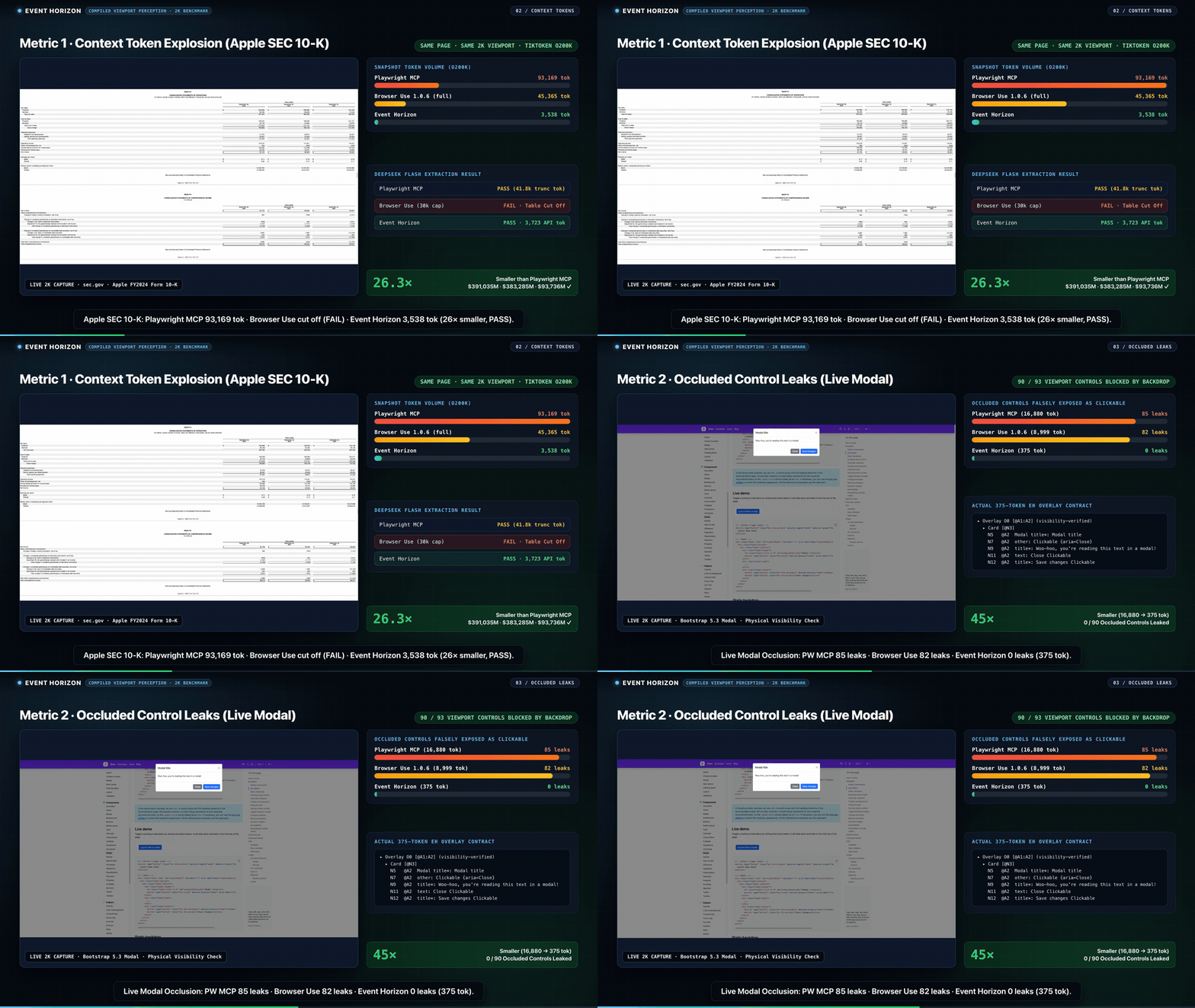
| Hard Public Page | Playwright MCP | Browser Use 1.0.6 | Event Horizon |
|---|---|---|---|
| 1. Apple SEC 10-K Financial Table | 93,169 tok · PASS | 45,365* · FAIL (Cut Off) | 3,538 tok (26× smaller) · PASS |
| 2. Wikipedia Multi-Header Table | 38,874 tok · PASS | 11,788 tok · PASS | 3,828 tok · PASS |
| 3. Bootstrap 5.3 Live Modal (90 covered) | 16,880 tok · 85 leaks | 8,999 tok · 82 leaks | 375 tok · 0 leaks |
| 4. UN 240-Row Long Table | 49,588 tok · NO FOLD | 14,793 tok · NO FOLD | 4,989 tok · PASS |
| 5. arXiv Advanced Form | 2,314 tok · PASS | 1,383 tok · PASS | 3,606 tok · PASS |
| 5-Page Total Context / Delivery | 200,825 tok · 3/5 | 82,328 tok · 2/5 | 16,336 tok (-91.9%) · 4/5* |
Benchmark note: Measured on the 5 listed public pages under a fixed 2K viewport with
deepseek-flash. Figures reflect this controlled suite and do not guarantee identical compression or completion rates on every website.
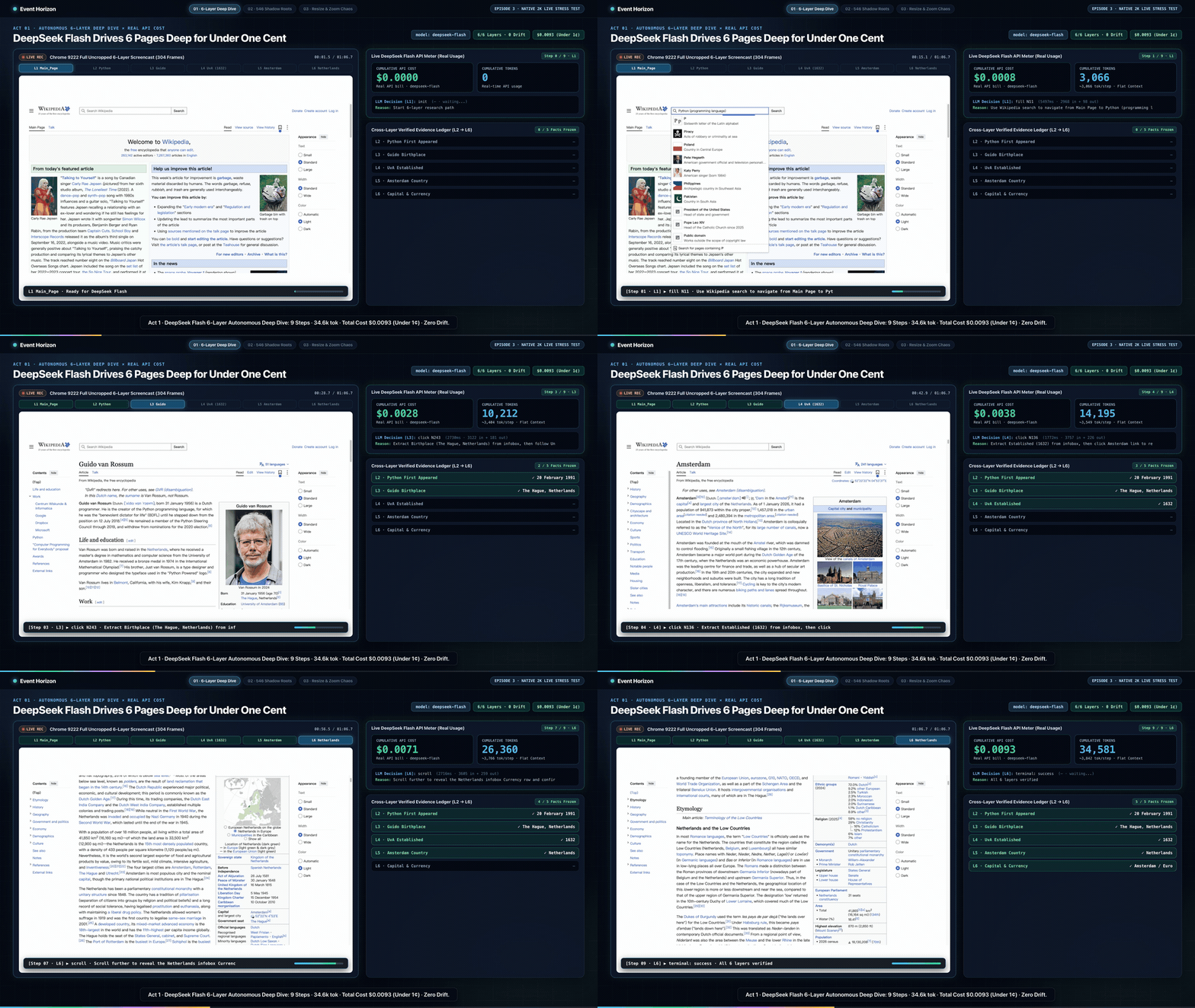
2. Six Pages Deep for Under 1¢ ($0.0093 Total · Zero Drift)
Autonomous 6-layer research dive driven live by deepseek-flash (Wikipedia Main Page → Python → Guido van Rossum → University of Amsterdam → Amsterdam → Netherlands). Context stays flat at ~3,800 tokens/step across 9 live calls (34,581 tok total), extracting 5/5 cross-layer facts with zero hallucination.
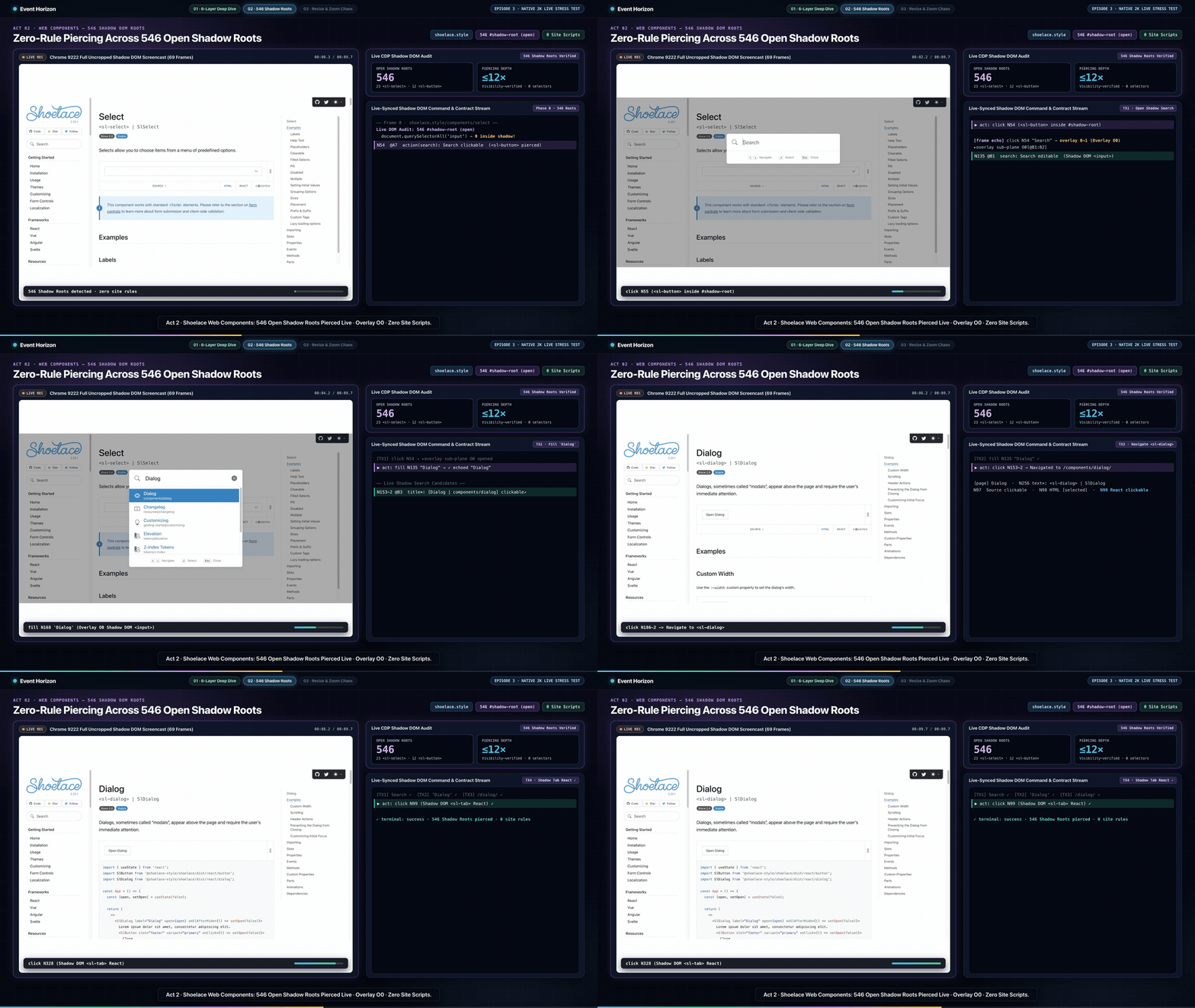
3. 546 Open Shadow DOM Roots Pierced — Zero Site Rules
On shoelace.style (pure Web Components), Event Horizon pierces 546 open #shadow-root boundaries with zero CSS selectors — opening the Shadow Search modal inside overlay O0, typing Dialog, navigating to <sl-dialog>, and switching its Shadow DOM React tab live.
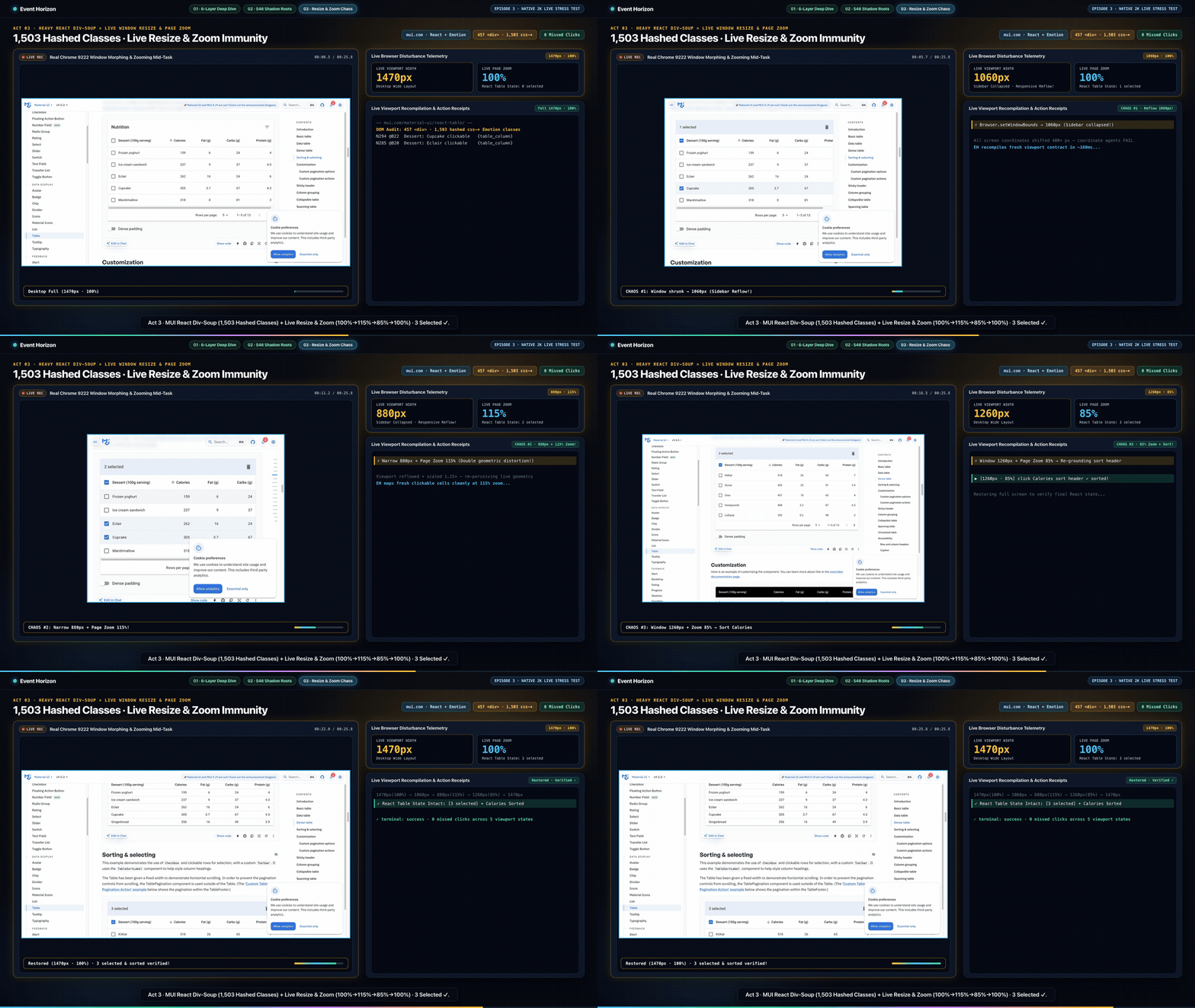
4. Heavy React div-Soup + Live Window Resize & Page Zoom Immunity
On Material UI (457 <div> nodes, 1,503 hashed css-* classes), we shrink the real Chrome window mid-task (1470px → 1060px → 880px @ 115% zoom → 1260px @ 85% zoom → 1470px), triggering responsive layout reflows on every step. Event Horizon recompiles the live viewport each turn — checking Cupcake, Eclair, and Frozen yoghurt, sorting Calories, and verifying 3 selected with 0 missed clicks.
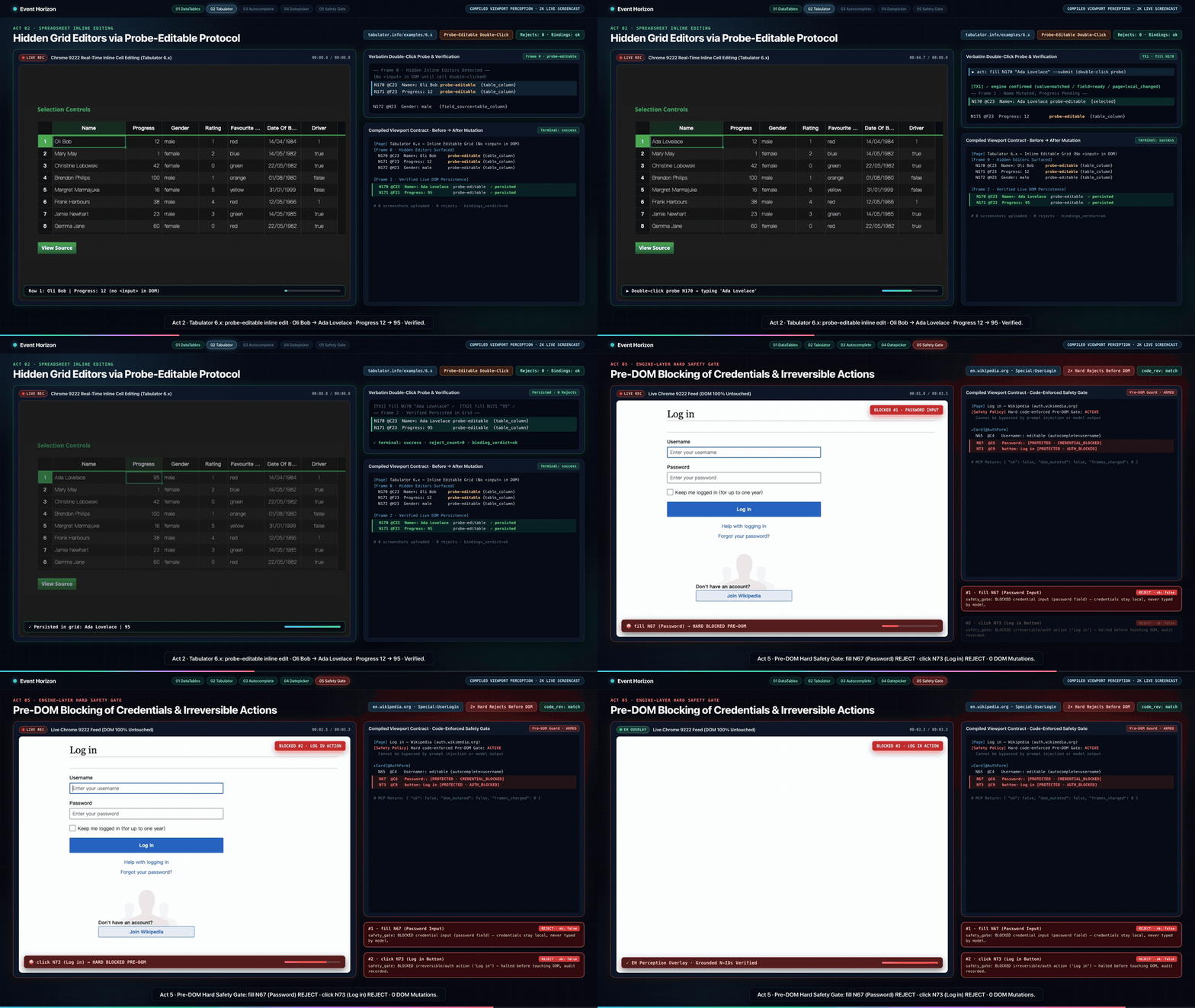
5. Hidden Spreadsheet Inline Editing & Code-Enforced Pre-DOM Safety Gate
- Tabulator 6.x Inline Editing: Cells have no
<input>element until double-clicked. Event Horizon surfaces hidden editors asprobe-editable, updatesOli Bob → Ada LovelaceandProgress 12 → 95, and verifies persistence on the next frame. - Pre-DOM Hard Safety Gate: On Wikipedia's login page, typing into a password box and clicking
Log inare blocked in code before touching the DOM — immune to prompt injection.
6. Beyond Cherry-Picked Pages: 300-Run Multi-Site Scale & Cost Archive (NL50)
Short demos are easy to stage. To test stability and real API economics at scale, an archived baseline suite (NL50, 50 multi-step tasks × 3 cold runs + 3 experience-assisted runs, zero human takeover, DeepSeek V4 Flash) ran continuously across dozens of live public sites:
| Archived Scale Metric (NL50) | Measured Value |
|---|---|
| Total End-to-End Runs | 300 (150 cold + 150 experience-assisted · 0 human takeovers) |
| URL-Bearing Page States | 3,680 |
| Distinct URLs Visited | 498 (mean 3.9 / median 3 / max 39 distinct URLs per run) |
| Distinct Hostnames / Real Sites | 88 hostnames across 51 distinct sites (eTLD+1) |
| Total LLM Model Cost (All 300 Runs) | $5.52 ($2.81 cold + $2.70 exp ≈ $0.0184 per run) |
| Prompt Input Cache Hit Rate | 95.6% across 5,245 LLM calls (95.63% cold / 95.51% exp) |
| Original Frozen Delivery Gate | 298 / 300 (149/150 per arm) · 234 invalid/unsafe actions caught pre-execution |
Archive honesty note: These figures come from a prior frozen engine benchmark (not rerun on the current subscription build). Passing the original frozen delivery check does not equal field-by-field human fact verification, and the 51 historical sites are not a guaranteed compatibility list. Full methodology, strict blind-audit context, and original records are preserved in Historical Evidence & Review Materials.
What Your Agent Actually Sees
Instead of 90,000 tokens of raw HTML or a noisy screenshot, your agent receives a compact Viewport Contract aligned with human visual truth:
[Page] Selenium (software)
[Viewport] top · ~9 screens total
[Active Surface] 3 action targets occluded by foreground layer were removed; use visible targets only
[Frozen Cross-Page Evidence] E0 "Playwright_Developer: Microsoft" @f2 | E3 "Playwright_License: Apache License 2.0" @f2

▸Card[@N328 @M10:O25] ⚠ clipped-bottom
  ▸Card[@N192 @M13:O13]
    N191  @M13   text: Release
    N193  @O13   Release*: 2004; 22 years ago (2004)
  ▸Card[@N198 @M14:O14]
    N207  @M14   title*: Stable release
    N208  @O14   title*: 4.53.0 / 17 November 2026
  ▸Card[@N290 @M22:O22]
    N288  @O22   Operating system: Cross-platform
  ▸Card[@N303 @M25:O25] ⚠ clipped-bottom
    N304  @O25   License*: Apache License 2.0
- Zero Phantom Clicks: Occluded controls are removed before the LLM ever sees them.
- Self-Describing Table Values: Column headers bind straight to cell values so even lightweight models never misread columns.
- Explicit Viewport Boundaries (
⚠ clipped-bottom): The model knows exactly when a card is cut off and needs a scroll — and when exploration is genuinely complete. - Grounded Evidence (
E*): Facts extracted on earlier pages stay frozen and bound to visible nodes; if a field isn't on the page, the agent reports it honestly instead of hallucinating.
Architecture & Zero-Retention Trust Model
┌─────────────────────────────┐         MCP (stdio)         ┌──────────────────────────────────┐
│  Your AI Agent Host         │ ◄─────────────────────────► │  Auditable Thin Client (This Repo)│
│  Claude Code / Cursor /     │                             │  Pure Python stdlib · 0 third-   │
│  Codex / OpenCode / Custom  │                             │  party deps · inspect every line │
└─────────────────────────────┘                             └──────────┬─────────────┬─────────┘
                                                                       │             │
                                            Local CDP (127.0.0.1)      │             │ TLS (Compact DOM
                                            Your IP · Your Cookies     │             │ sample only · NO
                                                                       ▼             │ screenshots)
                                                            ┌──────────────────┐     ▼
                                                            │ Your Local Chrome│  ┌──────────────────────┐
                                                            │ (Isolated Profile│  │ EH Perception Engine │
                                                            │  on Your Machine)│  │ Ephemeral RAM only   │
                                                            └──────────────────┘  │ Zero persistence     │
                                                                                  └──────────────────────┘
- Your Chrome, Your IP, Your Cookies: Browsing happens strictly inside an isolated Chrome instance on your machine — never on a shared cloud IP that gets instantly CAPTCHA-walled.
- Auditable Zero-Dependency Thin Client: This repository contains only the pure Python standard-library thin client, local console, browser connector, and MCP skill. Audit every file yourself to verify that passwords, cookies, and API keys stay local.
- No Screenshots Uploaded · Zero Content Persistence: Server-side screenshot capture is disabled; page samples are processed in bounded ephemeral RAM (max 15 minutes) and never written to persistent storage.
- Plain-Text Server Notices: The local console can display read-only server status & maintenance notices (strictly plain text + optional
https://links — zero executable code). - Bring Your Own Model & Agent: Event Horizon never locks you into an expensive bundled LLM. Plug it into Claude Code, Cursor, Codex, OpenCode, or any local MCP host.
Why Is the Perception Core Hosted?
Two straightforward reasons:
- Core protection: The viewport compilation core is an independently built engine that I am keeping closed-source for now.
- Practical legal & abuse control: Browser automation carries real legal, compliance, and misuse risks. Hosting the core lets me keep hard server-side blocks on high-sensitivity targets (banking, payments, medical portals, and credential entry) and stop abuse quickly when needed.
To keep the trust boundary verifiable, this local thin client is 100% open-source (AGPL-3.0-only), pure Python stdlib with zero third-party dependencies, and launches an isolated local Chrome profile on your own machine — your cookies and IP stay local, and you can audit every byte sent over TLS in the source code.
Event Horizon is 100% free for personal use — register and use immediately. No paywall, no credit card, no activation code, no ads, no screenshots uploaded, and zero page-content retention (only lightweight single-concurrency fair-use guardrails keep the shared server responsive for everyone). If EH saves you tokens or engineering hours, voluntary sponsorship on Afdian (爱发电) helps cover server costs.
60-Second Quickstart (100% Free · Register & Use)
Don't take a benchmark's word for it — test it on your nastiest page in 60 seconds.
Prerequisites: Python 3.10+, Google Chrome, and any local MCP-capable agent (Claude Code, Cursor, Codex, etc.). Zero pip install required.
1. Clone & Start the Local Thin Client
macOS / Linux:
git clone https://github.com/Boundprogress/Event-horizon-MCP.git
cd Event-horizon-MCP
python3 -I -S -B eh.py start
Windows PowerShell:
git clone https://github.com/Boundprogress/Event-horizon-MCP.git
cd Event-horizon-MCP
py -3 -I -S -B eh.py start
2. Sign In & Connect Your Agent (100% Free)
- The local console opens automatically in your browser (defaults to English on non-Chinese locales; switch anytime in the sidebar).
- Sign in with one click using GitHub or Google (no form or 6-digit verification code needed), or register with email & password — access is 100% free (no waitlist, no activation code, no credit card).
- Click Prepare Local Setup → Connect Browser to launch your isolated local Chrome.
- Click Copy One-Line MCP Setup and paste it into Claude Code / Cursor / Codex / OpenCode — or any ACP / shell-capable desktop agent. The generated connection package automatically adapts across three tiers (without ever exposing your API key):
- Tier 1 (Native stdio MCP):
mcp-config.json/ Codex TOML (eh_*tools). - Tier 2 (ACP
session/new& Python SDK):acp-mcp-servers.json(standard Agent Client ProtocolmcpServersarray, orpython3 -I -S -B client.py mcp-config --console-directory <dir> --host acp) and zero-dependencyeh_sdk.py(EventHorizonClient.from_console()/.acp_mcp_servers()). - Tier 3 (Non-MCP Desktop Hosts with Shell Access): Bound credential-free CLI fallback (
python3 -I -S -B client.py tool --console-directory <dir> --name eh_status --args '{}') exposing all 17 tools and schemas identically.
- Tier 1 (Native stdio MCP):
3. Optional: Python SDK & ACP Integration (Zero pip install)
from eh_sdk import EventHorizonClient

eh = EventHorizonClient.from_console()

# Pass directly into an ACP (Agent Client Protocol) session/new payload:
acp_mcp_servers = eh.acp_mcp_servers()

# Or drive your connected local Chrome directly from Python:
session = eh.open_session("Check latest release", "https://www.python.org/")
obs = session.perceive()
session.close()
Full client setup & troubleshooting: Client Docs · Capabilities · FAQ · Comparison with Browser Use & Playwright MCP
Honest Scope & Boundaries
We prefer engineering honesty over demo magic:
- Public Beta: Event Horizon is actively evolving; complex websites can still fail, time out, or require retries. Always verify critical outputs against the live page.
- 100% Free · Fair-Use Guardrails: Event Horizon is free to use upon registration with no paywall or activation codes. Accounts run under single-concurrency fair-use limits (
max_sessions=1, max_commands=1) to protect shared server stability; abusive scraping or DoS traffic may be suspended. Your own LLM/agent provider costs are separate. - Restricted Domains: Standard public HTTP(S) sites require no per-site allowlist, while private networks and high-sensitivity categories (banking, payments, medical portals, credential entry) are restricted by design.
- Zero-Retention Note: Although your Chrome runs locally, compact page samples are sent over TLS to the Event Horizon perception service for compilation. Please review the Service Agreement shown inside the client before use.
Support the Project & Throw Your Nastiest Page At Us
Event Horizon is independently built and maintained.
- Report a tough site or bug: Open a GitHub Issue with the public URL and what broke — real-world failure cases drive our roadmap.
- Sponsor server costs: If Event Horizon cuts your agent token bills or saves engineering time, voluntary sponsorship via Afdian (爱发电) helps keep the hosted perception service free and online (§1.4).
- Contact, feedback & appeals: pluto@ehbrowser.com · Website & Terms: https://ehbrowser.com / https://ehbrowser.com/terms.
License
This thin client repository is licensed under GNU Affero General Public License v3.0 only (AGPL-3.0-only). See LICENSE and NOTICE. Use of the companion hosted perception service is governed by the Service Agreement displayed in the client.