motionlint
atch bad animations before they ship. Deterministic motion audit + vision-LLM design review.
Documentation
MotionLint


Score any page's animation quality in one command. No API key, no config.
npx motionlint audit http://localhost:3000 --open
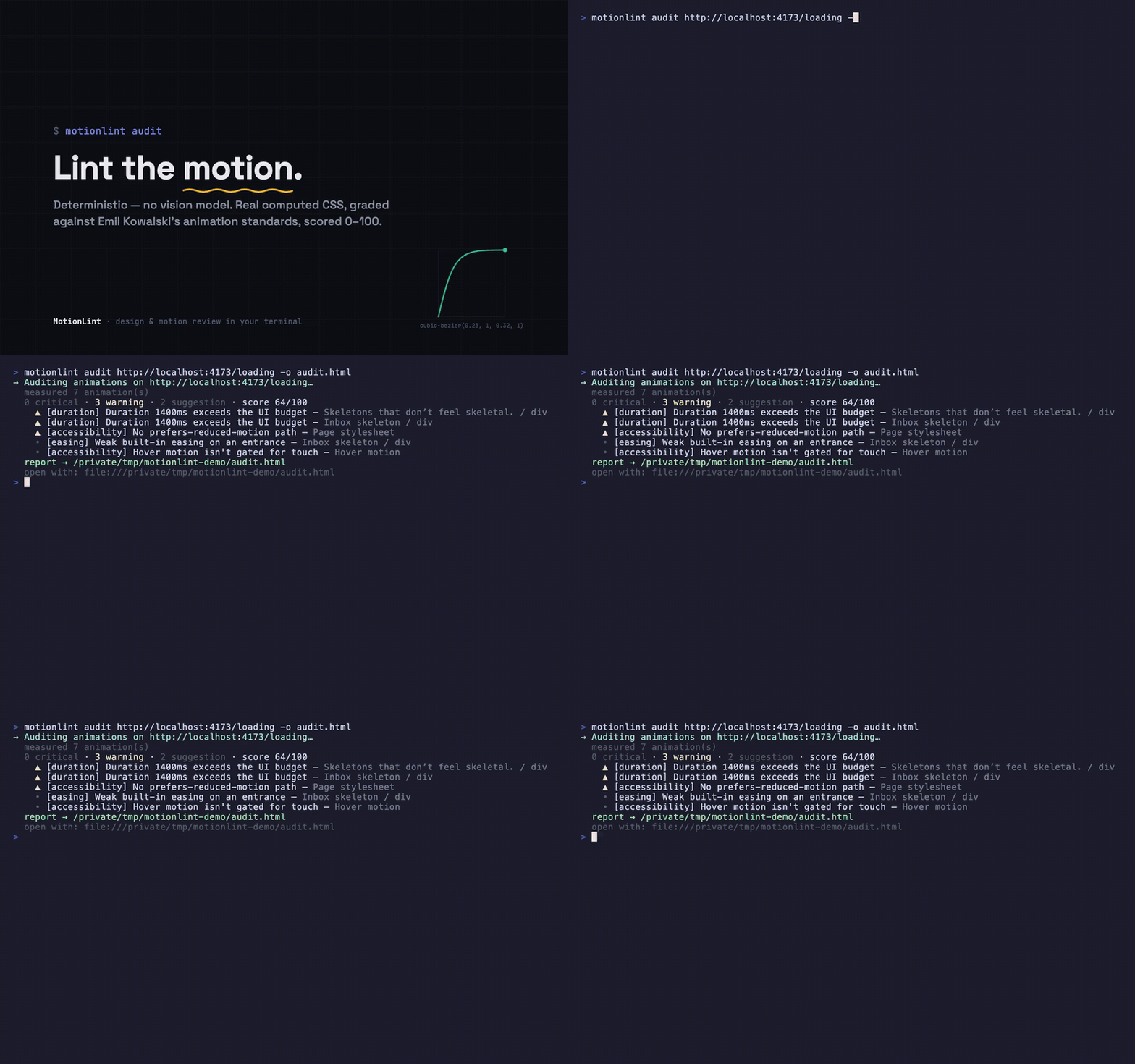
Deterministic — measured from the live page, no LLM involved. One-time prerequisite: npx playwright install chromium.
MotionLint measures the motion your app actually ships — durations, easing curves, stagger intervals, exit timing, reduced-motion support — and scores it against a published set of animation standards. Ease-in on a dropdown, a 600ms modal, a card that scales from 0, hover motion that fires on touch: all caught, all with the measured value and a concrete fix.
The audit is free and offline. Add an API key and MotionLint also does vision-LLM design review — multi-viewport screenshots and 50ms frame bursts of real user journeys, judged by a model and handed back to your coding agent as ranked findings. It runs as an MCP server inside Claude Code and Cursor.
Why this exists
AI coding agents read JSX, HTML, and CSS — they're blind to what the user actually sees, clicks, and watches animate. Rules in a prompt tell the agent what should happen; nothing checks what did. Modals that should slide in just pop; loading states get omitted; focus rings disappear. Code review can't catch any of this before merge, because none of it is visible in the diff.
MotionLint closes that loop: it measures the running app and feeds the verdict back.
How it's different
| MotionLint | Visual regression tools (Percy, Chromatic, Playwright snapshots) | AI design generators (v0, Galileo, Claude Design, Stitch) | |
|---|---|---|---|
| Deterministic motion audit | 13 checks, measured from the live page — no API key, $0 | ✗ | ✗ |
| Multi-viewport UX review | ranked findings across 12 dimensions | pixel diffs only | generates new layouts from prompts |
| Animation review | 50ms frame bursts via CDP screencast → contact sheet → LLM | ✗ | ✗ |
| Live animation tuning | Shadow-DOM previews + sliders + Claude Code export | ✗ | generates new motion, doesn't tune what's there |
| Native MCP server | ✓ stdio MCP for Claude Code / Cursor | ✗ | varies |
| CI gate | ✓ SARIF + exit codes for code scanning | ✓ image diff thresholds | ✗ |
| Validated quality | 100% recall on a 24-fixture stress test, across 5 frontier models | n/a | n/a |
The conceptual gap MotionLint closes: visual-regression tools catch what changed but not whether the new pixels are good; AI design tools generate from scratch but don't review what's already running. MotionLint reviews live behavior with a vision LLM and feeds the verdict back into the coding loop.
Start here — no API key needed
npx playwright install chromium          # one-time per machine (~300MB)
npx motionlint audit http://localhost:3000 --open
That's the whole setup for the audit. It's deterministic, runs offline, costs nothing, and works on any URL you can load — your dev server, a staging deploy, or someone else's site. Requires Node 18+.
The rules it checks are published in docs/STANDARDS.md — read them before you install anything.
Then: LLM design review
Set one API key (ANTHROPIC_API_KEY, OPENAI_API_KEY, or GOOGLE_API_KEY — or run Ollama locally for free) and three more commands unlock:
npm install -g motionlint

# Multi-viewport UX review of a page → ranked findings across 12 dimensions.
motionlint review http://localhost:3000

# Animation review of a scripted user journey → frame contact sheet + report.
motionlint flow --spec flows/signup.json

# Interactive HTML tuner — every animation on the page, with live sliders.
motionlint tune http://localhost:3000
Inside Claude Code / Cursor
claude mcp add motionlint -- npx -y motionlint mcp
Full flag surface — CI gates, route discovery, Storybook, dark mode, baselines
# CI mode — non-zero exit on critical issues, SARIF output for code scanning.
motionlint review https://staging.acme.dev --ci --threshold critical --format sarif -o ux.sarif

# Polished, shareable HTML review with embedded screenshots + before/after fixes.
motionlint review http://localhost:3000 --format html -o review.html

# Review every route the site knows about (sitemap.xml + Next.js app/ directory).
motionlint review http://localhost:3000 --discover-routes

# Storybook mode — discover stories from /index.json, review each story iframe as its own route.
motionlint review http://localhost:6006 --storybook

# Color-scheme sweep — light and dark modes, plus Windows High Contrast.
motionlint review http://localhost:3000 --schemes --forced-colors --format html -o review.html

# Interaction affordances — grid each element's default/hover/focus/active states.
motionlint review http://localhost:3000 --state-grid

# Agent focus — keep only the top 5 findings, and only ones not seen in prior runs.
motionlint review http://localhost:3000 --max-findings 5 --new-only

# Before/after comparison — PR preview vs. production baseline.
motionlint review https://pr-123.preview.example.com --against https://prod.example.com

# Reviewer focus — cap the SARIF upload at 10 annotations per report.
motionlint review https://staging.acme.dev --format sarif -o ux.sarif --max-pr-annotations 10

# Pick a provider explicitly (auto-detect picks the first reachable one).
motionlint review http://localhost:3000 --provider anthropic --model claude-sonnet-5

# Track provider quality across runs + teach the reviewer from eval misses.
motionlint eval --provider anthropic --evolve
Package on npm: motionlint.
Sample terminal output for a flow review:
$ motionlint flow --spec flows/signup.json --provider anthropic
→ Running flow "signup-happy-path" against http://localhost:3000/signup (11 steps, 50ms intervals × 750ms window)
  provider: anthropic (claude-sonnet-5)
  capturing flow…
  ✓ step 1: 16 frames    ✓ step 2: 16 frames    ✓ step 3: 16 frames    …
  captured 176 frames in 31s
  contact sheet → .motionlint/flows/signup-happy-path-…png
  analyzing flow…
  report → .motionlint/flows/signup-happy-path.md

Score: 4/10 · 3 critical findings
  [critical] interaction — input focus rings missing across steps 2/4/6
  [critical] interaction — submit button has no pressed state
  [critical] loading_state — 1.4s wait with no spinner during submit
Try the demo
A multi-route TS animation showcase ships in demo/ — covering Motion One, GSAP, anime.js, @formkit/auto-animate, and lottie-web — including a cat-themed one-pager that exercises every MotionLint capability in a single URL:
node demo/server.mjs                                # http://localhost:4173
motionlint review http://localhost:4173/cat --record --embed
motionlint flow --spec flows/signup.json
motionlint tune http://localhost:4173/dashboard
Routes available: /, /pricing, /signup, /dashboard, /loading, /cat. Reports go to .motionlint/reports/, screenshots to .motionlint/screenshots/, videos to .motionlint/videos/.
Setup
API keys
MotionLint auto-loads a .env file from the working directory at startup:
# .env (gitignored)
ANTHROPIC_API_KEY=sk-ant-...
# or
OPENAI_API_KEY=sk-...
# or
GOOGLE_API_KEY=...
# or run a local Ollama (no key needed) — auto-detected on http://localhost:11434
Real environment variables take precedence over .env. With no key set and no Ollama running, MotionLint falls back to a deterministic mock provider so the full pipeline (capture → analysis → report) still runs end-to-end for smoke tests.
Provider auto-detect
MotionLint auto-detects in this order: Ollama (local) → Anthropic → OpenAI → Google. The first one with a working API key (or running service) wins. Override with --provider <name> and --model <id>. See Providers in depth for the per-provider quality scorecard and how to pick.
Everything below is for readers who want to understand how MotionLint works under the hood, pick the right provider for their workflow, or wire it into CI.
Validated quality across providers
The flow-review pipeline was stress-tested across 12 popular web-app animation patterns × 2 variants (24 fixtures total) — staggered entrances, hover/press/focus, modal entrances, loading skeletons, form errors, toasts, counter ramps, multi-animation dashboards, modal-with-content stagger, rich form feedback (focus + press + spinner + success), and scroll-driven animations (progress bar + IntersectionObserver reveal + parallax).
Run on 2026-07-27 against the current flagship from each major provider:
| Provider · model | Recall (broken caught) | FPR (clean flagged) | Score gap | Wall time |
|---|---|---|---|---|
| OpenAI · gpt-5.6-sol | 100% (12/12) | 0% (0/12) | +3.3 | 10.9 min |
| OpenAI · gpt-5.5 | 100% (12/12) | 0% (0/12) | +3.3 | 11.5 min |
| Anthropic · claude-opus-5 | 100% (12/12) | 8% (1/12) | +4.1 | 21.0 min |
| Google · gemini-3.6-flash | 100% (12/12) | 17% (2/12) | +5.1 | 4.9 min |
| Anthropic · claude-sonnet-5 | 100% (12/12) | 33% (4/12) | +3.1 | 10.8 min |
Read this as: recall is no longer a differentiator. Every current flagship catches all 12 seeded faults. That is the finding — a year ago it wasn't true, and it means the model choice no longer decides whether MotionLint works. Pick on cost and latency.
Do not rank these models on the FPR column. A single 24-fixture run cannot resolve it. Across two clean runs of the identical suite, with nothing changed but sampling, FPR moved by 1–2 fixtures per model — gpt-5.5 1/12 → 0/12, gpt-5.6-sol 2/12 → 0/12, gemini-3.6-flash 3/12 → 2/12. One fixture is 8 percentage points, so the entire spread between "0%" and "17%" sits inside the noise floor. Treat the column as "all of these occasionally flag something clean", not as a ranking.
Why the older numbers in this table's history were wrong
The first 2026-07-27 run of this suite put claude-opus-5 at 83% recall — last among all five models — and the 2026-04-29 edition of this table reported several models at 0% FPR. Both were artifacts of a MotionLint bug, not model behaviour.
Anthropic's max_tokens defaulted to 4096. Verbose responses hit the ceiling mid-JSON, and the unparseable result was scored as 0/10, no issues found — indistinguishable from a clean review. Two of Opus 5's three truncations landed on broken fixtures, which produced the entire 83% figure.
The same bug deflated FPR everywhere: a truncated review reports nothing, so it cannot raise a false positive. Any historical "0% FPR" was partly measuring broken parsing rather than model precision. Fixed 2026-07-27, along with the sibling paths that turned truncated, refused, and safety-blocked responses into clean-looking results.
Full per-provider scorecards in .motionlint/stress/ after running scripts/run-all-benchmarks.mjs. Use --only <provider>:<model> to re-run a single model.
Providers in depth
| Provider | Model | Setup | Quality (24 fixtures) | Cost per review¹ |
|---|---|---|---|---|
google | gemini-3.6-flash | GOOGLE_API_KEY=… | 100% recall · 17% FPR · +5.1 gap | $0.019 |
anthropic | claude-sonnet-5 | ANTHROPIC_API_KEY=… | 100% recall · 33% FPR · +3.1 gap | $0.089 |
openai | gpt-5.5 | OPENAI_API_KEY=… | 100% recall · 0% FPR · +3.3 gap | $0.248 |
openai | gpt-5.6-sol | OPENAI_API_KEY=… | 100% recall · 0% FPR · +3.3 gap | $0.265 |
anthropic | claude-opus-5 | ANTHROPIC_API_KEY=… | 100% recall · 8% FPR · +4.1 gap | $0.293 |
ollama | any vision model | ollama serve + ollama pull <model> | not benchmarked in this run | $0 |
mock | heuristic stub | (auto fallback) | n/a — deterministic stub for CI smoke tests | $0 |
¹ Measured, not estimated — one real motionlint review per model against the demo app at the default 2 viewports, full-page, reading actual token counts from each provider's usage field and multiplying by published list price. Reproduce with formatUsageLine() on any run. Sonnet 5 uses its introductory rate (through 2026-08-31); it roughly rises by half after that. Flow review sends one composite image per flow but the contact sheet is larger. The Animation Tuner and motionlint audit make zero LLM calls and cost nothing.
Output tokens dominate. Input is within 2× across all five models; output spans 1,390 (Gemini) to 10,219 (Opus 5). That 7× spread, not image size, is what makes the most expensive model 15× the cheapest.
How to pick
- Default. Google
gemini-3.6-flash— 100% recall, 13× cheaper than Opus 5 and the fastest of the five (4.9 min). Since every model caught every fault, there is no quality argument for paying more by default. - Anthropic house.
claude-sonnet-5at $0.089 — 3× cheaper thanclaude-opus-5with identical recall. Opus 5 costs more and took 2× the wall time (21.0 min vs 10.8) for no measured recall advantage; reach for it only if you value its slightly higher score gap (+4.1 vs +3.1). - OpenAI house.
gpt-5.5andgpt-5.6-solare indistinguishable on every measured axis and within 7% on price. Take whichever your account already has. - Hard CI gate. Any of them on recall. Do not pick on FPR — see the noise-floor caveat above. If false positives matter to your gate, run your own fixtures rather than trusting a single 24-fixture run of ours.
- Local / air-gapped. Any Ollama vision model works, but confirm it is vision-capable: some accept images over the API, silently ignore them, and answer from the prompt alone. None was benchmarked in this run.
Switching providers
Every command honours --provider and --model:
motionlint review http://localhost:3000 --provider openai    --model gpt-5.5
motionlint flow   --spec flows/signup.json --provider google --model gemini-3.6-flash
motionlint review http://localhost:3000 --provider ollama    --model llava:13b
Benchmarking your own provider
To compare a new provider against the same 24-fixture stress test:
node -e "
import('./dist/config/env.js').then(async ({ loadEnv }) => {
  loadEnv();
  const { runStress, renderStressMarkdown } = await import('./dist/flow/stress.js');
  const { writeFile, mkdir } = await import('node:fs/promises');
  const { resolve } = await import('node:path');
  await mkdir('.motionlint/stress', { recursive: true });
  const r = await runStress({
    stressPath: resolve('eval/animation-stress.json'),
    fixturesDir: resolve('eval/animation-fixtures'),
    artifactDir: resolve('.motionlint/stress'),
    provider: 'YOUR_PROVIDER',  // 'openai' | 'google' | 'ollama'
  });
  await writeFile('.motionlint/stress/SCORECARD.md', renderStressMarkdown(r), 'utf8');
  console.error('Recall:', (r.broken_recall*100).toFixed(0)+'%, FPR:', (r.good_false_positive_rate*100).toFixed(0)+'%, gap:', r.avg_score_gap.toFixed(1));
});
"
Open .motionlint/stress/SCORECARD.md for the per-pattern breakdown.
How motionlint flow works
Static screenshots can't tell you whether a flow's animations and interaction states work — only whether the final frame looks right. motionlint flow fills that gap.
Given a scripted user journey, it:
- Runs the journey in headless Chromium via Playwright — clicking, typing, hovering, scrolling, pressing keys exactly like a user would.
- Captures a burst of 16 frames over 750ms (50ms intervals) after every interaction via CDP screencast (
Page.captureScreenshotJPEG, ~8ms per shot). 50ms is half the human visual-detection threshold and below the industry-typical 100ms minimum animation interval — short animations like 100ms button presses get caught with 2-3 mid-state frames. Every interaction burst is also pixel-diffed for input→feedback latency — interactions with no visible acknowledgment within the burst window are flagged deterministically. - Records the full Playwright video as an artifact you can scrub later.
- Composites every burst into a labeled contact sheet — one row per step, frames laid out in sub-rows.
- Sends the sheet to the vision LLM with a flow-aware rubric covering: missing animations, buggy/janky animations, missing loading states, perceived performance, affordance & state changes, choreography, smoothness, accidental flicker, navigation continuity, reduced-motion respect.
- Produces a Markdown report with per-step trace, ranked findings, and a "Prompt for Claude Code" block at the bottom — paste it into CC and it acts on the findings directly.
Multi-animation handling
A single recording can capture and analyze multiple concurrent animations. Validated on:
- Dashboard reveal (3 concurrent: tile stagger + counter ramps + chart bar rise)
- Modal stack (backdrop fade + modal slide+fade + inner content stagger)
- Rich form feedback (focus ring + button press + loading spinner + success card)
- Scroll-driven (scroll-progress bar + IntersectionObserver section reveal + parallax hero)
The LLM correctly identifies which animations are broken without false-flagging the working ones — see the validated-quality table.
Scroll-driven animations
For sites with scroll-linked animations, scroll <px> steps animate the scroll over the burst window via requestAnimationFrame so each frame shows progressive scroll position and the LLM sees the timing as the page scrolls.
Flow examples
# Inline DSL — semicolon-separated steps
motionlint flow \
  --url http://localhost:3000 \
  --steps "navigate /signup; click input#email; type input#email=ada@example.com; click button[type=submit]; wait 2000; capture \"post-submit\"" \
  --name signup-happy-path

# Or load a structured spec with expected_animations[] hints
motionlint flow --spec flows/signup.json --provider anthropic

# Pass team motion preferences (philosophy + inspirations + accepted defaults)
# Embedded into the prompt AND the report's CC handoff block.
motionlint flow --spec flows/signup.json --preferences flows/preferences.md

# Tighten the interval below 50ms for fine-grained timing review
motionlint flow --spec flows/signup.json --interval 30 --burst-ms 600

# Auto-detect: scan the page's animations, pick an interval that captures
# the shortest one with 4 frames inside it (clamped to [20, 100]ms).
motionlint flow --spec flows/signup.json --auto-interval
Inline DSL reference
| Action | Form | Notes |
|---|---|---|
| navigate | navigate /pricing | path or full URL |
| click | click button#start | CSS selector |
| hover | hover .feature | CSS selector |
| type | type input#email=ada@example.com | selector=value |
| press | press Enter | keyboard key |
| scroll | scroll 800 | pixels; animates over the burst window |
| wait | wait 500 | ms |
| capture | capture "post-submit" | take an explicit burst with optional label |
Defaults: a frame burst is taken after every interaction. Pass --no-implicit-bursts to only burst on explicit capture steps. Pass --no-record to skip video.
Three ready-to-run sample flows ship in the repo: flows/signup.json, flows/loading-state.json, and flows/preferences.md.
How the Animation Tuner works
Most AI coding tools generate animations from scratch. The Tuner lets you tune the animations that are already running on your page, in real time, and hand the changes back to your coding agent as a structured prompt.
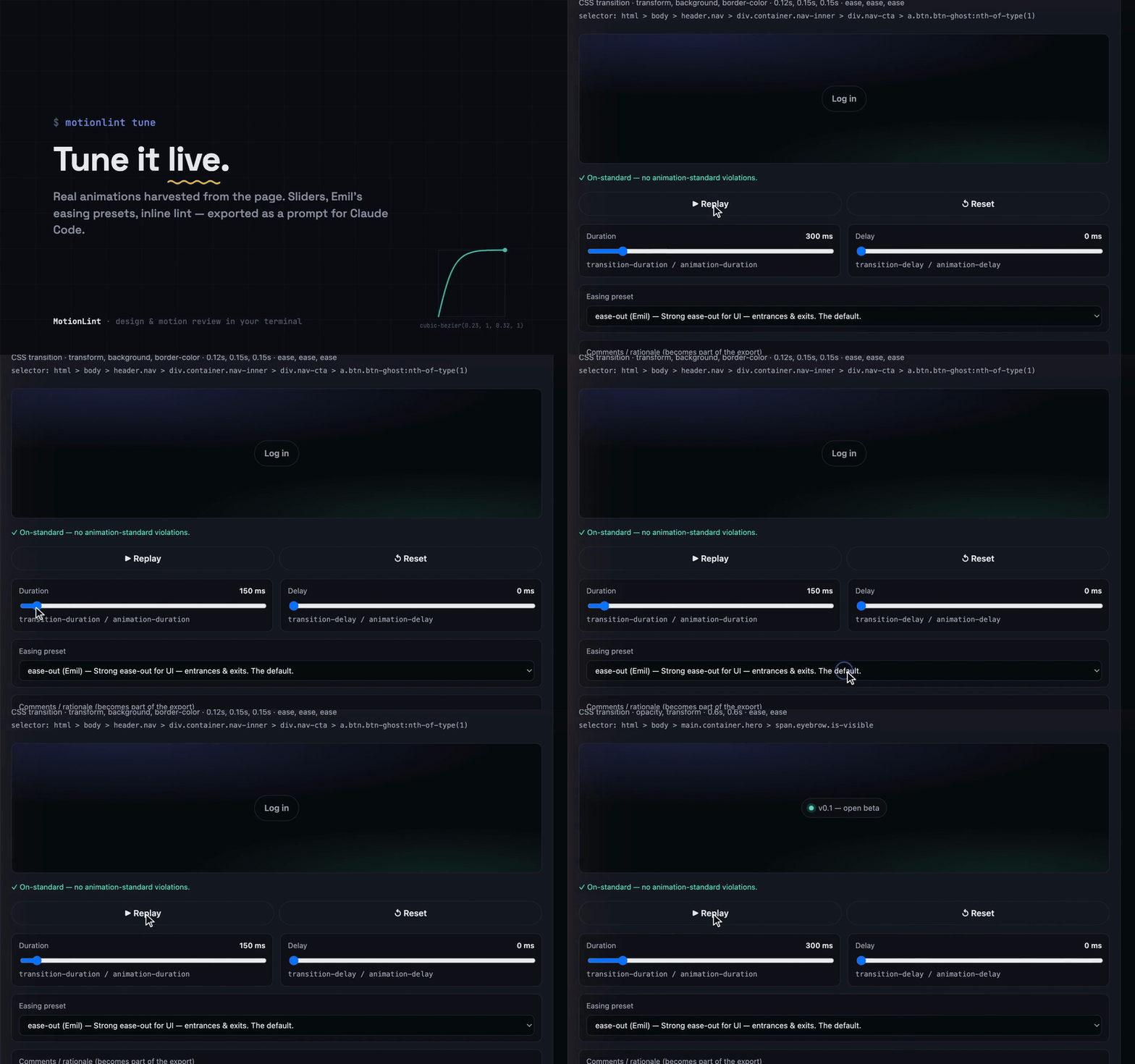
motionlint tune http://localhost:3000 --open
This:
- Opens your app in headless Chromium with an instrumentation script that hooks the major TS animation libraries (Motion One, GSAP, anime.js, @formkit/auto-animate, lottie-web) plus all CSS transitions and
@keyframesrunning on the page. - Captures every detected animation: the element selector, source library, timing parameters, and bounding box.
- Generates a self-contained interactive HTML page at
.motionlint/tuner/index.html(auto-opens with--open):- Live preview surface per animation (Shadow DOM — no iframes, no flash, themed to the source page).
- Sliders for duration / delay / stagger / speed.
- Easing-preset dropdown — Emil Kowalski's strong curves lead (ease-out, ease-in-out, iOS drawer), then the softer/decorative options.
- Inline standards linting — each card flags where the animation deviates from the motion standards (severity badge, fix, suggested value), with a header score.
- Comments box per animation for design rationale.
- Exports a markdown file plus a Claude-Code-ready prompt with a structured
changes[]JSON block. Paste that into CC and it edits your codebase to apply the new parameters.
$ motionlint tune http://localhost:3000

→ Capturing animations on http://localhost:3000…
  detected 15 animation(s)
  tuner → /Users/you/proj/.motionlint/tuner/index.html
  open with: file:///Users/you/proj/.motionlint/tuner/index.html
Animation standards — motionlint audit
MotionLint encodes Emil Kowalski's design-engineering standards as a deterministic linter — no vision model, no API key, no cost. motionlint audit instruments the page, reads the real timing/easing/transform values every animation is running, and grades them:
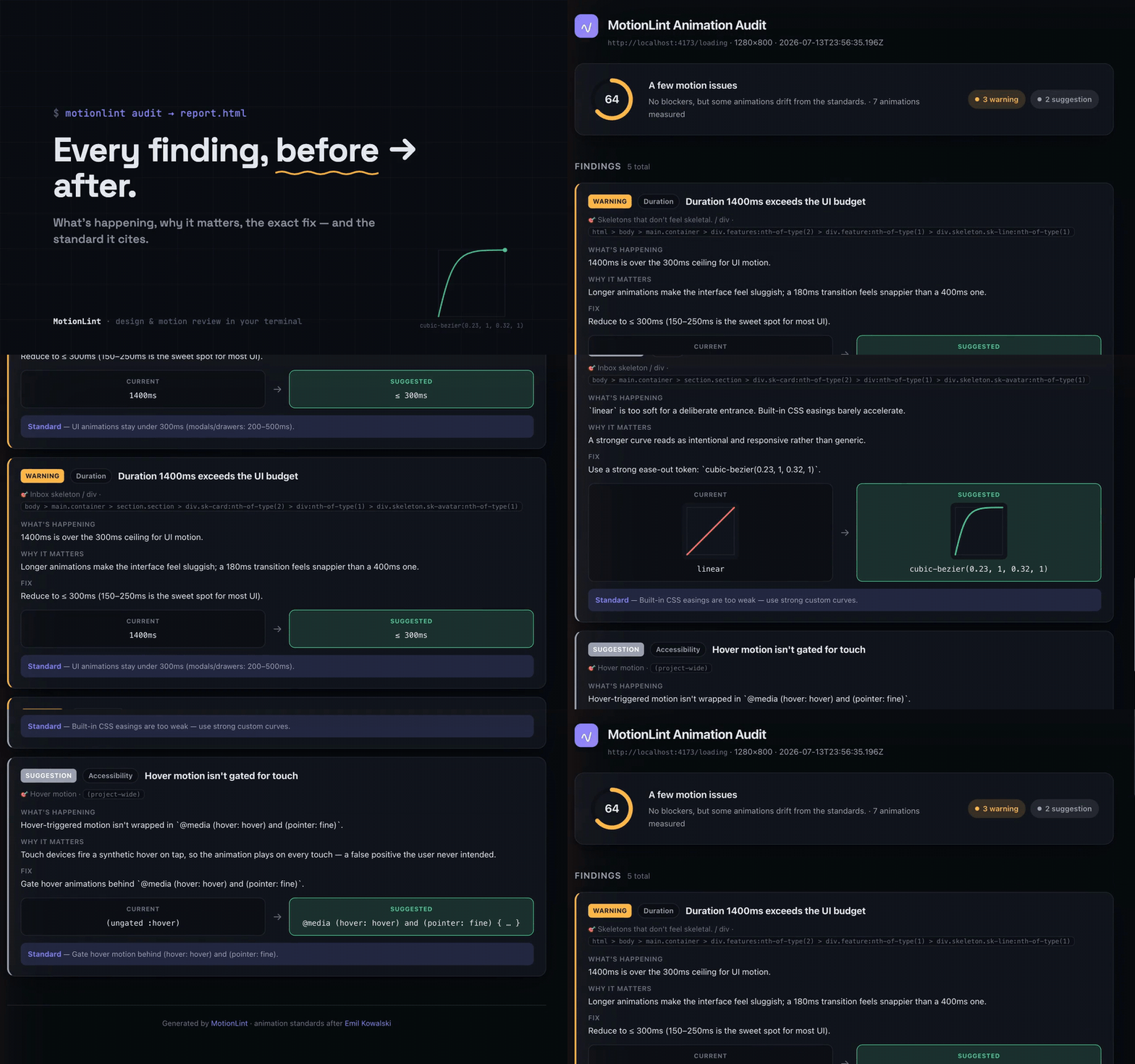
| Category | What it catches | The standard |
|---|---|---|
| Easing | ease-in on UI; weak built-in curves on deliberate entrances | Entering/exiting → strong ease-out cubic-bezier(0.23, 1, 0.32, 1); never ease-in |
| Duration | UI motion over the 300ms ceiling (modals/drawers get 200–500ms) | A 180ms transition feels snappier than a 400ms one; exits ~20% faster |
| Physicality | scale(0) entrances | Nothing appears from nothing — start from scale(0.95) + opacity: 0 |
| Performance | transition: all, animating layout properties, stray infinite loops | Animate transform and opacity only — they skip layout/paint |
| Cohesion | Hand-rolled easing-curve sprawl; stagger intervals outside the 30–80ms band | Curves and durations should live as shared tokens; grouped entrances stagger 30–80ms apart |
| Duration (pairs) | Exits that aren't faster than their entrance (fadeIn 300ms / fadeOut 300ms) | Exits run ~20% faster than the matching entrance |
motionlint audit http://localhost:3000 --open          # polished HTML report, scored 0–100
motionlint audit http://localhost:3000 --json audit.json --ci   # machine-readable; non-zero on critical
Add --layout to also lint layout (tap targets, text size, contrast, overflow) from live DOM measurements — still deterministic, still no API key.
Add --watch [dir] to re-run the audit on file changes under [dir] (default: cwd) and print the score with a delta after each run — a live readout while you iterate. Recursive watching requires macOS, Windows, or Linux with Node 20+.
The report pairs every finding with a before → after panel; easing findings render a live cubic-bezier curve comparison so the fix is visible, not just described. The same standards feed the flow review prompt (so vision findings cite concrete rules) and appear inline in the Animation Tuner.
MCP server — tools, resources, deployment
MotionLint ships an MCP server over stdio so an LLM agent can drive it directly inside a chat. The motionlint mcp subcommand boots it; the agent client spawns the process when a tool is called.
Installing in Claude Code
Published-npm version (recommended):
claude mcp add motionlint -- npx -y motionlint mcp
Local checkout (handy while developing):
claude mcp add motionlint -- node /absolute/path/to/motionlint/dist/index.js mcp
After registration:
- Confirm it appears:
claude mcp list—motionlintshould show asrunningoravailable. - Make sure API keys are reachable. The MCP server inherits the env it's spawned in. Cleanest path: drop a
.envfile in the project directory you're working from — MotionLint auto-loads it on startup. - First run:
npx playwright install chromiumif you haven't already.
Then in Claude Code:
"Use motionlint to review the local app at mobile and desktop and tell me the top 3 issues to fix."
"Run motionlint review_flow on
http://localhost:3000/signupwith stepsclick input#email; type input#email=test@test.com; click button[type=submit]; wait 2000; captureand check the animations.""Run motionlint tune_animations on
http://localhost:3000/pricing— I want to fine-tune the card hover animations."
Tools exposed
| Tool | What it does |
|---|---|
review_url(url, viewports?, provider?, model?, wait_for?, record?, format?, max_findings?, max_pr_annotations?, new_only?) | Static UX review of a URL at multiple viewports. Returns a markdown / JSON / SARIF report. |
review_routes(base_url, routes, viewports?, ..., max_findings?, max_pr_annotations?, new_only?) | Same review across multiple routes of one app. |
review_flow(url, steps?|spec_path?, preferences_path?, provider?, ...) | Animation/interaction review of a scripted user journey. Returns a flow report with the structured CC handoff block. |
tune_animations(url, viewport_*?, settle_ms?, output?) | Detects every animation on a page and writes an interactive HTML tuner. Returns the file path. |
get_latest_report(format?) | Returns the most recent review/flow report content. |
Resources: motionlint://reports/latest — the most recent report content.
Deployment checklist
Before deploying or sharing the MCP server with other users:
- Build is fresh.
npm run buildthen verifydist/index.jsexists. Without this,motionlint mcpwon't start. - Playwright Chromium installed on the target machine:
npx playwright install chromium. The postinstall hook reminds you, but it's not enforced (we don't auto-download a 300 MB binary onnpm install). - API keys reachable — either via shell env or via a
.envfile in the working directory the MCP client launches from. - Smoke-test the MCP surface.
npm testincludes an MCP smoke test that boots the server, lists tools, and asserts the expected tool surface. - No secrets committed.
.envis gitignored;.env.exampleshould be a placeholder. Worth a finalgit diff --cached | grep -i 'sk-\|api_key'before pushing. - Confirm with
claude mcp listthat the server shows up and isn't erroring at startup.
CI integration
# .github/workflows/ux.yml
- run: npm ci
- run: npx playwright install chromium
- run: npx motionlint review $STAGING_URL --ci --threshold critical --format sarif -o ux.sarif
- uses: github/codeql-action/upload-sarif@v3
  with: { sarif_file: ux.sarif }
MotionLint exits with 1 when critical issues exceed the configured threshold (failOnCritical) — wire it as a status check.
What it captures · what it analyzes
Captures:
- Full-page screenshots at three default viewports (mobile 375 / tablet 768 / desktop 1440). Override via config.
- Above-the-fold screenshots with
--no-full-page. - Videos of the navigation+capture run with
--record(Playwright.webm). - Interaction sequences before capture:
click,hover,type,scroll,wait. - Auth state: cookies,
localStorage, and abeforeNavigatescript — all configurable in.motionlintrc.json.
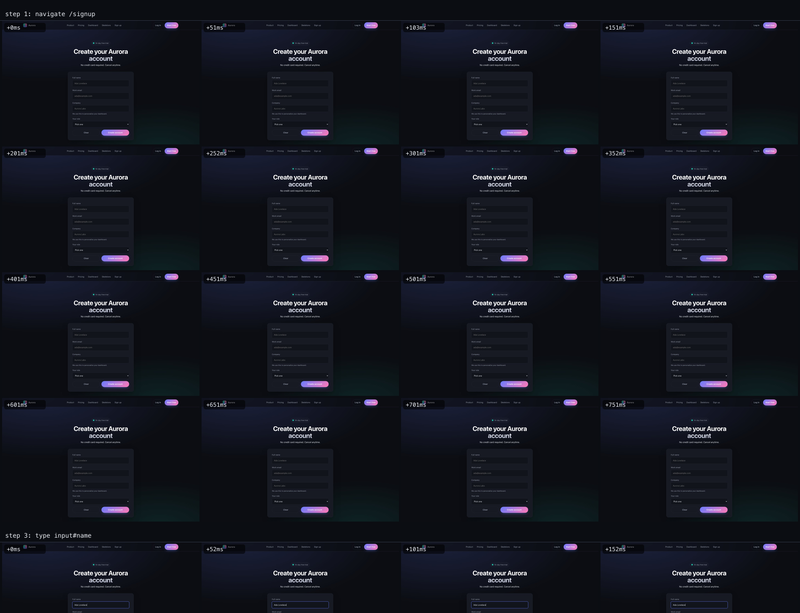
A motionlint flow contact sheet — timestamped bursts after each interaction, exactly what the vision model sees.
Analyzes: each screenshot is sent to a vision model with an opinionated UX-review system prompt covering twelve dimensions (hierarchy, spacing, alignment, typography, color, contrast, responsiveness, interaction, content, navigation, consistency, loading_state). For each issue the model returns:
{
  "category": "hierarchy",
  "severity": "critical | warning | suggestion",
  "location": "above-the-fold hero",
  "issue": "Primary CTA blends into the background gradient.",
  "why_it_matters": "Users miss the conversion path on first scroll.",
  "fix": "Increase background contrast or use a solid surface behind the button."
}
Override the prompt with --rules path/to/your-design-rules.md to inject project-specific heuristics.
Every review capture also takes a DOM snapshot: notable elements (headings, CTAs, inputs) get stable refs (E1, E2, …) with measured pixel rects, listed in the prompt so the model can ground a finding with "element_ref": "E3". Cited refs resolve back to their rects and are drawn as severity-colored bounding boxes on the screenshot in the HTML report (and reported as Where: E3 at (x, y) w×h in markdown). Refs the page never listed are dropped — the model can't annotate what it wasn't shown.
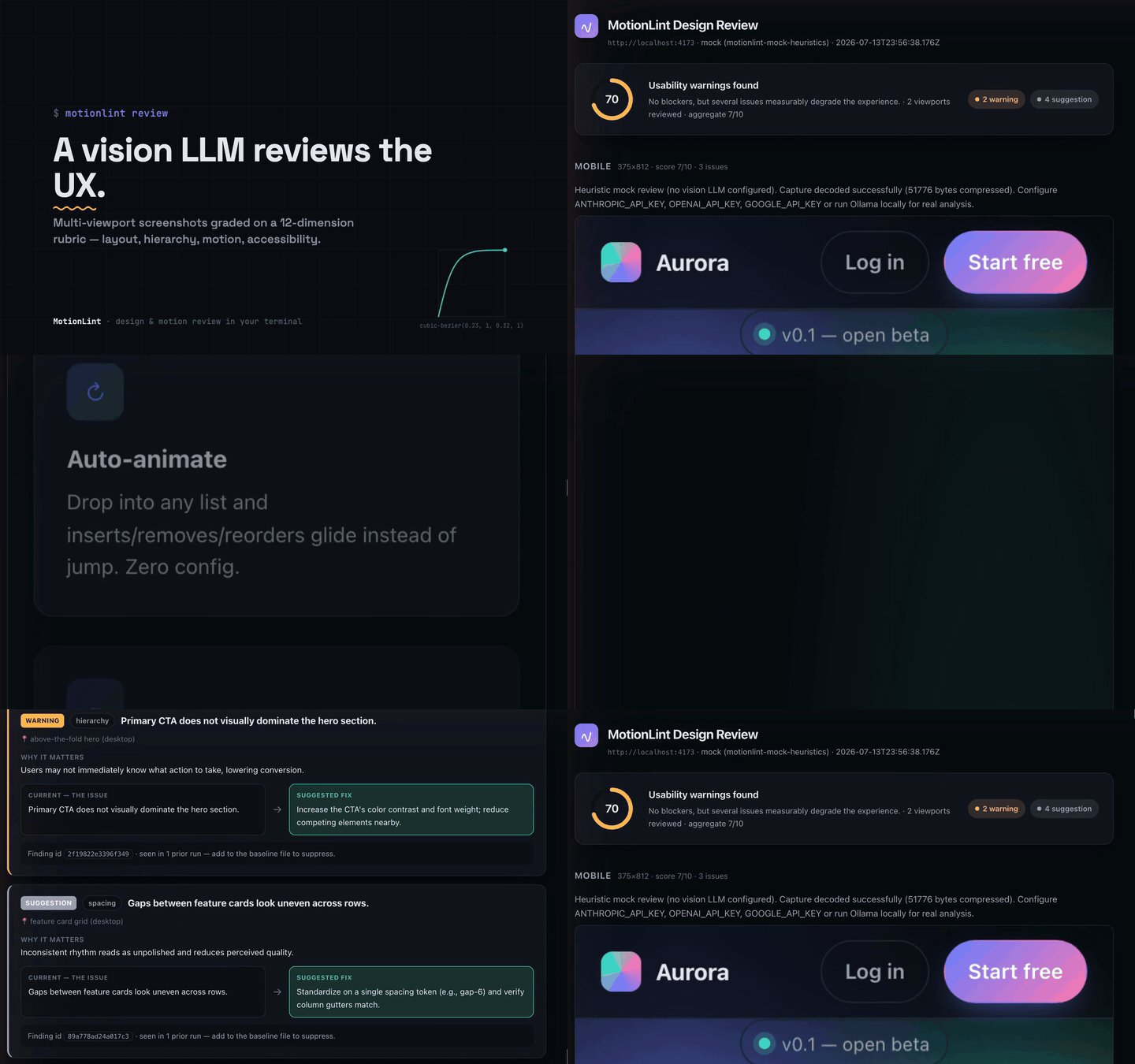
With --format html the findings render as a single shareable report — score ring, per-dimension breakdown, and an issue → fix panel per finding with the annotated screenshot:
Configuration reference
Drop a .motionlintrc.json in your repo root (or use motionlint.config.js / a "motionlint" key in package.json):
{
  "provider": "auto",
  "fallbackProvider": "anthropic",
  "fallbackModel": "claude-sonnet-5",
  "viewports": {
    "mobile":  { "width": 375,  "height": 812 },
    "tablet":  { "width": 768,  "height": 1024 },
    "desktop": { "width": 1440, "height": 900 }
  },
  "defaultViewports": ["mobile", "desktop"],
  "waitFor": "networkidle",
  "waitTimeout": 10000,
  "screenshotDir": ".motionlint/screenshots",
  "videoDir": ".motionlint/videos",
  "reportDir": ".motionlint/reports",
  "rules": null,
  "record": false,
  "maxFindings": null,
  "maxPrAnnotations": null,
  "memory": {
    "enabled": true,
    "path": ".motionlint/memory.json",
    "baseline": ".motionlintignore",
    "newOnly": false
  },
  "resources": { "maxConcurrentReviews": null, "providerCallsPerMinute": null, "maxTokensPerRun": null },
  "ci": { "threshold": "warning", "failOnCritical": true },
  "auth": { "cookies": null, "localStorage": null, "beforeNavigate": null }
}
Review volume control
Re-running review on the same routes used to surface the same findings every run. Two mechanisms keep the output focused:
- Per-run output cap —
--max-findings N(ormaxFindingsin config) keeps only the top N findings per run, severity-ordered, so an agent works on what matters most first. The report'sOmittedline says how many were capped. - PR-surface cap —
--max-pr-annotations N(ormaxPrAnnotationsin config; SARIF only) emits at most N results per report, severity-ordered, so a code-scanning upload doesn't flood a PR with annotations. The dropped count lands in the SARIF run'somitted_by_pr_capproperty. - Resource cap —
resources.maxConcurrentReviewsbounds how many reviews run at once in one process (an MCP server fielding several agents in flight), andresources.providerCallsPerMinuteis a process-wide sliding-window ceiling on vision-LLM calls (provider quota / spend control; also applies toflowreviews, where each--consistencysample counts). Both default to unlimited; both are config-only. Note they compose: a review holding a concurrency slot also waits out the rate limiter, so tight values on both multiply latency. - Cost ceiling — every provider call's token usage is captured and totalled per run (a
Tokens:line in reports,token_usagein SARIF run properties).--max-tokens N(orresources.maxTokensPerRunin config) sets a per-run token budget: once the running total crosses it, remaining viewports are skipped and the report lists them underskipped_viewports. Providers that report no usage still count calls but consume no budget. - Cross-run memory — every finding gets a stable id (hash of category + element location + normalized issue text). Recurrence detection goes further than exact hashing: category-synonym compatibility plus canonical-token overlap (thresholds calibrated on real cross-run data) matches the same fault even when the vision LLM rewords it between runs. Sightings are recorded per URL in
.motionlint/memory.json; recurring findings are annotated with seen in N prior runs rather than silently dropped. Opt into deltas-only with--new-only. To permanently wave off a finding, copy its id into.motionlintignore(one hash per line,#comments and trailing notes allowed). Disable everything with--no-memory.
SARIF output carries the finding id as a partialFingerprint, so GitHub code scanning dedups the same finding across runs and PRs natively.
Concurrent reviews of the same project are safe: the memory store is updated under a stale-aware file lock (memory.json.lock), so parallel runs don't clobber each other's recorded sightings. A wedged lock never fails a review — after a short wait the run warns and proceeds without it.
Use cases
- Pre-merge UX guardrail. Solo dev or 2-person startup with no designer. Run
motionlint review https://pr-123.preview.example.com --ci --threshold criticalin CI; warning-or-worse blocks the merge until you've at least seen the issues. - MCP design colleague inside Claude Code. Add MotionLint as an MCP server, then ask CC: "review the local app at mobile and desktop and tell me the top 3 issues to fix." CC drives the tool and gets back annotated feedback in the same conversation.
- Continuous quality monitoring. Schedule a nightly cron (
motionlint review https://prod.example.com --format sarif -o ux.sarif) and surface SARIF in your code-scanning dashboard so production regressions get caught the morning after. - Animation / flow QA on a feature you just shipped.
motionlint flowruns a scripted user journey through Playwright like a human would, captures frame bursts at every interaction, records video, and asks the LLM to review the animation behavior across the captured frames. - Live animation tuning + handoff to Claude Code. Capture every animation on a page, tune timing/easing/delay live with sliders, export a structured prompt CC can act on directly.
Project layout
src/
  capture/      Playwright capture (screenshot, mosaic, DOM snapshot) + interaction sequences
  providers/    Vision LLM providers (ollama, anthropic, openai, google, mock) + self-consistency wrapper
  analysis/     Rubric-style UX prompt + JSON parser + rule injection
  report/       Markdown / JSON / SARIF report generators
  eval/         Tiered eval harness (L1/L2/L3 fixtures, scorer, runner, report)
  flow/         Flow runner — spec parser, capture orchestrator, animation-aware report
  tuner/        Animation Tuner — extractor, instrumentation script, Shadow-DOM render
  mcp/          MCP server for Claude Code
  cli/          Commander.js commands + terminal output
  config/       cosmiconfig loader + .env loader
demo/           TS animation showcase used as a review target
flows/          Sample flow specs (signup, loading-state) for `motionlint flow`
eval/fixtures/  Labelled HTML pages with seeded UX faults at three complexity levels
test/           Node test runner unit + integration tests
Roadmap
v0.1 (this release) — shipped:
- Three CLI commands:
review,flow,tune+ MCP server (motionlint mcp). - Five vision providers: Anthropic, OpenAI, Google, Ollama, mock.
- Multi-viewport static review with mosaic capture, DOM measurement side-channel, self-consistency sampling, soft-keyword scoring with synonym graph.
- Tiered eval harness (L1 / L2 / L3) with 21 labelled fixtures and structured
next_actions[]JSON for downstream LLM coding tools. - Flow review at 50ms inter-frame intervals via CDP screencast (16 frames × 750ms burst), with multi-animation and scroll-driven support.
- Animation Tuner with Shadow-DOM previews, live sliders, easing presets, Claude-Code export.
- Animation stress-test harness validated at 100% recall / 0% FPR on 24 fixtures across 12 patterns.
- Team motion preferences markdown (
--preferences) embedded into the LLM rubric and the CC handoff block. - Auto-interval scan (
--auto-interval) that picks an inter-frame interval based on the shortest animation detected on the page. - SARIF output for GitHub code scanning.
v0.2 (in progress) — shipped so far:
- Token accounting + per-run cost ceiling (
--max-tokens/resources.maxTokensPerRun;Tokens:line in every report). - Auto-discover routes (
--discover-routes: sitemap.xml + Next.js app directory). - Annotated bounding boxes: DOM element refs in the prompt, findings drawn on the screenshot in the HTML report.
- Interaction-state grids (
--state-grid: default/hover/focus/active per element, one labeled image). - Provider scorecard history with per-model regression detection (
.motionlint/eval-history.json). - Closed-loop prompt evolution from eval
next_actions(eval --evolve→ learned heuristics in review prompts). - Two new audit rules: stagger-interval band (30–80ms) and exit-~20%-faster-than-entrance.
v0.2 (next):
- GitHub Action wrapper (
motionlint-action).
Acknowledgments
MotionLint stands on other people's work:
- Emil Kowalski — the animation standards behind
motionlint audit, the tuner's easing presets, and the flow-review rubric are distilled from his design-engineering writing and his animations.dev course. His open-source UI libraries — sonner (toasts) and vaul (drawers) — are living reference implementations of the motion these rules describe. MotionLint is an independent project, not affiliated with or endorsed by Emil. - ctx (ctx.rs) — local coding-agent history search. We used it while developing the cross-run memory layer to study how findings survive (or vanish) across agent runs; those experiments directly shaped the finding-id and baseline design.
License
MIT © Resila Technologies Inc.