Telebrief
Self-hosted digests of your Telegram channels over MCP: AI summaries, the last digest and raw per-channel messages, with OpenAI, Anthropic or Ollama.
Documentation

Telebrief
Automated Telegram Digest Generator powered by AI




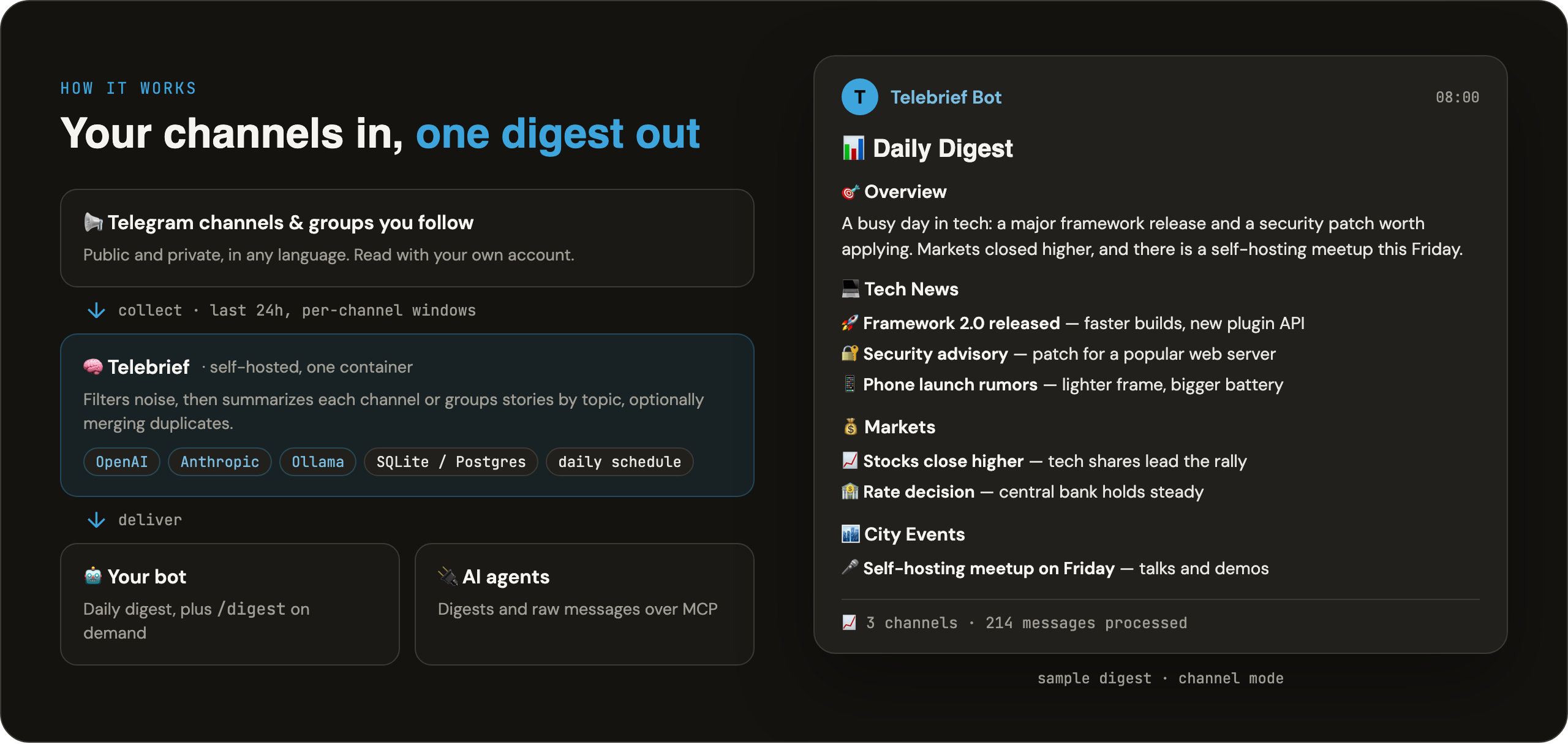
Telebrief collects messages from your Telegram channels (in any language), generates AI-powered summaries, and delivers a daily digest through your own Telegram bot. Group digests by channel or by AI-detected topics. Supports multiple AI providers: OpenAI, Ollama (local), and Anthropic. Digests come in English, Russian, Spanish, German or French (default: Russian).
📑 Contents
- Features
- Prerequisites
- Quick Start
- Bot Commands
- Example Output — channel mode, topic mode, deduplication
- Per-Channel Configuration — lookback window, AI instructions
- Persistent Storage — SQLite, PostgreSQL, schema
- Extensibility — filters, prompts, group binding, storage queries
- MCP Server — enabling, stdio mode, tools, single channel, security
- Development & Testing
- FAQ
- Contributing · License · Credits
✨ Features
- 🌐 Multi-language Support - Reads channels in ANY language (English, Russian, Ukrainian, Chinese, etc.)
- 🌍 Configurable Output Language - Summaries, labels and bot messages in English, Russian, Spanish, German or French (default: Russian)
- 🤖 Multi-Provider AI - Supports OpenAI (including GPT-6 Luna, Sol, Astra), Ollama (local), and Anthropic for summarization
- ⏰ Scheduled & On-Demand - Daily automatic digests + instant generation via bot commands
- 🔒 Private Channel Support - Access your private chats and channels
- 📑 Digest Modes - Group by channel (default) or by AI-detected topics like News, Events, Sport
- 🎨 Smart Formatting - Markdown with emojis, bullet points, and clickable channel links
- 📨 Long Message Splitting - Digests that exceed Telegram's 4096-character limit are automatically split into sequential messages instead of being truncated
- 🔐 Self-hosted - Single-user; your session, API keys and messages stay on your server
- 🧹 Auto-cleanup - Automatically removes old digest messages
- 🔌 MCP Server - Optional built-in MCP endpoint so AI agents can pull digests instead of reading Telegram
📋 Prerequisites
Before you begin, you'll need:
-
Docker - Install Docker
-
Telegram App Credentials - Get from my.telegram.org
api_idandapi_hash- If the form at my.telegram.org/apps only shows
ERROR, the rejection comes from Telegram, not Telebrief. Workarounds that usually help:- Use a unique, random alphanumeric App title and Short name (Short name: 5–32 letters/digits, no spaces)
- Turn off VPN, proxy, and ad-blocking extensions; try a private window or another browser
- Switch networks, e.g. mobile data instead of Wi-Fi
- Submit again a few times; the check is intermittent
- If nothing works, contact Telegram support. Never enter your login code on third-party sites that offer to create an app for you.
-
Telegram Bot Token - Create via @BotFather
- Send
/newbotto create a new bot - Save the bot token
- Send
-
AI Provider API Key (one of the following):
- OpenAI: Get from platform.openai.com
- Anthropic: Get from console.anthropic.com
- Ollama: No API key needed - install locally
🚀 Quick Start
No clone and no Python needed. In an empty directory, run the setup wizard:
mkdir telebrief && cd telebrief
docker run --rm -it --user "$(id -u):$(id -g)" -v "$PWD":/setup \
  ghcr.io/belaytzev/telebrief python main.py init /setup
The wizard logs into your Telegram account (phone, code, 2FA), checks the bot token, lets you pick channels from your dialogs by number, and writes .env, config.yaml, docker-compose.yml and sessions/user.session. Your user ID is taken from the login.
Then press Start in your bot's chat and launch the service:
docker compose up -d
docker compose logs -f telebrief
Send /digest to the bot to get the first digest right away. Re-run the wizard any time: it reuses the existing session and asks before overwriting files.
To update to the latest release:
docker compose pull && docker compose up -d
Images are published to GitHub Container Registry on every release with tags latest, X.Y (minor), X.Y.Z (patch). To build from source, replace the image: line in docker-compose.yml with build: .. For all options beyond the wizard, see config.yaml.example.
🤖 Bot Commands
Open Telegram and message your bot:
| Command | Description |
|---|---|
/start | Same as /help |
/help | Display help message with all commands |
/digest | Generate and send digest for last 24 hours (uses configured digest_mode) |
/status | Show AI provider and model, number of channels, auto-cleanup and the next scheduled run |
/cleanup | Manually delete old digest messages |
📊 Example Output
Telebrief supports two digest modes configured via digest_mode in config.yaml.
Channel mode (digest_mode: "channel" — default)
Groups summaries by source channel with clickable channel links:
# 📊 Daily Digest - 02 May 2026

## 🎯 Brief Overview

A busy day in tech: a major framework release and a security patch worth
applying. Markets closed higher, and there is a self-hosting meetup this Friday.

---

## 💻 Tech News · [Open channel →](https://t.me/technews)

- 🚀 **Framework 2.0 released**: faster builds, new plugin API
- 🔐 **Security advisory**: patch for a popular web server

## 💰 Markets · [Open channel →](https://t.me/markets)

- 📈 **Stocks close higher**: tech shares lead the rally
- 🏦 **Rate decision**: central bank holds steady

---
📈 **Statistics**: 3 channels, 214 messages processed
The layout of each channel's bullet points comes from the AI, guided by the prompt, so it varies slightly between providers and models.
Topic mode (digest_mode: "digest")
Groups summaries by AI-detected topics. You define topic groups in config.yaml:
digest_mode: "digest"
digest_groups:
  - name: "Events"
    description: "Conferences, meetups, releases, launches, announcements"
  - name: "News"
    description: "Politics, economy, world affairs, breaking news"
  - name: "Sport"
    description: "Sports results, transfers, tournaments, matches"
Messages that don't match any defined group are placed into an automatic "Other" category.
All labels (header, statistics, bot commands) follow the configured
output_language. The example above usesEnglish; the other supported values areRussian(default),Spanish,GermanandFrench.
dedup_topics — cross-channel deduplication
When multiple channels cover the same event, the grouper normally produces one bullet point per channel. Enable dedup_topics to instruct the AI to keep only the most informative description and merge the source attributions:
settings:
  digest_mode: "digest"
  dedup_topics: true        # default: false
  digest_groups:
    - name: "Tech"
      description: "Technology news and releases"
With deduplication enabled, if TechCrunch and HackerNews both report the same product launch, the digest will contain a single bullet point with source: "TechCrunch, HackerNews" instead of two separate entries.
Note:
dedup_topicshas no effect indigest_mode: "channel"— deduplication only applies during topic-based grouping.
⚙️ Per-Channel Configuration
Each channel entry supports two optional overrides in addition to the required id and name fields.
lookback_hours — per-channel lookback window
Override the global settings.lookback_hours for a specific channel. Useful when some channels post infrequently and need a wider collection window, or when you want a tighter window for high-volume channels.
channels:
  - id: "@breaking_news"
    name: "Breaking News"
    # no lookback_hours — uses the global settings.lookback_hours

  - id: "@weekly_digest"
    name: "Weekly Newsletter"
    lookback_hours: 168   # look back 7 days for this channel only

  - id: -1001234567890
    name: "High Volume Channel"
    lookback_hours: 6     # only last 6 hours for this channel
lookback_hours must be a positive integer. If omitted or set to null, the global value is used.
prompt_extra — per-channel AI instructions
Append extra instructions to the AI system prompt when summarizing a specific channel. Use this to guide tone, focus, or format for channels that need special treatment.
channels:
  - id: "@cryptonews"
    name: "Crypto News"
    prompt_extra: "Focus only on price movements and regulatory news. Ignore opinion pieces."

  - id: "@jobboard"
    name: "Job Board"
    prompt_extra: "Extract only senior engineering roles. Format as a list: Role — Company — Link."
prompt_extra is appended verbatim to the channel's summarization system prompt. Leave it empty (or omit the field) for standard behavior.
🗄️ Persistent Storage
By default, Telebrief generates digests on demand without storing raw messages. You can enable a persistent storage layer that saves every collected message to a database for historical access or external LLM workflows.
Storage is disabled by default and opt-in via config.yaml.
SQLite (default backend)
No extra setup required. Messages are saved to a local SQLite file.
storage:
  enabled: true
  backend: sqlite
  path: data/messages.db   # relative to project root
When running in Docker, the data/ directory is already mounted as a volume in docker-compose.yml, so the database persists across container restarts.
PostgreSQL (optional backend)
Use PostgreSQL for multi-host deployments or when you need concurrent read access to the message store.
storage:
  enabled: true
  backend: postgres
  url: "postgresql://user:pass@host:5432/dbname"
asyncpg ships in the Docker image and in the standard dependencies (uv sync), so no extra install step is needed.
Schema
Both backends create the same logical schema on first run (table and index are created automatically — no manual migration needed):
| Column | Type | Description |
|---|---|---|
channel_name | text | Channel name from your config |
sender | text | Message author |
text | text | Message body |
timestamp | text / timestamptz | Message timestamp |
link | text | Telegram message link |
has_media | bool / integer | Whether the message has media |
media_type | text | Media type string |
collected_at | text / timestamptz | When the row was inserted |
Note: Storage is append-only. Overlapping lookback_hours windows across runs will produce duplicate rows for messages collected in both windows.
🔌 Extensibility
Telebrief exposes four hook surfaces that let you customise behaviour via config.yaml without modifying core logic. All new fields are optional — existing configs run unchanged.
Filters
A filter chain runs after message collection and before storage and summarization. Dropped messages never reach the AI or the database.
Built-in filters live in src/extensions/filters.py:
| Filter | Purpose |
|---|---|
KeywordFilter | Keep/drop messages by keyword substring (case-insensitive) |
RegexFilter | Keep or drop messages matching a regex pattern |
MinLengthFilter | Drop messages shorter than a character threshold |
Configure a global filter chain under settings.filters. Each entry needs a class_path (dotted import path) and an optional config dict passed as keyword arguments to the constructor:
settings:
  filters:
    - class_path: src.extensions.filters.KeywordFilter
      config:
        include: ["job", "hiring", "remote"]
        exclude: ["nsfw"]
    - class_path: src.extensions.filters.MinLengthFilter
      config:
        min_chars: 30
Override the global chain for a single channel by adding filters: under that channel entry. Set filters: [] to disable filtering for that channel entirely, or provide a different list to replace the global chain for that channel only:
channels:
  - id: "@jobboard"
    name: "Job Board"
    filters:
      - class_path: src.extensions.filters.RegexFilter
        config:
          pattern: "senior|staff|principal"
          mode: "include"
Write your own filter by implementing the MessageFilter Protocol:
from __future__ import annotations
from src.extensions.filters import MessageFilter
from src.config_loader import ChannelConfig
from src.collector import Message

class MyFilter:
    name = "my_filter"

    def __init__(self, custom_param: str = "") -> None:
        self.custom_param = custom_param

    async def filter(self, channel: ChannelConfig, messages: list[Message]) -> list[Message]:
        return [m for m in messages if self.custom_param in (m.text or "")]
Then reference it in config.yaml:
settings:
  filters:
    - class_path: mypackage.mymodule.MyFilter
      config:
        custom_param: "important"
Prompts
The base prompt template lives in src/prompts/base_summary.txt. You can point to a custom template file or plug in a custom PromptComposer class.
prompts:
  base_template: src/prompts/base_summary.txt  # path to template file
  composer: ""                                  # empty = built-in DefaultComposer
The built-in DefaultComposer assembles the final system prompt in this order (empty parts are skipped):
base template (with {language} substituted)
  + group.prompt_extra  (if channel belongs to a group with prompt_extra set)
  + channel.prompt_extra  (if non-empty)
To use a custom composer, implement the PromptComposer Protocol and set composer to its dotted path:
from src.config_loader import ChannelConfig, DigestGroupConfig
from src.extensions.prompts import PromptComposer

class MyComposer:
    def __init__(self, base_template: str, language: str) -> None:
        self._base = base_template
        self._language = language

    def compose(self, channel: ChannelConfig, group: DigestGroupConfig | None) -> str:
        return f"{self._base}\nRespond in {self._language}."
Note: The constructor must accept
(base_template: str, language: str)as its first two positional arguments. A mismatched signature raises aTypeErrorat startup with a descriptive message.
prompts:
  composer: mypackage.mymodule.MyComposer
Group binding
Channels can be bound to a digest_groups entry. The group's prompt_extra is then injected into every channel in that group, before the channel's own prompt_extra.
settings:
  digest_groups:
    - name: "Jobs"
      description: "Job listings and hiring announcements"
      prompt_extra: "Extract only role title, company, and link. Format as a list."

channels:
  - id: "@techleads_jobs"
    name: "Tech Jobs"
    group: Jobs          # must match a digest_groups name or "Other"
    prompt_extra: "Focus on senior and staff-level positions only."
Channels without a group field (or group: null) use the base template and their own prompt_extra only.
Storage queries
When storage is enabled (storage.enabled: true), the StorageBackend exposes a query_messages read API for external tooling:
from src.storage import SQLiteBackend
from datetime import datetime, timezone

backend = SQLiteBackend("data/messages.db")
await backend.initialize()

messages = await backend.query_messages(
    channel_name="TechCrunch",  # the configured channels[*].name (NOT the @id)
    since=datetime(2026, 4, 1, tzinfo=timezone.utc),
    until=datetime(2026, 4, 30, tzinfo=timezone.utc),
    limit=500,
)
All parameters are optional. channel_name matches the human-readable channels[*].name value from config.yaml (this is the value persisted to the channel_name column at collection time); omit it to query across all channels. Renaming a channel in config will change the value stored for new rows — historical rows keep the old name. Results are ordered by timestamp descending and capped at limit (default 1000, must be ≥ 1).
🔗 MCP Server
Telebrief can expose its digests over the Model Context Protocol, so an MCP client (Claude Code, for example) can request a digest directly instead of reading it in Telegram.
The server runs inside the Telebrief process, sharing its Telegram session, configuration and generation lock with the scheduler and the bot. Digests it returns are byte-for-byte what Telegram receives, including topic grouping and deduplication.
Enabling it
mcp:
  enabled: true
  host: "127.0.0.1"
  port: 8765
  path: "/mcp"
Then register it with your client:
claude mcp add --transport http telebrief http://127.0.0.1:8765/mcp
Stdio mode
python main.py mcp serves the same tools over stdio without the bot and the scheduler, for clients that launch the server themselves. It reads the same config.yaml, .env and session, and connects to Telegram only when a tool is called. Don't run it alongside the main service on the same session file: prefer the HTTP endpoint above when Telebrief is already running.
Tools
| Tool | Arguments | Behaviour |
|---|---|---|
get_digest | hours (1–168, default 24) | Generates a fresh digest. Takes 20–90 seconds and spends AI provider tokens. |
get_last_digest | — | Returns the most recent digest from cache, with its generation time. Instant and free. |
get_channel_messages | channel, hours (1–168, default 24), limit (1–500, default 200) | Returns the individual messages of one channel, unsummarized. No AI tokens spent. |
Every successful digest — scheduled, bot-triggered or MCP-triggered — is cached to data/last_digest.json, so get_last_digest serves the same digest that was delivered to Telegram.
Digest generation is serialized: if the scheduler is already building a digest, an MCP call waits for it to finish rather than opening a second Telegram session.
Reading a single channel
get_channel_messages answers "what was actually posted in this channel", as opposed to the AI summary a digest gives you.
channel accepts either form from config.yaml — the human-readable channels[*].name or the channels[*].id (@username or numeric) — matched case-insensitively. An unknown value fails with the list of configured channel names, so no separate discovery call is needed.
The tool reads from persistent storage when it is enabled and holds messages for the requested window, and falls back to a live Telegram read otherwise. The response header states which path was used:
channel: AI News (from storage, 42 msgs, last 24h)

[2026-08-07T09:12:04+00:00] Alice
OpenAI released a new model...
https://t.me/ainews/1234

[2026-08-07T10:30:11+00:00] Bob
[photo] Benchmark chart
https://t.me/ainews/1235
Messages come back in chronological order; limit keeps the newest ones and drops the oldest. The live fallback runs under the same generation lock as digests and applies the channel's configured filters, so both paths return the same set of messages.
Two deliberate differences from digest generation:
channels[*].lookback_hoursis not applied — the tool honours thehoursthe caller asked for.- Media-only messages arrive as their placeholder text (
[photo],[video]), exactly as they are stored.
Security
The MCP server has no authentication. It relies on binding to loopback, where the SDK also enables DNS-rebinding protection. Anyone who can reach the port can trigger digest generation and read your channel summaries.
Keep host on 127.0.0.1. Telebrief logs a warning at startup if you bind anywhere else. In Docker, publish the port as 127.0.0.1:8765:8765 rather than exposing it on all interfaces, and put it behind a firewall or reverse proxy with auth if you genuinely need remote access.
🛠️ Development & Testing
This project uses uv and Python 3.14+. Setup, the full check suite, code style and the PR process are in the Contributing Guide.
Running Tests
uv sync --extra dev
uv run pytest tests/ -v
uv run mypy src/
❓ FAQ
Q: Which output languages are supported?
A: English, Russian (default), Spanish, German and French, set via output_language. Channels themselves can be in any language.
Q: How many channels can I monitor?
A: There is no hard limit. Each digest reads up to max_messages_per_channel messages per channel (500 by default), so run time and AI cost grow with the number of active channels.
Q: Can multiple users receive digests? A: No, Telebrief is single-user by design: one Telegram account, one recipient.
Q: Does it work with group chats?
A: Yes. The setup wizard lists your groups next to channels, or add a group's ID to config.yaml the same way as a channel.
Q: Is my Telegram account at risk?
A: Telebrief logs in as you through the Telegram user API (Telethon) and only reads messages, but this is a user session, not a bot, so Telegram's usual rules for third-party clients apply. The session file in sessions/ grants full access to your account: keep it private.
Q: How much does it cost to run? A: Only your AI provider's token usage, which depends on the model and how much your channels post. A nano/mini-tier model keeps it low; with Ollama it is free.
Q: Can I use a local AI model?
A: Yes. Set ai_provider: "ollama" in config.yaml and run Ollama. From Docker, point ollama_base_url at http://host.docker.internal:11434; on Linux this also needs extra_hosts: ["host.docker.internal:host-gateway"] in docker-compose.yml.
Q: Can I customize the digest format?
A: The digest layout is in src/formatter.py; changing it means building the image from source. Per-channel prompt_extra and custom prompts change what the AI writes without touching code.
🤝 Contributing
Contributions are welcome! Bug reports, feature requests, documentation fixes, new filters, AI providers, storage backends, and translations are all appreciated.
- Read the Contributing Guide for development setup, code style, and the PR process
- This project follows the Contributor Covenant Code of Conduct
- Found a security issue? Please report it privately — see the Security Policy
📄 License
This project is licensed under the MIT License.
🙏 Credits
Built with:
- Telethon - Telegram User API
- python-telegram-bot - Bot API
- OpenAI API - AI Summarization (OpenAI provider)
- Ollama - Local AI Summarization
- Anthropic API - AI Summarization (Anthropic provider)
- APScheduler - Task Scheduling
- MCP Python SDK - MCP server