Qorx
Local code search for Claude Code and Codex. Qorx indexes a repo on your machine and returns matching source with file paths and line numbers over MCP.
Documentation
Qorx 1.0.7
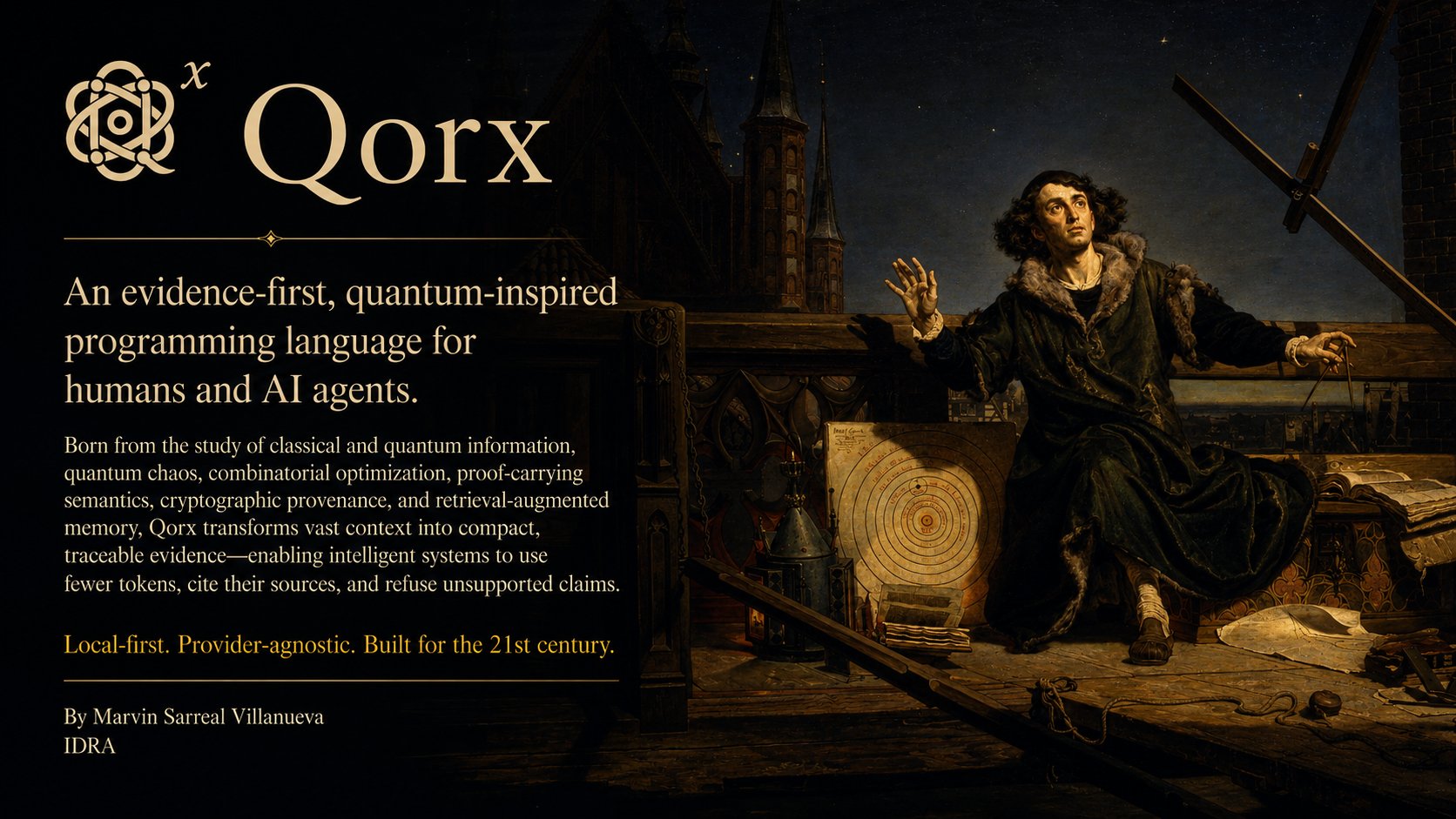
An evidence-first, quantum-inspired programming language for humans and AI agents.
Born from the study of classical and quantum information, quantum chaos, combinatorial optimization, proof-carrying semantics, cryptographic provenance, and retrieval-augmented memory, Qorx transforms vast context into compact, traceable evidence—helping intelligent systems use fewer tokens, cite their sources, and refuse unsupported claims.
Local-first. Provider-agnostic. Built for the 21st century.
AI tools repeatedly receive the same repositories, notes, logs, policies, and
project rules. Qorx keeps that repeated context local, sends a small carrier,
and retrieves exact cited lines only when a task needs them. Plain .qorx
source compiles to checked bytecode with explicit evidence budgets and refusal
when the available material cannot support an answer.
Qorx 1.0.7 runs deterministic classical algorithms on ordinary computers. Quantum information, quantum-inspired optimization, and quantum chaos are research influences; Qorx does not require quantum hardware.






Start with Qorx
Download a ready-made build for Windows, Linux or macOS (x64 and ARM64) from the 1.0.7 release, or install from the source tag:
cargo install --git https://github.com/bbrainfuckk/qorx --tag v1.0.7 --locked qorx
qorx --version
Then index a workspace and ask for grounded local evidence:
qorx doctor
qorx daemon start
qorx index .
qorx map "which files control authentication?"
qorx strict-answer "which files control authentication?"
qorx eco --local-tokens 13200000 --sent-tokens 8
New in 1.0.7: share skills between Claude Code, Codex, Antigravity and OpenCode on
your computer with qorx skills share (see the 1.0.7 notes).
The local monitor listens at http://127.0.0.1:47187/monitor by default. See
the installation guide for release binaries and package
recipes across Windows, Linux, macOS, x64, and ARM64. If a registry package is
not yet live at version 1.0.7, use the source install above.
Connect an MCP client
The open-source Qorx CLI includes a Model Context Protocol server.
Configure your client's stdio transport with qorx as the command and ["mcp"]
as its arguments. The client launches qorx mcp and exchanges messages over
standard input and output. For example, in a client that uses mcpServers:
{
  "mcpServers": {
    "qorx": { "command": "qorx", "args": ["mcp"] }
  }
}
To check the protocol from a source checkout, run
cargo test --locked --test mcp_stdio. The integration test
starts the CLI, sends initialize, and requests tools/list.
What Qorx changes
repo + notes + rules + logs
            |
            v
      Qorx stays local
            |
            v
 small carrier + exact cited lines
            |
            v
     human or AI agent
Measured proof
Two public proof surfaces are kept separate so the large product run is not confused with the reproducible repository run.
| Proof | Result | Boundary |
|---|---|---|
| AMD MI300X product run | 13,199,246.07x average carrier reduction; 0.8974 ms average local-core latency | 184,789,445 indexed tokens, 14.0-token average carrier, GPT-OSS 120b-ROCm7, 192 GB VRAM. Local core only—not model inference or a universal quality claim. |
| Qorx 1.0.6 repository run | 5,904.23x session; 993.64x pack; 909.36x squeeze | 407,392 local ceil(chars / 4) estimated tokens; generated by the committed benchmark script with zero provider calls. |
DataCamp + OpenAI gpt-4o-mini | 80.90x fewer provider-reported input tokens; 3/3 correct with full and Qorx context | 65,850 full-context input tokens versus 814 with Qorx across three synthetic questions. Median local pack time 11.82 ms. Small sequential check; not a universal cost, latency, or quality claim. |
DataCamp + Anthropic claude-sonnet-4-6 | 80.43x fewer provider-reported input tokens; 3/3 correct with full and Qorx context | 77,458 full-context input tokens versus 963 with Qorx across the same three questions. Median local pack time 14.03 ms. Small sequential check; not a universal cost, latency, or quality claim. |
| AMD ACT II agent score | Rank 106, 78.9% accuracy, 9,382 tokens | Public event leaderboard result, separate from the context-reduction benchmarks. |
The 1.0.6 repository run passed both strict checks: supported local evidence was returned and an unsupported question was refused. Inspect the human-readable report, machine-readable proof, exact runner, and scoped comparison board.
The provider check used the same corpus, questions, evidence budget, refusal rule, and deterministic scoring for both conditions. Inspect its methodology and caveats, normalized raw capture, and reproduction notebook.
The separate compact-kernel contract records six native x64/ARM64 CI artifacts from 0.21 to 0.39 MiB. Those are compact offline-kernel artifacts, not the full Windows x64 CLI; the local 1.0.6 release build of that CLI measured 4.65 MiB.
The AMD result is the largest published numeric factor among the ten closest public reduction references reviewed for the comparison board. It is not a matched comparison win: the systems used different corpora, hardware, tasks, outputs, and quality gates. See how to read the claim.
Published benchmark comparison
This is the scoped ten-system comparison behind that statement. The entries report each project's own published measurement; they are not reruns on a shared corpus or hardware stack.
| Closest reference | Published reference metric | Why the comparison is limited |
|---|---|---|
| LLMLingua | Up to 20x prompt compression with minimal performance loss. | Learned prompt compression is not local carrier resolution. |
| LongLLMLingua | 4x compression, a reported 17.1% performance gain, and 1.4x–3.8x latency speedup. | The paper evaluates long-context prompting, not a persistent local index. |
| LLMLingua-2 | Evaluated at 2x–5x compression and reported 3x–6x faster compression than earlier methods. | Its compression and latency boundaries differ from Qorx's local core path. |
| Active Context Compression | 22.7% token reduction on a five-task SWE-bench Lite experiment while retaining the same 3/5 resolution count. | Small-sample agent pruning, not a carrier-to-index ratio. |
| Gist Tokens | Up to 26x prompt compression, up to 40% FLOPs reduction, and 4.2% wall-clock reduction. | Learned soft tokens require model support; Qorx emits inspectable local evidence. |
| Context Mode | Up to 98% context reduction; its 50-turn example reports 30x fewer tokens. | Product examples are not a matched Qorx benchmark corpus. |
| LeanCTX | Illustrates about 100K tokens becoming a roughly 5K map, reports 60%–90% less context noise, and roughly 13-token re-reads. | Repository maps and cached re-reads are different output objects from a Qorx carrier. |
| sqz | Reports 24.7% average savings over 3,003 compressions, up to 92% on repeated file reads, and 13-token references. | Tool-output caching and compression are not the same operation as local evidence resolution. |
| indxr | Reports about 5x fewer tokens than full-file reads and sub-20 ms indexing for most projects. | Indexing time is not comparable to Qorx's measured query-side local core latency. |
| Codebase-Memory | Reports ten times fewer tokens and 83% answer quality versus 92% for its file-exploration agent across 31 repositories. | It measures graph-assisted code exploration; Qorx reports a different carrier and scorecard. |
Within the disclosed AMD carrier measurement, Qorx's 13,199,246.07x factor is numerically larger than the published factors above. That is the narrow claim: it is not a head-to-head win and does not establish better answer quality. The full comparison board and 60-item landscape preserve the wider methodology and scope.
Research lineage and inspirations
Qorx is independently authored. The works below are the public intellectual, engineering, evaluation, and comparison lineage—not contributors, bundled code, affiliations, or endorsements.
Every item is linked and scoped in the reference-source map, research and compiler map, or the 60-item audited landscape. Those pages explain what influenced Qorx, what is merely adjacent, and what can be compared numerically.
Why Qorx exists
I built Qorx after reading thousands of papers across information theory, retrieval, compilers, formal methods, cryptography, agent memory, optimization, quantum information, nonlinear dynamics, and energy-aware computing. The goal was practical: make useful AI cheaper and accessible to more people without making every request reprocess the same material.
— Marvin Sarreal Villanueva
Qorx turns that research into ordinary local software. Its engineering draws directly from classical information theory, information retrieval, programming languages, proof-carrying systems, authenticated provenance, and local runtime design. Quantum information, quantum-inspired optimization, and quantum chaos are conceptual influences on its vocabulary and design questions. Qorx 1.0.7 runs deterministic classical algorithms on ordinary computers; it does not run a quantum algorithm or require quantum hardware.
| Research area | Public Qorx connection |
|---|---|
| Classical information theory | Select useful evidence under a visible token budget. |
| Certified compilation and proof-carrying semantics | Check source, bytecode integrity, citations, and evidence boundaries. |
| Quantum-inspired combinatorial optimization and operations research | Treat local evidence selection as a constrained portfolio problem. |
| Retrieval-augmented agent memory | Reuse indexed local knowledge and retrieve only what the task needs. |
| Cryptographic provenance and local runtime architecture | Bind local records to hashes, receipts, and explicit ownership boundaries. |
| Nonlinear dynamics and quantum chaos | A research lens for stability and sensitivity, not an implemented physics model. |
| Energy-aware computing | Avoid unnecessary repeated model-bound input and calculate impact scenarios from user-supplied factors. |
The physics words are operational names, not claims about particles. A quark is a bounded, hashed evidence chunk. A carrier or photon is the small model-visible object selected from local state. Hot, penumbra, and abyss name resident, semi-active, and cold local storage layers. Prism is the planning term for splitting one objective into agent-ready packs. Hot and cold are storage metaphors, not quark flavours or temperature measurements.
See the research map, reference sources, and science and mathematics boundary.
The product family
| Name | What it is |
|---|---|
| Qorx | The open language, compiler, portable bytecode runtime, and local evidence tools in this repository. |
| Qorx Void | The private local project-memory product. This repository publishes Void documentation, not Void source or proprietary internals. |
| Qorx Zero | Four clean-room hackathon applications that demonstrate bounded local evidence, memory, and routing without using private Qorx Void code. |
The language
Qorx source is meant to be readable by a person and deterministic enough for an agent to generate, check, compile, and inspect.
QORX 1
use std.evidence
use std.branch as br

let question = "which files define the release boundary?"
let fallback = "local evidence does not support this answer"

pack evidence from question budget 700
cache evidence key question ttl 3600
strict answer from evidence limit 2
if supported(answer) then emit answer else emit fallback
qorx qorx-check goal.qorx
qorx qorx-compile goal.qorx --out goal.qorxb
qorx qorx goal.qorxb
qorx qorx-inspect goal.qorxb
The implementation path is explicit:
- The parser and semantic checker validate
.qorxsource. - The compiler lowers the source through an AST and QIR.
- The compiler emits integrity-checked
.qorxbbytecode. - The local runtime executes supported instructions and resolves cited evidence.
- Unsupported claims can be refused instead of filled with invented context.
The 1.0.7 compiler is bootstrapped in Rust. Qorx is not described as self-hosted until the stage-1 and stage-2 reproducibility gate passes. See Self-hosting.
Qorx Void
Qorx Void keeps project memory beside the work. Repositories, notes, instructions, logs, policies, and prior decisions remain available locally; the current task receives a compact proof-shaped frame and can request narrower source lines when needed.
Qorx Void for Windows is in the Microsoft Store. It connects Codex, Claude Code and OpenCode to one local map of your project, so your AI gets the few lines that answer its question instead of whole files. New in version 1.0.35.0 (21 November 2026):
- Shared notes: Codex, Claude Code and OpenCode can save notes and decisions about a project and recall them later. Notes stay on your PC, each kept to its own project.
- Shared skills: a skill folder added to one AI tool is copied to the others on your PC. Qorx marks its copies and never changes your own skills; edit a copy and it becomes yours.
- A simpler window: whether Qorx is working, your projects and your saved notes.
Free 24-hour trial, then $15 a month plus tax. Watch the three-minute film.
The public handbook documents:
- the user-visible workflow and local security boundary;
- all public CLI and MCP tools used by Void operators;
- supported agent integrations;
- the measured AMD MI300X results and comparison board;
- exactly what is and is not published in this repository.
It does not publish Qorx Void source, private algorithms, prompts, signing operations, account infrastructure, release procedures, or proprietary implementation details.
Start with the Qorx Void handbook, then see the complete tool surface and benchmark evidence.
Qorx Zero at four hackathons
Each Qorx Zero edition is an independently runnable clean-room application. It demonstrates some combination of local records, capped proof frames, expiry and forgetting, inspectable source hashes, and deterministic local-first routing.
Qorx is a one-man team led by its creator, Marvin Sarreal Villanueva.
| Hackathon edition | What it demonstrated | Links |
|---|---|---|
| NamasteDev Hackathon | Device-local IndexedDB memory, bounded recall, and an OpenAI Responses API adapter. | Repository · Live demo · Video |
| Qwen Cloud Global AI Hackathon, Track 1: MemoryAgent | Persistent local memory, TTL and forgetting, proof-supported learning, and a Qwen Cloud adapter through Alibaba Cloud Model Studio. | Repository |
| OpenAI Build Week | Local proof frames, visible recall scores, Codex build evidence, and a GPT-5.6 Terra Responses API adapter. | Repository · Live demo · Video |
| AMD Developer Hackathon: ACT II, T1 General-Purpose AI Agent | Ranked 106 on the AMD automated scoring leaderboard with 78.9% accuracy and 9,382 tokens. Submitted July 13, 2026 at 04:57 GMT+8 and scored at 11:44 GMT+8. The event recorded 20,728 participants across 4,892 teams and was marked as judging in progress when this result was documented. | Submission · Leaderboard · Event |
The Qorx Zero repositories do not contain or depend on private Qorx Void source, compiler internals, binaries, or private datasets.
Environmental accounting
One reason to keep repeated context local is to avoid unnecessary model-bound input. Transformer inference has a prefill phase that processes input context, and recent measurements show that energy behaviour depends on input length, output length, model, hardware, and serving conditions. Reducing repeated input can therefore reduce work in some deployments, but it does not produce a universal energy, CO2e, or water conversion.
qorx eco reports supplied token counts and reduction arithmetic locally. It
only calculates energy, CO2e, or water scenarios when you provide factors for
the hardware, workload, electricity source, cooling system, and reporting
boundary.
qorx eco --local-tokens 13200000 --sent-tokens 8
The command makes no network call and does not invent a universal
tokens-to-impact conversion. Its stable output contract is
qorx.eco.v1. The method and primary
environmental references are in Environmental accounting.
Build and verify
cargo fmt --check
cargo test --locked
cargo clippy --all-targets -- -D warnings
cargo build --release --locked
Useful proof commands:
qorx doctor --json
qorx index .
qorx session
qorx context verify
qorx security attest
qorx ground "release proof" --answer "Qorx is on 1.0.7."
Documentation
| Area | Start here |
|---|---|
| Language and compiler | Language handbook · Self-hosting boundary |
| Qorx Void | Void handbook · Tools · Benchmarks |
| Installation and commands | Install · Command guide · Manual |
| Metrics and science | Metrics · Science · SAFE-R · Technical credibility |
| Security and production | Security · Production status · Void release boundary |
| Release | Qorx 1.0.7 notes · 1.0.6 · Distribution |
Credits and acknowledgements
Qorx was created and is maintained by Marvin Sarreal Villanueva as a one-man team. If you use or cite it, see CITATION.cff and the Qorx Local Context Resolution preprint.
Research authors, projects, standards, and comparison systems are cited where their work is discussed in the research map, reference-source map, and audited comparison landscape. They are citations, not Qorx contributors, affiliations, or endorsements.
Thanks also to AMD and ROCm, Lablab.ai, Fireworks AI, OpenAI Build Week, Qwen Cloud and Alibaba Cloud, Devpost, and NamasteDev for the hardware, tools, or event settings used in the published hackathon work. No endorsement is implied.
The cover combines the Qorx identity with Jan Matejko's 1873 painting Astronomer Copernicus, or Conversations with God, a public-domain work.

Copyright (c) 2026 Marvin Sarreal Villanueva. Code and operational documentation are licensed under AGPL-3.0-only. See CONTRIBUTING, GOVERNANCE, and TRADEMARKS.