CTO Legends
Hosted MCP server and Python CLI router for on-demand open-source CLI modules. Browse, compare, and load one module playbook at a time.
Hosted MCP Server
npx add-mcp 'https://cto-legends.com/api/agent/mcp/public'Installs into Claude Code, Codex, Cursor and more
Documentation
cto-legends: agent skills that let you speak in plain english across a curated stack
sovereign business infrastructure & operational ontology



For decades, computers forced human beings to think like machines. You hunted for packages, memorized flags, and typed system commands into a terminal. Coding agents were supposed to end that, yet most agent skills setups quietly turn you back into the computer's assistant.
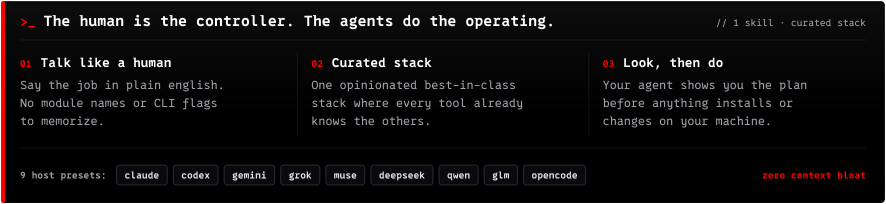
The human is the controller. The agents do the operating. Stop being your computer's assistant.
Your coding agent registers one small skill, once. From that moment on, you state what you want in plain english the way you would brief a sharp colleague across the desk, and your agent reaches into a curated stack of open-source modules, loads the right playbook on demand, and brings you a plan to approve.

Install cto-legends (python -m pip install cto-legends) and wire the router skill
into your host with cto-legends agent-setup. From then on, whenever I describe a
job in plain english, find the right module and show me the plan before making changes.
Plain english · Curated stack · Plan first · Host setup · The modules · Reference
Agent skills in plain english
Nobody who uses this describes it to a friend as a router or a CLI manager. They say: you tell your coding agent what you want in normal words, and it already knows which tools to combine to get the job done.
Months of building with coding agents every day taught this project one plain lesson: momentum dies the minute you stop thinking about your business or your build to hunt for a CLI flag, an environment variable, or a package name. The best sessions feel like a conversation across a desk. You state the outcome, and the stack assembles itself behind the scenes.
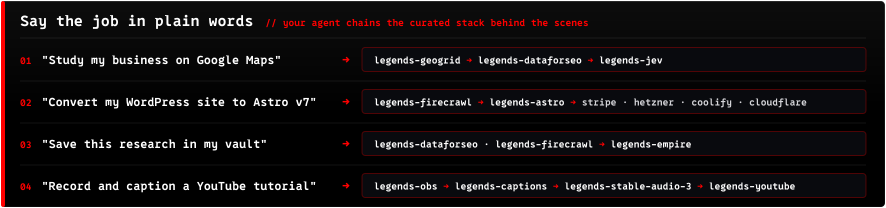
Start where a human actually starts, with a sentence. Here are four the stack was built to answer.
"Study my business on Google Maps."
Your agent asks the router and gets back ranked candidates with clear reasons, not a blind guess. legends-geogrid leads the plan and pairs with legends-dataforseo alongside it, combining city-wide Maps ranking grids with live Search demand, Business Profile audits, and visibility checks across Google AI Mode and LLM Mentions. Add legends-jev and your agent can verify whether the keywords stuffed into a competitor's Maps title actually appear on the physical sign above their storefront door.
"Convert my WordPress site to Astro v7."
Migrations land on legends-astro, and it never works alone. legends-firecrawl scrapes the legacy pages, runs interactive browser sessions when a site hides behind dynamic scripts, parses local PDFs, Word documents, and spreadsheets into clean Markdown, and queries structured data through Alexandria. Astro's source audit turns that harvest into a strict migration contract covering every URL, title, canonical tag, and structured data block.
Once the pages build cleanly, the rest of the web infrastructure lines up in order. legends-stripe audits price IDs and verifies payment webhooks, legends-hetzner sizes the cloud server, legends-coolify inspects the deployment pipeline, and legends-cloudflare cuts the DNS over with a reviewed change plan.
"Save this research in my vault."
legends-empire is the long-term memory that the rest of the stack writes into. Search and scraping tools export portable evidence packages bound to a SHA-256 manifest, and Empire verifies every file before planning it into your Markdown vault. With ontology queries, vault stewardship, and instant vault search built in, research you paid for on Tuesday is ready to query on Friday instead of bought twice.
"Record and caption a YouTube tutorial."
legends-obs configures and verifies your recording scenes first. Once the take wraps, legends-captions renders active-word subtitles with alignment timing, legends-stable-audio-3 scores background music or sound effects after checking your local GPU and model access, and legends-youtube validates the chapters and thumbnail before freezing a private draft upload.
Four everyday sentences, zero module names typed, and zero CLI flags memorized. Your agent connects the tools because the tools were designed as one family from day one, so you never have to play switchboard operator.
Why a curated stack beats a pile of Claude skills and Codex skills
In a sea of infinite options, a directory of five hundred unvetted plugins is not help. It is more homework.
Nobody wants a bookmark list of every package on GitHub. You want the internet boiled down to the one stack where every piece is vetted, maintained, and built to pass data cleanly to the next across local search, web hosting, site migration, payments, CRM, studio production, voice dictation, and vault memory.
Compare that with how most people manage Claude skills and Codex skills today. You find a repo, drop a folder into ~/.claude/skills, copy it into ~/.codex/skills, and repeat that over and over until your agent has two diverging shelves of stale instructions. Worse, if you wire up a dozen separate claude code mcp servers, every single session pays a permanent context-window tax before you even say hello.
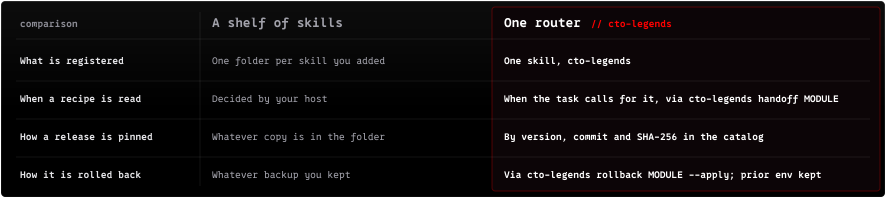
cto-legends asks your agent to register one lightweight router skill in total. Every module stays off the shelf until a sentence you speak calls for one. When it does, your agent runs cto-legends handoff and reads that single module's playbook on demand. Because the router is a plain Markdown skill backed by a local CLI, no background daemon or resident claude code mcp server ever sits in memory eating tokens between turns.
Why your agent shows the plan before anything changes
When you speak in plain english and let your coding agent drive, you only need one guarantee: the agent proposes, and you approve.
Traditional quick starts were written for an era when a human read the command before pressing Enter. Now your coding agent is the one typing. Left unchecked, an agent acts at machine speed without pausing to wonder what a random install script is about to do to your global Python environment or your live accounts.
cto-legends turns that habit around at the system level. Every action that can write to your disk or install a module prints its plan first and waits for confirmation. When you say go, the download is verified against a cryptographic SHA-256 digest, unpacked into its own isolated environment so dependencies never collide with your project, and backed by your previous working version for instant rollback.
Routing a question never triggers a hidden download, and installing a module never burns a paid API credit. You get the ease of speaking to a colleague, backed by the discipline of a systems engineer.
Host setup: Claude skills, Codex skills and 7 more presets
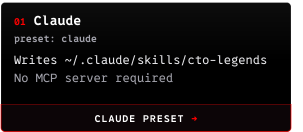
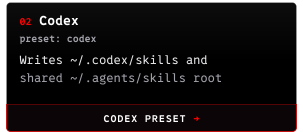
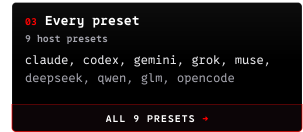
Every preset wires the single router skill into that host's standard directory and never overwrites a file you have customized by hand. Whether you rely on Claude skills, Codex skills, or switch between nine different coding agents, every host reads the same router contract.
| Preset | Skill folders agent-setup writes | Optional startup-setup file |
|---|---|---|
claude | ~/.claude/skills | ~/.claude/CLAUDE.md |
codex | ~/.codex/skills, ~/.agents/skills | ~/.codex/AGENTS.md |
gemini | ~/.gemini/skills, ~/.gemini/config/skills | ~/.gemini/GEMINI.md |
grok | ~/.grok/skills | ~/.grok/AGENTS.md |
muse | ~/.agents/skills | pass --instruction-file <path> |
deepseek | ~/.deepseek/skills, ~/.config/opencode/skills, ~/.agents/skills | pass --instruction-file <path> |
qwen | ~/.qwen/skills, ~/.agents/skills | ~/.qwen/QWEN.md |
glm | ~/.zcode/skills, ~/.config/opencode/skills, ~/.agents/skills | pass --instruction-file <path> |
opencode | ~/.config/opencode/skills, ~/.agents/skills | ~/.config/opencode/AGENTS.md |
Any coding agent without native skill loading can read cto_legends/SKILL.md directly, and you can register your own internal Markdown playbooks alongside the public catalog with cto-legends register-guide.
The curated modules
Every module is an independent open-source repository with its own test suite and release pins, and you never need to memorize their names. They are listed below so you can see how far a single plain-english request reaches, and you can also browse the interactive engineering specs at cto-legends.com/modules.

Every CLI module installs inside its own isolated release folder (dedicated Python virtual environments plus the prebuilt legends-obs Node CLI). The native desktop application, legends-hyperyap, routes through cto-legends guide legends-hyperyap so the router never triggers an operating system installer behind your back.

See where a business or product actually stands across Google, Maps, and AI answer engines, and keep the evidence so you never pay for the same lookup twice.
| Module | Say something like | What it does |
|---|---|---|
legends-geogrid | "Where does my pizza shop rank on Google Maps across the city?" | Google Maps ranking grids, competitive studies and a 21-page strategy report in PDF and HTML |
legends-dataforseo | "Check our Google AI Mode visibility and keyword demand" | Google AI Mode, LLM Mentions, Search, Maps, Business Profile and keyword research, with saved offline evidence |
legends-jev | "Read the text on this storefront photo and verify the sign" | Optical recognition, storefront signage verification and advice on the next computer-use action |
legends-firecrawl | "Turn this website and its PDF brochures into clean Markdown" | Web scraping, local PDF and document-to-Markdown parsing, interactive browser sessions, paper search and Alexandria data queries |
legends-github | "Improve how developers discover my GitHub repository" | Researches search demand, then improves repository copy, metadata, presentation and releases |
legends-grant | "Find US grants for a small business or nonprofit" | Discovers US grants, reviews eligibility and drafts evidence-linked proposals |

Move from a scraped legacy site to a live production server taking payments, running durable background schedules, and syncing CRM pipelines, one reviewed plan at a time.
| Module | Say something like | What it does |
|---|---|---|
legends-hetzner | "Check my Hetzner project and plan a new server" | Inspects Hetzner Cloud projects, scans Cost-Optimized stock and prepares reviewed server plans |
legends-coolify | "Inspect my Coolify applications and deployment logs" | Read-only Coolify operations and source-cited runbooks |
legends-cloudflare | "Preview a DNS cutover before applying it" | Cloudflare DNS automation with reviewed change plans and readback checks |
legends-astro | "Convert my WordPress export to an Astro v7 site and verify parity" | Astro v7 migrations, source contract extraction and build parity checks |
legends-stripe | "Audit my .env file against Stripe and check for mismatched price IDs" | Stripe governance: price-ID audits, catalog lint, hosted invoicing, fee telemetry and webhook verification |
legends-gohighlevel | "Audit my GoHighLevel sub-account health, pipelines and workflows" | GoHighLevel CRM, workflows and agency governance, with preview-first changes and API readback |
legends-buzz | "Check why my Buzz agent gets HTTP 403 when the relay is healthy" | Self-hosted Buzz relay operations, membership diagnostics and agent routing |
legends-temporal | "Schedule a nightly 2:30am job and diagnose any failed workflows" | Temporal durable cron schedules, one-shot timers, zero-rewrite ScriptJob workers and failure history verdicts |

Record your screen, score it with local AI audio, render active-word captions, pull verified yt-dlp video archives, and ship a verified private YouTube draft, with your own voice as the keyboard.
| Module | Say something like | What it does |
|---|---|---|
legends-obs | "Prepare OBS scenes for a 4K tutorial recording" | Inspects, configures and verifies OBS Studio recording workflows (live OBS control targets Windows) |
legends-captions | "Caption this video with active-word timing" | Caption QA and rendering with contextual correction, alignment timing and proof evidence |
legends-youtube | "Pull this video batch, cut word-timed clips, and freeze a private draft" | YouTube channel operations, lossless metadata updates, quota planning, private-draft uploads and verified yt-dlp archiving (legends-yt-dlp) |
legends-stable-audio-3 | "Can we generate some AI music?" | Instrumental music, sound effects and continuous mixes |
legends-hyperyap | "Let me type with my voice in any app" | Local voice typing, dictation and app-focused paste |
legends-ambient-intelligence | "Transcribe my voice memos offline and distill key notes" | Ambient audio capture, deduplicated archiving, offline transcription and vault distillation |

Memory is the vault that every other module writes into, so tomorrow's session begins with everything today's session proved.
| Module | Say something like | What it does |
|---|---|---|
legends-empire | "Save this research in my vault and index it" | Markdown vault memory, instant vault search, hash-verified research intake and ontology stewardship |
Message Benjamin from your terminal
cto-legends dm is the 2-way direct line to Benjamin from a coding session. It sends immediately, saves your guest thread locally at ~/.cto-legends/dm-thread.json, and polls politely when you ask it to watch for a reply. Replies are printed as plain text and are never executed.
cto-legends dm login
cto-legends dm send "Hi Benjamin, I have a question about my stack." --name Jane --email jane@example.com
cto-legends dm send "Following up on the above" --watch --timeout 1800
cto-legends dm read
cto-legends dm watch --timeout 1800
cto-legends dm link
cto-legends dm logout
dm login signs you in with Google or GitHub in 1 click. It prints a pairing link, tries to open it in your browser (add --no-browser to skip that), and polls until you approve. Any guest thread you already sent merges into your account on approval. After that, dm send, dm read and dm watch use your saved sign-in automatically, and dm link shows the account you are signed in as. dm logout revokes the saved sign-in and clears it from this machine. Opening the dm link claim URL in your browser and signing in there also works, so Benjamin's reply can reach you by email and stay synced across devices. Set CTO_LEGENDS_MCP_TOKEN to override the saved sign-in with an explicit member Bearer token. dm watch polls at 10s, then 20s, then 30s intervals, defaults to a 30 minute timeout, and never watches longer than 60 minutes.
Reference
Everything you need to use cto-legends with your coding agent is in the essay above. Open these two drawers whenever you want the full command table or filesystem layout.
The full CLI: all commands
Every command returns structured JSON. A "yes" in the final column means the command prints its preview plan and changes nothing on disk until you add --apply.
| Group | Command | What it does | Look, then do |
|---|---|---|---|
| Discovery | route "<goal>" | Finds modules for a plain-english goal and returns ranked candidates with reasons | |
| Discovery | capabilities [--markdown] | Reads the outcome-based capability index offline | |
| Discovery | handoff <module> | Resolves one module's instructions without registering another skill | |
| Discovery | guide <module> | Shows pinned setup instructions, platform requirements and release downloads | |
| Discovery | catalog | Lists the bundled, verified module set | |
| Lifecycle | status | Shows managed paths and installed versions | |
| Lifecycle | install <module ...> | Installs modules from pinned, verified releases | yes |
| Lifecycle | update [module ...] | Updates the named modules, or every installed module when none are named | yes |
| Lifecycle | rollback <module> | Switches a module back to its retained previous environment | yes |
| Lifecycle | run <module> -- <args> | Runs an installed module; everything after -- goes straight to it | |
| Lifecycle | check-updates | Compares installed, catalog and upstream versions without installing | |
| Lifecycle | sync [--rollback] | Refreshes the catalog; --rollback reverts to the previous one | yes |
| Readiness | doctor | Checks installed environments without provider API calls | |
| Readiness | task-readiness [task] | Offline checks for task prerequisites: all, reports, research, evidence or github | |
| Readiness | report-readiness | Checks GeoGrid reports, map browser and transport without paid calls | |
| Host and shelf | agent-setup <host> | Registers the router skill for an agent host | yes |
| Host and shelf | install-skill --directory <folder> | Registers the router in an explicit skills folder | yes |
| Host and shelf | agent-audit <host> | Lists retired standalone skills still in a host's folders | |
| Host and shelf | isolate-skills <host> | Moves those skills into a manifest-tracked backup | yes |
| Host and shelf | restore-skills <manifest> | Puts isolated skills back from their manifest | yes |
| Host and shelf | startup-setup <host> | Writes the capability index into the host's startup instruction file, with a backup | yes |
| Host and shelf | startup-status <host> | Inspects the startup contract for a host | |
| Host and shelf | startup-restore <manifest> | Restores a startup change from its checked backup | yes |
| Host and shelf | register-guide <name> <path> | Registers one of your own local Markdown guides so handoff can resolve it | yes |
| Direct message | dm login | Signs in with Google or GitHub in 1 click and pairs this CLI | |
| Direct message | dm send "<message>" [--watch] | Sends a message to Benjamin and saves the guest thread locally | |
| Direct message | dm read | Reads the DM thread and shows Benjamin's replies as plain text | |
| Direct message | dm watch [--timeout 1800] | Polls politely for Benjamin's reply; exits 0 on reply or timeout | |
| Direct message | dm link | Prints the saved claim URL and signed-in status for this thread | |
| Direct message | dm logout | Revokes the saved sign-in and clears it from this machine |
Staying current follows the exact same look-then-do rhythm:
cto-legends check-updates                     # compare installed, catalog and upstream; installs nothing
cto-legends sync                              # look: preview a catalog refresh
cto-legends sync --apply                      # do: adopt the refreshed catalog
cto-legends update                            # look: see which installed modules would move
cto-legends update --apply                    # do: upgrade them in isolated environments
cto-legends rollback legends-geogrid          # look: preview the kept release it would switch to
cto-legends rollback legends-geogrid --apply  # do: switch back to the retained working environment
Global options: --home <path> moves the managed home folder, and --version prints the installed version. The CLI answers to cto-legends, ctolegends, python -m cto_legends and python -m ctolegends.
Disk, verification and license notes
- Where it lives. Everything the hub manages sits under
~/.cto-legends(override it with--homeor theCTO_LEGENDS_HOMEenvironment variable). Managed modules unpack under~/.cto-legends/releases/into isolated per-release folders (dedicated virtual environments for Python modules and a self-contained prebuilt package forlegends-obs), so modules never share dependencies with each other or pollute your project packages. - What gets verified. Every release in the bundled catalog is pinned by version, commit hash and SHA-256 digest. Running
--applyverifies the downloaded archive against that cryptographic pin before building the virtual environment. Runcto-legends catalogat any time to inspect every pin. - How you go back. When a module updates, the previous environment stays on disk so
cto-legends rollback <module> --applyrestores your prior working version in one step without a new download. The catalog keeps a rollback copy too, and any interrupted install writes full diagnostics toinstall.log. - Refused paths. Managed paths reject symlinks, Windows junctions and reparse points.
- Requirements. Python 3.11 or newer. Running
cto-legends doctoralso checks whether optional host binaries (node,pnpmandgh) are available on yourPATH. - More hosts. Beyond the nine main presets,
agent-setupalso acceptsantigravity(aliasagy),cursor,windsurfandaider, plus the aliasesmetamuse,qwen-code,zaiandzcode. - Old names still work. Twelve earlier module names resolve automatically as aliases in the router catalog.
- Licenses.
cto-legendsis MIT. Every module is MIT exceptlegends-stable-audio-3(Apache-2.0) andlegends-hyperyap(AGPL-3.0), and the optional OBS cursor overlay extra is GPL-2.0-or-later, all documented in THIRD_PARTY_NOTICES.md beside NOTICE. - Deeper docs. Architecture, capability discovery, agent hosts, startup, research workflow, Home adapter, contributing and security.
Contributors can run the release verification suite locally:
python -m unittest discover -s tests -v
python -m pip install build twine
python -m build
python -m twine check dist/*
Start here
Paste the agent handoff block at the top of this page into your coding agent, let it wire the router skill, and speak your first sentence. One install opens the door to every module in the stack, and agent skills never have to pile up in your folders again.
Running a company and not a terminal? Founders and operators who want this way of working applied directly to their own business stack have one route: message Avalon Reset at cto-legends.com/dm or start with a 48-hour diagnostic at cto-legends.com/home#home-offer. The desk is async, so the conversation starts the moment you write and nobody forces you onto a sales call.

Built in public by one maker, Avalon Reset.