PHI Guard MCP
Scans source code for PHI leaking into LLM prompts, logs, and analytics calls - local-first, no network calls.
Documentation
phi-guard-mcp



A local-first MCP server that catches PHI (protected health information) flowing into LLM prompts, log statements, and analytics calls — in your source code, before it ships.
The server itself makes no network calls: it runs as a local stdio process and never uploads your code. What it returns is a different matter. Findings go back to whatever MCP client launched it, so if that client is a hosted assistant, the findings enter that model's context. Matched PHI values are masked out of results by default for exactly this reason — see Security boundary.
Why
The risky moment in a healthcare codebase is rarely the database. It's the line
where a patient record gets interpolated into a prompt, a console.log, or an
analytics event. Those lines look harmless in review and never show up in
infrastructure scanning, because nothing is misconfigured — the code is just
doing what it says.
Demo
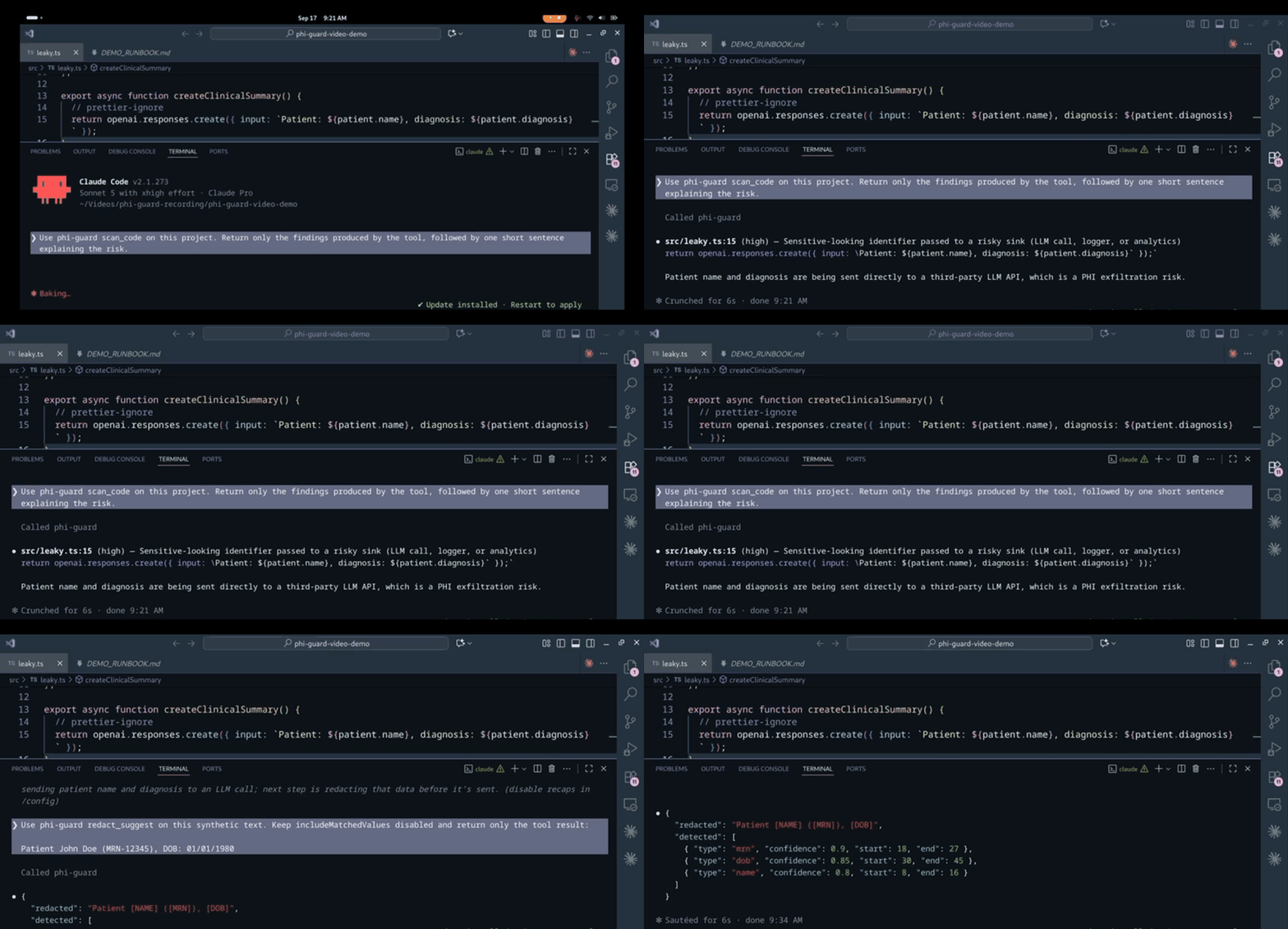
Eleven seconds of the walkthrough: scan_code flags line 15 — a patient name
and diagnosis interpolated into an openai.responses.create call — and
redact_suggest masks the same values out of a raw prompt. Every value shown is
synthetic.
A linter for one class of mistake. Not a HIPAA certification, not a compliance attestation, and not a dataflow analyzer — see What this is NOT.
Install
Requires Node.js 22 or newer. The entrypoint uses JSON import attributes
(with { type: "json" }), so older runtimes will not start it. Verified on
Node 22.18.0, 24.2.0, and 26.8.2; Node 20 and below are unsupported and
untested.
From npm (recommended)
Nothing to clone or build. Your MCP client runs it on demand:
npx -y phi-guard-mcp --version
From source
git clone https://github.com/Abidit/phi-guard-mcp.git
cd phi-guard-mcp
npm ci
npm ci runs the prepare script, which builds dist/. There is no separate
build step to forget. npm install works too; npm ci is the reproducible one
because it installs exactly what package-lock.json pins.
MCP configuration
Copy-paste one of the following. The npm form needs no paths and is the one to hand to someone else.
Claude Code
One command, project scope:
claude mcp add phi-guard -- npx -y phi-guard-mcp
Or commit a .mcp.json at your project root:
{
  "mcpServers": {
    "phi-guard": {
      "command": "npx",
      "args": ["-y", "phi-guard-mcp"]
    }
  }
}
Claude Desktop
~/Library/Application Support/Claude/claude_desktop_config.json on macOS,
%APPDATA%\Claude\claude_desktop_config.json on Windows:
{
  "mcpServers": {
    "phi-guard": {
      "command": "npx",
      "args": ["-y", "phi-guard-mcp"]
    }
  }
}
Cursor
.cursor/mcp.json in the project, or ~/.cursor/mcp.json globally:
{
  "mcpServers": {
    "phi-guard": {
      "command": "npx",
      "args": ["-y", "phi-guard-mcp"]
    }
  }
}
Running a local clone instead of the npm release
Point the client at the build output. Use an absolute path unless you are certain your client launches the server with the project root as its working directory:
{
  "mcpServers": {
    "phi-guard": {
      "command": "node",
      "args": ["/absolute/path/to/phi-guard-mcp/dist/index.js"]
    }
  }
}
The .mcp.json committed in this repo uses the relative form (dist/index.js)
so the repo can dogfood its own server after npm ci.
Whichever form you use: restart the client, or run /mcp in Claude Code and
reconnect phi-guard. A rebuild alone will not reach an already-running stdio
process.
Tools
redact_suggest
Takes a raw text snippet — a log line, a prompt, an error message — detects PHI-shaped values, and returns a redacted version alongside what it found.
Input
{ "text": "Patient John Doe (MRN-12345), DOB: 01/01/1980" }
Output
{
  "redacted": "Patient [NAME] ([MRN]), [DOB]",
  "detected": [
    { "type": "mrn",  "confidence": 0.9,  "start": 18, "end": 27 },
    { "type": "dob",  "confidence": 0.85, "start": 30, "end": 45 },
    { "type": "name", "confidence": 0.8,  "start": 8,  "end": 16 }
  ]
}
The matched values are not echoed back by default, and neither is the
unredacted original. A tool result flows straight into the context of
whatever model called it, so repeating the raw PHI there would undo the point
of the tool. start/end are offsets into the original text, which is enough
to locate a match without restating it.
detected is ordered by pattern, not by position.
Pass includeMatchedValues: true when you genuinely need the raw values (a
local CLI, a test harness) and detected[].value plus original come back:
{ "text": "Patient John Doe (MRN-12345)", "includeMatchedValues": true }
Patterns and their confidence scores:
| Type | Confidence | Matches |
|---|---|---|
ssn | 0.95 | 123-45-6789 |
mrn | 0.90 | MRN-12345, MRN: 12345 |
dob | 0.85 | DOB: 01/01/1980, born 3/14/75 |
name | 0.80 | Patient John Doe (captures John Doe) |
phone | 0.75 | 555-867-5309, (555) 867 5309 |
email | 0.70 | jane.roe@example.com |
That table is the complete list. The patterns start deliberately narrow — a false positive that trains someone to ignore the tool is worse than a missed match.
scan_code
Walks a directory and flags lines where a sensitive-looking identifier appears on the same line as a risky sink.
Sensitive identifiers — the complete list:
patient, diagnosis, dob, ssn, mrn, birthdate, medicalrecord
Matching is case-insensitive and bounded by non-letters, so patient_name
matches while outpatient and inpatient do not.
Sink categories — the complete list:
| Category | Matches |
|---|---|
| LLM providers | openai, anthropic, bedrock |
| Console | console.log, console.error, console.warn |
| Loggers | logger., winston, pino |
| Analytics | .track( |
| Error reporting | capture(, captureException(, captureMessage( |
Languages scanned — the complete list:
| Extension | Language |
|---|---|
.ts, .tsx | TypeScript |
.js, .jsx | JavaScript |
.py | Python |
.go | Go |
Detection is purely lexical, so language support means "these file extensions are read". There is no parser and no type information for any of them.
Skips node_modules, dist, build, coverage, out, .next, .turbo,
and any dotfile or dot-directory. Whole-line // and # comments are skipped,
so a file that discusses PHI handling in prose doesn't trip the scanner on its
own documentation.
Given the operative lines of
test/fixtures/leaky-example.ts:
const prompt = await openai.responses.create({ input: `Patient: ${patient.name}, diagnosis: ${patient.diagnosis}` });
console.log("Sending patient prompt to LLM:", prompt);
Input
{ "path": "/abs/path/to/repo/test/fixtures" }
Output — excerpt. That directory returns 9 findings in total: 2 from this file, and 7 from the positive fixtures described under Evaluation.
[
  {
    "file": "/abs/path/to/repo/test/fixtures/leaky-example.ts",
    "line": 7,
    "severity": "high",
    "issue": "Sensitive-looking identifier passed to a risky sink (LLM call, logger, or analytics)",
    "snippet": "const prompt = await openai.responses.create({ input: `Patient: ${patient.name}, diagnosis: ${patient.diagnosis}` });"
  },
  {
    "file": "/abs/path/to/repo/test/fixtures/leaky-example.ts",
    "line": 8,
    "severity": "high",
    "issue": "Sensitive-looking identifier passed to a risky sink (LLM call, logger, or analytics)",
    "snippet": "console.log(\"Sending patient prompt to LLM:\", prompt);"
  }
]
file is built by joining path with the entry name, so it comes back in
whatever form you passed in: absolute in, absolute out. severity is always
"high" — there is one rule, so there is one severity.
snippet is the offending line with any literal PHI masked, for the same
reason redact_suggest withholds matched values: the finding is going into a
model's context. Identifier names like patient.diagnosis are not literal
values, match no PHI pattern, and stay visible — they are the actionable part.
An empty array means every eligible source file discovered under path was
read successfully and no line matched both conditions. "Eligible" and
"discovered" are load-bearing: files with an unsupported extension, and
anything under a skipped or dot-prefixed directory, are never opened.
A scan that cannot read a directory or a file fails with a named error rather than returning a shorter list, because a partial result reads as a clean result:
No such path: "/nope". Pass an absolute path to a directory that exists on the
machine running this server. (ENOENT: no such file or directory, stat '/nope')
The same-line rule
Both conditions must hold on the same physical line. This is the single most important thing to understand about the scanner, in both directions.
It is what keeps it quiet. On this repo's own src/ — which is dense with the
words patient, diagnosis, mrn, and ssn inside its pattern definitions —
it reports zero findings.
It is also the main reason it misses things. This leaks and is not flagged:
const value = patient.diagnosis;   // sensitive identifier, no sink
console.log("audit", value);       // sink, no sensitive identifier
There is no dataflow analysis, no variable tracking, and no cross-line
correlation. A worked example lives in
test/fixtures/known-limitations/split-across-lines.ts,
and the test suite scans it on every run so the gap stays visible rather than
forgotten.
Evaluation
npm run verify
One command: typecheck (src/ and test/ under strict mode), build, then the
fixture suite against the real server over stdio.
The current result:
Detected all 7 representative leak fixtures and flagged none of 5 clean fixtures.
Those fixtures are all in test/fixtures/, so you can read
them rather than take this on faith.
The 7 leak fixtures cover 5 sink categories (OpenAI, Anthropic, Sentry,
Winston, analytics) and 2 languages (TypeScript, Python). They include
snake_case identifiers (patient_name, patient_diagnosis), which a naive
word-boundary regex misses and which is the dominant naming convention in
Python and Go, and a hardcoded-literal fixture that verifies scan_code masks
literal PHI out of the snippet it returns.
The 5 clean fixtures include code that discusses PHI policy in comments and prose without ever leaking it, and code that legitimately handles patient records without sending them anywhere risky.
The suite also asserts:
- the README's worked example still produces exactly 2 findings, on lines 7 and 8
- no raw literal PHI appears anywhere in a
scan_coderesult redact_suggestomits every matched value and the original by defaultincludeMatchedValues: trueactually returns them- a missing path and a file-instead-of-directory each return a named error
What this number is not. It is a fixture suite of 12 hand-written files that this project wrote to exercise its own rules. It is not a detection rate, not a benchmark, not a false-positive rate, and not external validation. It says nothing about how the scanner performs on a real healthcare codebase, where the false-negative rate is unknown and, given the same-line rule above, certainly not zero. Measuring that would need a labelled corpus this project does not have.
Other checks:
npm test          # fixture suite only
npm run typecheck # src/ and test/ under strict mode
npm run test:smoke  # minimal stdio round-trip
Or drive it through the official Inspector without a browser:
npx @modelcontextprotocol/inspector --cli node dist/index.js --method tools/list
npx @modelcontextprotocol/inspector --cli node dist/index.js \
  --method tools/call --tool-name redact_suggest \
  --tool-arg text="Patient John Doe (MRN-12345)"
The server declares only the tools capability, so at the protocol level
resources/list and prompts/list return -32601 Method not found. The
Inspector CLI normalises those into {"resources": []} and {"prompts": []},
and the Inspector UI may show them in red. Both are expected, not a fault.
Troubleshooting
The server appears to hang when I run it. That is correct behaviour. It is
a stdio server: it waits for JSON-RPC on stdin and prints nothing on its own.
Run npx -y phi-guard-mcp --help or node dist/index.js --version if you just
want to confirm it is installed.
The client shows phi-guard as failed or disconnected. Run the command
from your config by hand and look at stderr — npx -y phi-guard-mcp --version,
or node /absolute/path/to/dist/index.js --version. If that prints a version,
the problem is the config path, not the server.
Cannot find module '.../dist/index.js'. You are running from a clone and
dist/ has not been built. dist/ is gitignored on purpose. Run npm ci.
SyntaxError: Unexpected identifier 'assert' or an import-attribute error on
startup. Your Node is older than 22. Check with node --version. Note
that your MCP client may launch a different Node than your shell does.
Code changes don't show up. An already-running stdio process keeps the old
build. Rebuild, then restart the client or reconnect the server (/mcp in
Claude Code).
scan_code returns [] on a repo I know has leaks. Three likely causes,
in order: the identifier and the sink are on different lines (see
the same-line rule); the file extension is not in the
supported list; or the directory is skipped (dist, build, anything
dot-prefixed). Confirm the scanner is alive by pointing it at this repo's
test/fixtures directory, which must return 9 findings.
scan_code errors with No such path. The path is resolved on the machine
running the server, and a relative path is resolved against whatever working
directory your MCP client gave the process. Pass an absolute path.
What this is NOT
- Not a hosted service. It is a local stdio process. There is no backend, no account, and no telemetry, and the server makes no network calls of its own. That is not the same as "nothing leaves your machine": findings are returned to the MCP client, which may be a hosted assistant. See Security boundary.
- Not a HIPAA certification, audit, or compliance attestation. Passing a
scan_coderun proves nothing to a regulator. It is a linter for a specific class of mistake, not evidence of compliance. Treat a clean result as "these particular patterns didn't fire", never as "this codebase is HIPAA-safe". - Not validated by anyone but its author. The fixtures were written by this project to test this project. There has been no external review, no third-party audit, and no evaluation against a real healthcare codebase.
- Not a competitor to Prowler, AWS Config, or cloud posture tools. Those scan infrastructure and configuration. This reads source code and finds a different class of problem. They are complementary; this replaces neither.
- Not exhaustive. Regex-based detection has a real and unmeasured false-negative rate. It will not catch PHI in a variable it can't name-match, or values arriving from an external call.
- Not able to follow a value across lines. See the same-line rule. Real dataflow analysis is out of scope; this is a deliberate boundary.
- Not fully comment-aware. Only whole-line
//and#comments are skipped. Block comments (/* ... */) and trailing end-of-line comments are still scanned, so a sink keyword sitting inside one of those can produce a finding even though nothing executes. - Not a secrets scanner, and not a substitute for code review. It looks for one pattern: a sensitive-looking name next to a risky call.
Security boundary
The server reads any directory it is handed, on the machine it runs on, with the permissions of the user who started it. It has no sandbox and no allowlist. Point it at code you are entitled to read.
The server opens no sockets and makes no outbound requests. It does not follow
that your data stays local. A tool result is returned to the MCP client that
launched the server, and if that client is a hosted assistant, the result is
transmitted to and processed by that provider under their terms, not this
project's. Treat every scan_code and redact_suggest result as content you
are sending to your model provider.
snippet and redact_suggest results are masked by default specifically so
that what gets transmitted is identifier names and positions rather than PHI
values. The masking is the same regex set described above, so it carries the
same false-negative rate: a value those patterns do not recognise is passed
through unmasked. Do not treat "it was masked" as a guarantee, and do not run
this against production PHI through a hosted client without first satisfying
yourself about that client's data handling.
Contributing
npm run verify must pass. CI runs it on Node 22 and 24.
License
MIT — see LICENSE.
Mcp Server Approved
