MindForge
Memória vitalícia de nível de produção para agentes de IA — modelo de memória de 4 níveis (sensorial/curto prazo/longo prazo/permanente), grafo de conhecimento, criptografia AES-256-GCM, compartilhamento federado de memória P2P. Prioridade local, SQLite + FTS5, recuperação híbrida.
Documentação
MindForge
A local-first, production-grade memory system for AI agents.
Maintainer — Gu Fengyu (顾冯雨), born 2008-01-10 · GitHub: opok-ops · 抖音: shidianduo3116 · 小红书: 4406811524 · Feedback: 2638895480@qq.com
MindForge gives AI agents a persistent, structured long-term memory: a four-tier lifecycle model, knowledge graphs, hybrid retrieval, end-to-end encryption, and MCP / CLI / REST interfaces. All data stays on your machine.
The story — one developer, seven months, from v1.0 (March 2026) to v6.5.5: no team, no funding, 1,272 passing tests. Read the journey →





English · 中文文档 · Live Demo · Documentation · Discussions
Overview
Agent memory solutions that rely on cloud backends introduce latency, cost, and privacy trade-offs. MindForge takes the opposite approach: memory is computed and stored locally, encrypted at rest, and exposed through standard interfaces your existing agents already speak.
Key design decisions:
- Local-first. No cloud dependency. Storage runs on SQLite + FTS5 with WAL, a single file that moves with you.
- Structured memory. Four tiers (sensory, short-term, long-term, permanent) with promotion and decay driven by the Ebbinghaus forgetting curve.
- Retrieval quality. Six complementary retrieval paths fused into one ranked result, instead of a single vector index.
- Encryption by default. AES-256-GCM at rest with PBKDF2 key derivation; encrypted backups you can export and trust.
- Open interfaces. MCP server (87 tools), Python SDK, CLI with shell completion, and a REST API for non-Python consumers.
Quick Start
Install from source, then start writing and reading memories in minutes:
git clone https://github.com/opok-ops/MindForge.git
cd MindForge
pip install -e .               # zero ML deps: 3-path retrieval (TF-IDF + FTS5 + fuzzy)
pip install -e ".[embedding]"  # + vector path → full 6-way hybrid search
Without the
embeddingextra, MindForge runs in zero-dependency mode — fully functional, but paraphrased queries may go unrecalled (no semantic path). With it, a small sentence-transformers model downloads on first vector search.
from mindforge import MindForge

m = MindForge(db_path="./data/memory.db", encrypted=False)
m.add("User prefers type-hinted Python code", category="preferences", importance="HIGH")
result = m.search("coding preferences")
print(result.chunks[0].content)
CLI:
MindForge add "User likes cats" --category preferences --importance HIGH
MindForge search "what does user like"
MindForge stats
Scale & Quality Benchmarks (v6.4.9, measured)
| Scale | add throughput | search p50 (rare token) | search p50 (realistic mixed) | search p50 (pathological all-common) | db size |
|---|---|---|---|---|---|
| 200 entries (baseline) | — | 1.8 ms | — | — | <1 MB |
| 10,000 | 1,080/s | ~9.5 ms | ~16 ms | — | 10 MB |
| 100,000 (~10M chars) | ~546/s | 6.8 ms | 3.0 ms | 0.4 ms | 98 MB |
- Ten-million-character library, millisecond-class across all query types (v6.4.9): pathological 218→0.4ms (−99.8%), mixed 143→3.0ms (−98%), rare 6.8ms, combined 17.8ms (100k full-pipeline, clean environment). The last bottleneck — FTS5 high-frequency-phrase bm25 scoring — is now pruned query-side via trigram-df pre-check (df upper bound = min trigram df, pruned at 5% corpus size, symmetric to the TF-IDF max_df design; df served from an in-process cache — fts5vocab is a streaming virtual table, per-term probes scan it fully).
- Index-blindness fix (v6.4.8): TF-IDF vocabulary was locked to the first 5 documents since v6.4.6 — incremental adds indexed as empty vectors (TF-IDF effectively half-dead; previous numbers carried by FTS5/fuzzy). Fixed with incremental vocabulary growth; all pipeline numbers above are now true full-pipeline measurements.
- Retrieval quality (fixed-seed,
benchmarks/quality_bench.py, 2k entries): needle Recall@1 = 1.0, MRR = 1.0, topic Recall@1 = 1.0, noise false-recall = 0. - Full LLM-judged benchmarks (LoCoMo / LongMemEval) — interface ready, not yet run (requires external LLM API key).
- TF-IDF degraded mode process memory at 100k: ~700 MB. Index LRU cap: 100,000 docs (MINDFORGE_INDEX_MAX_DOCS).
What's New
v6.1.3 – v6.4.9 shipped in ten days (2026-11-01 → 11-11; four releases in the last two days), guarded by 1,273 tests (1,272 passing, 1 environment-skipped).
-
v6.4.9 — ten-million-char library at millisecond latency: FTS5 high-frequency-phrase scoring pruned (2026-11-11). The last honest bottleneck from v6.4.8's ledger. Root cause (30k per-path timing): under the trigram tokenizer, corpus-wide phrases (template data's "陈述性记忆") match every row — bm25 full-match scoring cost 50.5ms/query, the dominant remainder of 100k mixed latency. Fix, query-side df pre-pruning symmetric to TF-IDF max_df: a phrase's df upper bound = min df of its trigrams (phrase matches ⊆ every trigram's row set); prune at 5% of corpus size; keep the lowest-ub phrase if all pruned. df is served from an in-process cache keyed by
max(rowid)(add/update invalidate; hard-delete leaves df slightly stale = prunes more conservatively) — two real pitfalls found en route: fts5vocab is a streaming virtual table — per-term probes ANDINbatches trigger full scans (combined regressed 17→45ms before the cache). Plus: FTS5 path skipped on pathological fallback (no discriminating signal). Clean-environment 100k re-bench: pathological 122→0.4ms (−99.7%), mixed 134.9→3.0ms (−98%), all query types millisecond-class at ~10M chars. AI-flavored comment cleanup (essay-style docstrings → engineer-speak, info preserved). 5 new guards. -
v6.4.8 — pathological query path & index-blindness fix: O(N) fallback eliminated, TF-IDF actually indexing (2026-11-11). Two deeper findings beyond the v6.4.6 stress test: (1) the all-common-word fallback traversed all inverted chains at full length (O(N×dims), 209ms p50 at 100k), and the 0.5×N max_df threshold still let half-corpus chains into the active set; (2) the TF-IDF vocabulary had been locked to the first 5 documents — every incremental add after that indexed as an empty vector (the TF-IDF path was effectively half-dead since v6.4.6; published numbers were carried by FTS5/fuzzy). Fix, six cuts: max_df tightened 0.5×N→0.05×N; fallback semantics → shortest-chain-first (≤3 dims, per-chain cap 5,000, islice); fuzzy candidate budget (SQL cap 2,000 with exact-substring-first ordering); fuzzy gating (runs only on zero TF-IDF hits — the true typo-correction scenario; encrypted mode unaffected);
incremental_fit()vocabulary growth for adds after fit (old vectors not recomputed — new tokens contribute zero on old docs mathematically); empty-query fallback-signal reset. 30k repro: pathological steady-state 3825→4.0ms (−99.9%), mixed pipeline 1607→1.2ms, fuzzy single-path −93%. 100k re-bench: pathological −44%, all numbers now true full-pipeline. Remaining bottleneck honestly documented: FTS5 high-frequency-phrase scoring (v6.5). New observable_last_traversed+ deterministic budget contracts. 9 new guards. -
v6.4.6 — scale validation & retrieval benchmarks (2026-11-10). First 100,000-entry stress test: add throughput ~600/s (linear), ~98MB db, memory peak ~700MB (TF-IDF degraded mode), search p50 7.4ms (rare token, −92% vs pre-fix) / 143ms (realistic mixed); pathological all-common query 421→218ms (−48%). Fixed a real bottleneck found by the stress test: Chinese long-query p50 was 421ms — profile showed low-IDF common words degenerating the inverted index into full-corpus scans. Fix: two-tier pruning (relative-eps + standard IR max_df stop-wording for df > 0.5×N) + heapq.nlargest; pathological all-common-word queries (synthetic-template data only) honestly documented as known O(N) characteristic, realistic queries verified unaffected (8k A/B, 30k side-by-side: 43ms mixed vs 86ms pathological). Shipped reproducible benchmarks (
benchmarks/scale_bench.py,benchmarks/quality_bench.py): needle Recall@1 = 1.0 / MRR = 1.0, zero noise false-recall. Full LLM-judged benchmarks (LoCoMo/LongMemEval) deferred — needs external LLM API key. 7 new guards. -
v6.4.5 — audit-driven fixes (2026-11-10; v6.4.4 skipped by maintainer decision). Two inverse doc-code inconsistencies (v6.4.3 fixed "claimed but not done"; this one fixes "done but not tracked"):
connectors.pyoutgoing HTTP User-Agent was hardcodedMindForge-Connector/5.8.9— lying about the version to every target site since the 5.8.9 era (event_bus.pyfixed the same disease in v5.6.8; this one slipped through). Now dynamic from the single version truth. Website "core modules" count was stale (17 in prose, 15 in stat card, 31 measured) — both fixed to the measured 31; MCP tool count 87 verified exact, untouched. Audit archive (not a defect): WAL auto-checkpoint verified healthy under daemon-like load — 4 rounds × 400 mixed ops, WAL converged at ~4.1MB (default 1000-page threshold), TRUNCATE resets to zero. 5 new guards intests/test_v645_fixes.py. -
v6.4.3 — documentation-code consistency fix (2026-11-10). Pre-release audit found that v6.4.2's claimed first cut — WAL +
synchronous=NORMAL— never landed in code:_get_conn()set onlyjournal_mode=WAL, leavingsynchronousat SQLite's default FULL. The 2.1× search gain was real, but carried entirely by the other four cuts — real numbers, misattributed cause. This release addsPRAGMA synchronous=NORMALon the WAL branch (per-connection, cross-thread; network-FS DELETE fallback stays FULL by design). Same-machine A/B on SSD shows no statistically significant latency delta (search p50 1.8 → 1.8ms — fsync is ~0.1ms-scale here); the benefit targets slow disks and IO-saturated containers, and more importantly makes the documented power-loss semantics (un-checkpointed access counts / search audits may be lost; compliance audits still commit immediately) actually hold. 4 new guard tests intests/test_v643_fixes.py. -
v6.4.2 — tens-of-thousands-chars latency: another 2× (2026-11-09). Same-machine A/B benchmark (400 memories / ~47k chars, 3 runs each): search p50 6.3→3.0ms (2.1×), p95 11.7→4.2ms (2.8×); 24k-char library p50 2.5ms; fast machine state 1.8ms. Five surgical cuts: WAL +
synchronous=NORMAL(commits skip per-write fsync), enum-downgrade memo,row.keys()set reuse, first-visit access-count batching merged into oneflush_access()transaction per search, and search-audit INSERT folded into the same commit. The v5.6.3 throttle contract and v5.5.4recently_accessedsemantics are pinned by 23 contract tests — all green. Compliance-grade audits still commit immediately. (Note: thesynchronous=NORMALcut landed in v6.4.3 — see above.) -
v6.4.1 — million-character millisecond search (2026-11-09). Scale benchmark (8,000 memories / ~990k chars) exposed a fuzzy-fallback long tail: search p95 881ms. Root causes: SequenceMatcher wasted on mathematically-impossible matches (ratio = 2M/(m+n), M ≤ m, so n ≥ 4m can never pass 0.4) + a ~50μs/entry Python full-scan tax. Fixed with a math-capped prune + SQLite-level candidate pre-filtering: search p95 881→30.7ms (28×), add p50 2.6ms flat at 10k-scale. New
scripts/bench_scale.py+ CI scale guard (3000 memories, millisecond contract) + 4 behavior-level regression tests pin the semantics. -
v6.4.0 — resident daemon & performance guards (2026-11-08). New
mindforge daemonsubcommand: line-JSON over stdio, engine resident in a long-lived process — per-request p50 2.5ms vs 400–700ms for CLI subprocess spawning (two orders of magnitude; 2026-11-09 quiet-machine re-bench: 2.5ms vs 401ms p50, ~160×). CI now guards latency (engine in-process thresholds) and daemon 13-step E2E alongside the 16-step CLI E2E guard. -
v6.3.6 — E2E-verified fixes (2026-11-07). Found by real-bridge E2E testing of dsh-mindforge v3.0: compression TF-IDF index was never hydrated on real stores (
compressalways reported 0 clusters — now hydrated from storage), four v6.3.5 commands ignored--json(fixed),adaptive_searchleakedsession_idinto privacy access control (INTERNAL memories always rejected — permanently empty results, now separated), andkey_file=""misdetected as encryption. Tests 1210 → 1219. -
v6.3.5 — Memory compression & adaptive context (2026-11-07). Two new capabilities: MemoryCompressor clusters near-duplicate memories (TF-IDF cosine), replaces them with a searchable summary, and restores originals on
decompress— compressed sources stop appearing in every retrieval path; STRICT memories never participate. AdaptiveContextEngine tracks per-session query patterns and dynamically adjusts the relevance threshold (exploration mode lowers it, focus mode raises it, always bounded). Facade methods + four new CLI commands (compress,compress-list,decompress,adaptive-search). Also fixes a P0-class integration issue in the draft compression write path (raw SQL bypassing FTS/embedding/audit — including a plaintext-into-encrypted-store flaw) and a ZeroDivisionError in keyword search. -
v6.3.2 — Explain everywhere (2026-11-06). Retrieval explainability, previously CLI/Python-only, is now aligned across all three interfaces: MCP
memory_searchgains anexplainparameter and REST/api/searchaccepts?explain=1— per-result score breakdowns (per-path scores, winner, fusion details) everywhere, zero overhead and byte-identical responses when not requested. -
v6.3.1 — Encryption upgrade: scrypt KDF (2026-11-06). The default key-derivation function moves from PBKDF2 to scrypt (N=2^16, r=8, p=1 — a 64 MiB memory wall): GPU/ASIC rigs can no longer parallelize offline brute-force; per-derivation cost ~0.3 s. New key files and encrypted exports use scrypt; every historical key file (PBKDF2 600k / 60k / legacy) still decrypts unchanged, and
rekeymigrates an existing store in one step. Also fixes a P0: facaderekey()had been broken since v5.8.13 (dead import path), and bumps cryptography to ≥50.0.2. -
v6.3.0 — Retrieval explainability (
search --explain). Hybrid search used to be a black box: you saw the ranking, not the reasoning. Every result can now carry its full score breakdown — per-path scores (TF-IDF / FTS5 / fuzzy / vector), the winning path, and text+vector fusion weights when both hit. Debug why a memory ranked first — or why another was never recalled at all. Zero overhead when disabled. -
v6.2.0 — Growth governance & reproducible benchmarks. Audit logs get a brake: search-audit debouncing (one row per unique query per 60 s, compliance events never sampled or pruned),
audit-prunefor trimming, and a 7th doctor check that flags runaway growth. Also shipsbenchmarks/repro_benchmark.py— the methodology that killed the "encrypted writes are faster" benchmark artifact: same-N alternating rounds, P50/P95 latency over 50 samples per query type, 8-thread concurrency runs, orphan-repair verification. -
v6.1.3 — Self-healing data integrity. GDPR erasure now removes derived data too — embeddings, notes, review schedules, evolution history, and graph relations (five tables previously survived "the right to be forgotten").
doctorgained orphan detection with one-command repair (--fix): dangling graph references, orphaned versions, and stray embeddings left behind by older cascade deletes are found and cleaned, withdry_runfor impact assessment. -
v6.1.1 — Follow-up closed loop. Memories don't just wait to be queried — they nudge. Follow-up items can now trigger proactive reminders when their time comes (87 MCP tools total).
Features
v6.0.0 — multi-agent spaces & 6G preview (2026-10-31)
- Multi-agent memory spaces — shared spaces with three-tier roles (owner / editor / reader), last-write-wins conflict resolution, and PRIVATE / STRICT privacy guardrails. Promoted from experimental to a supported capability; available through the
multi_agentfacade, CLIspace-*, MCPspace_*, and the v6 port registry (statusAVAILABLE). - 6G AI memory preview — four capabilities on the preview port, each replacing a former stub: parallel Preview Channels (isolated SQLite stores that never touch the stable database), context distillation (
distill_contextranks memories HIGH / MEDIUM / LOW under a token budget), incremental index statistics (write-time indexing with near-real-time recall metrics), and per-memory timelines (versions, evolutions, and audit trail). Available through CLIpreview-*, REST/api/preview/*, and MCPpreview_*. - Agent workflow toolkit — eight features covering the full memory lifecycle: chat-history import for cold start, timeline visualization, shareable skill packs, memory evolution, outcome-based learning, memory passports for cross-model migration, explainable principled forgetting, and follow-up tracking. Each is exposed consistently across CLI, REST, and MCP.
- v6 port registry —
v6_status()reports capability readiness;v6_port(capability)injects a ready-to-use instance (multi-agent adapter or memory preview), so callers can depend on ports instead of concrete modules.
Retrieval
- Six-way hybrid search — vector, FTS5, TF-IDF, fuzzy, query expansion, and cross-encoder reranking fused into a single ranked result set.
- Knowledge graph — automatic entity and relation extraction, path finding, and associative recall.
- Weighted recall — multi-factor scoring (coverage, importance, access frequency, time decay) instead of similarity alone.
Memory lifecycle
- Four-tier memory — sensory buffer, short-term, long-term, and permanent tiers with Ebbinghaus-based decay and periodic consolidation.
- Conflict detection — antonym pairs, attribute inconsistencies, and timeline conflicts, with automatic decay.
- Procedural memory (Cases → Skills) —
record_experience()stores agent success cases,distill_skills()turns them into reusable skill templates (persisted, restart-safe),skill_match()/skill_render()reuse them on new tasks with parameterized steps (v5.8.0). - Knowledge-graph pipeline —
auto_extract_graphhooks intoadd();extract_graph()draws entities/relations into a persisted graph (survives restarts),graph_related/graph_pathquery it, STRICT-privacy memories are never extracted (v5.7.9). - Reproducible embedding eval —
benchmarks/embedding_eval.pycompares hybrid / vector / FTS5 / TF-IDF on a fixed multilingual set with fixed seeds (Recall@5 / MRR@10 / NDCG@10); deterministicfakebackend runs without any model for CI baselines (v5.7.8). - Agent memory governance —
agent_pinfreezes decay and pins key memories,agent_forgetsoft-deletes with a reason,agent_decay_boostaccelerates forgetting, andexpire_memorycloses a fact's validity window (v5.7.7). - Conflict auto-reconcile —
reconcile_conflictscloses the stale side ofkeep_newer/keep_higher_importanceconflicts (Bi-temporal expiry, never deletes), and routesmerge/review_neededto human review (v5.7.7). - Connector framework — pluggable
json/csv/markdown/file/urlconnectors with a registry and SSRF guard; extensible viaregister_connector(v5.7.7). - Bi-temporal facts —
valid_from/valid_towindows with as-of queries (valid_at) andsupersedefact replacement that expires the old fact instead of deleting it, keeping full version history (v5.7.6). - Skill extraction — clusters memories into reusable slots, steps, and trigger words.
Privacy and security
- Privacy engine — four isolation levels (PUBLIC / INTERNAL / PRIVATE / STRICT) with fine-grained access control.
- At-rest encryption — AES-256-GCM with PBKDF2-SHA256 key derivation.
- Encrypted export / import —
export-json --passwordandimport-json --passwordproduce encrypted backups that remain unreadable even if the file leaks (v5.7.3). - GDPR toolkit —
gdpr-report/gdpr-export-all/gdpr-erasefor data portability and the right to be forgotten, with automatic backup before erasure (v5.7.6). - Memory health report —
memory_report()aggregates four-tier counts, TTL expirations, trash, conflict events, FTS consistency, database health, and encryption status, without exposing any plaintext memory content (v5.9.0). - Audit export —
export_audit()returns machine-readable audit entries (limit / since / actor filters) for GDPR and forensics; exposed asGET /api/audit(v5.9.0). - Privacy health check —
privacy_report()aggregates privacy-tier distribution, STRICT count, trash, audit events, encryption / key-file state, and the federated sharing surface, without exposing any plaintext memory content (v5.9.2). - Knowledge-graph export —
export_graph()exports entities and relations as structured JSON (schemamindforge-knowledge-graph/1.0, memory IDs attached, no plaintext) for external visualization, audit, and migration (v5.9.2). - Privacy-filtered graph export —
export_graph(max_privacy="INTERNAL")drops edges sourced from STRICT/PRIVATE memories (fail-closed, isolated nodes pruned); CLI--privacyand RESTGET /api/meta/graph?max_privacy=support the same filter (v5.9.3). - Unknown-privacy grouping —
privacy_report()buckets unknown/malformed privacy levels intounknown_privacy_countinstead of leaking raw level names into the distribution (v5.9.3).
Integration
- MCP server — 87 tools, drop into Claude Code, OpenClaw, or any MCP client.
- Federated memory — P2P sharing between agents with trust levels, ACLs, and conflict resolution.
- REST API — standard HTTP endpoints for non-Python applications.
- CLI — 200+ commands with bash / zsh / fish completion.
- Embedding backends — sentence-transformers, OpenAI, Ollama, or a custom HTTP endpoint.
Architecture
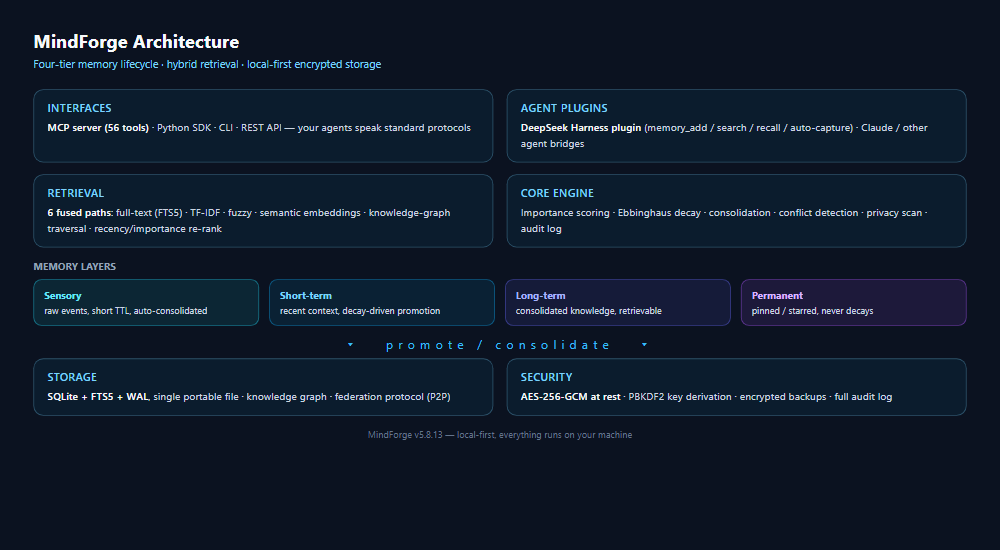
┌──────────────────────────────────────────────────────┐
│           MindForge v6.5.5            │
│  Cognitive Layer  Personality · KnowledgeGraph       │
│                   MemoryEvolution · FederatedMemory  │
├──────────────────────────────────────────────────────┤
│  Function Layer   RecallEngine · HybridSearch        │
│                   IntentRouter · ConflictDetector    │
│                   SkillExtractor · SessionFocus       │
├──────────────────────────────────────────────────────┤
│  Core Layer       Storage (SQLite+FTS5) · Index     │
│                   Encryption (AES-256-GCM) · Query  │
├──────────────────────────────────────────────────────┤
│  Adapter Layer    OpenClaw · Claude Code · MCP       │
│                   REST API · CLI · Python SDK        │
└──────────────────────────────────────────────────────┘
Four-Tier Memory Model
| Tier | Retention | Capacity | Purpose |
|---|---|---|---|
| Sensory | sec ~ min | ~50 | Input buffer, noise filtering |
| Short-term | hrs ~ days | ~100 | Working memory, active session |
| Long-term | wks ~ months | unlimited | Consolidated semantic memory |
| Permanent | forever | unlimited | Core knowledge, preferences, key experience |
High-value entries strengthen over time through consolidation; low-value entries decay naturally.
Performance
Benchmarked on i7-12700H / 32GB RAM / NVMe SSD / Python 3.12 / SQLite WAL.
| Operation | 1K | 10K | 100K |
|---|---|---|---|
| Write (plaintext) | 0.3 ms | 0.5 ms | 0.9 ms |
| Write (encrypted) | 0.8 ms | 1.2 ms | 2.1 ms |
| TF-IDF Search P50 | 4 ms | 12 ms | 38 ms |
| FTS5 Search P50 | 0.4 ms | 0.9 ms | 3.2 ms |
| Cross-Encoder Rerank P50 | 5 ms | 15 ms | 45 ms |
| Consolidate (100 entries) | 45 ms | 120 ms | 580 ms |
Retrieval quality (500 multi-domain memories, 50 annotated queries):
| Metric | TF-IDF | +FTS5+Fuzzy | +Cross-Encoder | +Query Expansion + Vector |
|---|---|---|---|---|
| MRR@10 | 0.62 | 0.71 | 0.82 | 0.85 |
| NDCG@10 | 0.60 | 0.69 | 0.80 | 0.84 |
| Recall@10 | 0.70 | 0.80 | 0.88 | 0.92 |
Integration
Claude Code
from adapters import ClaudeCodeAdapter

adapter = ClaudeCodeAdapter.from_env()
adapter.remember("User prefers concise code style", ["preferences"])
context = adapter.get_context("database optimization")
MCP Server
MindForge-mcp --db-path ./data/memory.db
REST API
MindForge serve --api --port 9000
# GET  /api/memories
# POST /api/memories
# GET  /api/search?q=...
# GET  /api/stats
OpenClaw
memory:
  adapter: MindForge
  adapter_config:
    db_path: ~/.MindForge/data/memory.db
    encrypted: true
    auto_consolidate: true
Security
- Encrypted databases: when a key file is present, set
MINDFORGE_PASSWORDso the process can unlock the store. This is required for the dsh-mindforge bridge and any non-interactive integration (MCP / REST API / scripts) accessing an encrypted store. - API authentication: if
MINDFORGE_API_KEYis configured, unauthenticated callers are treated asanonymousand can only reach PUBLIC memories. All read/write paths carry actor identity for authorization and audit. - Access logs are sanitized: search terms and memory IDs are stripped from logs.
- Upgrade note: v5.5.7 removed the experimental HMAC-XOR downgrade path (config flag
EXPERIMENTAL_HMAC_XOR, the 「降级加密」 experiment). Blobs created under that flag can no longer be decrypted — back up your database before upgrading if you enabled it.
See SECURITY.md for the full security policy.
Roadmap
- v6.0 — multi-agent memory spaces and the 6G AI memory preview, both promoted from experimental ports to supported capabilities, alongside an eight-feature agent workflow toolkit (released 2026-10-31)
- v6.1 – v6.3 — trust & quality: retrieval explainability (
search --explain), data-integrity self-repair indoctor, GDPR-complete erasure, audit-log growth governance, reproducible benchmarks (released 2026-11-05) - Vector database backend (Qdrant / Chroma)
- Web UI dashboard
- Plugin ecosystem
Documentation
License
MIT — Copyright (c) 2026 MindForge Project. If MindForge is useful to you, consider starring it on GitHub — it helps the project stay active and visible.