ATR (Automation for Token Reduction)
Proxy MCP que economiza tokens. Oculta as listas de ferramentas dos seus servidores MCP por trás de uma ferramenta de busca e reduz resultados extensos de ferramentas (GitHub, Playwright, logs, saída de testes), mantendo o resultado completo disponível sob demanda. Configuração com um único comando para Claude Code, Codex, Claude Desktop e Cursor.
Documentação
ATR: Automation for Token Reduction
ATR makes your AI use fewer tokens when it works with tools. Fewer tokens means lower bills and fewer "usage limit reached" messages.
It works with Claude Code, Codex, Claude Desktop, Cursor, Windsurf, claude.ai and ChatGPT. It's free. Run it on your own computer, or add the hosted connector to a chatbot in a minute, with no install: https://atr-mcp.vercel.app (connector link: https://atr-mcp.vercel.app/mcp).
The problem
When an AI uses tools (GitHub, a browser, a database, your test runner), two things waste tokens:
- Every tool's instructions are sent on every message, even tools the AI never uses. Ten MCP servers can mean 10,000+ tokens before you've typed anything.
- Tool results are huge. A list of GitHub issues, a web page or a test run can be tens of thousands of tokens, and all of it goes into the chat.
What ATR does
ATR sits between your AI app and your tools:
- It hides the tool list. The AI sees a few small ATR tools and searches for the tool it needs when it needs it.
- It shrinks results. Before the AI sees a result, ATR removes the noise and keeps what matters. A failing test run keeps the failures and drops the passing tests. A web page keeps its text and links and drops the layout.
- Nothing is lost. When ATR cuts something, it keeps the full result, and the AI can ask for any part of it.
Get started
You need Python 3.11 or newer.
pip install atr-mcp
atr setup
atr setup finds the AI apps on your computer, shows you what it will change, and asks first. Then it:
- moves your MCP servers behind ATR, and
- adds ATR to each app.
Restart your apps and you're done.
| Command | What it does |
|---|---|
atr setup --dry-run | Shows the plan without changing anything |
atr setup --undo | Puts every app back exactly how it was |
pip install --upgrade atr-mcp | Updates ATR |
Every file atr setup changes also gets a backup copy (.atr-backup).
Just want to try it?
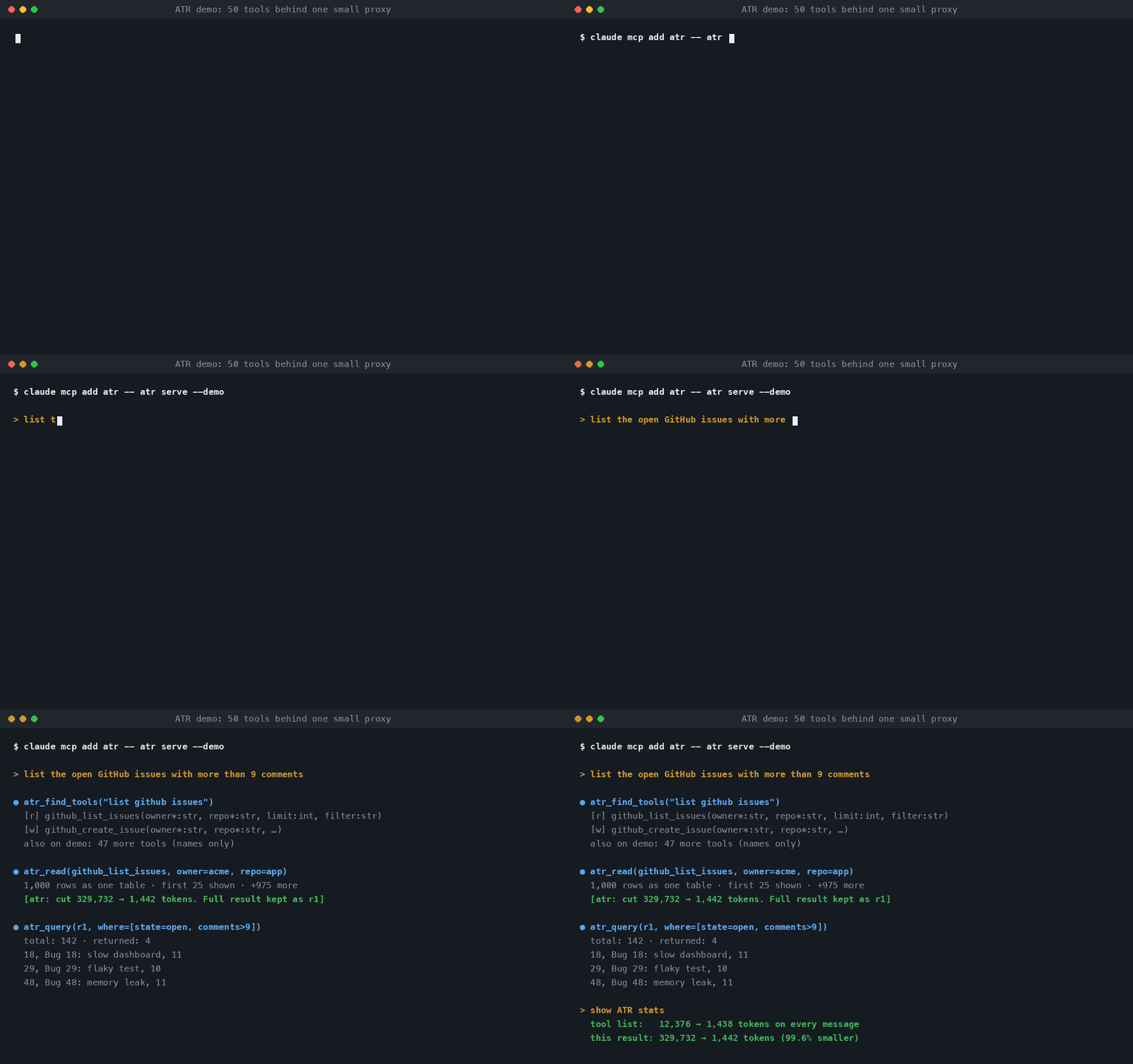
The demo connects a fake server with 50 tools (GitHub, Slack, logs, a database). Nothing leaves your computer.
claude mcp add atr -- atr serve --demo        # Claude Code
codex mcp add atr -- atr serve --demo         # Codex
Ask your AI to "list the open GitHub issues", then "show ATR stats" to see how many tokens it saved.
How much it saves
Live tests
We gave AI agents the same browser task with and without ATR: open Hacker News, click "new", then open a GitHub issues page. Each setup ran 3 times, and every answer was correct.
| Agent | Without ATR | With ATR |
|---|---|---|
| Claude Code | $0.237 per task, 13 turns | $0.110 per task, 10 turns (54% cheaper) |
| Codex | 84k tokens (33k at full price) | 134k tokens (18k at full price) |
Codex is mixed: with ATR it sends about half as many full-price tokens, but more tokens overall.
Single results
What the AI receives, in tokens, measured with python -m benchmarks.bench_atr:
| Result | Without ATR | With ATR | Saved |
|---|---|---|---|
| 1,000 GitHub issues | 429,203 | 879 | 99.8% |
| 2,000-line server log | 61,072 | 208 | 99.7% |
git diff with a lockfile change | 22,294 | 207 | 99.1% |
| Web page in a browser (Hacker News) | 12,023 | 4,046 | 66% |
| 50 tools' instructions, on every message | 12,056 | 1,508 | 87.5% |
pytest -v, 303 tests, 3 failing | 6,685 | 675 | 90% |
pip install, 60 packages | 5,977 | 697 | 88% |
In each case, the parts that matter are kept: errors, failing tests, changed code lines, page text and links.
When ATR helps, and when it doesn't
- Helps most: you use MCP servers that return big results, like GitHub, browsers (Playwright), databases, logs or web pages.
- Helps a little: plain coding in Claude Code or Codex with no MCP servers. Those apps already trim their own commands, so in our test ATR made no difference there.
- Can't help: your chat history and the AI's own replies. An MCP server only sees tool calls, never the conversation.
ATR's tools
The AI uses these. You don't need to call them yourself.
In the free hosted connector
| Tool | What it does |
|---|---|
atr_fetch | Reads live web pages, PDFs, Office documents and JSON as compact text |
atr_search | Searches the web with DuckDuckGo, Bing and Brave at once and returns one short merged list (about 60 tokens a result); no API key needed |
atr_places | Finds local businesses and places with free OpenStreetMap data; no API key needed |
atr_site | Inspects a website or searches its public sitemap and navigation |
atr_weather | Gets current weather and up to seven forecast days; no API key needed |
atr_query | Retrieves more from a large result ATR kept |
atr_stats | Shows how many tokens ATR has saved |
For your MCP servers
| Tool | What it does |
|---|---|
atr_find_tools | Searches all your servers' tools and returns the few that fit the task |
atr_read | Runs a tool that only reads, and shrinks the result |
atr_call | Runs a tool that changes something (your app can ask you first) |
atr_query | Reads more of a result that was cut, such as one page, one field or a search |
For coding
| Tool | Instead of |
|---|---|
atr_repo_map | Opening files one by one to learn a project |
atr_search_code | Pages of search results |
atr_read_file | Reading a whole file to see one function. It also says "unchanged" if the AI reads the same part twice |
atr_diff | A git diff full of lockfiles |
atr_run | Thousands of lines of test or build output |
atr_stats | Shows how many tokens ATR has saved |
Safety
- Secrets are never read, searched or shown, including
.envfiles, private keys, cloud credentials, and files named likeapi_keys.json. This also applies to tools behind ATR and toatr_diff. - Reading and changing are separate. Tools that only read go through
atr_read. Anything that changes something goes throughatr_call, so your app can ask you before it runs.atr_run(shell commands) always asks. - Files stay in allowed folders. File tools only see the folders listed in your settings.
Using ATR in claude.ai or ChatGPT
No install: add the hosted connector https://atr-mcp.vercel.app/mcp the same way (Settings → Connectors → Add custom connector, no sign-in). Then do the one-time step below.
Tell your chatbot to use it. Chatbots pick their own built-in web tools first, and in tests Claude never chose ATR by itself. Add this once under Settings → Profile → personal preferences (or in a Project's instructions):
When I ask you to search the web or read a link, use atr_search and atr_fetch instead of the built-in web tools.
Or skip the setup and ask your question and add "use atr", like "What is the latest on the MCP spec? Use atr." (or "use atr_search", "use atr_fetch"). This is only needed for the web tools. Tools you put behind ATR (GitHub, for example) are found by name.
For your own tools behind ATR, you need a link of your own:
These apps can only reach servers on the internet, so ATR needs a public link.
pip install "atr-mcp[http]"
atr serve --http                               # prints a link with a secret in it
tailscale funnel --bg 8789                     # a permanent public https link (or: cloudflared tunnel --url http://127.0.0.1:8789)
Add https://<your-link>/mcp/<secret> as a connector:
- claude.ai: Settings → Connectors → Add custom connector (no sign-in)
- ChatGPT: Settings → Apps & Connectors → developer mode → create a connector (no sign-in)
Keep the link private. Anyone who has it can use your tools. File reading and shell commands are off over the internet unless you turn them on with --read-files and --allow-run. To change the secret, delete ~/.atr/http_token.
Settings
atr setup writes these for you. You can also edit ~/.atr/config.json yourself:
{
  "servers": {                          // the MCP servers ATR runs for you
    "github": { "command": "npx", "args": ["-y", "@modelcontextprotocol/server-github"] }
  },
  "budget": 1500,                       // most tokens one result may use
  "level": 2,                           // 1 = keep almost everything, 3 = shrink hard
  "pin": ["github__create_issue"],      // tools to always show (skips the search step)
  "read_only": ["github__list_*"],      // tools that only read, if a server doesn't say so itself
  "read_roots": ["~"]                   // folders the file tools may open
}
More
No MCP at all? atr compress shrinks a file or your clipboard before you paste it into any chat:
atr compress dump.json --copy
pbpaste | atr compress --copy
Set up by hand: atr init writes the settings file, and atr snippet prints the entry to add to your app's MCP config.
"No module named 'atr'" on macOS: run chflags nohidden .venv*/lib/python*/site-packages/*.pth, or use the entry from atr snippet.
Limits:
- Online servers that need a sign-in (OAuth) can't go behind ATR yet, so
atr setupleaves them in your app. - ATR lowers what each message costs. It doesn't change your plan's limits.
For developers
git clone https://github.com/JacobBhatt12/atr && cd atr
pip install -e ".[dev]"
python -m pytest atr/tests -c /dev/null       # 44 tests
python -m benchmarks.bench_atr                # the savings table above
| File | What's in it |
|---|---|
atr/server.py | The MCP server your app talks to |
atr/remote.py | The same server over the internet (atr serve --http) |
atr/downstream.py | Talks to the MCP servers behind ATR |
atr/compress.py | Shrinks results |
atr/stash.py | Keeps full results for atr_query |
atr/router.py | Tool search |
atr/code.py | Coding tools |
atr/setup.py | atr setup |
Next up: remembering repeated tool calls so the same result isn't sent twice, sign-in support for online servers, and a small local model that summarizes long text when cutting would lose meaning.
License: MIT