mcp-of-mcps
MCP of MCPs는 모든 MCP 서버를 하나의 스마트 엔드포인트로 통합하는 메타 서버입니다. AI 에이전트에게 즉각적인 도구 발견, 선택적 스키마 로딩, 대폭 저렴한 실행 비용을 제공하여 토큰과 시간 낭비를 줄여줍니다. 지속적인 도구 메타데이터, 의미 검색, 도구 간 직접 코드 실행을 통해 혼란스러운 멀티 서버 환경을 빠르고 효율적이며 환각 없는 워크플로우로 전환합니다. 또한 도구 출력 스키마가 없는 경우 자동으로 분석하여 세션 간에 보존함으로써 일관된 동작을 보장합니다.
문서
MCP of MCPs
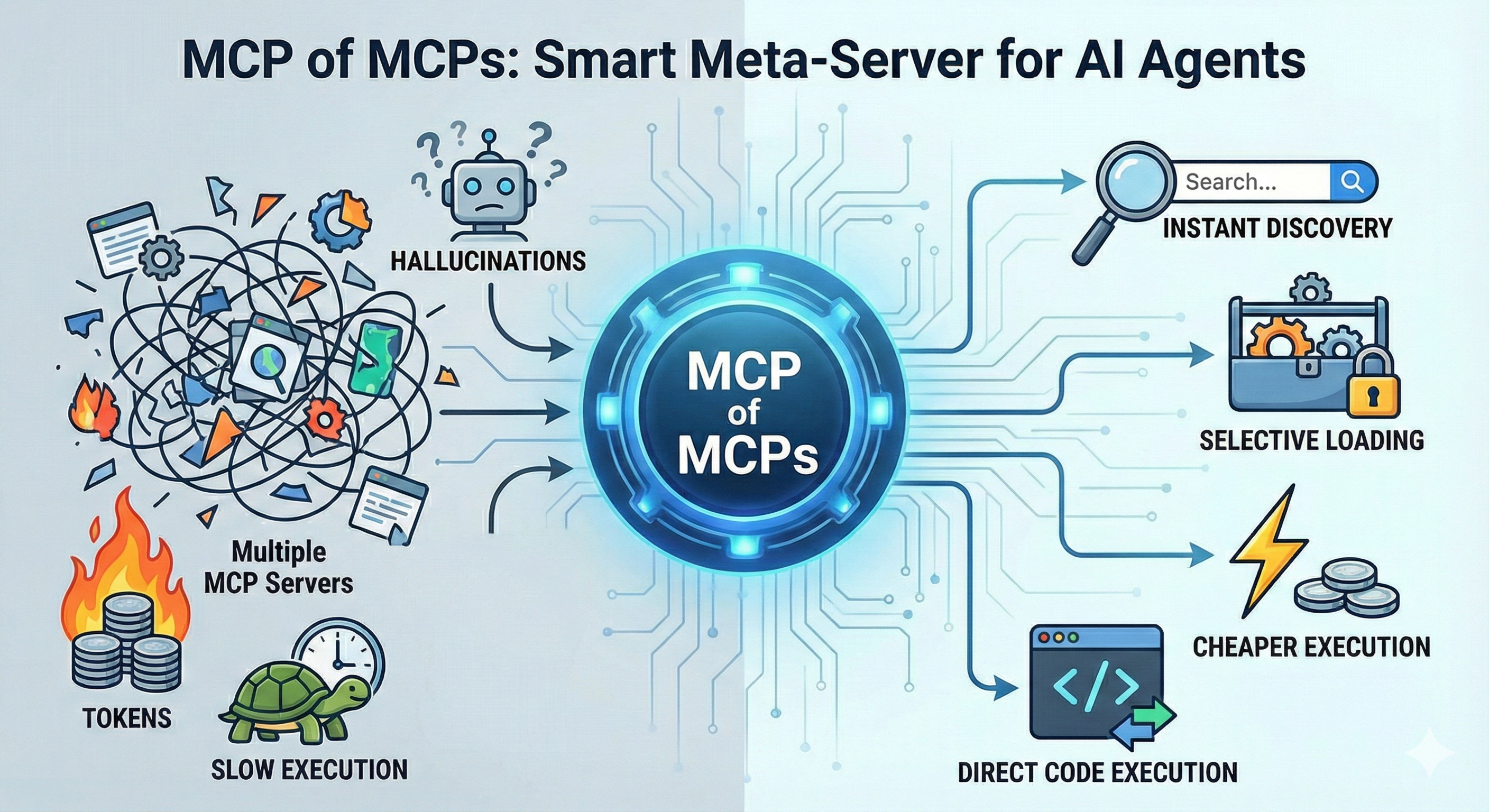
MCP of MCPs is a meta-server that merges all your MCP servers into a single smart endpoint. It gives AI agents instant tool discovery, selective schema loading, and massively cheaper execution, so you stop wasting tokens and time.
With persistent tool metadata, semantic search, and direct code execution between tools, it turns chaotic multi-server setups into a fast, efficient, hallucination-free workflow. It also automatically analyzes the tools output schemas if needed and preserves them across sessions for consistent behavior.
In short:
🚀 Faster automation
🧠 Cleaner reasoning
💰 Drastically fewer tokens
📦 Persistent + analyzed schema metadata
Tool 1: semantic_search_tools
Semantic Discovery Tool - Search tools by describing the task you want to accomplish. Instead of browsing all of tool names—or when tool names don't clearly indicate what they do—just describe your intent in plain English (e.g., "send notifications", "query database", "process images") and get back only the most relevant tools instantly. This provides a fast and lightweight approach to investigate what tools are available across all connected servers without loading any full tool definitions.
// Search by task/intent, not by tool names:
// Input: { query: "send notifications to a channel", limit: 5 }
// Returns only relevant matches (ranked by similarity):
// [
//   {
//     serverName: "slack",
//     toolName: "post_message",
//     description: "Post a message to a Slack channel",
//     similarityScore: 0.94,
//     fullPath: "slack/post_message"
//   },
// ....
//   // Only 5 most relevant tools returned - fast and lightweight!
// ]
Perfect for quick investigation:
- Describe what you need to do, not what tool you need
- Get instant results without loading full schemas
- Discover capabilities across all servers in milliseconds
- No token overhead - just lightweight tool names and descriptions
Tool 2: get_mcps_servers_overview
Discovery Tool - This tool returns only tool names without full schemas, giving agents a lightweight overview in seconds instead of loading hundreds of detailed definitions upfront. By showing just what's available without overwhelming details, it prevents confusion and hallucinations while eliminating loading delays.
// Returns:
// google_drive/download_file
// google_drive/upload_file
// slack/send_message
// database/execute_query
// ...
Tool 3: get_tools_overview
Introspection Tool - Load only the tools you actually need instead of all 30+ tools, saving thousands of tokens through selective loading. This on-demand approach provides faster responses and focused context that reduces confusion and improves accuracy.
// Input: ["google_drive/download_file", "slack/send_message"]
// Returns: Full tool definitions with:
// - Parameter schemas
// - Required vs optional fields
// - Example usage code
Tool 4: run_functions_code
Execution Tool - Data flows directly between tools without round-trips through the model, so a 2MB file transfer uses ~100 tokens instead of 50,000+. The model only sees clean final results instead of noisy intermediate data, executing complex workflows in one shot without processing delays.
// Write code that:
// - Calls multiple tools in sequence or parallel
// - Processes and transforms data
// - Implements complex logic and error handling
// - Returns only final results to the model
How The Full Flow Solves All Problems
When you need to accomplish a task, start by using get_mcps_servers_overview to get a lightweight list of all available tool names across servers—this gives you a quick scan of what's available without loading any schemas. If you can't find the tools you need for your task or if tool names aren't clear, use semantic_search_tools to search by describing your intent in plain English (e.g., "send notifications to a channel"), which uses AI-powered semantic understanding to instantly return only the most relevant tools ranked by similarity. Once you've identified the specific tools you need, use get_tools_overview to load only those tool definitions with their full schemas and parameters—saving thousands of tokens by avoiding irrelevant tools and giving the model focused context. Finally, use run_functions_code to execute your workflow where data flows directly between tools in memory, keeping intermediate results as native objects rather than serializing them into tokens, with only the final result returned to the model. This pattern dramatically cuts token usage, speeds up execution by avoiding unnecessary model processing, and eliminates hallucinations by showing only relevant information at each step.
Real-World Example
Traditional Approach:
TOOL CALL: gdrive.getDocument(documentId: "abc123")
  → returns full transcript text (loads into context: 50,000 tokens)

TOOL CALL: salesforce.updateRecord(...)
  → model writes entire transcript again (doubles the tokens: +50,000 tokens)
Total: 100,000+ tokens processed, slow response time
With MCP of MCPs:
const transcript = (await gdrive.getDocument({ documentId: 'abc123' })).content;
await salesforce.updateRecord({
  objectType: 'SalesMeeting',
  data: { Notes: transcript }
});
The code executes in one operation. Data flows directly between tools. Only the final result returns to the model.
Total: 2,000 tokens processed (98.7% reduction) ⚡
Key Benefits
✅ Faster Response Time - No need to load all tools upfront
✅ Reduced Hallucinations - Model sees only relevant information
✅ Progressive Disclosure - Load tools on-demand as needed
✅ Code Composition - Orchestrate complex workflows with familiar JavaScript
✅ Persistent Tool Metadata - Automatically preserves tool output schemas across sessions
Setup
Prerequisites
- Node.js
- npm or yarn
- Configured MCP servers you want to aggregate
Add to Cline
Add this to your Cline MCP settings file:
Option 1: Using inline configuration
{
  "mcpServers": {
    "mcp-of-mcps": {
      "autoApprove": [],
      "disabled": false,
      "timeout": 60,
      "type": "stdio",
      "command": "npx",
      "args": [
        "-y",
        "@dbestai/mcp-of-mcps",
        "--config",
        "[{\"name\":\"weather\",\"command\":\"npx\",\"args\":[\"-y\",\"@h1deya/mcp-server-weather\"]},{\"name\":\"time\",\"command\":\"uvx\",\"args\":[\"mcp-server-time\"]}]"
      ]
    }
  }
}
Option 2: Using a config file
First, create a config.json file that specifies which MCP servers to connect to:
[
  {
    "name": "weather",
    "command": "npx",
    "args": ["-y", "@h1deya/mcp-server-weather"]
  },
  {
    "name": "time",
    "command": "uvx",
    "args": ["mcp-server-time"]
  }
]
Then reference this file in your Cline settings:
{
  "mcpServers": {
    "mcp-of-mcps": {
      "autoApprove": [],
      "disabled": false,
      "timeout": 60,
      "type": "stdio",
      "command": "npx",
      "args": [
        "-y",
        "@dbestai/mcp-of-mcps",
        "--config-file",
        "/absolute/path/to/your/config.json"
      ]
    }
  }
}
Configuration Options:
autoApprove: Array of tool names that don't require approval (e.g.,["get_mcps_servers_overview"])disabled: Set tofalseto enable the servertimeout: Timeout in seconds for tool execution (default: 60)type: Connection type, always"stdio"for MCP servers
Learn More
This implementation follows the patterns described in Anthropic's article on code execution with MCP:
📖 Code execution with MCP: Building more efficient agents
Contributing
Contributions are welcome! Please feel free to submit a Pull Request.
License
ISC