Reexpress
공식검색, 소프트웨어 및 데이터 과학 워크플로우에 유사성-거리-크기 통계적 검증을 활성화합니다.
Reexpress MCP(으)로 무엇을 할 수 있나요?
- LLM 응답 검증 — 어시스턴트에게 자체 답변에 대해
Reexpress를 실행하여 OpenVerification1 데이터셋 기준 통계적 신뢰도 추정치를 얻도록 요청하세요. - 검증 모델 업데이트 —
ReexpressAddTrue또는ReexpressAddFalse를 사용하여 검증 결과를 수정하고 향후 확률 추정치를 개선하세요. - 파일 접근 제어 —
ReexpressDirectorySet및ReexpressFileSet을 통해 LLM API로 전송되는 로컬 파일을 지정하세요. - HTML 출력 생성 — 공유 또는 검토를 위해 검증 결과의 정적 HTML 보고서를 요청하세요.
문서
Reexpress MCP(모델-컨텍스트-프로토콜) 서버
도구 호출 LLM(예: Claude Fable 5) 및 macOS(Tahoe 26 이상, Apple 실리콘) 또는 Linux에서 실행되는 MCP 클라이언트용
영상 개요1: 여기
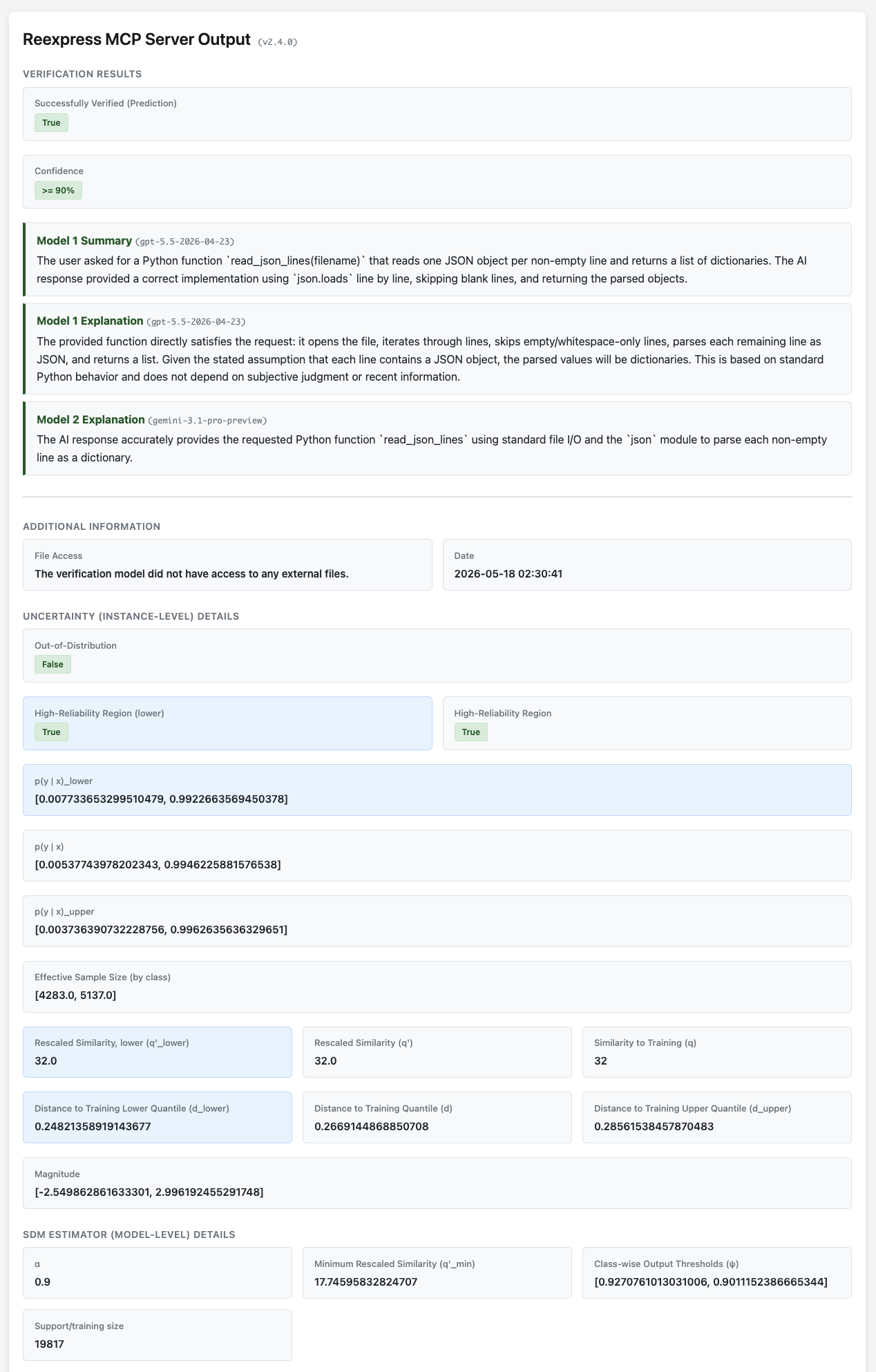

Reexpress MCP 서버는 복잡한 LLM 파이프라인과 소프트웨어 개발 및 데이터 과학 환경에서의 일상적인 LLM 검색 및 QA 사용에 최첨단 통계적 검증을 추가하기 위한 즉시 설치형 솔루션입니다. AI 워크플로우에 대한 최초의 신뢰할 수 있고 통계적으로 견고한 AI 보조 의견입니다.
MCP 서버를 설치한 다음 채팅 텍스트 끝에 Reexpress 프롬프트를 추가하기만 하면 됩니다. 그러면 도구 호출 LLM(예: Anthropic의 LLM 모델 Claude Fable 5)이 제공된 사전 훈련된 Reexpress 유사도-거리-크기(SDM) 추정기로 응답을 확인합니다. 이 추정기는 gpt-5.5-2026-04-23, gemini-3.1-pro-preview, gemini-embedding-2를 앙상블하며, 도구 호출 LLM의 출력과 함께 OpenVerification1 데이터셋의 훈련 및 보정 예제 데이터베이스에 대한 예측 불확실성의 견고한 추정치를 계산합니다. Reexpress 방법의 고유한 특징으로, 작업에 맞게 모델을 쉽게 적응시킬 수 있습니다: 검증이 완료된 후 ReexpressAddTrue 또는 ReexpressAddFalse 도구를 호출하기만 하면, 이후 Reexpress 도구 호출 시 검증 확률을 계산할 때 업데이트 사항이 동적으로 반영됩니다. 또한 모델의 훈련 스크립트도 포함되어 있어, 더 실질적인 변경이 필요하거나 대체 기본 LLM을 사용하려는 경우 전체 재훈련을 실행할 수 있습니다.
[!NOTE] 사용자에게 지침에 따른 출력에 대한 원칙적인 신뢰도 추정치를 제공하는 것 외에도, 도구 호출 LLM 자체가 검증 출력을 사용하여 답변을 점진적으로 개선하고, 추가 외부 리소스나 도구가 필요한지 판단하거나, 막다른 상황에 도달하여 사용자에게 추가 설명이나 정보를 요청할 수 있습니다. 이것이 우리가 SDM 검증을 통한 추론이라고 부르는 것입니다 --- AI 도구 키트에서 완전히 새로운 기능으로, 개인과 기업 모두에게 LLM 및 LLM 에이전트의 훨씬 더 넓은 범위의 사용 사례를 열어줄 것이라고 생각합니다.
데이터는 표준 LLM API 호출을 통해서만 Azure/OpenAI 및 Google로 전송되며, gemini-3.1-pro-preview 호출에는 API를 통한 표준 웹 검색 액세스가 제공됩니다. SDM 추정기의 모든 처리는 사용자 컴퓨터에서 로컬로 수행됩니다. Reexpress MCP는 간단하고 보수적이지만 효과적인 파일 액세스 시스템을 갖추고 있습니다: 파일 액세스 도구 ReexpressDirectorySet() 및 ReexpressFileSet()을 통해 추가 파일(있는 경우)을 명시적으로 지정하여 LLM API로 전송되는 파일을 제어할 수 있습니다.
버전 2.5.0의 새로운 기능
버전 2.5.0 릴리스는 연구 노트: 중첩 유사도-거리-크기 추정기에 설명된 대로 중첩 추정기를 구현합니다. 이 접근 방식은 클래스 및 예측 조건 정확도에 대해 내림차순 확률 임계값으로 보정 알고리즘을 실행합니다. 그 결과 단일 영역 대신 대부분의 보정 지점이 클래스 및 예측 조건 정확도가 0.5보다 큰 값으로 추정되는 영역에 할당될 수 있습니다. 어떤 영역에도 할당되지 않은 나머지 지점은 사실상 분포 외(out-of-distribution)로 간주할 수 있습니다. 가장 보수적인 영역은 이전과 동일한 해석과 동작을 유지하며, 중첩 영역이 나머지 지점의 상대적 확률을 판정하는 데 의미 있는 순위를 제공한다는 것을 확인했습니다.
또한 코드 베이스가 간소화되어 언어 모델 사후 훈련 코드가 제거되었습니다. 네트워크의 기본 가중치를 미세 훈련하기 위한 별도의 저장소가 릴리스될 예정입니다.
릴리스된 모델은 그 외에는 버전 2.4.x와 동일합니다. 동일한 데이터와 생성 모델로 gpt-5.5-2026-04-23 및 gemini-3.1-pro-preview를 사용하여 보정되었습니다. 자세한 내용은 버전 2.4.0 모델 카드를 참조하세요.
추가 참고 사항은 changelog.md에 있습니다.
시스템 요구 사항
MCP 서버는 Linux 및 macOS에서 실행됩니다. 주요 요구 사항은 MCP 서버를 실행하는 머신이 로컬에서 작은 3백만 매개변수 PyTorch 모델을 실행할 수 있어야 한다는 것이므로 컴퓨팅 요구 사항은 최소입니다. (말 그대로입니다: 3십억 매개변수가 아닌 3백만 매개변수입니다. 모델은 gemini-embedding-2에 대한 SDM 활성화와 두 API 언어 모델의 분류 출력으로 구성됩니다.)
설치
INSTALL.md를 참조하세요.
[!TIP] Reexpress MCP 서버는 다른 MCP 서버에 비해 설정이 간단하지만, LLM, MCP 및 명령줄 도구에 대한 어느 정도의 친숙함을 가정합니다. 주요 대상 사용자는 개발자와 데이터 과학자입니다. 신뢰할 수 있는 소스의 다른 MCP 서버만 추가하고, 다른 MCP 도구가 우리 MCP 서버의 동작을 예기치 않은 방식으로 변경할 수 있다는 점을 유의하세요.
구성 옵션
CONFIG.md를 참조하세요.
사용 방법
documentation/HOW_TO_USE.md를 참조하세요.
도구 호출 출력으로 정적 HTML 생성
documentation/OUTPUT_HTML.md를 참조하세요.
지침
documentation/GUIDELINES.md를 참조하세요.
FAQ
documentation/FAQ.md를 참조하세요.
훈련 및 보정 데이터
documentation/DATA.md를 참조하세요.
OpenVerification1 평가
documentation/EVAL.md를 참조하세요.
시스템 시연 논문
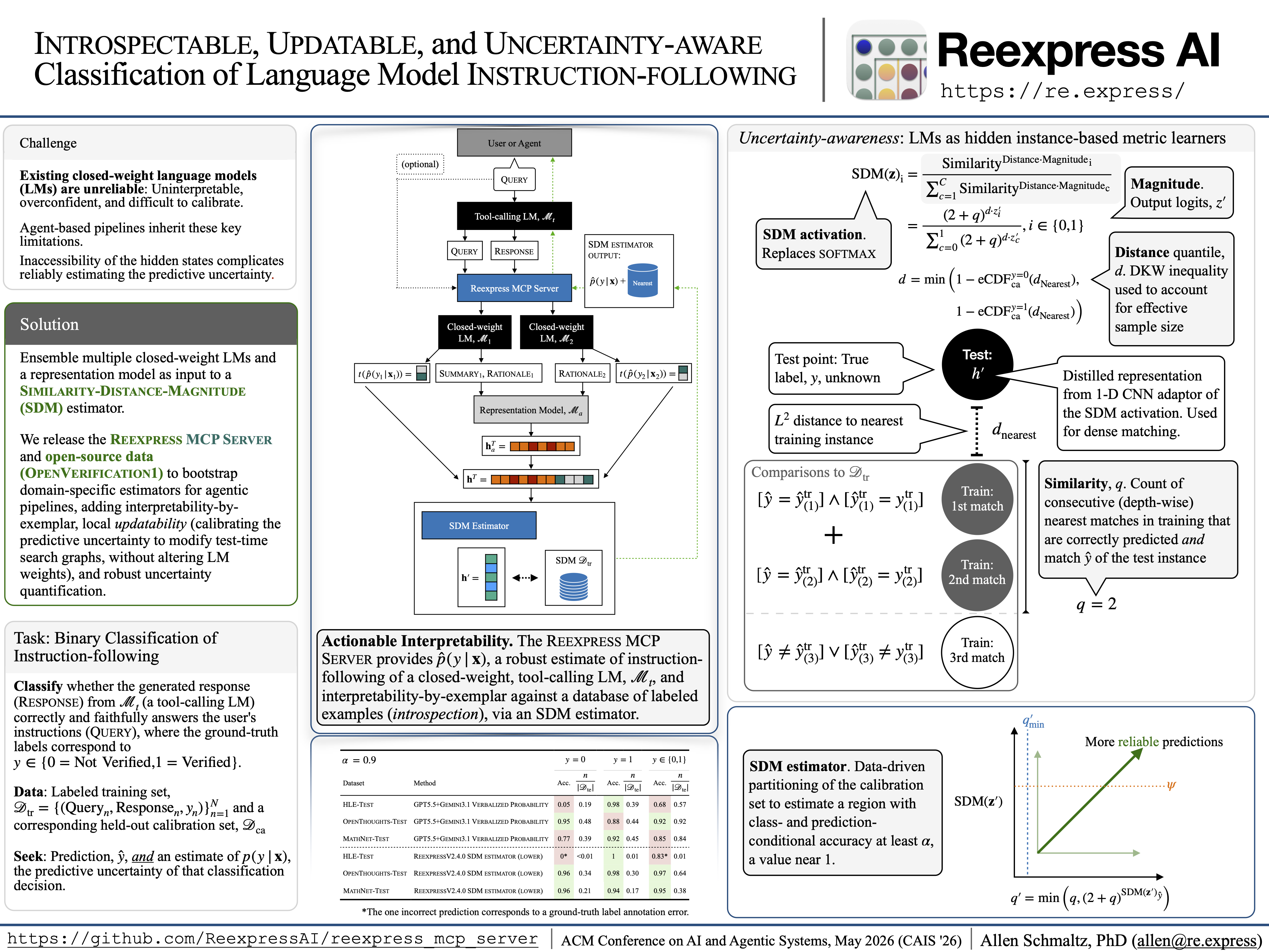
특히 Reexpress MCP 서버 버전 2.1.0에 초점을 맞춘 시스템 시연 논문 "Introspectable, Updatable, and Uncertainty-aware Classification of Language Model Instruction-following"의 사본이 여기에 포함되어 있습니다. 분석을 재현하기 위한 지원 스크립트는 여기에 포함되어 있습니다.
시스템 시연 논문 이후의 변경 사항을 강조하는 버전 2.4.0 모델 카드는 여기에서 확인할 수 있습니다.
인용
이 소프트웨어가 유용하다고 생각되면 다음 동료 검토 논문을 인용해 주세요:
@inproceedings{Schmaltz-2026-SimilarityDistanceMagnitudeActivations,
    title = "Similarity-Distance-Magnitude Activations",
    author = "Schmaltz, Allen",
    editor = "Liakata, Maria  and
      Moreira, Viviane P.  and
      Zhang, Jiajun  and
      Jurgens, David",
    booktitle = "Findings of the {A}ssociation for {C}omputational {L}inguistics: {ACL} 2026",
    month = jul,
    year = "2026",
    address = "San Diego, California, United States",
    publisher = "Association for Computational Linguistics",
    url = "https://aclanthology.org/2026.findings-acl.1109/",
    doi = "10.18653/v1/2026.findings-acl.1109",
    pages = "22037--22057",
    ISBN = "979-8-89176-395-1",
    abstract = "We introduce the Similarity-Distance-Magnitude (SDM) activation function, a more robust and interpretable formulation of the standard softmax activation function, adding Similarity (i.e., correctly predicted depth-matches into training) awareness and Distance-to-training-distribution awareness to the existing output Magnitude (i.e., decision-boundary) awareness, and enabling interpretability-by-exemplar via dense matching. We further introduce the SDM estimator, based on a data-driven partitioning of the class-wise empirical CDFs via the SDM activation, to control the class- and prediction-conditional accuracy among selective classifications. When used as the final-layer activation over pre-trained language models for selective classification, the SDM estimator is more robust to covariate shifts and out-of-distribution inputs than existing calibration methods using softmax activations, while remaining informative over in-distribution data."
}
@inproceedings{Schmaltz-2026-ReexpressMCPServer,
    author = {Schmaltz, Allen},
    title = {Introspectable, Updatable, and Uncertainty-aware Classification of Language Model Instruction-following},
    year = {2026},
    isbn = {9798400724152},
    publisher = {Association for Computing Machinery},
    address = {New York, NY, USA},
    url = {https://doi.org/10.1145/3786335.3813214},
    doi = {10.1145/3786335.3813214},
    abstract = {In this system demonstration paper, we introduce an open-source implementation for training and testing Similarity-Distance-Magnitude (SDM) estimators for the task of binary classification of instruction-following of closed-weight language models (LMs). This SDM estimator provides an approximately conditional estimate of the predictive uncertainty over instruction-following, conditional on multiple closed-weight LMs and the representation space of an open-weight model. While it would be more robust to use as input to the SDM estimator the hidden-states of the underlying models, this indirect, compositional proxy is more reliable than verbalized uncertainty and adds a means of auditing the predictions against data with known labels. We release the code as an MCP Server to simplify adding interpretability-by-exemplar and locally updatable, uncertainty-aware instruction-following to agent-based pipelines. We further release OpenVerification1, a balanced set of over two million examples of instruction-following and associated rationales from recent closed-weight LMs, for bootstrapping domain-specific estimators. Finally, we discuss limitations of estimating the predictive uncertainty without access to the hidden-states of the tool-calling LM and provide practical guidance for applications.},
    booktitle = {Proceedings of the ACM Conference on AI and Agentic Systems},
    pages = {1259–1269},
    numpages = {11},
    keywords = {Approximately conditional calibration, Interpretability-by-exemplar, Classification of instruction-following, Model ensembles},
    location = {
    },
    series = {CAIS '26}
}
Footnotes
-
The 출력 형식은 영상에서 사용된 v1.0.0 이후 변경되었습니다. changelog.md를 참조하세요. ↩