Continuum Memory
AIコーディングエージェント(Cursor、Claude Code)が1,000ターン以上にわたってコンテキストを失うのを防ぎ、75KBの純RustでLLMトークンを96%削減します。
ドキュメント
 ContextSpindle
Durable task continuity for AI agents.
Keep the goal and next action across context compaction, restarts, and unrelated work.



Get started · Website · Measured results · 中文说明
The persistent task ledger keeps authoritative goals, decisions, and progress. A separate bounded memory engine supplies optional hints. ContextSpindle assembles a focused handoff within a conservative byte budget, so the next agent can resume without replaying the whole conversation. Product definition · Agent protocol · Operations
Why we built it
A long conversation can be compressed. An agent may switch to another task, restart, or return much later. If the only record of the original goal lives in a chat window or an evicting retrieval cache, the agent can lose the task line even while remembering scattered details. ContextSpindle separates the two jobs: a persistent task ledger keeps authoritative state; a bounded memory engine supplies optional retrieval hints. Resuming starts with the task, not with a dump of every conversation.
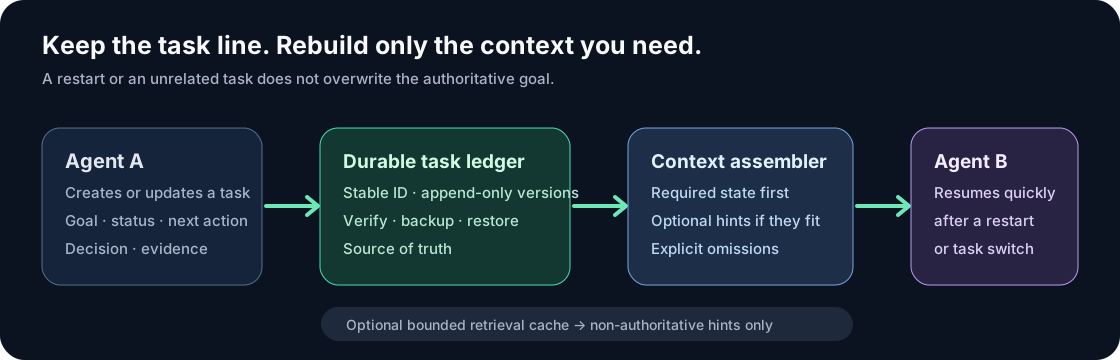
The ledger records a stable task ID, goal, completion criteria, status, owner, blocker, next action, parent and dependencies, decisions, evidence, notes, and version history. Updates are serialized across local processes; an expected version detects concurrent edits. Completed dependencies and a cleared blocker are required before marking a task done. Checksum verification, backup, and restore are built in. The contextspindle task context command keeps required state intact, includes optional information only if it fits, and reports omissions.
What a user gets
- A resumable handoff: another agent can open the task ID and see what is being done, why, what remains, and what is blocked.
- Less irrelevant input: assemble one task's context instead of sending a list of every task. The measured example below shows the size difference for one explicit workload—not a universal savings promise.
- Auditable changes: previous versions, decisions, evidence references, and caller-declared actor labels remain available. Actor labels are provenance, not authentication.
- Recovery independent of retrieval: losing or corrupting the bounded
.continuum/cache does not erase the.contextspindle/tasks/ledger. Verified backups can be restored into a fresh workspace. - A shared local interface: agents can use the same CLI or 15 MCP tools without relying on one model's private chat history.
Measured, not imagined
The reproducible benchmark created one anchor task with 24 notes and 999 unrelated tasks in a fresh workspace. On an Apple M4 / macOS 26.6.2, a release CLI process recovered the anchor's 2,048-byte-budget context in 34.23 ms median and 35.73 ms p95 across 11 sequential warm-cache runs. The goal and next action were present at every tested budget. The optional retrieval snapshot was then corrupted; the task remained readable. Backup into, and restore from, a fresh workspace also passed. Raw JSON records the exact outputs and conditions.
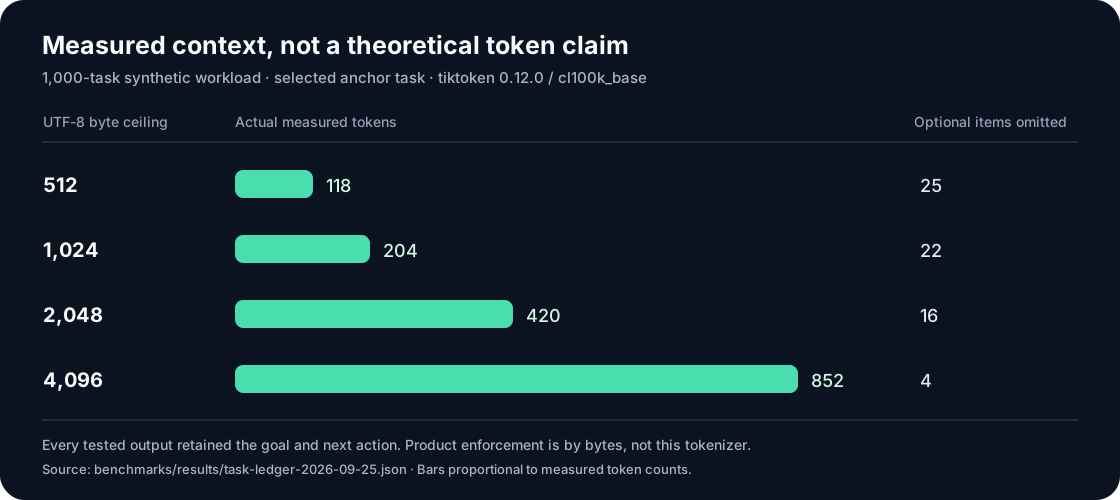
Same 1,000-task test, cl100k_base encoding | UTF-8 bytes | Measured tokens |
|---|---|---|
| Naively concatenate all 10 paginated task-summary responses | 322,607 | 94,701 |
| Assemble only the anchor task with a 2,048-byte ceiling | 1,908 | 420 |
That selected context was 99.56% smaller in token count for this specific comparison. The baseline is intentionally naive and the two inputs are not semantically identical. This is evidence that task selection can avoid unrelated input; it is not a claim that every user or model saves 99.56% of tokens. The product enforces a conservative UTF-8 byte ceiling, not a model-specific tokenizer. The reported token counts use tiktoken 0.12.0 with cl100k_base only. The tasks and notes were synthetic; the runtime, outputs, and counts are actual measurements.
| Operation on that 1,000-task workspace | Median | p95 | Runs |
|---|---|---|---|
| Inbox, 10 tasks | 32.80 ms | 33.92 ms | 11 |
| Search for the anchor | 32.49 ms | 32.89 ms | 11 |
| Assemble anchor context, 2,048-byte ceiling | 34.23 ms | 35.73 ms | 11 |
| Verify all task records | 62.73 ms | 63.44 ms | 11 |
These timings include a fresh CLI process per call with a warm filesystem cache. They do not measure model response time, Linux, cold storage, very long per-task histories, or multi-year durability. The older bounded-memory research and its distinct benchmarks are in BENCHMARKS.md; they are not task-ledger results.
We also used ContextSpindle to track this repository's own rename and publication task. Its version-3 handoff contained the real goal and next action in 1,892 bytes / 438 cl100k_base tokens; this is a dogfood observation, not an independently reproducible benchmark, because the operational ledger is Git-ignored.
Try it locally
Build from this checkout—no global install, hook, or IDE setting change is needed:
cargo build --release --bin contextspindle
./target/release/contextspindle init .
./target/release/contextspindle task create \
  "Ship the release" --criteria "Tests pass and release is published" \
  --idempotency-key ship-release
Copy the returned task ID, then update and resume it:
./target/release/contextspindle task update TASK_ID \
  --status active --next "Run final tests" --expect-version 1
./target/release/contextspindle task inbox 10
./target/release/contextspindle task context TASK_ID 2048
./target/release/contextspindle task verify
./target/release/contextspindle task backup /path/to/new-backup-directory
Use task search <query> when an old ID is unknown, task history <id> to review changes, and task restore <backup-directory> in a new workspace. A task cannot be remembered if no agent ever records it. The agent protocol gives the full start/switch/stop workflow, and the operations runbook explains backup and security responsibilities.
The project-scoped .mcp.json starts the same server from this checkout. To make task continuity available in new local Codex conversations across repositories, use the personal Codex installer and setup guide; merely cloning the repository does not install a global skill or MCP server. The task tools cover create, update, show, list, inbox, search, context, history, children, verification, backup, and restore. contextspindle_remember, contextspindle_recall, and contextspindle_stats remain available for the bounded cache. The legacy continuum-cli command, Python import, Rust crate names, and .continuum/ snapshot paths remain for compatibility; see the naming decision.
Limits worth knowing
The ledger is local and Git-ignored: pushing code does not back up tasks. Schedule protected, off-device backups and test restores if long-term continuity matters. Checksums detect accidental corruption, not malicious rewriting by a user who can edit the workspace. Task text and retrieved hints must be treated as data, not higher-priority instructions. Some list/search operations scan task directories, so measure your own workload before setting a scale target. Deterministic retrieval for a fixed snapshot does not make a language model's response deterministic.
Source on GitHub · Contributing · Code of Conduct · Security · License