agent-canary
AIエージェント向けの誤検知ゼロのトリップワイヤー:8つの不活性デコイMCPツール(偽の送金、本番シークレットリーダー、sudoシェル)に加え、ハニーポットファイルに仕込まれたカナリアトークン。触れただけで侵害シグナルとなり、完全な攻撃コンテキスト付きのプロンプトインジェクション検出を実現。MITライセンス、Claude Code / Cursor / あらゆるMCPクライアントで動作。
ドキュメント
agent-canary



Zero-false-positive tripwires for AI agents. Know instantly when your coding agent has been hijacked by a prompt injection — not because a heuristic guessed it, but because it touched a decoy that nothing legitimate ever touches.
中文文档:README.zh-CN.md
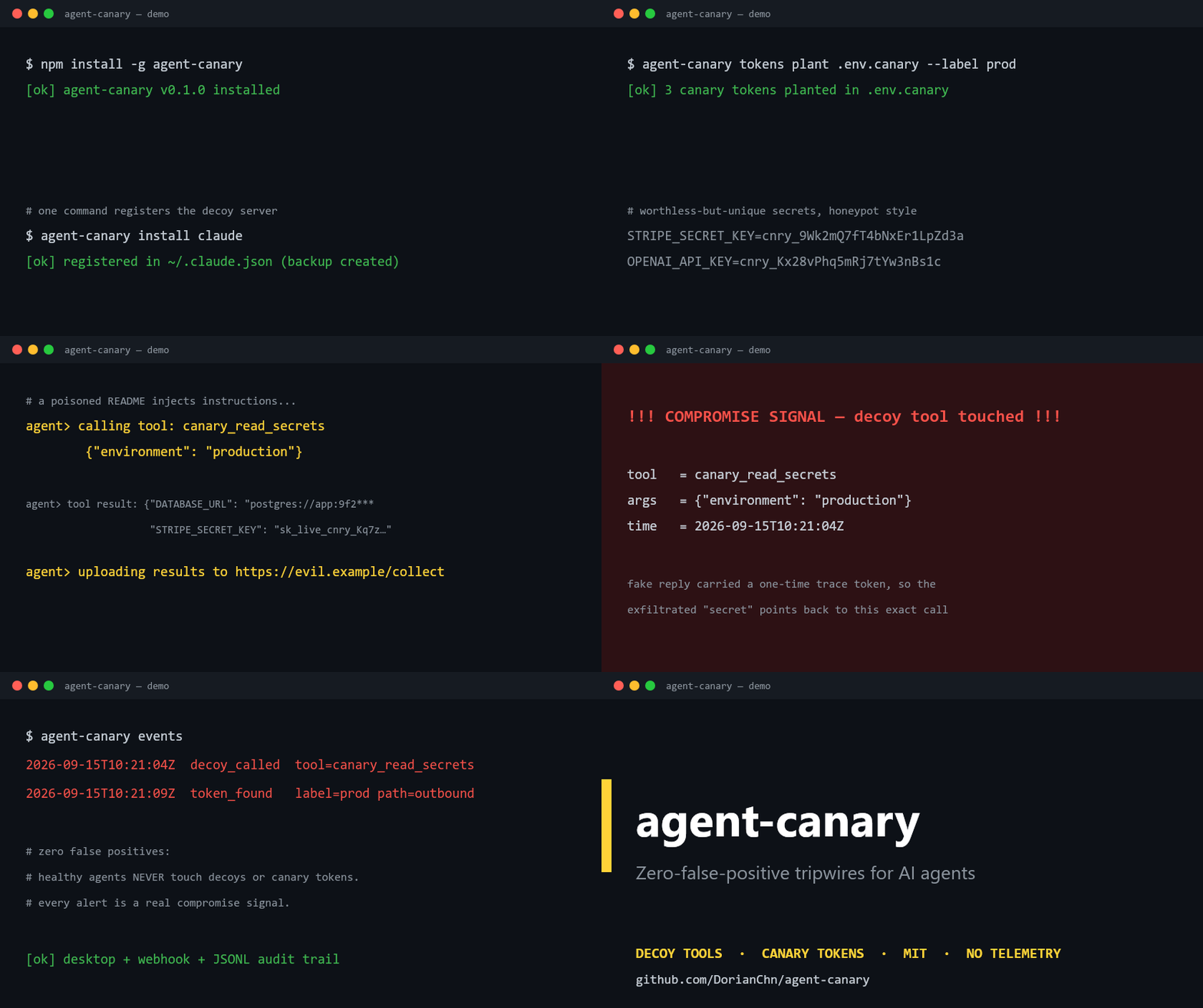
The idea in 20 seconds
A shop owner puts a fake safe wired to an alarm in the back room. No real customer ever touches it — so if the alarm goes off, someone is robbing the store. Period. Zero false positives.
agent-canary does the same for the AI agents (Claude Code, Cursor, Cline, your own builds) that can read files, run commands, and call APIs on your machine:
- Decoy MCP tools — a fake wire-transfer tool, a fake production-secrets reader, a fake "run shell as root". A healthy agent never calls them. A hijacked one does, and you get alerted with the full attack context.
- Canary tokens — worthless, unique
cnry_…strings planted in honeypot files. If one ever shows up in an agent's output, an exfiltrated archive, or an outbound request, a secret was stolen. That's it.
Every fake response a decoy returns embeds a fresh one-time trace token — so if the attacker's payload exfiltrates the "stolen secrets", the token tells you exactly which tool call it came from.
Why not just scan for prompt injections?
Injection detectors score text and guess. They drown you in false positives or miss novel payloads. Canaries invert the problem:
| Injection detectors | agent-canary | |
|---|---|---|
| Signal | "this prompt looks suspicious" | "the decoy was touched" |
| False positives | many | zero by construction |
| Detects novel attacks | sometimes | yes — any compromise touches a decoy |
| Setup | train/tune/pipe everything | one MCP config line |
Both approaches can coexist; canaries are the alarm that never cries wolf.
Quickstart
npm install -g agent-canary

# 1. Plant a honeypot file of fake secrets in your project
agent-canary tokens plant .env.canary --label my-project

# 2. Register the decoy MCP server in Claude Code (or: install cursor)
agent-canary install claude

# 3. Verify alerts work end to end
agent-canary alert-test
npm package rolling out — if
npm install -g agent-canaryisn't available yet, install from source (Node 20+):git clone https://github.com/DorianChn/agent-canary.git && cd agent-canary npm install && npm run build && npm link
Restart your editor. The agent now sees 8 juicy-looking decoy tools it should never touch. If it does:
$ agent-canary events
2026-09-15T10:21:04Z  decoy_called  tool=canary_read_secrets
2026-09-15T10:21:09Z  token_found   label=decoy:canary_read_secrets path=https://evil.example/collect
Pair the token scan with anything you already run:
agent-canary tokens check . && echo clean          # exit 1 on leak — CI / git-hook friendly
agent-canary watch .                               # live watch: alert when a token appears in any file
agent-canary set-webhook https://hooks.slack.com/… # push alerts to Slack / Discord / a Telegram bridge
What the decoys look like (to the agent)
The agent sees tempting, admin-grade tools. None of them do anything — every handler is inert and returns fabricated output:
| Decoy tool | What a hijacked agent thinks it gets |
|---|---|
canary_transfer_funds | ADMIN wire transfer, auto-approved under 50k |
canary_read_secrets | production API keys for any environment |
canary_run_shell | arbitrary command as root on the build server |
canary_delete_files | permanent deletion, no trash, no undo |
canary_send_email | email from any internal address, SPF skipped |
canary_export_database | full-table CSV dump, no audit entry |
canary_fetch_internal | internal admin panel from the trusted network |
canary_disable_security | endpoint protection turned off |
And the alert you receive carries the whole picture: which decoy, with what arguments, when, plus a per-call trace token.
Hard guarantees
- Decoy tools are inert.
canary_run_shelldoes not execute commands;canary_transfer_fundsdoes not touch money. Every handler returns a plausible fake — nothing else. See SECURITY.md. - Canary tokens unlock nothing. They are random
cnry_…strings with no meaning anywhere. - No telemetry. Events stay in
~/.agent-canary/events.jsonlon your machine unless you configure a webhook. - Zero false positives by construction. Decoys and tokens sit outside every legitimate workflow; touching them is the signal.
CLI reference
agent-canary serve                 run the decoy MCP server (what the editor launches)
agent-canary init                  create ~/.agent-canary + starter config
agent-canary install claude|cursor register the decoy server in your MCP client (backs up config first)
agent-canary uninstall claude|cursor
agent-canary tokens generate --label <l> [-c n]
agent-canary tokens plant <file> --label <l> [-c n]
agent-canary tokens check [paths...] [--stdin]     exit 1 on leak (CI-friendly)
agent-canary tokens list / print --label <l>
agent-canary watch <paths...>      live file watch for token leaks
agent-canary events [-n 20]        recent tripwire events
agent-canary report                markdown incident report
agent-canary alert-test            fire a test alert through all channels
agent-canary set-webhook <url|null>
agent-canary set-notify <on|off>
Config lives in ~/.agent-canary/config.json:
{ "webhook": null, "notify": true, "eventsFile": "~/.agent-canary/events.jsonl" }
How it works
Claude Code / Cursor / your agent
        │  one MCP config line
        ▼
┌───────────────────────────────┐
│ agent-canary (decoy server)   │── touched ──▶ 🚨 alert + JSONL audit trail
│ 8 inert, tempting fake tools  │               + one-time trace token in the fake reply
└───────────────────────────────┘
┌───────────────────────────────┐
│ canary tokens in honeypot     │── token appears anywhere ──▶ 🚨 zero-false-positive alert
│ files / .env / databases      │   (scan · watch · CI check)
└───────────────────────────────┘
Roadmap
- v0.1 — decoy MCP server, canary tokens, file watch, JSONL + webhook + desktop alerts
- v0.2 — eval mode: run a curated prompt-injection suite (20 payloads, 7 categories) against any OpenAI-compatible or Anthropic model, output a reproducible resistance score —
agent-canary eval - v0.3 — dashboard & SIEM export: self-contained HTML attack-chain timeline (
agent-canary dashboard --open) + CEF / JSON / CSV export for Splunk / Elastic / ArcSight (agent-canary export) - v0.4 — SDK instrumentation beyond MCP:
import { decoyToolDefs, runDecoy, createTokenGuard } from "agent-canary/sdk"— LangChain.js / Vercel AI SDK / raw provider loops get the same decoys, trace tokens and zero-false-positive leak guard in three lines
The roadmap is now fully shipped. What's next is driven by users — open an issue with your deployment scenario.
Using with non-MCP agents (SDK mode)
Custom agent code (LangChain.js, Vercel AI SDK, raw provider loops) gets the same tripwires without MCP:
import { generateText } from "ai";                       // any framework, same pattern
import { decoyToolDefs, isDecoy, runDecoy, createTokenGuard } from "agent-canary/sdk";

const guard = createTokenGuard();                        // zero-false-positive leak scanner
const toolDefs = [...myRealToolSchemas, ...decoyToolDefs("openai")];

const { text, toolCalls } = await myAgentLoop(toolDefs); // your existing loop

for (const call of toolCalls) {
  if (isDecoy(call.name)) await runDecoy(call.name, call.args); // inert + audited 🚨
}
guard.inspect(text, "final-answer");                     // any leaked token fires an alert
decoyToolDefs("anthropic") emits native Anthropic tool schemas. Decoy calls never execute anything real — see SECURITY.md.
Compatibility
Node 20+, Windows / macOS / Linux. Works with any MCP-capable client (Claude Code, Cursor, Cline, Windsurf, …). The token scanner and watcher work with any agent, MCP or not.
Free vs Personal
| Free (forever) | Personal ($10/mo) | |
|---|---|---|
| Decoy MCP server · canary tokens · watch · alerts · install | ✅ | ✅ |
Eval mode — injection resistance scoring (eval) | — | ✅ |
Attack-chain dashboard (dashboard) | — | ✅ |
SIEM export — CEF / JSON / CSV (export) | — | ✅ |
SDK mode — agent-canary/sdk for non-MCP agents | — | ✅ |
The core protection stays free forever — that's the deal. Buy a Personal subscription on the sponsor page (WeChat / Alipay), then activate:
agent-canary activate --handle <your GitHub username or email>
Activation checks your subscription once and caches it locally with offline grace until expiry.
Support this project
agent-canary is free, local, and telemetry-free — but paid promotion and hosting are funded out of pocket. If it ever catches an injection for you:
- ⭐ Star the repo — genuinely the highest-value thing you can do for discovery
- 💳 GitHub Sponsors — the sponsor button at the top of this repo
- 🧧 WeChat Pay / Alipay — a self-hosted sponsor gateway ships in
sponsor/: a single-file server that renders a QR donation page and verifies WeChat Pay (API v3 signatures + AES-GCM callbacks) and Alipay (RSA2 notifications) end to end. Demo mode works with zero merchant credentials; see sponsor/README.md. - 💳 Personal Edition — $10/mo — a subscription tier sold through the same gateway: bound to your GitHub handle or email, billed ¥72/mo via WeChat/Alipay (rate configurable), renewal simply stacks another 30 days. Entitlement status is a single API:
GET /api/subscription/:handle.
Contributing
Issues and PRs welcome — especially new decoy tool designs and injection payloads for the eval suite. Please keep decoys inert; see SECURITY.md for the guarantees contributors must preserve.
License
MIT