Linksee Memory
MCP memori lintas-agen yang mengutamakan penyimpanan lokal. Otak terstruktur 6 lapis (tujuan/konteks/emosi/implementasi/peringatan/pembelajaran) dengan cache diff file hemat token (penghematan terukur 86% pada pembacaan ulang)
Dokumentasi
linksee-memory
Claude Code forgets everything when you start a new session. Your successor knows even less.
Linksee Memory lets you hand a project over — to your next session, to Cursor or Codex, to the person after you — with the reasons attached. Record a decision once (
remember({ content, anchor: {} })) and it comes back before the agent acts on it: re-injected on session start and ahead of every Edit / Write / Bash that touches it. Change your mind on the record and it stops nagging; leave it and it keeps the next agent from repeating last week's mistake.Underneath: drift detection across every project you run in parallel — which ones quietly left their goal (🔴), which were checked and hold (🔵), which nobody has looked at yet (⚫). One local SQLite file that Claude Code, Cursor, Windsurf, OpenAI Codex and Gemini CLI all read. Nothing leaves your machine.
npx -y linksee-memory setup— one command, on in every repo.




🌐 Landing page: linksee.app (includes non-developer onboarding for Claude Desktop / Cursor / Claude Code / OpenAI Codex / Gemini CLI) 📖 Docs: docs.linksee.app — full reference: the product map & drift, install, and all 11 tools
Questions this answers
These are the questions people actually type — measured, verbatim (2026-09-04). If yours is here, this is the answer.
Claude Code forgets everything when I start a new session. How do I make it remember decisions across sessions?
Run npx -y linksee-memory setup. Every new session opens with recall() — a brief of what needs attention, where you are, what's unresolved — and your locked decisions are re-injected before the agent acts. Nothing to re-explain.
Claude Codeがセッションをまたぐと過去の経緯を忘れてしまいます。記憶を持たせる方法を教えてください。
npx -y linksee-memory setup の一回で入ります。新しいセッションは recall() の brief(注意すべきこと・いまどこか・未解決)から始まり、固定した決定は行動の直前に再注入されます。説明し直す必要はありません。
What is the best MCP server for persistent memory across AI coding agents?
Honest answer: if "remember across sessions" is all you need, a CLAUDE.md is enough — we measured it. Linksee is for the three moments it isn't: right before a mistake, when you change your mind, and when you run many projects and need to see which one drifted.
AIコーディングエージェント用の記憶MCPサーバーでおすすめはありますか?
正直に言うと、「セッションを跨いで覚える」だけなら CLAUDE.md で足ります(実測しました)。Linksee が要るのは、間違いかけたとき・方針を変えたとき・並行案件のどれが外れたかを知りたいとき、の3場面です。
I want one shared memory between Claude Code, Cursor, and OpenAI Codex. What tools exist for that?
One SQLite file. Claude Code, Cursor, Windsurf, OpenAI Codex and Gemini CLI all read and write the same memory — a decision made in one shows up in the others.
Claude CodeとCursorとCodexで同じ記憶を共有したいのですが、どうすればいいですか?
SQLite ファイル1つを全員で読みます。Claude Code / Cursor / Windsurf / Codex / Gemini CLI のどこで決めた決定も、他のエージェントの行動の直前に出てきます。
My AI agent keeps re-implementing things we already decided against. How can I detect that a codebase has drifted from past decisions?
Declare the decision (remember({ content, anchor: { violation_signal: [...] } })). The guard then warns — or blocks, if you hardened it — the moment an edit contradicts it, and drift_status shows every decision that reality has quietly left.
過去に決めた設計方針とコードがずれていないかを検出できるツールはありますか?
決定を宣言しておくと(remember({ content, anchor: {...} }))、それに反する編集の直前に警告(hardened なら拒否)が出ます。drift_status は「宣言と現実がずれた決定」を証拠つきで一覧します。
Is there a local-first, self-hosted alternative to Mem0 for agent memory?
Yes. No account, no API key, no cloud — one local file, MIT licensed. npx -y linksee-memory setup and it's on.
Mem0 vs Zep vs Letta for a coding agent's long-term memory — which should I pick?
We installed them and ran one scenario across all of them. Storing and recalling a decision: everyone passes. The difference appears before a mistake and when you change your mind — Linksee is built for those two moments; the others leave them to you.
How do I stop Claude Code from repeating the same mistake it made last week?
Record it as a caveat (remember({ content, layer: 'caveat' })). Caveats are protected from forgetting and come back when the same ground is touched again — and if you anchor it, the guard stops the repeat before it lands.
開発の意思決定履歴をMCPサーバーで残しておく定番のやり方はありますか?
remember({ content, anchor: {} }) の1回で、記録と強制が同時に入ります。drift_status がその台帳で、各決定が いま守られているか(🔵)・ずれているか(🔴)・誰も確かめていないか(⚫)を示します。
🪄 Three spells to remember
| Say this | What happens |
|---|---|
| "use linksee" | Recalls relevant memories before acting |
| "linksee this" | Saves the decision / lesson right now |
| "what's drifting?" | Reconciles reality against your locked decisions |
Make it automatic: add "Use Linksee Memory" to your system prompt /
CLAUDE.md.
🗺️ Not just memory — a product map
Memory is the entry point. Tie it to a map.yaml of how your product fits together, and the linksee-memory map CLI catches drift with file:line evidence:
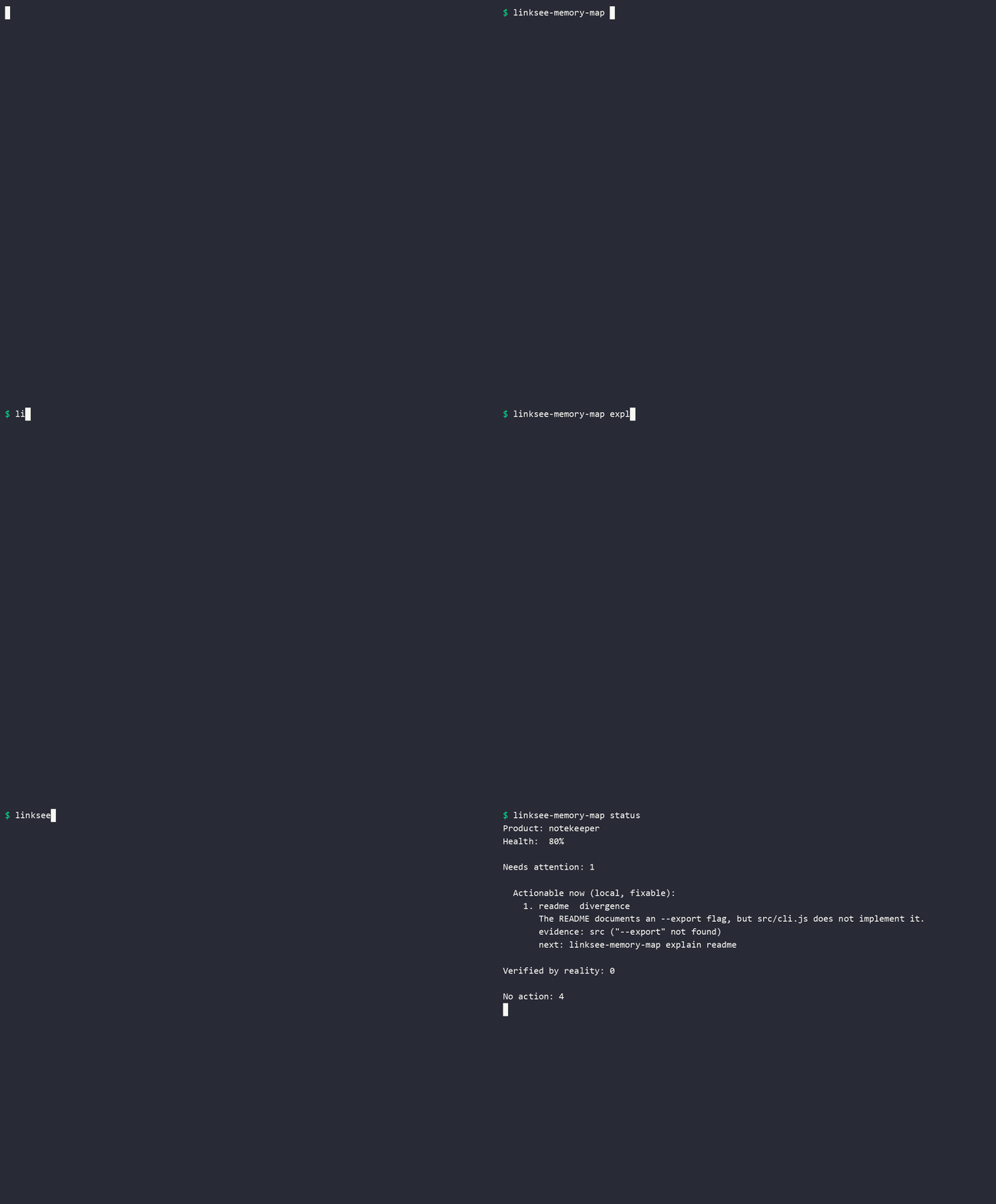
The 30-second demo above: the README says --export. The code doesn't. Linksee catches it — and shows what else a change would touch.
npx -y linksee-memory map where README.md   # this file belongs to the README node — and what it touches
npx -y linksee-memory map explain readme    # README promises --export; the code doesn't implement it — drift, with evidence
npx -y linksee-memory map affects readme    # changing the README also touches docs, the CLI help, and the npm listing
→ see The Map for the full flow.
📣 As featured on
- Zenn: あなたの Claude Code、 実は前回のセッションを完全に忘れている — 73 ♡ on Zenn, 165+ users on Hatena Bookmark, picked up by tech blogs + YouTube shorts (May 2026)
- Zenn: あなたの MCP server、 実は Tools しか使ってない (5 blocks 全実装 / v0.3.0) — the 1% of MCP servers that implement all 5 blocks
- Zenn: あなたの Claude memory、 実は Claude にしか残らない (5 LLM 横断する方法) — cross-LLM memory pattern (May 12, 2026)
- Zenn: Glama listing で 3 週間止まった話 (5 つの罠と解決策) — npm + Glama deployment retrospective
「Cordex/Cursor/Code/Gemini 全部につなげられるから、 横断的にできてる MCP ってところがこれのすごいところ」 — Hatena Bookmark, May 2026 (165+ users)
🎬 See it in action
Drift, caught. Decisions don't survive session boundaries — but their consequences do. Ask any session:
You:    What's drifting right now?
Agent:  [calls drift_status]

        28 anchors: ⚪ 1 held · 🔵 27 aligned

        Needs attention:
        ⚪ HELD — "Focus on 4 areas: Recipe layer, agent-native API,
           Japanese market, Agent Insights"
           ↻ Reopens 2026-07-04

        Everything else is aligned — no unaccounted divergence.
The memory underneath. Drift detection only works because the why survives the session boundary:
Without linksee-memory — Monday morning, new Claude session:
You:    We deployed last week but it crashed. How did we fix it?
Claude: I don't have access to previous sessions. Can you describe
        what happened and walk me through the problem?

[30 minutes of log-spelunking and re-explanation]
With linksee-memory — Same question, different outcome:
You:    We deployed last week but it crashed. How did we fix it?
Claude: Let me check my caveats...

        🧠 [caveat] NextAuth sessions invalidate when JWT_SECRET
           rotates — redeploy all affected projects in parallel.
           (from session 2026-04-13, importance: 0.9)

        Is this the deploy you're asking about? We hit it when
        we rotated secrets mid-flow.

You:    Yes, exactly. Let's not repeat that.
That single caveat memory is what separates "flat fact storage" from "the agent actually remembers the WHY". linksee-memory stores it across six explicit layers so retrieval stays explainable.
🔍 Drift Detection — "Intent Datadog"
Most teams make decisions, then forget them. The agent from last week decided "we'll use FTS5 instead of vector search" — but this week a new session installs pgvector without knowing why that was rejected. That's drift. Not a bug. Not malice. Just forgotten context.
Memory tools remember what you did. Nothing notices when you drift from what you decided — that's the layer Linksee Memory adds. Think "Datadog for product decisions": unaccounted divergences surface as drift, intentional evolution (recorded as supersede/fix) stays quiet.
How it works
- Declare decisions as anchors:
declare_anchor({ kind: "decision", statement: "We use FTS5, not vector search", violation_signal: ["pgvector", "embedding"] }) - The engine detects when committed code reality diverges from these anchors
- State derivation classifies each anchor:
- 🔴 Drift — reality diverges with no recorded resolution
- 🟡 Review — a soft signal awaits your decision
- ⚪ Held — you acknowledged the gap, parked it with a review date
- 🔵 Aligned — reality matches intent, or a recorded resolution explains the change
- Resolve with
fix,supersede,acknowledge, ordismiss— plus two gates:harden(PreToolUse will block) andsoften(back to a warning)
The make-or-break rule: a divergence accounted for by a recorded resolution (supersede/fix/acknowledge) is NOT drift. Only unaccounted gaps are flagged. This means intentional evolution stays quiet while silent abandonment gets caught.
4-species taxonomy
Anchors are classified into four species with different display formats:
| Species | Icon | Display Format | Example |
|---|---|---|---|
| Hypothesis | 🧪 | Decision Card (journal format) | "We'll launch English-first on HN" |
| Constraint | 🔒 | Rule (pass/fail checklist) | "All writes go through remember()" |
| Commitment | 🔁 | Heartbeat (alive/dead) | "Ship a new version every week" |
| Source of Truth | 📍 | Reference (stable anchor) | "MCP server runs on stdio, single SQLite" |
🗺️ The Map — linksee-memory map
Drift detection (above) checks individual anchors. The Map lifts it to the whole product: a map.yaml describing how value reaches your user (discover → understand → try → adopt → retain → monetize → expand), with typed dependencies between the pieces — README, npm listing, onboarding, the engine that powers them. The reconciler checks that map against your real code, and the CLI answers the question an engineer actually has:
I'm touching this file — where is it on the map, and what else must move?
1. Where am I? — locate a file (or, with no argument, infer from your recent edits):
$ npx -y linksee-memory map where README.md
"README.md" belongs to this Map node:

  readme  [understand]  convergence
    changes ripple to:
      must fix together (hard):  lp, docs-site
      should align (soft):       onboarding, client-configs
      fyi (may ripple):          telemetry-contract
The blast radius is graded — must fix together vs should align vs fyi — so a wide ripple isn't flat noise.
2. Why is it in this state? — the diagnosis, with file:line evidence:
$ npx -y linksee-memory map explain readme

STATUS
  declared: healthy (active)
  reality:  implemented / matches
  verdict:  declared and reality agree (verified)

EVIDENCE
  ✓ README's Tools section lists where_am_i
      README.md:424 — found "where_am_i" in section "Tools"
Declared state and the reality verdict are shown separately — a hand-declared suspect the scanner refutes reads as "declared suspect, refuted by reality (→ convergence)", not a confusing mix.
3. Whole-project triage: npx -y linksee-memory map status — a health %, what is fixable now in code vs external checks, and any deferral with no expiry (so "accounted-for" can't quietly become a drift graveyard).
How it works
map.yaml(repo root) is the desired-state source of truth: a journey spine × surface/implementation layers × typed edges (must-stay-consistent-with/should-align-with/realizes).reconcilechecks each node's declaredrealityagainst the code (signal/regex/section_contains/ file checks) and overlays a verdict — reality overrides what you hand-declared, with evidence.where_am_iis also an MCP tool, so a coding agent can re-anchor itself mid-task.
Commands: where · affects · explain · status · next · reconcile · inspect --json · blueprint. Add --lang ja for Japanese labels.
🛡 Re-injection Guard — enforce decisions before the action
Drift detection (above) is post-hoc — it tells you reality diverged after the change lands. The re-injection guard is the pre-action half: it re-surfaces the decision you locked before the agent runs the tool that would break it.
It exists for one specific, infuriating failure mode (anthropics/claude-code#15443): "Claude read the rule, understood it, and still used cp." Having the rule in context isn't enough — so the guard runs outside the agent's volition, as a Claude Code hook:
| Hook event | Fires on | What it does |
|---|---|---|
PreToolUse | Edit / Write / Bash | Checks the pending action against your accepted anchors. A gate_mode:'hard' contradiction is denied; a softer match re-injects the decision as a reminder; no match → nothing happens. |
SessionStart | startup / resume / compact | Replays your locked decisions + open forks into the fresh session — killing the "groundhog day" amnesia where a new agent repeats last week's call. |
It is fail-open by construction: any parse / DB / logic error surfaces nothing and lets the action through. The only thing that ever blocks is an explicit hard contradiction on a decision you declared.
Enable it
npx -y linksee-memory setup wires this into ~/.claude/settings.json (Step 4), so it is on in every repo — the same scope your memory already lives at. One SQLite file holds the anchors for all your projects; enforcing them per-repo meant declaring a decision once and having it enforced nowhere.
--project-guard— this repo only, the old behaviour--no-guard— skip it
Anchors with affects globs fire only on matching paths; an unscoped anchor fires on its own detect_terms / violation_signal. Nothing is ever blocked unless you explicitly hardened it (resolve_drift(action:'harden')) — everything else re-injects the decision as context.
To wire it by hand instead, drop this block into .claude/settings.json (project root, or ~/.claude/settings.json for every repo) — it points at the globally-installed linksee-memory-guard bin, so no build step is needed:
{
  "hooks": {
    "SessionStart": [
      {
        "matcher": "startup|resume|compact",
        "hooks": [
          { "type": "command", "command": "npx -y linksee-memory guard", "timeout": 15 }
        ]
      }
    ],
    "PreToolUse": [
      {
        "matcher": "Edit|Write|Bash",
        "hooks": [
          { "type": "command", "command": "npx -y linksee-memory guard", "timeout": 8 }
        ]
      }
    ]
  }
}
It's project-scoped on purpose — the guard enforces this repo's decisions, and you opt in per project rather than letting it deny tool calls everywhere (the Stop hook from setup, by contrast, is user-global). Declare what it should watch with declare_anchor(...); set card_policy.gate_mode:'hard' on an anchor to make a contradiction block instead of just warn (the soft default only re-injects). Anchors that are stale (at_risk), superseded, or card-disabled never gate.
Developing linksee-memory itself? The repo dogfoods the guard via a (gitignored)
.claude/settings.jsonthat points at the local build (node ${CLAUDE_PROJECT_DIR}/dist/bin/guard-hook.js) so it runs against your uncommitted changes. End-user projects should use the publishednpx -y linksee-memory guardform above.
What it does
Most "agent memory" services (Mem0, Letta, Zep) save a flat list of facts. Then the agent looks at "edited file X 30 times" and has no idea why. And none of them notice when this week's work contradicts last week's decision. linksee-memory keeps the WHY — and watches the drift.
It is a Model Context Protocol (MCP) server with 11 tools that gives any AI agent structured memory + drift detection:
| Mem0 / Letta / Zep | Claude Code auto-memory | linksee-memory | |
|---|---|---|---|
| Drift detection | ❌ | ❌ | ✅ intent ↔ reality divergence tracking |
| Cross-agent | △ (cloud) | ❌ Claude only | ✅ single SQLite file |
| 6-layer WHY structure | ❌ flat | ❌ flat markdown | ✅ goal / context / emotion / impl / caveat / learning |
| File diff cache | ❌ | ❌ | ✅ AST-aware, 50-99% token savings on re-reads |
| Active forgetting | △ | ❌ | ✅ Ebbinghaus curve, caveat layer protected |
| Local-first / private | ❌ | ✅ | ✅ |
Four pillars
- Drift detection — declare decisions as anchors, then the engine automatically detects when committed reality diverges from stated intent. Think "Datadog for product decisions" — unaccounted divergences surface as drift, intentional evolution (recorded as supersede/fix) stays quiet.
- Cross-agent portability — single SQLite file at
~/.linksee-memory/memory.db. Same brain for Claude Code, Cursor, Windsurf, OpenAI Codex, Gemini CLI. - WHY-first structured memory — six explicit layers (
goal/context/emotion/implementation/caveat/learning). Solves "flat fact memory is useless without goals". - Token savings via
read_smart— sha256 + AST/heading/indent chunking. Re-reads return only diffs. Measured 86% saved on a typical TS file edit, 99% saved on unchanged re-reads.
🧠 The 6-layer structure
┌─────────────────────────────────────────────────────────────┐
│ 🎯 goal           ← what the user is working toward         │
├─────────────────────────────────────────────────────────────┤
│ 🧭 context        ← why this, why now — constraints, people │
├─────────────────────────────────────────────────────────────┤
│ 💗 emotion        ← user tone signals (frustration, etc.)   │
├─────────────────────────────────────────────────────────────┤
│ 🛠  implementation ← how it was done (+ what failed)         │
├─────────────────────────────────────────────────────────────┤
│ ⚠️  caveat         ← "never do this again" · auto-protected │
├─────────────────────────────────────────────────────────────┤
│ 🌱 learning       ← patterns distilled from cold memories   │
└─────────────────────────────────────────────────────────────┘
                            │
                            ▼
           Ranked recall via relevance × heat × momentum × importance
                  Returns match_reasons explaining each hit
Every memory is tagged with exactly one layer. caveat-layer entries are protected from auto-forgetting. Cold low-importance memories are auto-consolidated into learning entries on server startup.
Quick Start — One Command
npx -y linksee-memory setup
This does everything:
- Registers the MCP server with Claude Code
- Installs the agent skill (teaches the agent when to recall/remember)
- Configures auto-capture (every session saved to your local brain)
- Offers to wire the re-injection guard into this project (pre-action decision enforcement)
Restart Claude Code, then just chat normally. Add "Use Linksee" to any prompt to trigger memory recall.
Manual setup (if you prefer step-by-step)
Click to expand manual installation
Install & register:
claude mcp add -s user linksee -- npx -y linksee-memory
Tools appear as mcp__linksee__remember, mcp__linksee__recall, mcp__linksee__read_smart.
Install the skill (auto-invocation):
npx -y linksee-memory install-skill
Copies SKILL.md to ~/.claude/skills/linksee-memory/. Agent auto-fires on phrases like "前に…", "また同じエラー", "覚えておいて", new task starts, file edits, etc.
Configure auto-capture (Stop hook):
Add to ~/.claude/settings.json:
{
  "hooks": {
    "Stop": [
      {
        "matcher": "",
        "hooks": [
          { "type": "command", "command": "npx -y linksee-memory sync" }
        ]
      }
    ]
  }
}
Each turn end takes ~100 ms. Failures are silent. Logs at ~/.linksee-memory/hook.log.
Other editors / CLIs
Linksee Memory is a standard MCP server (stdio). Any tool that speaks MCP can connect:
Cursor
Add to ~/.cursor/mcp.json:
{
  "mcpServers": {
    "linksee": {
      "command": "npx",
      "args": ["-y", "linksee-memory"]
    }
  }
}
Restart Cursor. Memory tools appear in the agent panel.
Windsurf
Add to ~/.codeium/windsurf/mcp_config.json:
{
  "mcpServers": {
    "linksee": {
      "command": "npx",
      "args": ["-y", "linksee-memory"]
    }
  }
}
OpenAI Codex CLI
codex mcp add linksee -- npx -y linksee-memory
Or add to ~/.codex/config.toml:
[mcp_servers.linksee]
command = "npx"
args = ["-y", "linksee-memory"]
Gemini CLI
Add to ~/.gemini/settings.json:
{
  "mcpServers": {
    "linksee": {
      "command": "npx",
      "args": ["-y", "linksee-memory"]
    }
  }
}
Claude Desktop
Add the same stdio command to claude_desktop_config.json:
{
  "mcpServers": {
    "linksee": {
      "command": "npx",
      "args": ["-y", "linksee-memory"]
    }
  }
}
Config file: macOS ~/Library/Application Support/Claude/, Windows %APPDATA%\Claude\. Restart Claude Desktop.
All editors share the same ~/.linksee-memory/memory.db. A decision made in Claude Code is recalled in Cursor. A caveat recorded in Windsurf prevents the same mistake in Codex.
Database location
Default: ~/.linksee-memory/memory.db. Override with LINKSEE_MEMORY_DIR env var.
Uninstall
# 1. Remove the MCP server registration
claude mcp remove linksee

# 2. Remove the hooks from settings.json (edit the file, delete the linksee entries):
#    ~/.claude/settings.json          → the Stop hook running "npx -y linksee-memory sync"
#    <project>/.claude/settings.json  → the SessionStart/PreToolUse hooks running "npx -y linksee-memory guard"

# 3. Remove the installed skill and all local memory (optional)
rm -rf ~/.claude/skills/linksee-memory
rm -rf ~/.linksee-memory   # deletes all stored memory — nothing is kept anywhere else
Nothing ever leaves your machine, so step 3 fully erases everything Linksee stored.
What's new in v0.9
| Feature | Detail |
|---|---|
| Re-injection guard | The pre-action half of drift detection. A Claude Code PreToolUse hook re-surfaces (or, on a hard contradiction, blocks) an accepted decision before the agent runs Edit/Write/Bash; a SessionStart boot digest replays your locked decisions into each fresh session. Fail-open by design. See Re-injection Guard. |
| Shippable hook wiring | linksee-memory-setup now offers to merge the guard hooks into your project's .claude/settings.json (pointing at the published linksee-memory-guard bin), and the block is documented for copy-paste. Previously the wiring lived only in a gitignored dogfood config. |
What's new in v0.8
| Feature | Detail |
|---|---|
| 4 drift detection tools | drift_status, check_decision, declare_anchor, resolve_drift — agents can now query and act on intent ↔ reality divergence. The biggest gap in agent memory (decisions are forgotten across sessions) is now closed. |
| Truth engine | State derivation logic (drift/review/held/aligned) now lives in the MCP engine, not just the dashboard. Any MCP client can query drift status. |
| 4-species taxonomy | Anchors classified as hypothesis/constraint/commitment/source_of_truth with species-appropriate display formats. |
| Resolution priority | When multiple resolutions exist for an anchor, the most recent one wins (prevents stale acknowledge from shadowing a newer fix). |
What's new in v0.7
| Feature | Detail |
|---|---|
| 3-tool unified surface | 8 tools → 3: remember (create + update + delete), recall (search + file history + overview), read_smart (token-saving reads). Fewer tools = better cross-LLM consistency. Follows Context7's proven pattern. |
| Auto-consolidate | Consolidation runs automatically on server startup (non-blocking, 7-day threshold). No manual consolidate() calls needed. |
| Deprecation guidance | Old tool names (forget, recall_file, etc.) return specific migration examples instead of silent failures. |
| "Use Linksee Memory" trigger | Add "Use Linksee Memory" to any prompt to force memory recall — same adoption pattern as Context7. |
| Claude Code Plugin | claude plugin add -- linksee-memory — ships MCP server + auto-invocation skill in one install. |
What's new in v0.4
| Feature | Detail |
|---|---|
| One-command setup | npx -y linksee-memory setup — registers MCP server, installs skill, configures auto-capture hook. One command instead of three. |
| Structured memory v2 | 3-axis classification (altitude × type × state) for every memory. Auto-extraction from sessions produces machine-scannable JSON, not raw chat dumps. |
| Precision recall guide | SKILL.md now teaches agents HOW to write effective queries, WHEN to recall vs skip, and WHEN to proactively surface caveats before risky actions. |
| Five MCP Blocks | Tools + Resources + Prompts + Sampling + Roots + Elicitation. Most MCP servers expose only Tools; linksee-memory implements all five primitives. |
6 Tools
Two pillars, one surface. Memory and drift each get the minimum; nothing else is exposed. Eleven tools bled model-dependent behaviour across Claude / GPT / Cursor / Codex / Gemini — six is what an agent can hold without a manual.
| Tool | What it does |
|---|---|
recall | Start here. No arguments → the session brief: what needs attention, where you are on the Map, open loops, top entities. query → search; path → a file's edit history with the user intent behind each edit; where: "<topic>" → your position on the Current Truth Map + blast radius; dream: true → the triage session (North Star, orphaned proposals, distill queue, friction). |
remember | Save / update / delete. content is the only required field — entity and layer default to the project you're in. Add anchor: {} to record a decision and enforce it in one call (re-injected before Edit/Write/Bash and on session start). |
read_smart | Token-saving file reader with AST diff caching. Re-read unchanged = ~50 tokens; modified = changed chunks only. |
drift_status | "What's drifting right now?" The truth map: 🔴 drift / 🟡 review / ⚪ held / 🔵 verified / ⚫ unverified, with the evidence for each. anchor_id → deep-dive into one decision. |
declare_anchor | Record a normative claim — decision / prohibition / constraint the detector checks against reality, or proposal: an option you presented that the user never addressed, parked as a review item. |
resolve_drift | Close the loop. fix · supersede · acknowledge · dismiss (with hit_term, and the gate stops firing on it) · harden / soften. With candidate_id: surface or dismiss an orphaned proposal. |
The five earlier names — where_am_i, check_decision, flag_proposals, dream,
resolve_proposal — are folded into the six above. They are hidden from tools/list but still
answer if called, so a skill or agent written against an older version keeps working.
LINKSEE_LEGACY_TOOLS=1 lists them.
CLI utilities
| Command | Purpose |
|---|---|
npx -y linksee-memory setup | One-command setup: MCP server + skill + Stop hook + the re-injection guard for every repo (--project-guard for this repo only, --no-guard to skip). Idempotent — skips what's already done. |
npx linksee-memory | MCP server (stdio) |
npx -y linksee-memory sync | Claude Code Stop-hook entry point |
npx -y linksee-memory guard | Re-injection guard hook: PreToolUse gate (Edit/Write/Bash) + SessionStart boot digest. Wired by setup for every repo (see Re-injection Guard); fail-open. |
npx -y linksee-memory import | Batch-import Claude Code session JSONL history |
npx -y linksee-memory install-skill | Install the Claude Code Skill that teaches the agent when to call recall/remember/read_smart |
npx -y linksee-memory stats | Summary of the local DB (entity count / layer breakdown / top entities / top edited files). Add --json for machine-readable output. |
The 6 memory layers
Each entity (person / company / project / file / concept) can have memories across six layers. Since v0.4, each memory uses the 3-axis structured format (altitude × type × state):
{
  "title": "freee OAuth token expires in 24h",
  "altitude": "implementation",
  "type": "outcome",
  "state": "done",
  "what": "freee OAuth token expires in 24 hours. Must refresh proactively.",
  "why": "freee uses short-lived tokens unlike most SaaS (usually 30-90 day expiry)",
  "affects": ["src/integrations/freee/auth.ts"],
  "next_action": null
}
caveatmemories are auto-protected from forgetting (pain lessons, never lost).goalmemories bypass decay while the goal is active.statetracks lifecycle:open→decided→in_progress→done/stalled/superseded.
Architecture
A single SQLite file (better-sqlite3 + FTS5 trigram tokenizer for JP/EN) contains five layers:
- Layer 1 —
entities(facts: people / companies / projects / concepts / files) - Layer 2 —
edges(associations, graph adjacency) - Layer 3 —
memories(6-layer structured meanings per entity) - Layer 4 —
events(time-series log for heat / momentum computation) - Layer 5 —
file_snapshots+session_file_edits(diff cache + conversation↔file linkage)
The conversation↔file linkage is the key. Every file edit captured by the Stop hook is stored alongside the user message that drove the edit. So recall({ path: "server.ts" }) returns "this file was edited 30 times across 3 days, and here are the actual user instructions that motivated each change".
Why the design choices
- Local-first — your conversation history is private. Nothing leaves your machine.
- Single file —
memory.dbis one portable artifact. Backup = file copy. - MCP stdio — works with every agent that speaks MCP, no plugins per host.
- Reuses proven schemas —
heat_score/momentum_scoreported from a production sales-intelligence codebase. Rule-based, no LLM dependency in the hot path.
Roadmap
- ✅ 3-tool unified surface (remember / recall / read_smart) — v0.7.0
- ✅ Auto-consolidate on server startup — v0.7.0
- ✅ Claude Code Plugin (
claude plugin add -- linksee-memory) - ✅ Five MCP Blocks (Tools + Resources + Prompts + Sampling + Roots + Elicitation)
- ✅ Stop-hook auto-capture for Claude Code
- ✅ JP/EN trigram FTS5
- ✅ One-command setup (
npx -y linksee-memory setup) - ✅ Structured memory v2 (3-axis classification: altitude × type × state)
- ✅ Cross-LLM: Claude Code, Cursor, Windsurf, OpenAI Codex, Gemini CLI
- ✅ Landing page (linksee.app)
- ✅ Drift detection engine + 4 MCP drift tools — v0.8.0
- ✅ 4-species truth map (hypothesis/constraint/commitment/source_of_truth) — v0.8.0
- ✅ Dashboard with Decision Register visualization
- 🔮 Obsidian plugin (read truth map in your vault)
- 🔮 Vector search via
sqlite-vec(already in deps, embedding backend pending) - 🔮 Cross-device cloud sync (Pro tier)
Comparison with Claude Code auto-memory
Claude Code ships a built-in memory feature at ~/.claude/projects/<path>/memory/*.md — flat markdown notes for user preferences. linksee-memory complements it:
- auto-memory = your scrapbook of "remember I prefer X"
- linksee-memory = structured cross-agent brain with file diff cache and per-edit WHY
Use both.
Security & privacy
linksee-memory runs locally and is built to read — and send — as little as possible.
- Local-first. Memory is one SQLite file at
~/.linksee-memory/memory.db. No account, no cloud, no API key. - Telemetry is opt-in and OFF by default.
setupasks once; nothing is sent unless you agree there (or setLINKSEE_TELEMETRY=basic). Even then it never sends your source code, file contents, prompts, conversation, entity/project names, or the memory DB — only anonymous counters (details). - No automatic repo crawling. linksee reads: memory you explicitly save, your
map.yaml, the specific files a map reality-check points at, the local SQLite DB, and — when the Stop hook fires — your Claude Code session transcript (locally, to capture what happened). It does not crawl your repo, read.env/secrets/node_modules, or touch your home directory on its own. - Clean MCP transport. The server writes only JSON-RPC to stdout; all logs go to stderr.
- Hooks are documented and removable.
setupadds a Stop hook (session capture) and an optional guard hook. They make no network calls by default, are time-bounded, fail-open (a hook error never breaks your session), and are listed under Uninstall. - No shell-injection surface. Subcommands run via
spawnwith array args andshell: false, from a fixed allowlist;map.yamlis parsed with the safeyamlparser (no arbitrary tag execution). - Supply chain. MIT, published from a single owner.
npx -y linksee-memoryruns the published package — pin a version in CI if you need reproducibility.
Found a security issue? See SECURITY.md.
Telemetry (opt-in, off by default)
linksee-memory ships with opt-in anonymous telemetry that helps us understand which MCP servers and workflows actually work in the wild. Nothing is sent unless you explicitly enable it. No conversation content, no file content, no entity names, no project paths — ever.
Enable
export LINKSEE_TELEMETRY=basic     # opt in
export LINKSEE_TELEMETRY=off       # opt out (or just unset the variable)
# `linksee-memory setup` also asks once and records your choice in
# ~/.linksee-memory/telemetry-consent (delete that file to be asked again).
Exactly what gets sent (Level 1 contract)
After each Claude Code session ends, the Stop hook sends one POST to https://linksee-site.vercel.app/api/telemetry/linksee containing only these fields:
| Field | Example | What it is |
|---|---|---|
anon_id | d7924ced-3879-… | Random UUID generated locally on first opt-in. Stored at ~/.linksee-memory/telemetry-id — delete the file to reset. |
linksee_version | 0.0.3 | Package version |
session_turn_count | 120 | How many turns the session had |
session_duration_sec | 3600 | How long the session lasted |
file_ops_edit/write/read | 12, 2, 40 | Counts only |
mcp_servers | ["kansei-link","freee","slack"] | Names of MCP servers configured (from ~/.claude.json). Names only — never command paths. |
file_extensions | {".ts":60,".md":30} | Percent distribution of file extensions touched |
read_smart_*, recall_* | counts | Tool usage counters |
What is NEVER sent:
- ❌ Conversation messages (user or assistant)
- ❌ File contents
- ❌ Entity names, project names, file paths, URLs
- ❌ Memory-layer text (goal / context / emotion / impl / caveat / learning)
- ❌ Authentication tokens, API keys, secrets
- ❌ Your IP address (only a one-way hash for abuse detection)
Why we ask
Aggregated MCP-usage data helps the KanseiLink project rank which agent integrations actually work for real developers. If you're happy to contribute, LINKSEE_TELEMETRY=basic takes 1 second to set and helps the entire MCP ecosystem improve.
The full payload schema and validation logic is open-source — read src/lib/telemetry.ts if you want to verify exactly what leaves your machine.
Pricing
Free forever.
linksee-memory is local-first and runs entirely on your machine. There is no hosted component you need to pay for. The SQLite DB lives in your home directory; backup = file copy.
No account, no credit card, no API key. Just install and use.
Troubleshooting
The skill isn't firing — Claude Code doesn't call recall when I ask about past work.
- Verify the skill was installed:
If absent, runls ~/.claude/skills/linksee-memory/SKILL.mdnpx -y linksee-memory install-skill. - Restart Claude Code. Skills are indexed on session start.
- Check that the MCP is registered under the name
linksee(the skill expectsmcp__linksee__*tool names):
If it's registered as something else, either re-register or editclaude mcp list | grep linksee~/.claude/skills/linksee-memory/SKILL.mdto match.
Stop hook isn't recording my sessions.
- Check the hook log:
cat ~/.linksee-memory/hook.log - Run a manual test:
echo '{"session_id":"test","transcript_path":"/path/to/some.jsonl"}' | npx -y linksee-memory sync - Make sure the
Stophook in~/.claude/settings.jsonpoints tonpx -y linksee-memory sync(not the old-import).
Upgrading from v0.0.5 or earlier — my recalls are mostly tagged "Card_Navi" or my project-dir name.
v0.0.6+ fixed the entity detection bug that collapsed all memories into the session's starting cwd. To re-index existing history with correct project attribution, run:
npx -y linksee-memory import --all
The importer is idempotent (wipes existing session data before re-inserting). Typical runtime: a few minutes for hundreds of sessions. Expect a dramatic improvement in recall precision afterward.
recall returns too much — the context window fills up fast.
Reduce max_tokens:
recall({ query: "...", max_tokens: 800 }) // default is 2000
Or narrow with entity_name and layer:
recall({ query: "...", entity_name: "my-project", layer: "caveat" })
How do I reset / delete all memory?
rm -rf ~/.linksee-memory # nuke everything; next run creates a fresh DB
Or delete individual memories via remember({ forget: true, memory_id: <id> }).
DB is getting large (>100 MB). How do I trim it?
Consolidation runs automatically on server startup (7-day threshold). It clusters old cold memories into compressed learning-layer summaries. Caveat and active-goal layers are always preserved.
If you want to force a manual consolidation, restart the MCP server — auto-consolidate triggers on every startup.
FAQ
What is drift detection and why do I need it?
Drift = when your code reality silently diverges from what you decided. Example: Last week you decided "FTS5, not vector search" but this week a new agent session installs pgvector without knowing the history.
Linksee Memory tracks this by letting you declare decisions as "anchors" and then automatically checking committed code against them. The make-or-break rule: intentional evolution (recorded as fix/supersede) stays quiet, while unaccounted gaps get flagged. It's like Datadog but for product decisions instead of server metrics.
You don't need to use drift detection to benefit from linksee-memory — the 3 memory tools (remember/recall/read_smart) work independently. Drift tools are an additional layer for teams and solo devs managing multiple projects.
How is this different from Mem0 / Letta / Zep?
Three axes:
- Local-first: those tools require cloud accounts and send your data to their servers. linksee-memory runs entirely on your machine — one SQLite file, no network calls by default.
- WHY-layered: they store flat facts or knowledge-graph nodes. linksee-memory has 6 explicit layers (
goal/context/emotion/implementation/caveat/learning) so retrieval returns structured reasoning, not just data. - File diff cache:
read_smarttool saves 86–99% of tokens on file re-reads via AST-aware chunking. None of the memory services do this — it's a feature usually shipped in IDEs.
Why not just use Claude's built-in auto-memory?
Claude Code's auto-memory is Claude-only (doesn't help if you switch to Cursor, OpenAI Codex, or Gemini CLI) and stores flat markdown with no structure. linksee-memory is the same local-first principle but:
- Works across Claude Code, Cursor, OpenAI Codex, Gemini CLI (shared SQLite)
- Structured 6-layer format makes recall explainable
- Auto-consolidation compresses cold memories on startup; caveats are permanently protected
Is 86% token savings real? Where does it come from?
Yes — see tools/bench-read-smart.ts in the repo. The read_smart tool:
- Hashes file content on first read, returns full content + chunk metadata (AST/heading/indent boundaries).
- On re-read with unchanged mtime+sha256, returns
~50 tokensof "unchanged" confirmation instead of re-sending the file. - On real edits, returns only the changed chunks as full content + unchanged chunks as metadata-only references.
For a typical TypeScript file edit in an agentic loop, this cuts round-trip token costs by ~86%. On pure re-reads (user navigating back to a previously-read file), savings exceed 99%.
Does "local-first" mean no way to sync across my machines?
The default is no sync — the SQLite file lives at ~/.linksee-memory/memory.db and stays there. If you want multi-machine sync, put that directory under Syncthing / iCloud Drive / Dropbox / Google Drive — it's a single file, so any file-sync tool works. (Avoid simultaneous edits from two machines while the MCP server is running on both; SQLite's WAL mode handles single-writer well but multi-writer conflicts can corrupt.)
What happens when the DB gets huge?
Two mechanisms:
- Ebbinghaus forgetting: cold low-importance memories decay naturally, eligible for auto-forget sweeps.
caveatlayer and memories withimportance ≥ 0.9are always protected. - Auto-consolidation: runs on every server startup (7-day threshold). Compresses clusters of cold low-importance memories by entity into a single
learning-layer summary, then deletes the originals. No manual scheduling needed.
In practice a solo developer hits ~100MB after 6 months of heavy use. A year-old DB I tested with 80K memories still recalls in <10ms.
Can I use this without Claude Code?
Yes — any MCP-compatible client works:
- Claude Code:
claude mcp add -s user linksee -- npx -y linksee-memory - Claude Desktop: add to
claude_desktop_config.json(see onboarding on the LP) - Cursor: add to MCP settings in Cursor → Settings → Features → Model Context Protocol
- OpenAI Codex:
codex mcp add linksee -- npx -y linksee-memory(or~/.codex/config.tomlwith[mcp_servers.linksee]block) - Gemini CLI: add to
~/.gemini/settings.jsonmcpServers section - ChatGPT (web/mobile app): stdio MCP not supported by the consumer app — requires Remote MCP server over HTTPS (not yet available).
- Custom agent: the MCP stdio protocol is documented at modelcontextprotocol.io
What telemetry does it send?
By default: zero network calls, zero telemetry. There's an optional Level-1 telemetry mode you can enable that sends anonymized aggregate metrics (tool call counts, error rates, latency percentiles — never memory content, never file paths, never queries). The exact payload schema is documented in the Telemetry section and you see every byte before opting in.
How do I verify it's actually working?
After install, in a new Claude session ask: "Can you remember that I prefer TypeScript over JavaScript? Use Linksee Memory." Claude should confirm it called mcp__linksee__remember and stored this. Then in a different session ask: "What languages do I prefer? Use Linksee Memory." It should recall via mcp__linksee__recall and return the preference with match_reasons showing why.
Support
- Issues & bug reports: github.com/michielinksee/linksee-memory/issues
- Feature requests: open an issue with the
enhancementlabel - Security concerns: see SECURITY.md if present, or file a private advisory on GitHub
- Company: Synapse Arrows PTE. LTD. (Singapore)
Changelog
v0.11.3 — Robustness + MCP hygiene (2026-06-16)
- Corrupt-database recovery: if
~/.linksee-memory/memory.dbis unreadable, linksee preserves it asmemory.db.corrupt-<timestamp>and starts a fresh one (with a clear message) instead of crashing with a raw SQLite error. Old memories stay recoverable in the backup. recalltool description no longer suggests editing your system prompt — cleaner MCP citizenship.
v0.11.2 — More cold-start hardening (2026-06-16)
statsworks on a fresh database instead of crashing withno such table— it ensures the schema exists first (it may be the first command a new user runs).map --helpprints usage instead of trying to import a map.
v0.11.1 — Cold-start fixes (2026-06-16)
- Run any CLI through the package name:
npx -y linksee-memory setup(andmap,sync,guard,stats,import,install-skill). A fresh user couldn't reach the standalone bins (linksee-memory-setup, …) vianpx— npx resolves package names, not sibling bin names — so the one-command install 404'd. The main bin now dispatches subcommands; the standalone bins remain as aliases. mapexits gracefully with a next-step message when there's nomap.yamlyet (was a raw stack trace — the exact state of a first-time user).- serverInfo now reports the real package version (was pinned to an old string).
v0.11.0 — The Map: where_am_i + linksee-memory map (2026-06-15)
Memory is the entry point; the product map is the new surface. Drift detection grows up from individual anchors into a whole-product map you navigate from the CLI.
where_am_i(11th MCP tool) — locate the current topic/file on the Current Truth Map and get its blast radius. Call it with no args to auto-locate from your recent edits.linksee-memory mapCLI —where·affects·explain·status·next·reconcile·inspect --json·blueprint. Amap.yaml(git source of truth) describes how value reaches your user; the reconciler checks it against your code with file:line evidence. Bilingual: add--lang ja.- Graded blast radius (
must fix together/should align/fyi), declared-vs-reality verdicts, and an anti-graveyard guard for accounted-for drift. - Per-project keys so the Map handles many projects at once.
v0.8.0 — Drift Detection MCP Tools (2026-06-08)
3 tools → 7 tools. The biggest update since launch — agents can now detect, query, and resolve intent ↔ reality drift.
New tools:
drift_status— returns the truth map with 4-species classification and per-node drift statecheck_decision— deep-dive into a single anchor: state, edges, pending candidatesdeclare_anchor— record a decision/constraint/prohibition as a truth-map node (with v9 ProjectCoreNode fields)resolve_drift— close the feedback loop: fix / supersede / acknowledge / dismiss
New engine module:
truth-engine.ts— state derivation logic migrated from the dashboard into the MCP engine. Any MCP client can now query drift status without a dashboard.- Resolution priority fix: when multiple resolutions reference the same anchor, the most recent one wins (by
resolved_attimestamp). Prevents a stale acknowledge from shadowing a newer fix. - 4-species classification: nodes classified by
decision_modeinto hypothesis / constraint / commitment / source_of_truth with display format guidance.
No breaking changes to existing memory tools. All 3 memory tools (remember, recall, read_smart) are unchanged.
v0.7.2 — Recall ergonomics + auto-edge detection + classifier precision (2026-05-30)
Quality pass on v0.7.0 / v0.7.1 — sharper day-to-day agent UX and cleaner data for the dashboard:
recalltoken discipline: drops the redundantcontent_rawfrom the response (parsedcontentwas already there — it was a 2× duplicate), and actually enforcesmax_tokensby greedy assembly that measures real serialized size (was a flat ~100 tok/memory estimate). Addsapprox_tokensto the response so the agent can see its budget usage. The same query that previously returned ~15,800 tokens for a 1200 budget now stays inside it.recallprecision: near-duplicate memories — same entity + near-identical core text, e.g. the same message captured under bothgoalandlearning— collapse to one in the result set. Composite weights adapt to query specificity: multi-term queries weight relevance higher so off-topic-but-pinned memories don't crowd narrow recalls.- Capture dedup (write side):
session-extractornow produces AT MOST one memory per user turn, with prioritygoal[first_intent] > caveat > decision > context. A first-intent message containing decision words (e.g. "決めた" / "これで進めよう") is no longer double-saved as bothgoalandlearning. memory_edgesauto-detection: the previously-emptymemory_edgestable is now populated during the sleep-mode consolidation sweep.detectMemoryEdges()links a later DECISION memory to the most-recent earlier same-topic decision within an entity (chain, not clique) so the dashboard can render Pivot Chains. The default relation isextends— a same-topic later decision builds on, but does NOT deactivate, the earlier one. Explicit reversal markers (やめる / revert / instead of) producecontradicts; explicit replacement markers (の代わり / replaces / deprecate) producesupersedes. Prevents silent deactivation of still-valid decisions.inferType/inferStateprecision: chitchat acknowledgements ("そうだね" / "ありがとう"), pasted terminal/git/email content, and meta-noise no longer classify asdecision— they returnnote/openbefore pattern matching. The learning-layer default →decisionis gated by this guard. Real decisions (採用 / 決めた, even after an acknowledgement opener) survive.
No schema migration, no breaking API changes. Existing rows keep their stored content; the classifier improvements apply to new captures going forward.
v0.7.1 — Review fixes (2026-05-29)
Based on Opus 4.7 design review of v0.7.0:
- P0 — Required params guidance:
remembertool description now includes "REQUIRED PARAMS BY MODE" section so LLMs know exactly which fields are needed for create vs update vs delete. - P0 — Migration guidance: Deprecated tool names (
forget,recall_file, etc.) now return specific migration examples instead of generic errors. - P1 — recall path+query merge: When both
pathandqueryare provided torecall, results from file history and memory search are merged into a single response. - P2 — Auto-consolidate safety: Table existence check via
sqlite_masterbefore queryingconsolidationstable, preventing errors on fresh databases.
v0.7.0 — 3-Tool Unified Surface (2026-05-29)
8 tools → 3 tools. Following Context7's proven pattern of fewer tools = better cross-LLM consistency.
Breaking change: The following tools are removed from the MCP surface. Calling them returns a migration guide:
| Old tool | New equivalent |
|---|---|
forget | remember({ forget: true, memory_id: <id> }) |
update_memory | remember({ memory_id: <id>, content: "..." }) |
recall_file | recall({ path: "server.ts" }) |
list_entities | recall({}) (no params = entity overview) |
consolidate | Auto-runs on server startup (7-day threshold) |
New unified tools:
remember— create + update + delete in one tool. Mode is inferred from params.recall— search + file history + overview in one tool. Mode is inferred from params.read_smart— unchanged.
Other changes:
- Auto-consolidate on server startup (non-blocking
setTimeout, 7-day threshold,sqlite_mastersafety check) - Claude Code Plugin bundle (
claude plugin add -- linksee-memory) - Deprecation errors include specific migration examples
All internal handler functions are preserved — this is a surface change, not a logic rewrite.
v0.2.0 — English-first launch readiness (2026-04-20)
Prepares the package for a broader (primarily English-speaking) audience on Reddit, Hacker News, and Anthropic Discord. No breaking API changes.
- Bilingualized
SKILL.md(auto-invocation skill). The bundled skill thatlinksee-memory-install-skillcopies into~/.claude/skills/linksee-memory/SKILL.mdwas Japanese-first; it is now English-primary with Japanese trigger phrases preserved inline. English speakers now get the skill firing on natural English phrases ("how did we solve this before?", "same error again", "remember this") in addition to the existing JP triggers. - Install-skill CLI output is bilingual: example test phrases shown after installation include both English and Japanese.
- Session-extractor EN coverage (
linksee-memory-import): expanded regex patterns for decisions, failures, and caveats so English Claude Code session logs get auto-tagged correctly. Additions includelet's go,pivot,switch to,settled on,approved,doesn't work,stuck,same error again,hit an error,debug,broke,revert. - Clearer caveat-forget error hint: the previous message said "lower importance below 0.9 first, then forget" which was misleading — caveat-layer memories are permanently protected regardless of importance. The hint now correctly distinguishes layer-protection from pin-protection.
- README rework for launch readiness: added a "See it in action" before/after scenario, ASCII 6-layer diagram, MCP Official Registry + Glama score badges, landing-page link, and an 8-item FAQ covering questions that surface during public launches.
- Internal: SKILL.md now documents pairing with KanseiLink skill as an English workflow example.
No code changes to the MCP protocol surface; all existing MCP clients continue to work unchanged.
v0.1.1 — Pin threshold tweak (2026-04-19)
Based on real-world feedback that importance=0.95 memories were not
being treated as pinned despite intent.
- Pin threshold lowered from
>= 1.0to>= 0.9. Memories withimportance >= 0.9are now exempt from the auto-forget sweep and surfacepinned: trueinrecallandrememberresponses. This matches the natural mental model ("0.9 = high importance = should survive cleanup") without requiring exact1.0. - All existing memories with
importance >= 0.9(including older ones set to0.9or0.95) become pinned automatically — no migration needed. - Updated tool descriptions and error messages to reflect the new threshold.
v0.1.0 — Major UX update (2026-04-18)
Based on one week of dogfooding, here's what changed:
New tools
update_memory— atomic edit with preservedmemory_id. Solves the "forget+remember breaks session_file_edits links" bug.list_entities— fast "what do I know about?" primitive for session init. Supportskind/min_memoriesfilters and returns layer breakdown.npx -y linksee-memory stats— local DB summary CLI.
recall enhancements
match_reasonsarray on each memory: e.g.["content_match_fts", "heat:hot", "pinned"].score_breakdownwith per-dimension scores (relevance / heat / momentum / importance).- Pagination via
offset/has_more/stopped_by. limitparameter (hard cap, complementsmax_tokensbudget).bandfilter to request only hot/warm/cold/frozen memories.mark_accessed=falsefor preview queries that shouldn't bump heat.- Layer aliases:
decisions→learning,warnings→caveat,how→implementation, etc. - Fix: opportunistic refresh of stale entity momentum scores. Entities recalled >1 h after last remember() no longer return stale momentum.
remember enhancements
- Quality check: rejects pasted assistant output / CI logs / stack traces unless
force=true. importance=1.0now implicitly pins the memory (survives auto-forget).- Layer aliases accepted.
forget changes
- Pinned memories (importance=1.0) now preserved alongside caveat-layer memories.
- Clear error response when attempting to delete a protected or missing memory.
- dry-run now includes
sample_ids_to_drop.
consolidate changes
dry_run: truepreview mode — reports cluster count + candidates without writing.
Infra
- Fixed fresh-DB migration bug (was querying
metatable before it existed). - Bumped to Node 20+ for structured language feature usage.
All changes are backward compatible — existing integrations continue to work. Server.ts version banner now reports v0.1.0.
Older versions
See GitHub Releases.
License
MIT — Synapse Arrows PTE. LTD.