BrainBox
AI एजेंटों के लिए हेबियन मेमोरी — फ़ाइल एक्सेस पैटर्न सीखता है, तंत्रिका मार्ग बनाता है, अगले टूल्स/फ़ाइलों की भविष्यवाणी करता है, टोकन बचाता है
दस्तावेज़
BrainBox
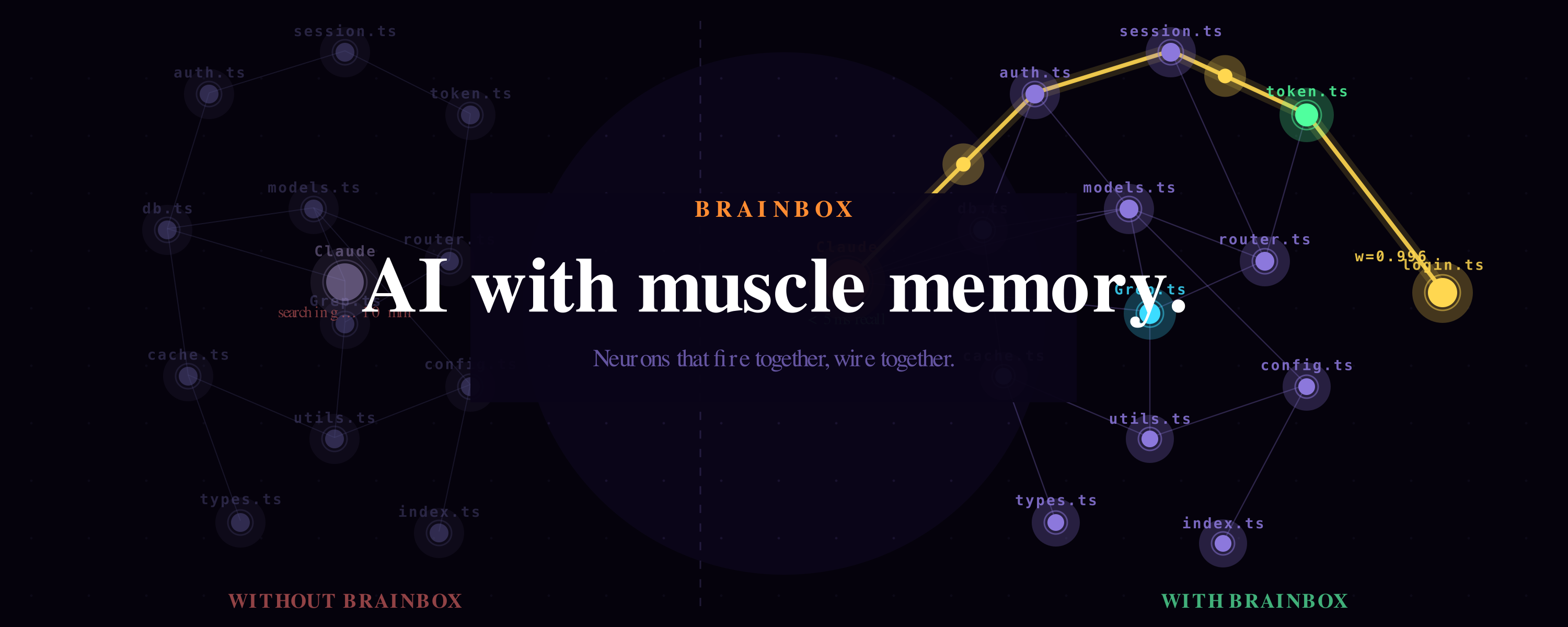


Hebbian memory for AI coding agents. Learns which files you access together, which errors lead to which fixes, and which tool chains you use most — then recalls them instantly.
Not a vector database. Not RAG. Procedural memory.
If BrainBox saved you tokens, give it a star — it helps others find it. Built by @thebasedcapital
Session 1:  agent greps for auth.ts, reads it, edits it (2000 tokens)
Session 5:  agent recalls auth.ts directly, skips search (500 tokens saved)
Session 20: auth.ts is a superhighway — instant recall, zero search cost
Install
npm install brainbox-hebbian
That's it. The postinstall script automatically:
- Adds
PostToolUsehook to~/.claude/settings.json(learns from every file read/edit/search) - Adds
UserPromptSubmithook (injects neural recall into prompts automatically) - Registers the MCP server via
claude mcp add(6 tools for manual recall/recording) - Creates
~/.brainbox/database directory
BrainBox learns passively from your next Claude Code session. No configuration needed.
What does NOT happen automatically
The macOS daemon (system-wide FSEvents file watcher) is completely separate and opt-in:
# Only if you want BrainBox to learn from VS Code, Xcode, vim, shell, etc.
brainbox daemon install   # installs LaunchAgent, starts watching
brainbox daemon status    # check if running
brainbox daemon uninstall # remove completely
The daemon watches file changes across all your editors — not just Claude Code. It requires explicit opt-in because it registers a LaunchAgent and monitors your configured project directories.
Uninstall
brainbox uninstall # removes hooks + MCP server, preserves database
Seed from git history (recommended)
Kill cold start by bootstrapping from your existing git history:
brainbox bootstrap --repo /path/to/project --imports
This seeds the neural network from git commit co-changes and import graphs so BrainBox starts with knowledge instead of from zero.
How It Works
BrainBox implements neuroscience-inspired learning:
- Neurons — files, tools, and errors you interact with
- Synapses — connections formed when things are accessed together ("neurons that fire together wire together")
- Myelination — frequently-used paths get faster (like muscle memory)
- Spreading activation — recalling one file activates related files
- Decay — unused connections weaken naturally, keeping the network clean
Hebbian Learning in Action (click to play)
https://github.com/thebasedcapital/brainbox/raw/main/assets/brainbox-animation.mp4
Spreading Activation — recalling one file activates related files through synaptic connections
https://github.com/thebasedcapital/brainbox/raw/main/assets/brainbox-spreading.mp4
Superhighway Formation — frequently-used pathways become instant-recall superhighways
https://github.com/thebasedcapital/brainbox/raw/main/assets/brainbox-superhighway.mp4
Error-Fix Immune System — remembers which files fixed which errors
https://github.com/thebasedcapital/brainbox/raw/main/assets/brainbox-immune.mp4
Other Integrations
MCP Server (any agent)
If you're not using Claude Code, you can run the MCP server standalone:
# 6 tools: record, recall, error, predict_next, stats, decay
npx tsx node_modules/brainbox-hebbian/src/mcp.ts
Kilo / OpenCode (native plugin)
Add to ~/.config/kilo/config.json:
{
  "plugin": ["node_modules/brainbox-hebbian/src/kilo-plugin.ts"]
}
OpenClaw (NeuroVault)
BrainBox can be deployed as an OpenClaw memory slot plugin. See NeuroVault for the reference implementation.
| Aspect | Claude Code | OpenClaw |
|---|---|---|
| Tool names | PascalCase (Read) | Lowercase (read) |
| Context injection | UserPromptSubmit hook | before_agent_start lifecycle |
| Learning trigger | PostToolUse hook | after_tool_call lifecycle |
| Embeddings | all-MiniLM-L6-v2 | Keyword-only (lower confidence gate) |
CLI
brainbox recall "authentication login"
brainbox record src/auth.ts --context "authentication"
brainbox stats
brainbox error "TypeError: cannot read 'token'"
brainbox predict Read
brainbox embed          # add vector embeddings for semantic recall
brainbox hubs           # most connected neurons
brainbox stale          # decaying superhighways
brainbox projects       # list project tags
brainbox sessions       # recent sessions with intents
brainbox streaks        # anti-recall ignore streaks
brainbox graph          # ASCII neural network
brainbox highways       # show superhighways
brainbox decay          # weaken unused connections
Key Features
Hebbian Learning
Files accessed together form synapses. Access auth.ts then session.ts 10 times and BrainBox learns they're related — recalling one activates the other.
Error-Fix Immune System
When you fix a bug, BrainBox remembers which files fixed which errors. Next time a similar error appears, it suggests the fix files immediately.
Tool Sequence Prediction
After 20 Grep-Read-Edit chains, BrainBox predicts you'll Read after Grep and pre-loads likely files.
SNAP Plasticity
Strong synapses resist further strengthening (like real neural synapses). Prevents any single connection from dominating the network.
Anti-Recall Escalation
Files recalled but never opened get progressively stronger decay. Consecutive ignores escalate: 1st = 10%, 2nd = 19%, 3rd = 27%. Opening the file resets the streak.
Hub Detection & Staleness Alerts
Identify the most-connected neurons in your network and detect decaying superhighways before they fade.
Project Tagging
Auto-tag file neurons by project. Recall scoped to current project reduces cross-project noise.
Architecture
src/
  hebbian.ts     # Core engine: record, recall, decay, SNAP, BCM, spreading activation
  db.ts          # SQLite schema: neurons, synapses, access_log, sessions
  embeddings.ts  # Optional vector embeddings (all-MiniLM-L6-v2, 384 dims)
  installer.ts   # Auto-installer: adds hooks + MCP to ~/.claude/settings.json
  mcp.ts         # MCP server (6 tools)
  hook.ts        # Claude Code PostToolUse hook
  prompt-hook.ts # Claude Code UserPromptSubmit hook
  kilo-plugin.ts # Kilo/OpenCode native plugin
  bootstrap.ts   # Git/vault/import seeder
  daemon.ts      # FSEvents file watcher (macOS, opt-in)
  cli.ts         # CLI interface
  test.ts        # 59 tests, all passing
Algorithm Details
| Component | Mechanism |
|---|---|
| Synapse formation | Sequential window (25 items), positional decay |
| Strengthening | SNAP sigmoid plasticity (midpoint 0.5, steepness 8) |
| Myelination | BCM sliding threshold + diminishing returns, 0.95 ceiling |
| Confidence | Multiplicative: contextScore * (1 + myelin + recency + path) |
| Spreading | 2-hop BFS, fan-out cap 10, fan effect 1/sqrt(degree) |
| Decay | Activation -15%, synapses -2%, myelination -0.5% per cycle |
| Error learning | 2x boosted learning rate for error neurons |
| Anti-recall | Compound decay: 1 - (1 - 0.1)^streak, floor at 0.1 |
Full details in WHITEPAPER.md.
Tests
npm test # 59 tests, ~2s
Requirements
- Node.js 18+
- macOS or Linux (FSEvents daemon is macOS-only, everything else is cross-platform)
License
MIT